From Surf Wiki (app.surf) — the open knowledge base
Pentadecagon
Polygon with 15 edges
Polygon with 15 edges
In geometry, a pentadecagon or pentakaidecagon or 15-gon is a fifteen-sided polygon.
Regular pentadecagon
A regular pentadecagon is represented by Schläfli symbol {15}.
A regular pentadecagon has interior angles of 156°, and with a side length a, has an area given by : \begin{align} A = \frac{15}{4}a^2 \cot \frac{\pi}{15} & = \frac{15}{4}\sqrt{7+2\sqrt{5}+2\sqrt{15+6\sqrt{5}}}a^2 \ & = \frac{15a^2}{8} \left( \sqrt{3}+\sqrt{15}+ \sqrt{2}\sqrt{5+\sqrt{5}} \right) \ & \simeq 17.6424,a^2. \end{align}
Construction
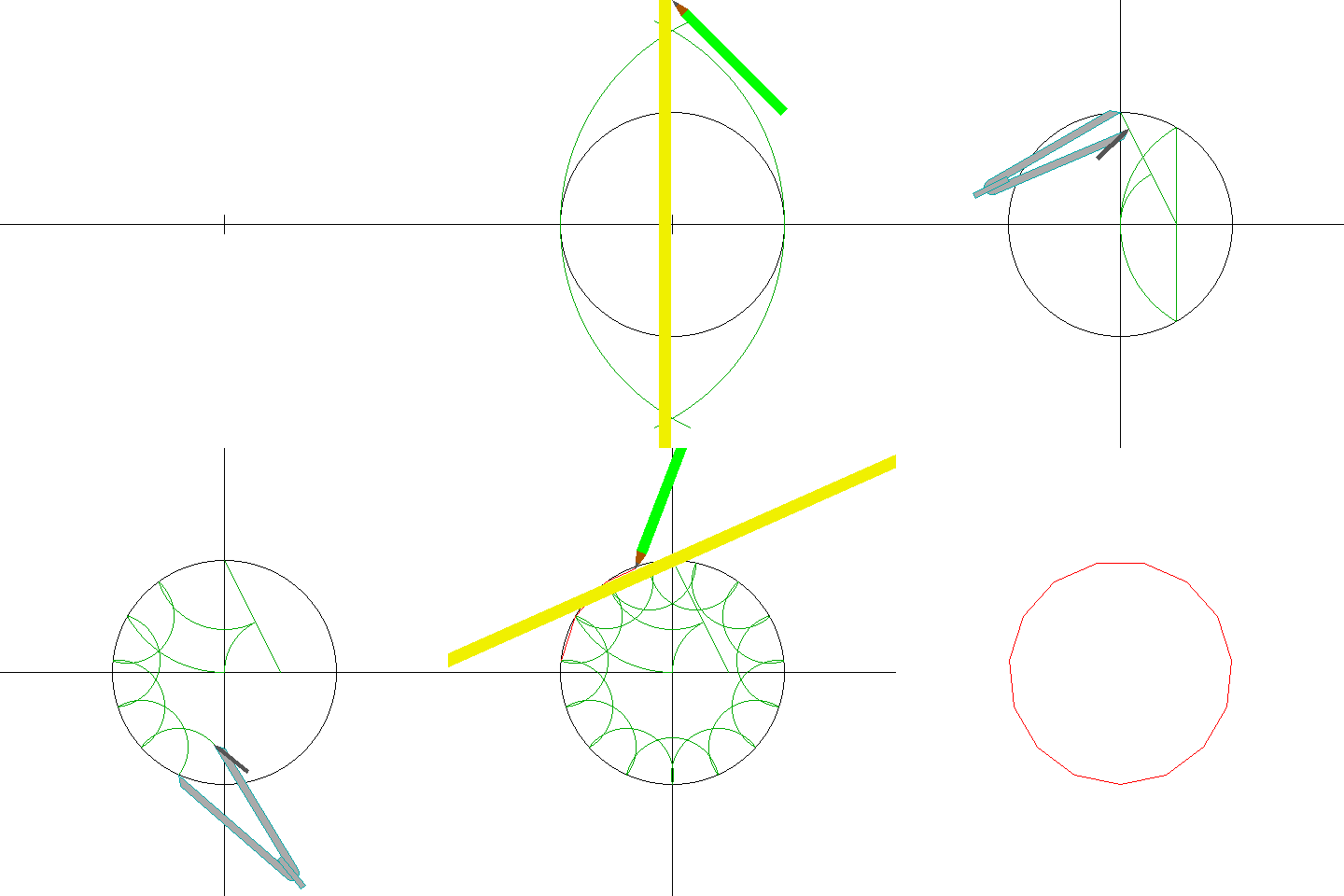
As 15 = 3 × 5, a product of distinct Fermat primes, a regular pentadecagon is constructible using compass and straightedge: The following constructions of regular pentadecagons with given circumcircle are similar to the illustration of the proposition XVI in Book IV of Euclid's Elements.
Compare the construction according to Euclid in this image: Pentadecagon

In the construction for given circumcircle: \overline{FG} = \overline{CF}\text{,} ; \overline{AH} = \overline{GM}\text{,} ; |E_1E_6| is a side of equilateral triangle and |E_2E_5| is a side of a regular pentagon. The point H divides the radius \overline{AM} in golden ratio: \frac{\overline{AH}}{\overline{HM}} = \frac{\overline{AM}}{\overline{AH}} = \frac{1+ \sqrt{5}}{2} = \Phi \approx 1.618 \text{.}
Compared with the first animation (with green lines) are in the following two images the two circular arcs (for angles 36° and 24°) rotated 90° counterclockwise shown. They do not use the segment \overline{CG}, but rather they use segment \overline{MG} as radius \overline{AH} for the second circular arc (angle 36°).

A compass and straightedge construction for a given side length. The construction is nearly equal to that of the pentagon at a given side, then also the presentation is succeed by extension one side and it generates a segment, here \overline{FE_2}\text{,} which is divided according to the golden ratio:
\frac{\overline{E_1 E_2}}{\overline{E_1 F}} = \frac{\overline{E_2 F}}{\overline{E_1 E_2}} = \frac{1+ \sqrt{5}}{2} = \Phi \approx 1.618 \text{.}
Circumradius \overline{E_2 M} = R;;;; Side length \overline{E_1 E_2} = a;;;; Angle D E_1M = ME_2D = 78^\circ
\begin{align} R &= a \cdot \frac{1}{2} \cdot \left(\sqrt{5 + 2 \cdot \sqrt{5}} + \sqrt{3} \right)= \frac{1}{2} \cdot \sqrt{8+ 2 \cdot \sqrt{5}+2\sqrt{15 + 6 \cdot \sqrt{5}}}\cdot a\ &= \frac {\sin (78^\circ)}{ \sin (24^\circ)} \cdot a \approx 2.40486\cdot a \end{align}
Symmetry

The regular pentadecagon has Dih15 dihedral symmetry, order 30, represented by 15 lines of reflection. Dih15 has 3 dihedral subgroups: Dih5, Dih3, and Dih1. And four more cyclic symmetries: Z15, Z5, Z3, and Z1, with Zn representing π/n radian rotational symmetry.
On the pentadecagon, there are 8 distinct symmetries. John Conway labels these symmetries with a letter and order of the symmetry follows the letter. He gives r30 for the full reflective symmetry, Dih15. He gives d (diagonal) with reflection lines through vertices, p with reflection lines through edges (perpendicular), and for the odd-sided pentadecagon i with mirror lines through both vertices and edges, and g for cyclic symmetry. a1 labels no symmetry.
These lower symmetries allows degrees of freedoms in defining irregular pentadecagons. Only the g15 subgroup has no degrees of freedom but can be seen as directed edges.
Pentadecagrams
There are three regular star polygons: {15/2}, {15/4}, {15/7}, constructed from the same 15 vertices of a regular pentadecagon, but connected by skipping every second, fourth, or seventh vertex respectively.
There are also three regular star figures: {15/3}, {15/5}, {15/6}, the first being a compound of three pentagons, the second a compound of five equilateral triangles, and the third a compound of three pentagrams.
The compound figure {15/3} can be loosely seen as the two-dimensional equivalent of the 3D compound of five tetrahedra.
| Picture | Interior angle |
|---|---|
| [[File:Regular star polygon 15-2.svg | 120px]] |
| {15/2} | |
| [[File:Regular star figure 3(5,1).svg | 120px]] |
| {15/3} or 3{5} | |
| 132° | 108° |
Isogonal pentadecagons
Deeper truncations of the regular pentadecagon and pentadecagrams can produce isogonal (vertex-transitive) intermediate star polygon forms with equal spaced vertices and two edge lengths.
| Vertex-transitive truncations of the pentadecagon | Quasiregular | Isogonal | Quasiregular | ||||
|---|---|---|---|---|---|---|---|
| [[File:Regular polygon truncation 15 1.svg | 120px]]t{15/2}={30/2} | [[File:regular_star_truncation_15-13_8.svg | 120px]] | [[File:regular_star_truncation_15-13_7.svg | 120px]] | [[File:regular_star_truncation_15-13_6.svg | 120px]] |
| [[File:regular_star_truncation_15-7_1.svg | 120px]]t{15/7} = {30/7} | [[File:regular_star_truncation_15-7_2.svg | 120px]] | [[File:regular_star_truncation_15-7_3.svg | 120px]] | [[File:regular_star_truncation_15-7_4.svg | 120px]] |
| [[File:regular_star_truncation_15-11_1.svg | 120px]]t{15/11}={30/22} | [[File:regular_star_truncation_15-11_2.svg | 120px]] | [[File:regular_star_truncation_15-11_3.svg | 120px]] | [[File:regular_star_truncation_15-11_4.svg | 120px]] |
Uses

References
References
- Dunham, William. (1991). "Journey through Genius - The Great Theorems of Mathematics". Penguin.
- Kepler, Johannes, translated and initiated by MAX CASPAR 1939. (2006). "WELT-HARMONIK". Oldenbourg Verlag.
- [[John H. Conway]], [[Heidi Burgiel]], [[Chaim Goodman-Strauss]], (2008) The Symmetries of Things, {{isbn. 978-1-56881-220-5 (Chapter 20, Generalized Schaefli symbols, Types of symmetry of a polygon pp. 275-278)
- The Lighter Side of Mathematics: Proceedings of the Eugène Strens Memorial Conference on Recreational Mathematics and its History, (1994), ''Metamorphoses of polygons'', [[Branko Grünbaum]]
This article was imported from Wikipedia and is available under the Creative Commons Attribution-ShareAlike 4.0 License. Content has been adapted to SurfDoc format. Original contributors can be found on the article history page.
Ask Mako anything about Pentadecagon — get instant answers, deeper analysis, and related topics.
Research with MakoFree with your Surf account
Create a free account to save articles, ask Mako questions, and organize your research.
Sign up freeThis content may have been generated or modified by AI. CloudSurf Software LLC is not responsible for the accuracy, completeness, or reliability of AI-generated content. Always verify important information from primary sources.
Report