From Surf Wiki (app.surf) — the open knowledge base
Penang
State in Malaysia
State in Malaysia
| Field | Value | |||
|---|---|---|---|---|
| name | Penang | |||
| native_name | Pulau Pinang | |||
| official_name | State of Penang | |||
| ms | ||||
| settlement_type | State | |||
| image_flag | Flag of Penang (Malaysia).svg | |||
| image_shield | Coat of arms of Penang.svg | |||
| shield_size | 40px | |||
| shield_link | Coat of arms of Penang | |||
| etymology | Areca nut | |||
| nickname | "Pulau Mutiara" | |||
| "Pearl of the Orient" | ||||
| motto | "Bersatu dan Setia" | |||
| "United and Loyal" | ||||
| anthem | "Untuk Negeri Kita" | |||
| "For Our State" | ||||
| image_map | Penang in Malaysia.svg | |||
| map_caption | Penang in Malaysia | |||
| coordinates | ||||
| subdivision_type | Country | |||
| subdivision_name | Malaysia | |||
| established_title | Founded by the British East India Company | |||
| established_date | 11 August 1786 | |||
| established_title1 | Straits Settlements | |||
| established_date1 | 1 April 1867 – 1 April 1946 | |||
| established_title2 | Japanese occupation | |||
| established_date2 | 19 December 1941 – 3 September 1945 | |||
| established_title3 | Malayan Union | |||
| established_date3 | 1 April 1946 | |||
| established_title4 | Federation of Malaya | |||
| established_date4 | 31 August 1957 | |||
| established_title5 | Proclamation of Malaysia | |||
| established_date5 | 16 September 1963 | |||
| capital | George Town | |||
| largest_settlement | Seberang Perai | |||
| ethnic_groups_year | 2020 | |||
| ethnic_groups_ref | ||||
| ethnic_groups | ||||
| religion_year | 2020 | |||
| religion_ref | ||||
| religion | ||||
| demonym | Penangite | |||
| government_type | Parliamentary | |||
| leader_title1 | Governor | |||
| leader_name1 | Ramli Ngah Talib | |||
| leader_title2 | Chief Minister | |||
| leader_name2 | Chow Kon Yeow | |||
| (PH–DAP) | ||||
| legislature | Legislative Assembly | |||
| area_km2 | 1049 | |||
| area_rank | 12th | |||
| area_rank_link | States and federal territories of Malaysia#States | |||
| elevation_max_point | Penang Hill | |||
| elevation_max_m | 833 | |||
| elevation_m | 24 | |||
| population_census | 1,740,405 | |||
| population_census_year | 2020 | |||
| population_density_km2 | 1659.11 | |||
| population_density_sq_mi | ||||
| population_density_rank | 3rd | |||
| population_density_rank_link | Demographics of Malaysia#Demographic trends and key rate | |||
| GDP_PPP | $97,779 million | |||
| GDP_PPP_year | 2024 | |||
| GDP_PPP_rank | 5th | |||
| GDP_PPP_per_capita | $54,309 | |||
| GDP_PPP_per_capita_rank | 3rd | |||
| GDP_nominal | $29,889 million | |||
| GDP_nominal_year | 2024 | |||
| GDP_nominal_rank | 5th | |||
| GDP_nominal_rank_link | List of Malaysian states by GDP#Gross Domestic Product by state | |||
| GDP_nominal_per_capita | $16,601 | |||
| GDP_nominal_per_capita_rank | 3rd | |||
| GDP_nominal_per_capita_rank_link | List of Malaysian states by GDP#Gross Domestic Product per capita by state | |||
| Gini | 0.371 | |||
| Gini_year | 2022 | |||
| Gini_change | increase | |||
| Gini_ref | ||||
| HDI | 0.849 | |||
| HDI_year | 2024 | |||
| HDI_change | increase | |||
| HDI_ref | ||||
| HDI_rank | 4th | |||
| HDI_rank_link | List of Malaysian states by Human Development Index | |||
| currency | Malaysian ringgit (RM/MYR) | |||
| timezone | Malaysian Time | |||
| utc_offset | +8 | |||
| date_format | dd-mm-yyyy | |||
| drives_on | Left | |||
| iso_code | MY-07 | |||
| postal_code_type | Postal code | |||
| postal_code | 10xxx–11xxx (George Town) | |||
| 12xxx-14xxx (Seberang Perai) | ||||
| calling_code | +604-2, +604-6, +604-8 (George Town) | |||
| +604-3, +604-5 (Seberang Perai) | ||||
| website | ||||
| blank_name | Public Transport | blank_info=[[File:Rapid Penang Logo.svg | 120px | link=Rapid Penang]] |
the Malaysian state
ms "Pearl of the Orient" "United and Loyal" "For Our State"
- 41.3% Chinese
- 41.1% Bumiputera
- 40.7% Malay
- 0.5% indigenous groups from Sabah and Sarawak
- 8.9% Indian
- 0.6% Other ethnicities
- 8.1% Non-citizens (PH–DAP) 12xxx-14xxx (Seberang Perai) +604-3, +604-5 (Seberang Perai)
Penang is a Malaysian state located on the northwest coast of Peninsular Malaysia. It is divided into two parts by the Strait of Malacca: Penang Island to the west, where the capital city George Town is located, and Seberang Perai on the Malay Peninsula to the east. These two halves are physically connected by the Penang Bridge and the Second Penang Bridge. The state shares borders with Kedah to the north and east, and Perak to the south.
Penang is one of Malaysia's most developed economic powerhouses, with the highest GDP per capita of all states. It also ranks second among the states in terms of average wages. Penang is Malaysia's leading exporter with nearly RM495 billion (US$ billion) in exports in 2024, primarily through the Penang International Airport which is also the nation's second busiest by aircraft movements.
Established by Francis Light in 1786, Penang became part of the Straits Settlements, a British crown colony also comprising Malacca and Singapore. During World War II, Japan occupied Penang, but the British regained control in 1945. Penang was later merged with the Federation of Malaya (now Malaysia), which gained independence in 1957. Penang's economy shifted from entrepôt trade to electronics manufacturing and the tertiary sector throughout the late 20th century.
With 1.74 million residents and a population density of 1,659 /km2 , Penang is one of Malaysia's most densely populated and urbanised states. Seberang Perai is Malaysia's third largest city by population. Penang is culturally diverse with a population that includes Chinese, Malays, Indians, Eurasians, Siamese and expatriates.
Etymology
The name Penang comes from the modern Malay name Pulau Pinang which means 'areca nut island'. Penang is also colloquially referred to as the "Pearl of the Orient" and "The Island of Pearls" ().
Over the course of history, Penang Island had been known by different names by seafarers from various regions. The locals named it Pulo Ka Satu, meaning "The First Island", as it was the largest island on the maritime route between Lingga and Kedah. The Siamese, who were the overlords of Kedah, called it Ko Mak ().
Maritime explorers also took note of the island's abundance of areca nut. During the 15th century, Admiral Zheng He of Ming China referred to the island as Bīngláng Yǔ () in his navigational charts. In the Description of Malacca, Portuguese cartographer Manuel Godinho de Erédia named it Pulo Pinaom.
History
Main article: History of Penang
United Kingdom British Raj 1858–1867
Straits Settlements 1826–1941; 1945–1946
Empire of Japan Empire of Japan 1941–1945
Malayan Union 1946–1948
Malaya 1948–1963
Malaysia 1963–present
Early history
Archaeologists have discovered human remains such as the "Penang Woman", along with seashells, pottery and stone tools, in Seberang Perai. The artefacts indicate that around 5,000 to 6,000 years ago, Penang was inhabited by nomadic Melanesians during the Neolithic era.
Pali inscriptions on the Cherok Tok Kun megalith suggest the Hindu-Buddhist Bujang Valley civilisation, based in present-day Kedah, held authority over parts of Seberang Perai by the 6th century. The entirety of Penang later formed part of Kedah, which came under Siamese suzerainty by the late 18th century.
Establishment and British rule
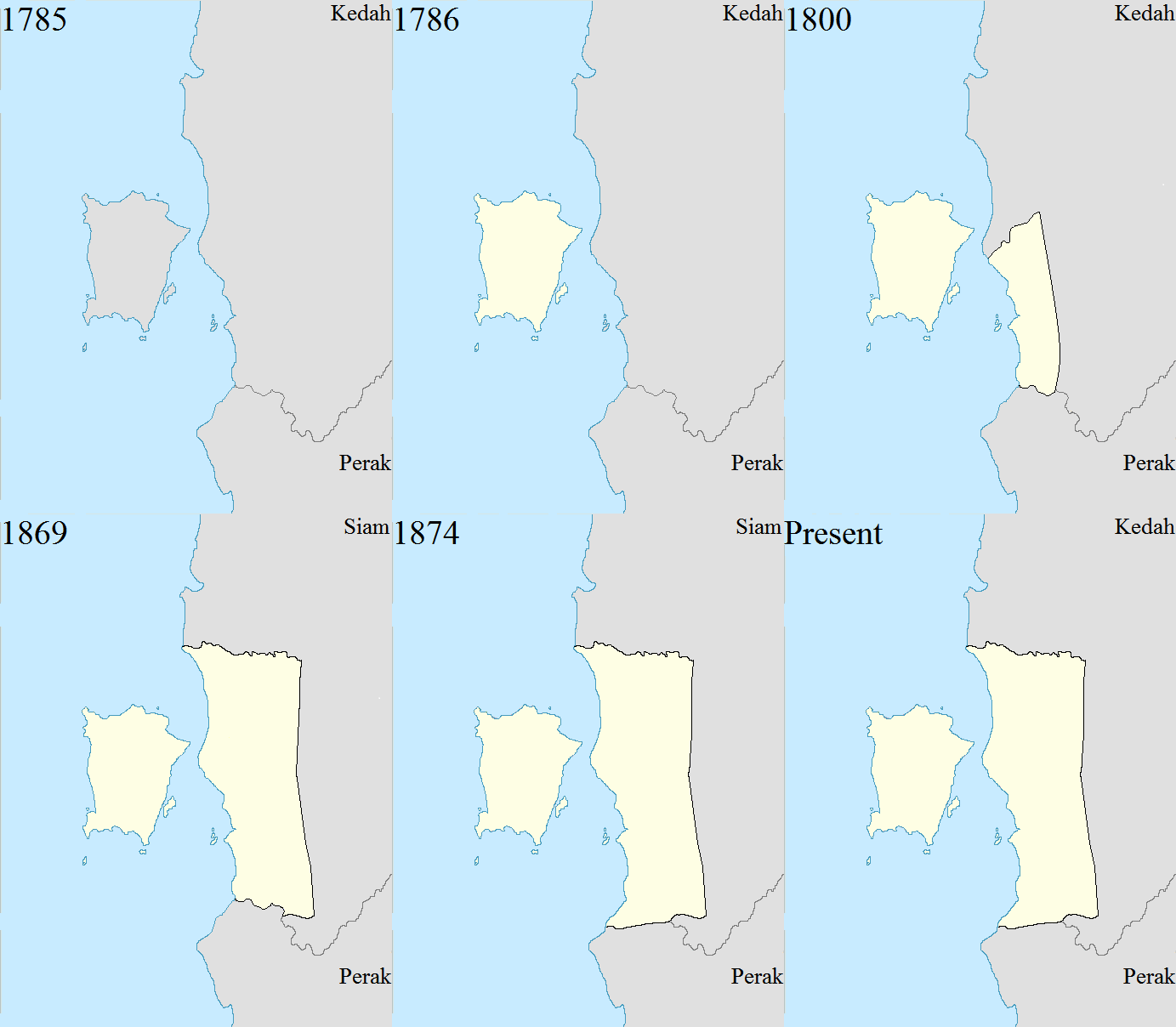
Penang's modern history began in 1786 when Francis Light, a representative of the British East India Company (EIC), obtained Penang Island from Sultan Abdullah Mukarram Shah of Kedah in exchange for military aid. Light had been sent to the Malay Peninsula by the EIC to build trade relations in the region, where he saw the strategic potential of Penang Island as a "convenient magazine for trade" that could enable the British to check Dutch and French territorial ambitions in Southeast Asia.
After negotiating an agreement with the Sultan, Light and his entourage landed on Penang Island on 17 July that year and took formal possession of the island "in the name of King George III of England" on 11 August. The island was renamed Prince of Wales Island after the heir to the British throne and the new settlement of George Town was established in honour of King George III.
Unbeknownst to Sultan Abdullah, Light had acted without the authority or the consent of his superiors in India. When the EIC reneged on military protection, the Sultan launched an attempt to recapture the Prince of Wales Island in 1791. However, the attempt was defeated by EIC forces and the Sultan sued for peace. An annual payment of 6,000 Spanish dollars was agreed in exchange for British sovereignty over the island.
In 1800, Lieutenant-Governor George Leith secured a strip of hinterland across the Penang Strait, which was subsequently named Province Wellesley (now Seberang Perai). The EIC gained permanent sovereignty over both Prince of Wales Island and the new mainland territory, while the annual payment to the Sultan of Kedah was increased to 10,000 Spanish dollars. The British government and, subsequently, the Malaysian government maintained the annual payments to Kedah until 2018, when the Malaysian federal government increased the amount by RM10 million yearly.
George Town grew rapidly as a free port and a conduit for spice trade, diverting maritime commerce away from Dutch outposts in the region. In 1805, Penang became a separate presidency of British India, sharing similar status with Bombay and Madras. By 1808, George Town had established its local government, while the founding of the Supreme Court of Penang marked the birth of Malaysia's modern judiciary. In 1826, George Town was made the capital of the Straits Settlements which included Singapore and Malacca. As Singapore soon supplanted George Town as the region's premier entrepôt, Singapore became the capital instead in 1832.
Despite its secondary importance to Singapore, George Town retained its importance as a vital British entrepôt. Towards the end of the 19th century, it became a major tin exporter and Malaya's primary financial centre. Penang's prosperity attracted a cosmopolitan population comprising Chinese, Malay, Indian, Peranakan, Siamese and migrants of mixed European-Asian lineage referred to as "Eurasians", and led to the development of hitherto rural areas such as Butterworth and Bukit Mertajam. However, the population growth created social problems such as inadequate sanitation, health facilities and rampant crime, culminating in street violence and rioting in 1867.
The Straits Settlements became a British crown colony within the same year. Direct British rule led to improved law enforcement, and investments in health care and public transportation in Penang. Owing to enhanced access to education, active participation of Asian residents in municipal affairs and substantial press freedom, George Town was perceived as being more intellectually receptive than Singapore. The settlement attracted intellectuals and revolutionaries, including Rudyard Kipling, Somerset Maugham and Sun Yat-sen. In 1910, Sun selected George Town as the centre for the Tongmenghui's political activities in Southeast Asia, aimed at overthrowing the Qing dynasty.
World wars
.jpg)
Penang Island was subsequently renamed Tojo-to after Prime Minister Hideki Tojo. Japanese military police imposed order by massacring Chinese civilians under the Sook Ching policy, while women were forced into sexual slavery. Swettenham Pier was converted into a major submarine base by the Axis Powers.
Between 1944 and 1945, Allied bombers from India targeted naval and administrative buildings in George Town, damaging and destroying several colonial buildings in the process. The Penang Strait was mined to restrict Japanese shipping. Following Japan's surrender, George Town was the first Malayan settlement liberated by British marines through Operation Jurist on 3 September 1945.
Post-war years
Penang was placed under British military administration until 1946, after which the Straits Settlements was abolished. The British sought to consolidate the various political entities in British Malaya, including the Crown Colony of Penang, under a single polity known as the Malayan Union. Initially, the impending annexation of Penang into the vast Malay heartland proved unpopular among Penangites. The Penang Secessionist Committee was formed in 1948 due to economic and ethnic concerns, but their attempt to avert Penang's merger with Malaya was unsuccessful due to British disapproval.
To relieve the concerns raised by the secessionists, the British government guaranteed George Town's free port status and reintroduced municipal elections in 1951. George Town became the first fully-elected municipality in Malaya by 1956 and was granted city status by Queen Elizabeth II in the following year. This made George Town the first city within the Federation of Malaya, and by extension, Malaysia.
Post-independence era
George Town's status as a free port was rescinded by the Malaysian federal government in 1969. This led to a loss of maritime trade, causing massive unemployment and brain drain. To revive the economy, Chief Minister Lim Chong Eu established the Bayan Lepas Free Industrial Zone in 1972. Massive industrialisation proved instrumental in reversing Penang's economic slump and led to the state's rapid economic growth until the late 1990s. Under Lim's tenure, the Penang Bridge, the first road link between Penang Island and the Malay Peninsula, was built.
Persistent brain drain, aggravated by federal policies prioritising the growth of Kuala Lumpur, resulted in Penang losing its leading position in the national economy by the 21st century. This decline, compounded by various issues including incoherent urban planning, poor traffic management and the dilapidation of George Town's heritage enclave following the repeal of the Rent Control Act in 2001, contributed to growing dissatisfaction within Penang's society.
In response, civil societies in George Town mobilised public support to rejuvenate the city. Resentment against the Barisan Nasional (BN) administration led to the Pakatan Rakyat bloc (now Pakatan Harapan) rising to power through the 2008 state election. Efforts to preserve George Town's heritage architecture led to the city's historical core being designated as a UNESCO World Heritage Site that year.
Governance and politics
Main article: Government of Penang
Governor
Chief Minister

Penang, a former British crown colony, is one of the four Malaysian states without hereditary monarchies. The Constitution of Penang, codified in 1957, is the state's highest law, consisting of 42 articles that govern the proceedings and powers of the state government. The head of state is the Governor (), who is appointed by the King of Malaysia. Ramli Ngah Talib is the current Governor of Penang, having assumed office in 2025. In practice, the Governor's role is largely symbolic and ceremonial. This includes the authority to appoint the head of government and approve legislation that has been passed by the state's legislature.
The Penang state government has its own executive body and legislature, but their powers are limited compared to the Malaysian federal government. According to the Federal Constitution, the state can legislate on matters pertaining to Malay customs, land, agriculture and forestry, local government, civil and water works, and state administration. Matters falling under the joint purview of state and federal authorities include social welfare, wildlife protection and national parks, scholarships, husbandry, town planning, drainage and irrigation, and public health regulations.
The 40-member Penang State Legislative Assembly forms the state's legislature and is elected for a maximum term of five years from single-member constituencies through state elections. Compared to the rest of Peninsular Malaysia, Penang's electoral landscape is perceived as being more liberal and distinct due to the state's ethnic diversity and socio-economic development. Unlike other Peninsular states, ethnic Chinese have formed the plurality in Penang for decades, and the state's economic infrastructure is based primarily on commerce and trade rather than agriculture. , non-Malays formed the majority in 25 of the 40 state constituencies. Thus, non-Malay electoral support is crucial to any political coalition aiming for power in Penang.
Executive

Main article: Penang State Executive Council}}{{See also, Chief Minister of Penang
The Penang State Executive Council is the executive authority of the Penang state government, similar in function to the federal Cabinet. It is led by the Chief Minister, who serves as the head of government in Penang. To this day, Penang remains the only Malaysian state where the position of the head of government has been continuously held by an ethnic Chinese since the nation's independence. Additionally, Penang was the first state to impose a two-term limit for the head of government's tenure. The current Chief Minister of Penang is Chow Kon Yeow of the Democratic Action Party (DAP), having assumed office after the 2018 state election.
Legislature
Main article: Penang State Legislative Assembly
The unicameral 40-seat Penang State Legislative Assembly, whose members are called State Assemblymen, convenes at the neoclassical State Assembly Building in George Town. Penang practises the Westminster system whereby the State Executive Council members are appointed from the elected State Assemblymen. Any amendment to Penang's Constitution requires the support of at least two-thirds of the State Legislative Assembly. Prior to a state election, it is customary to dissolve the legislature, which necessitates the consent of the Governor.
The 2023 state election witnessed an unprecedented alliance between Pakatan Harapan (PH) and its erstwhile adversaries Barisan Nasional (BN). The PH–BN alliance currently commands a supermajority in the State Legislative Assembly, controlling 29 out of the 40 seats. However, the election also saw the right-wing Perikatan Nasional (PN) opposition bloc gaining ground in the rural Malay-majority constituencies, occupying the remaining 11 seats in the legislature.
| Affiliation | Coalition/Party Leader | Status | Seats | 2023 election | Current | Total | 40 | 40 | Government majority | 18 | 18 |
|---|---|---|---|---|---|---|---|---|---|---|---|
| Pakatan Harapan | |||||||||||
| Barisan Nasional | Chow Kon Yeow | Government | 29 | 29 | |||||||
| Perikatan Nasional | Muhammad Fauzi Yusoff | Opposition | 11 | 11 |
Local governments
Penang is further divided into two city-level municipalities, each administered by a local government. The local governments exercise power in areas such as planning and development control, public housing, public spaces, waste disposal, business licensing, markets, local transport, and municipal roads.
- The Penang Island City Council (MBPP) administers the city of George Town, which includes the entirety of Penang Island. It is made up of a mayor, a city secretary and 24 councillors.
- The Seberang Perai City Council (MBSP) is in charge of Seberang Perai. Similar in structure to the MBPP, it also consists of a mayor, a city secretary and 24 councillors.
Penang is also divided into five administrative districts two in George Town and three in Seberang Perai. Each district is headed by a district officer. The lands and district office in each district deals with land taxation, thus differing from local governments that manage urban administration and maintenance of infrastructure.
After Pakatan Rakyat was voted into power in 2008, the newly-elected state government attempted to reinstate local government elections within Penang, which have been suspended since the 1960s. At the time, the Barisan Nasional-controlled federal government objected to the move, which eventually led to the Federal Court's decision that local government elections do not fall under the jurisdiction of state governments.
Judiciary
.jpg)
The present-day Malaysian judicial system traces its roots to 19th-century George Town. In 1807, Penang was granted a Royal Charter which paved the way for the establishment of a Supreme Court. In the following year, the Supreme Court of Penang (now Penang High Court) was inaugurated at Fort Cornwallis with the appointment of Edmond Stanley as the first Recorder.
The Penang High Court serves as the highest court in the state. Notable lawyers who served the high court include Tunku Abdul Rahman, Cecil Rajendra and Karpal Singh. There are also four Magistrates Courts and two Sessions Courts throughout Penang.
Foreign relations
Penang is home to the largest contingent of foreign diplomatic missions among Malaysian states. , a total of 27 countries have either established consulates or appointed honorary consuls within Penang. The Penang state government has also inked a sister state agreement with Japan's Kanagawa Prefecture and a friendship state partnership with China's Hainan Province.
Consulates
This list is based on information from the Ministry of Foreign Affairs, unless otherwise cited.
- Austria
- Bangladesh
- Belgium
- Brazil
- Canada
- Chile
- China
- Denmark
- Fiji
- Finland
- France
- Germany
- Hungary
- Indonesia
- Japan
- Nepal
- Pakistan
- Poland
- Russia
- South Africa
- Sweden
- Thailand
- Tunisia
- United Kingdom
- Ukraine}}
Security

In 1861, the Penang and Province Wellesley Volunteer Corps (P&PWVC) was established as the second volunteer military force in Malaya after the Singapore Volunteer Corps. Initially, the unit was exclusively formed by Europeans, with other races being barred until 1899. Over time, the P&PWVC transformed into the 3rd Battalion of the Straits Settlements Volunteer Force (SSVF) and by 1937, the unit also contained a European machine gun platoon, a Malay rifle company, a medical section and headquarters reserve. Although enlistment increased prior to the Japanese invasion of Malaya, 3rd Battalion SSVF was eventually evacuated from Penang without engaging in any combat.
Since independence, the Malaysian federal government assumes sole responsibility for the country's defence. Penang houses the Malaysian Army's 2nd Battalion of the Royal Malay Regiment and Rejimen 509 Askar Wataniah, which traces its lineage back to the P&PWVC. The Royal Malaysian Navy maintains a volunteer reserve base in George Town. RMAF Butterworth Air Base also serves as the headquarters of the Five Power Defence Arrangements Integrated Area Defence System (HQIADS). The air base continues to host Australian air force and army units on a rotational basis, including Rifle Company Butterworth.
Geography

With a land area of only 1049 km2, Penang is the second smallest state in Malaysia after Perlis. It is located on the northwestern coastline of Peninsular Malaysia, lying between latitudes 5.59° and 5.12°N, and longitudes 100.17° and 100.56°E. The state is divided into two major halves by the Penang Strait, which is only 3 km wide at the narrowest point and 13 km at its widest.
- Penang Island, a 295 km2 island.
- Seberang Perai, a 748 km2 hinterland on the Malay Peninsula. It shares land borders with Kedah to the north and east, and Perak to the south. The state capital, George Town, encompasses the entirety of Penang Island and a few surrounding islets, including Jerejak, Betong, Kendi, Rimau and Andaman islands. On the other hand, the city of Seberang Perai covers the mainland side of Penang.
Topography

Penang Island is irregularly shaped, with a hilly and mostly forested interior. The island's coastal plains are narrow, with the most extensive plain located at the northeastern cape. George Town, which started off as a small settlement at the northeastern tip of the island, has expanded over the centuries to encompass the entire island, although the marshy western coast remains relatively underdeveloped. The highest point of the state is Penang Hill, which stands at a height of 833 m at the centre of the island. On the other hand, Seberang Perai has mostly flat topography, save for a hilly region along the eastern border with Kedah.
Due to land scarcity in George Town, land reclamation projects have been undertaken at high-demand areas, particularly along the island's east coast. In 2023, a massive reclamation project commenced off the city's southern coast to build the 920 ha Silicon Island, envisioned as a new hub for high-tech manufacturing and commerce. Following years of reclamation works, the Gurney Drive shoreline is also being transformed into Gurney Bay, intended as "a new iconic waterfront destination for Penang".
The major rivers within Penang include the Pinang, Perai, Muda and Kerian rivers. The Muda River serves as the northern border between Seberang Perai and Kedah, while the Kerian River forms part of the southern boundary between Seberang Perai, Kedah and Perak.
Climate
Penang has a tropical rainforest climate under the Köppen climate classification (Af). The state experiences relatively consistent temperatures throughout the course of the year, with an average high of about 32 °C and an average low of 24°C. Penang's proximity to Sumatra makes it susceptible to dust particles carried by wind from transient forest fires that create the perennial Southeast Asian haze. The Penang Meteorological Office at Bayan Lepas is the primary weather forecast facility for northwestern Malaysia.
| Jan record high C = 35.9 | Feb record high C = 37.0 | Mar record high C = 36.6 | Apr record high C = 35.0 | May record high C = 34.0 | Jun record high C = 34.8 | Jul record high C = 34.4 | Aug record high C = 34.0 | Sep record high C = 34.0 | Oct record high C = 34.3 | Nov record high C = 33.9 | Dec record high C = 36.4 | Jan record low C = 22.3 | Feb record low C = 19.8 | Mar record low C = 21.6 | Apr record low C = 22.7 | May record low C = 23.3 | Jun record low C = 22.5 | Jul record low C = 22.2 | Aug record low C = 22.1 | Sep record low C = 22.0 | Oct record low C = 22.7 | Nov record low C = 22.8 | Dec record low C = 21.6 |access-date=25 December 2024}} | access-date = 22 March 2024}}
Nature
In spite of rapid urbanisation, Penang has managed to preserve a significant portion of its natural environment. Within the state, 7761 ha have been designated as protected forest reserves. In 2021, the 12481 ha Penang Hill Biosphere Reserve was designated a UNESCO Biosphere Reserve in recognition of the area's biodiversity. The gazetted nature reserve includes the Penang National Park, which covers 2562 ha of the northwestern tip of the island. It has been identified as one of the state's ecotourism destinations, alongside the Penang Botanic Gardens and the Tropical Spice Garden.
Economy
Main article: Economy of Penang
| export-goods = | export-partners = | import-goods = | import-partners = | presentUS$asdefault =
Despite its small size, Penang has one of the most robust economies in Malaysia. The state's tertiary-based economy is largely driven by the manufacturing and services sectors. In 2023, Penang's GDP was worth nearly RM128.593 billion (US$28.016 billion) with a growth rate of 3.3%. Penang's GDP per capita of RM72,586 (US$15,814) was the highest among Malaysian states, surpassing the World Bank's threshold of US$14,005 to be considered a high-income economy. In addition, the George Town Conurbation had a GDP worth US$30 billion in 2020, making it the second largest metropolitan economy in Malaysia after the Klang Valley.
Penang contributed approximately RM7 billion (US$ billion) of Malaysia's yearly tax revenue and consistently records one of the lowest unemployment rates in the nation at 2.2% . Average monthly salaries rose to RM3,557 (US$), the second highest among Malaysian states after Selangor, while labour force participation rate increased to 71.3% from 70.1% in the previous year.
Penang is the top destination in Malaysia for foreign investors, capturing US$13.4 billion or nearly 33% of the country's inbound foreign direct investments (FDI) in 2023. , the bulk of Penang's FDI originated from the Netherlands, Cayman Islands and Singapore. The state has also attracted hundreds of multinational corporations (MNCs) to its shores and plays a growing role in the global electronics supply chain, holding a share of more than 5% in the world's semiconductor sales. Penang is concurrently Malaysia's largest exporter, accounting for nearly RM495 billion (US$ billion) or 32.8% of the country's exports in 2024. The services sector has been growing in tandem as well, with Penang being the second most popular hub in Malaysia for Global Business Services (GBS) and the financial heart of the country's northwestern region, complemented by the state's traditional popularity as a destination for tourism, business events and health care.
Penang's economic renaissance, particularly since 2008, was described by Bloomberg as Malaysia's "biggest economic success", in spite of the federal government's focus on other states such as Johor and Sarawak. The Penang state government has also managed to pare down public debt to RM41.1 million (US$ million) by 2022. In addition, Penang's Human Development Index (HDI) value increased to 0.839 , the second highest of all Malaysian states excluding the federal territories.
The booming economy has also led to a considerable interest in real estate in Penang. In 2016, George Town was ranked Malaysia's most attractive destination for commercial property investment by Knight Frank, surpassing even Kuala Lumpur. In 2023, Penang's residential market was ranked the second most popular in Southeast Asia after Singapore.
Manufacturing

However, the revocation of George Town's free port status and the fall of Wong's administration in 1969 marked a turning point in Penang's economic fortunes. Wong's successor, Lim Chong Eu, initiated a massive transformation of Penang's economy. The Bayan Lepas Free Industrial Zone (Bayan Lepas FIZ) in George Town was established in 1972, followed by the Perai Free Industrial Zone (Perai FIZ) in 1980. The zones played a critical role in reviving Penang's economy and driving the state's economic growth in the late 20th century. The Penang state government has since embarked on building newer industrial parks within Seberang Perai where land is more readily available, such as at Seberang Jaya, Bukit Minyak and Batu Kawan.
Penang's manufacturing sector attracted US$13.1 billion of foreign direct investments (FDI) in 2023, accounting for almost 47% of Malaysia's total that year. Among the hundreds of MNCs with manufacturing operations in Penang are technology firms such as AMD, Bosch, Broadcom, Dell, HP Inc., Intel, Motorola, Osram and Renesas. According to Financial Times in 2024, Penang is well-positioned to benefit from the ongoing China–United States trade war, as restrictions push businesses to adopt the China Plus One strategy.
Services

The services sector contributed 48% of Penang's GDP and employed almost of the state's workforce. George Town is the commercial hub of northern Malaysia. , finance and ancillary services contributed 9% of Penang's GDP. The Penang International Airport (PIA) is the country's second busiest in terms of aircraft movements and in 2023, handled RM365 billion (US$ billion) worth of exports, the highest of all entry points nationwide. In 2024, the Port of Penang processed over 1.4 million TEUs of cargo, the third highest among Malaysia's seaports.
Traditionally one of Malaysia's most popular tourist destinations, Penang has embarked on economic diversification by expanding its tourism offerings in areas such as health care, business events, ecotourism and cruise arrivals. Penang is the leading destination in Malaysia for medical tourism. The state's business events industry generated an economic impact of nearly RM1.3 billion (US$ billion) in 2024. Penang's retail sector is characterised by a diverse range of establishments, including modern shopping malls and traditional shophouses that specialise in local delicacies and produce.
Penang is also a major hub for shared services and outsourcing (SSO). By 2016, the state attracted RM4.1 billion of investments for global business services (GBS), the second largest share in the country after Kuala Lumpur. The offshore expansion of multinational firms to Penang has led to the creation of thousands of jobs and an increased demand for new office spaces within the state. In addition, Penang is home to a thriving startup community, driven by home-grown companies like Piktochart and DeliverEat.
Utilities
Water supply, which comes under the jurisdiction of the Penang state government, is wholly managed by the Penang Water Supply Corporation (PBAPP). The state enjoys the lowest domestic water tariff in Malaysia, at RM0.32 (US$) per 1,000 litres, but also records the highest domestic water consumption per capita in Malaysia at 278 L in 2018. Over 80% of Penang's water supply comes from the Muda River, which forms the northern border between Seberang Perai and Kedah. This leaves the state vulnerable to effluents from upstream Kedah, as well as constant political disputes between the neighbouring states over the river. To counter water supply disruptions, PBAPP has contingency plans in place to draw water from alternative sources such as the Ayer Itam, Teluk Bahang and Mengkuang dams. The state government has also been negotiating with neighbouring Perak to secure additional water supply.
In 1904, George Town became the first city within British Malaya to be supplied with electricity. At present, electricity for industrial and domestic consumption is provided by Tenaga Nasional (TNB). In 2024, TNB built a RM500 million (US$ million) overhead power grid comprising 31 monopole transmission towers across the Penang Strait, boosting power transmission to George Town to 2,000 MW. Collaboration between TNB and the two city governments in Penang to replace existing street lighting with energy-efficient LED street lights is ongoing.
Municipal solid waste is disposed at the Pulau Burung landfill in Seberang Perai. The amount of solid waste generated in Penang has been steadily increasing over the years, from 838,365 metric tons in 2009 to 1,518,010 metric tons in 2019, with an average increase of 6.5%. However, Penang boasts the highest recycling rate in the country, standing at 47% . To streamline the waste management process, the two city governments reintroduced a waste sorting policy in 2024.
In 2020, Penang had become the first Malaysian state to require the installation of fibre-optic communication infrastructure for all development projects. , 5G coverage had reached 73.4% of the populated areas in the state. In 2024, DE-CIX inaugurated the Penang Internet Exchange (PIX), with internet traffic being routed through a data centre at Bayan Baru. State government agencies have been promoting the digital economy and intensifying efforts to attract high-value technology players to further boost the state's economic growth.
Transportation
Main article: Transport in Penang
Land

Penang Island is physically connected to mainland Seberang Perai by two road bridges the 13.5 km Penang Bridge and the 24 km Second Penang Bridge. Seberang Perai is accessible through the North–South Expressway, a 966 km expressway that stretches along the western part of Peninsular Malaysia. Other major toll routes in the state include the Butterworth Outer Ring Road (BORR) and the Butterworth–Kulim Expressway.
In addition, the Keretapi Tanah Melayu (KTM) West Coast Line runs through Seberang Perai, with the Butterworth railway station serving as the principal terminal in northwestern Malaysia. Aside from regular KTM services, Butterworth is also one of the main stops of the Eastern and Oriental Express service between Bangkok and Singapore. Penang Sentral is the main transit hub within Penang, located in close proximity to the Sultan Abdul Halim Ferry Terminal and the Butterworth railway station.
Excluding toll routes, Penang's road system covered a distance of 6725.1 km . Within George Town, the Tun Dr Lim Chong Eu Expressway is a coastal highway that runs along the city's eastern seaboard, connecting the city centre with the Penang Bridge, the Bayan Lepas Free Industrial Zone and the Second Penang Bridge. The Federal Route 6 is a pan-island trunk road that circles the city, while the George Town Inner Ring Road serves as the main thoroughfare within the city centre.
Public transportation
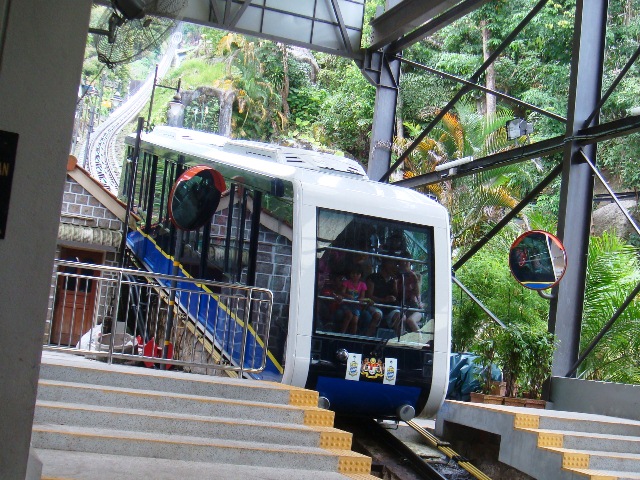
Under British rule, George Town was a pioneer in public transportation within Malaya. The city's first tram system, originally powered by steam, began operations in the 1880s, but the trams became obsolete by 1936. The trishaw from the colonial era still plies the city's streets, catering primarily to tourists.
Public buses form the backbone of public transportation in Penang. Established in 2007, Rapid Penang is the state's main public transport operator, with 47 active routes throughout the George Town Conurbation including interstate routes into the neighbouring towns of Sungai Petani, Kulim and Kerian. Since 2024, Rapid Penang has introduced demand-responsive transport services within the state, utilising vans to address last mile connectivity.
The only rail-based transportation system within Penang is the century-old Penang Hill Railway, a funicular service to the peak of Penang Hill. A cable car system is being constructed to reduce overreliance on the railway. The Penang state government has also planned to introduce urban rail throughout the state as part of the Penang Transport Master Plan. In 2024, the Malaysian federal government assumed control of the Mutiara LRT line from the state government. Spanning a distance of 29.5 km, the line is the first domestic light rail system outside the Klang Valley, and will link the cities of George Town and Seberang Perai. Construction commenced in 2025 and is expected to be complete by 2031.
To promote urban mobility, pedestrian and cycling infrastructure throughout the state are also being upgraded. In 2016, George Town became the first city in Malaysia to operate a public bicycle-sharing service with the inauguration of LinkBike.
Air

Main article: Penang International Airport
The Penang International Airport (PIA) is located 16 km south of downtown George Town. It serves as the main airport for northwestern Malaysia, with services to major regional cities such as Kuala Lumpur, Singapore, Bangkok, Taipei, Hong Kong, Xiamen, Shanghai, Doha and Dubai. PIA is Malaysia's second busiest airport for aircraft movements and recorded more than 7.6 million passengers in 2024. It is also the country's second busiest in terms of cargo tonnage and handles the largest export volume of all entry points nationwide. , the airport is being upgraded to raise its annual capacity from 6.5 million passengers to 12 million by 2028.
Sea

Formerly a vital British entrepôt, Penang's maritime trade has significantly declined due to the loss of George Town's free-port status in 1969 and the concurrent development of Port Klang near the federal capital Kuala Lumpur. Despite this, the Port of Penang remains the primary harbour for northwestern Malaysia and southern Thailand. It handled more than 1.4 million TEUs of cargo in 2024, the third highest among Malaysia's seaports.
Swettenham Pier, situated within downtown George Town, accommodates cruise ships and is one of the major entry points into the city. In 2017, Swettenham Pier recorded 125 port calls, surpassing Port Klang as the busiest cruise shipping terminal in Malaysia. The pier has attracted some of the world's largest cruise liners, such as the Queen Mary 2, and also sees occasional port visits by warships.
The cross-strait Penang ferry service connects George Town and Seberang Perai, and was formerly the only transportation link between the island city and the mainland until the completion of the Penang Bridge in 1985. At present, four ferries ply the Penang Strait between both cities daily.
Demographics
|1881 |190597 |1891 |231224 |1901 |247808 |1911 |270537 |1921 |292485 |1931 |340259 |1947 |446321 |1957 |572100|1970 |776124 |1980 |954638 |1991 |1116801 |2000 |1313449|2010 |1526324 |2020 |1740405 Main article: Demographics of Penang
, Penang had a population of 1,740,405 and the highest population density of all Malaysian states at 1,659 /km2. Penang is Malaysia's second most urbanised state, with an urbanisation level of 92.5%. Residents of Penang are colloquially known as Penangites or "Penang-lang".
54% of Penang's population resided in Seberang Perai, Malaysia's third largest city, while George Town was home to the remaining 46%. George Town serves as the core city of the George Town Conurbation, Malaysia's second largest metropolitan area.
In 2020, Penang recorded negative migration rate with more people leaving the state than it received. However, between 2015 and 2016, Penang had the highest migration effectiveness ratio among Malaysian states, due to the state's diversified economy. Most interstate immigrants came from Perak, Selangor, Kedah, Johor and Kuala Lumpur.
Ethnicities
, ethnic Chinese and the Bumiputeras, which include Malays and indigenous East Malaysians, each constituted about 41% of Penang's population, while Indians made up nearly 9%. The Chinese community in Penang includes the Peranakan Chinese, a hybrid ethnicity known for their distinctive architecture, costumes and cuisine. The state is also home to a cosmopolitan mix of ethnic Eurasians, Siamese and Arabs.
Foreigners comprised 8% of Penang's population in 2020. Over 38% of Penang's expatriates resided within downtown George Town, Paya Terubong and Bayan Lepas. George Town's affordable living costs, natural destinations, health care infrastructure, an established ecosystem of multinational companies (MNCs) and the widespread use of English have been cited as pull factors for expatriates.
Languages
Malay is the official language of Penang. English once served as the official language during British rule and recently there have been calls to reinstate it as one of Penang's official languages. Tamil is the most widely spoken language among ethnic Indians, while Penang's Chinese population uses a variety of Chinese dialects such as Teochew, Hakka and Cantonese. Penang Hokkien serves as the lingua franca between the different ethnic groups in Penang, with efforts being made at the grassroots level to preserve its relevance.
Religions
Penang allows freedom of religion and religious assembly, and is one of three states to have a dedicated department for non-Muslim affairs. In 2021, the Penang state government formed the Penang Harmony Corporation to further enhance interreligious harmony in the state.
Education

Penang is home to 49 tertiary institutions (including universities, colleges, medical colleges, industrial training institutes and teaching schools), 13 international and expatriate schools, 128 secondary schools, 271 primary schools and 609 kindergartens. George Town is home to some of Malaysia's oldest schools. Established in 1816, Penang Free School (PFS) is the oldest English school in Southeast Asia. British colonial rule had also encouraged the growth of mission schools in George Town such as St. Xavier's Institution, St. George's Girls' School and Methodist Boys' School.
Penang is also a pioneer in Malaysia's present-day Chinese education system, with the establishment of its first Chinese school in 1819. Prominent Chinese schools in the state include Chung Ling High School, Penang Chinese Girls' High School, Heng Ee High School and Jit Sin High School, among others. In addition, George Town has 13 international and expatriate schools that offer either British, American or International Baccalaureate syllabuses.
Universiti Sains Malaysia (USM) is the premier public university in Penang. , it is ranked 146th in the QS World University Rankings, third in Malaysia after Universiti Malaya and Universiti Kebangsaan Malaysia. Most of the other tertiary institutions in the state are privately-run, including Wawasan Open University, Han Chiang University College of Communication, DISTED College and RCSI & UCD Malaysia Campus. RECSAM, one of the 26 specialist institutions of the Southeast Asian Ministers of Education Organization, is headquartered in George Town.
The Penang Public Library Corporation is the state government body tasked with the operation of public libraries throughout the state. In 2016, the Penang state government launched Malaysia's first digital library, situated within the grounds of PFS. Similar digital libraries have since been built at various locations throughout the state.
Healthcare

Health care in Penang is provided by a two-tier system consisting of public and private hospitals. The Penang General Hospital, administered and funded by the Malaysian Ministry of Health, is the main tertiary referral hospital within northwestern Malaysia. It is supported by five other public hospitals in Penang, all of which also come under the administration of the country's Ministry of Health.
In addition, Penang has 19 private hospitals that offer specialist services, making the state the leading hub for medical tourism in Malaysia. The total number of beds in public and private hospitals in Penang is 4,329, or nearly 248.7 beds per 10,000 people, higher than the national average. While private hospitals in Penang operate independently of the Ministry of Health, there have been instances of public-private cooperation, such as during the COVID-19 pandemic which saw private hospitals sharing equipment and taking in non-COVID-19 patients in need of urgent medical procedures.
The infant mortality rate in Penang has decreased significantly, dropping by 85% between 1970 and 2000 to 5.7 per 1,000 live births. Similarly, the neonatal mortality rate has also decreased by 84.7% during the corresponding period to 4.1 per 1,000 live births. , the life expectancy at birth in Penang is 71.9 years for men and 77.2 years for women. According to an official survey in 2019, Penang recorded one of the lowest obesity rates in Malaysia, with an obesity rate of 18.6%.
Culture
Main article: Culture of Penang

Festivals
Penang's cosmopolitan society results in a great number of celebrations and festivities throughout the year. The state hosts major cultural and religious events, including Chinese New Year, Eid al-Fitri, Diwali, Thaipusam, Vaisakhi, Christmas, Vesak and Songkran. Chinese New Year celebrations last for 15 days and are marked with festivities unique to the state, such as the birthday of the Jade Emperor, and the annual opening of Chinese ancestral halls and associations in George Town. The 15th and final day of Chinese New Year is celebrated with a Peranakan Chinese-inspired Lantern Festival.
George Town is credited as the origin of a unique form of the Chingay procession, which involves participants balancing oversized flags on their heads or hands. A state-held Chingay parade takes place in George Town annually, although Chingay performances are also frequently included in Chinese festivals and significant state events throughout Penang.
Expatriates residing in Penang have introduced their celebrations to the state. Bon Odori, a Japanese festival celebrated annually in George Town, has gained popularity among locals. St. Patrick's Day and Oktoberfest, traditionally celebrated by ethnic Irish and German communities respectively, are also celebrated in the city.
Penang also hosts several major festivals each year, including the George Town Festival which has become one of the largest arts events in Southeast Asia since its inaugural event in 2010. In 2018, the George Town Literary Festival became the first Southeast Asian literary event to achieve the international Literary Festival Award at the London Book Fair.
Arts
.jpeg)
Bangsawan is a form of Malay theatre that originated in Penang at the end of the 19th century, and incorporates Indian, Western, Islamic, Chinese and Indonesian influences. It was a popular outdoor performance in the 1920s. Another unique form of theatre that began in Penang is boria, which features singing accompanied by violin, maracas and tabla. Boria reached the height of its popularity in the 1930s and was typically performed as a form of satire. While the British imposed a ban on boria in Singapore and Malacca, the art form was never banned in Penang.
Apart from traditional forms of art, the Penang Philharmonic Orchestra, funded by the state, was established in 2010 to elevate the standard of classical music in Penang. Dewan Sri Pinang and Setia SPICE in George Town are the main venues for performing arts and concerts within the state.
George Town is a hub for the arts and culture scene in Malaysia. The inscription of parts of George Town as a UNESCO World Heritage Site has enhanced cultural and creative industries within the city. In 2012, Lithuanian artist Ernest Zacharevic created a series of six wall paintings depicting local culture, inhabitants and lifestyles as part of the George Town Festival. The city is also adorned with 52 wrought iron caricatures and 18 wall murals that showcase the city's history and the daily lives of the local community. Additionally, art exhibitions are held at the city's event spaces like the Hin Bus Depot and Sia Boey.
Penang's literary heritage stems from the colonial-era Peranakan Chinese literature and its role as a translation hub in Malaya, where prior to World War II, the publishing industry facilitated the translation of Chinese and Western literary works into Malay. Post-independence, the state's literary scene has diversified, with independent local publishers and retailers such as Areca Books, Gerakbudaya and the George Town World Heritage Incorporated running alongside major bookstore chains like Popular Holdings and MPH Group.
Media

George Town was once the hub of Malaysia's print press. The nation's first newspaper, the Prince of Wales Island Gazette, was founded in the city in 1806. Under British rule, Penang had relatively more press freedom as compared to Singapore, which had a stronger government apparatus.
The Star, one of Malaysia's top English dailies, started as a regional newspaper that was first published in George Town in the 1970s, while the country's oldest Chinese newspaper, Kwong Wah Yit Poh, was also established in the city in 1910. In addition, the Penang state government publishes its own multi-lingual newspaper, Buletin Mutiara, which is distributed for free every fortnight. The newspaper focuses on current issues within Penang, providing valuable information and insights for the local community.
The well-preserved colonial-era cityscape has made George Town a popular filming location for movies and television series that depict Asian culture. Films and series that were filmed within the city include Crazy Rich Asians, Anna and the King, Lust, Caution, The Little Nyonya and You Mean the World to Me; the latter was the first movie to be produced entirely in Penang Hokkien. George Town was also featured as a pit-stop in The Amazing Race 16, The Amazing Race Asia 5 and The Amazing Race Australia 7.
Architecture
Main article: Architecture of Penang}}{{See also, List of tallest buildings in George Town, Penang
In 2008, UNESCO gazetted nearly 260 ha within downtown George Town as a World Heritage Site. The city centre is recognised by UNESCO for its "unique architectural and cultural townscape without parallel anywhere in East and Southeast Asia". Shophouses sit alongside Anglo-Indian bungalows, mosques, temples, churches, and European-style administrative and commercial complexes, forming the city's multicultural framework. Elsewhere within the city, Siamese and Burmese cultures are prominently displayed at places of worship such as Wat Chayamangkalaram, Dhammikarama Burmese Temple and Kek Lok Si.
Apart from the colonial-era architecture, George Town is home to most of Penang's skyscrapers, including Komtar Tower, Marriott Residences and Muze @ PICC. There has been rising demand for residential high-rises at the suburbs since 2015, driven by the growing need for strata housing and the city's thriving economy.
Cuisine
Main article: Penang cuisine

Penang's culinary scene incorporates Malay, Chinese, Indian, Peranakan and Thai influences, evident in the variety of street food that includes char kway teow, asam laksa and nasi kandar. Described by CNN as "the food capital of Malaysia", George Town was also listed by Time and Lonely Planet as one of the best in Asia for street food. According to Time in 2004, only in the city "could food this good be this cheap". Robin Barton of the Lonely Planet remarked that the city was a "culinary epicentre of the many cultures that arrived after it was set up as a trading port in 1786, from Malays to Indians, Acehenese to Chinese, Burmese to Thais".
Over the years, Penang's culinary scene has expanded to include fine dining establishments, adding to its already diverse street food options. In 2022, the Michelin Guide made its debut in the state, in recognition of its "small-scale restaurants and street food that embodies Malaysia's distinctive streetside dining culture". The 2025 edition of the Michelin Guide features 69 eateries throughout the state.
Sports

Despite its small size, Penang has hosted regional and international sporting events, such as the 2001 SEA Games, 2013 Women's World Open Squash Championship and Asia's first Masters Games in 2018. The state represents itself with its own sports teams in the interstate Sukma Games.
Penang is home to a variety of sports facilities. The Penang State Stadium in Seberang Perai is the state's main stadium, while the City Stadium in George Town is the home ground of Penang FC. Setia SPICE in George Town is another major sporting venue, consisting of an indoor arena and an aquatics centre. The city is also home to Malaysia's oldest equestrian centre the Penang Turf Club, which was established in 1864.
Major annual sporting events in Penang include the Penang International Dragon Boat Festival and the Penang Bridge International Marathon. The Penang International Dragon Boat Festival takes place every December and attracts participants from abroad. The Penang Bridge International Marathon, which features the iconic Penang Bridge as its route, has also gained international recognition, attracting about 20,000 participants from 61 countries in 2023.
Notable people
Penang is the birthplace of illustrious Malaysian and Singaporean personalities, professionals and politicians, including:
- Chan Kim Boon (1851–1920), novelist and translator
- Wu Lien-teh (1879–1960), physician and inventor of the respiratory mask
- Hon Sui Sen (1916–1983), former cabinet minister in Singapore
- Wee Chong Jin (1917–2005), first Chief Justice of Singapore
- P. Ramlee (1929–1973), actor, filmmaker, musician, composer and icon of Malay-language entertainment
- Abdullah Ahmad Badawi (1939–2025), fifth Prime Minister of Malaysia
- Karpal Singh (1940–2014), lawyer, politician and former national chairman of the Democratic Action Party
- Lim Pik-Sen (born 1944), British actress
- Anwar Ibrahim (born 1947), tenth and current Prime Minister of Malaysia
- Jimmy Choo (born 1948), fashion designer knighted with the Order of the British Empire
- David Arumugam (born 1950), singer and founder of the pop band Alleycats
- Yeohlee Teng (born 1951), American fashion designer
- Khaw Boon Wan (born 1952), former cabinet minister in Singapore
- Tan Hock Eng (born 1952), chief executive officer of Broadcom
- Sultan Nazrin Shah (born 1956), reigning monarch of the neighbouring state of Perak
- Ooi Keat Gin (born 1959), academician and historian
- Saw Teong Hin (born 1962), film director
- Tan Twan Eng (born 1972), award-winning novelist
- Nicol David (born 1983), former world number one female squash player
- Mamak Puteh (born 1984), actor and comedian
- Loh Kean Yew (born 1997), Singaporean badminton player
Notes
References
Sources
References
- (Aug 2024). "Laporan Sosioekonomi Negeri Pulau Pinang 2023". [[Department of Statistics Malaysia]].
- "Malaysia Human Development Index (MHDI), 2024".
- (23 December 2022). "Statistics Dept: Malaysia's Urbanisation Rate Tripled over Five Decades". [[Malay Mail]].
- Gardner, Simon. (2011). "Heritage Trees of Penang". Areca Books.
- Abe, Burhanuddin. (29 December 2009). "Penang: Pearl of the Orient". [[The Jakarta Post]].
- "Mari Kenali Bendera Negeri-Negeri di Malaysia".
- "Pulo Ka Satu : Warisan Sejarah Awal Persuratan Melayu Pulau Pinang". [[National Library of Malaysia]].
- Larry, Sternstein. "The London Company's Envoys Plot Siam". [[Siam Society]].
- Ooi, Kee Beng. (September 2012). "Penang before Francis Light (As the English Saw It in 1905)".
- Haji Endut, Esmawee. (November 1993). "Traditional Malaysian Built Forms: A Study on the Origins, Main Building Types, Development of Building Formd, Design Principles and the Application of Traditional Concepts in Modern Buildings". [[University of Sheffield]].
- Liew, Jia Xian. (12 August 2022). "5,000-Year-Old 'Penang Woman' Now Has a Face". [[The Star (Malaysia).
- (19 April 2017). "Prehistoric Human Skeleton Found at Penang Neolithic Site". [[Today (Singapore newspaper).
- (26 April 2017). "Penang to Seek UNESCO Heritage Status for Guar Kepah Neolithic Site". [[The Star (Malaysia).
- Freedman Leonard, Rousham Emily. (1996). "Perspectives in Human Biology: Humans in the Australasian Region". World Scientific.
- Habibu, Sira. (9 December 2013). "Lembah Bujang Covers a Larger Area". [[The Star (Malaysia).
- (2020). "The Hokkien Rayas of Songkhla". [[Siam Society]].
- Hill, Ronald David. (23 November 1839). "Plan of Prince of Wales Island and Province Wellesley".
- Moniot, Jules Michael. (1860). "Map of Prince of Wales Island, or Pulo Penang and Province Wellesley including a Careful Survey of the South Channel".
- Stanford, Edward. (1870). "Map of Prince of Wales Island and Province Wellesley, Straits Settlements".
- (1981). "Documents Archive - Pangkor Engagement of 1874". [[National University of Singapore]].
- {{Harvard citation no brackets. Lewis Su. 2016
- Merican, Ahmad Murad. (29 October 2021). "The 1786 Acquisition of Pulau Pinang: Unveiling the Light Letters, Revisiting Legal History Case Materials and R. Bonney's Kedah 1771–1821". [[Universiti Sains Malaysia]].
- Ooi, Keat Gin. (2010). "The A to Z of Malaysia". Rowman & Littlefield.
- Ooi, Keat Gin. (2015). "Disparate Identities: Penang from a Historical Perspective, 1780–1941". Kajian Malaysia.
- {{Harvard citation no brackets. Jenkins. 2008
- Blackledge, J.P.. (6 July 1950). "Province Wellesley Looks Back". The Singapore Free Press.
- Marcus Langdon. (2013). "Penang: The Fourth Presidency of India. 1805-1830. Volume One: Ships, Men and Mansions". Areca Books.
- (11 February 2017). "Unconstitutional to Wipe Penang off Malaysia's map, Kedah Told". [[Malay Mail]].
- Ida Lim. (7 June 2023). "Report: Kedah MB Denies Asking for Return of Penang, Just Wants Higher Lease Payment". [[Malay Mail]].
- {{Harvard citation no brackets. Jou. Michael Hsiao. Aveline-Dubach. 2014
- Jackson. (Nov 2013). "Buildings of Empire". [[Oxford University Press]].
- Ooi, Kee Beng. (2014). "When Penang Became a Spice Island".
- {{Harvard citation no brackets. Khoo. 2007
- {{Harvard citation no brackets. Lewis Su. 2016
- Koay Su Lin, Steven Sim. (2014). "A History of Local Elections in Penang Part I: Democracy Comes Early".
- "Singapore Becomes Admin Centre of the Straits Settlements".
- Turnbull, C. M.. "The Penang Story". Penang's Changing Role in the Straits Settlements, 1826–1946.
- {{Harvard citation no brackets. Hockton. 2012
- Wong, Yee Tuan. (2015). "Penang Chinese Commerce in the 19th Century: The Rise and Fall of the Big Five". [[ISEAS – Yusof Ishak Institute]].
- {{Harvard citation no brackets. Langdon. 2014
- Chan, Wai Yeap. "The History of Bukit Mertajam (1800-1957): From Agrarian Town to Central Hub of Northern Malaya". Penang Institute.
- Ooi, Giok Ling. (2 September 1991). "British Colonial Health Care Development and the Persistence of Ethnic Medicine in Peninsular Malaysia and Singapore". [[National University of Singapore]].
- (16 September 1867). "The Disturbances at Penang". The Sydney Morning Herald.
- Wong, Chun Wai. (20 April 2013). "A cowboy town that was old Penang". [[The Star (Malaysia).
- Jaime Koh. "Straits Settlements".
- {{Harvard citation no brackets. Lewis Su. 2016
- {{Harvard citation no brackets. Lewis Su. 2016
- {{Harvard citation no brackets. Langdon. 2014
- (21 January 2007). "Chinese Hero's Memory Burns Bright in Penang House". [[Reuters]].
- {{Harvard citation no brackets. Barber. 2010
- {{Harvard citation no brackets. Barber. 2010
- {{Harvard citation no brackets. Bayly. 2004
- B. Frank, Richard. (2020). "Tower of Skulls: A History of the Asia-Pacific War: July 1937-May 1942". W. W. Norton & Company.
- {{Harvard citation no brackets. Bayly. 2004
- {{Harvard citation no brackets. Barber. 2010
- {{Harvard citation no brackets. Barber. 2010
- Stevens, David. "German U-Boat Operations in Australian Waters".
- Eugene Quah. (December 2023). "When Penang Was an Axis Submarine Base".
- {{Harvard citation no brackets. Langdon. 2014
- {{Harvard citation no brackets. Barber. 2010
- H. Kratoska. (1998). "The Japanese Occupation of Malaya: A Social and Economic History". C. Hurst & Co. Publishers.
- {{Harvard citation no brackets. Barber. 2010
- Koay, Su Lin. (September 2016). "Penang: The Rebel State (Part One)".
- {{Harvard citation no brackets. Barber. 2010
- Christie, Clive. (1996). "A Modern History of Southeast Asia: Decolonization, Nationalism and Separatism". Tauris Academic Studies.
- Koay, Su Lin. (1 October 2016). "Penang: The Rebel State (Part Two)". Penang Monthly.
- Wong, Chun Wai. (5 October 2013). "George Town's First Mayor Ramanathan was a Fiery Man, Politician, Educationist and Unionist". [[The Star (Malaysia).
- Daniel Goh, P. S.. (2014). "Between History and Heritage: Post-Colonialism, Globalisation, and the Remaking of Malacca, Penang and Singapore". Trans-Regional and -National Studies of Southeast Asia.
- Ooi, Kee Beng. (December 2009). "Tun Lim Chong Eu: The past is not passé".
- (2019). "From Free Port to Modern Economy: Economic Development and Social Change in Penang, 1969 to 1990". Penang Institute.
- Evelyn Teh. (July 2016). "Where the Sea Meets the City is Where the World Meets Penang".
- {{Harvard citation no brackets. Ooi. Goh. 2010
- {{Harvard citation no brackets. Ooi. Goh. 2010
- {{Harvard citation no brackets. Jenkins. 2008
- Ng, Su-Ann. (7 November 2004). "Penang losing its tourism lustre". [[The Star (Malaysia).
- Li, Ho Fai. (September 2011). "The Politics of Heritage Conservation in a Southeast Asian Postcolonial City: The Case of Georgetown in Penang, Malaysia". [[Chinese University of Hong Kong]].
- Saravanamuttu Jayaratnam, Lee Hock Guan, Ooi Kee Beng. (2008). "March 8: Eclipsing May 13". [[Institute of Southeast Asian Studies]].
- (7 July 2008). "Melaka and George Town, Historic Cities of the Straits of Malacca". [[UNESCO]].
- "Constitution of the State of Penang". [[Government of Penang.
- Dermawan, Audrey. (29 April 2025). "Chief Minister Leads Ceremonial Welcome for Penang's 9th Yang di-Pertua Negeri". [[New Straits Times]].
- (19 July 2022). "Pejabat Tuan Yang Terutama (TYT)".
- "Constitution of Malaysia".
- Darrelle Ng. (21 November 2022). "Parti Islam Se-Malaysia's rise in GE15: Is Malaysia Becoming More Conservative?". [[CNA (TV network).
- Chew, Huat Hock. (28 November 2008). "Some Observations on Coalition Politics in Penang". [[Cambridge University Press]].
- Hutchinson, Francis. (23 November 2023). "The August Poll in Penang: A Perspective on Pakatan, its Partners and its Prospects". [[ISEAS – Yusof Ishak Institute]].
- Goh, Beng-Lan. (2018). "Modern Dreams: An Inquiry Into Power, Cultural Production, and the Cityscape in Contemporary Urban Penang, Malaysia". [[Cornell University Press]].
- (17 November 2018). "Penang Passes Bill to Cap CM's Tenure to Two Terms". [[Malaysiakini]].
- (12 May 2018). "Chow Kon Yeow to be Penang CM". [[The Star (Malaysia).
- (7 August 2023). "State Elections like No Other". [[The Edge (Malaysia).
- Opalyn Mok. (17 November 2023). "Penang PAS Chief Fauzi Yusof is New State Opposition Leader". [[Malay Mail]].
- Harding, Andrew. (Sep 2022). "A Baseline Study of Local Government in West Malaysia". [[National University of Singapore]].
- Ganason, Anesh. "Land Administration System in Malaysia: Building Institutional and Organisational Capacity for Coordinating Land Administration between the Federal and State Authorities". [[National University of Malaysia.
- (2019). "Key Geographical Features on Malaysia's Land Tax System: A Comparison Study in Negeri Sembilan, Malaysia". International Geography Seminar 2019.
- [[Gooi Hsiao Leung]]. "Enabling Decentralisation and Improving Federal-State Relations in the Federation of Malaysia". Penang Institute.
- Abdullah, Saifuddin. "George Town: Malaysia's First Local Democracy".
- (13 June 2012). "Chor: Penang Local Govt Polls Act Not Valid". [[The Edge (Malaysia).
- {{Harvard citation no brackets. Hockton. 2012
- {{Harvard citation no brackets. Langdon. 2014
- (2016). "The Malaysian Judiciary: Yearbook 2016". [[Federal Court of Malaysia]].
- (21 April 2014). "Thousands Pay Last Respects to Karpal Singh". [[The Borneo Post]].
- (15 January 2018). "Court Directory". Penang Bar Committee.
- "Diplomatic and Consular List November 2023". [[Ministry of Foreign Affairs (Malaysia).
- (22 November 2011). "Penang-Kanagawa Twin City Ties Renewed to Mark 20th Anniversary". [[The Star (Malaysia).
- Christopher Tan. (31 May 2019). "Malaysia-China Celebrate 45-year Strong Diplomatic Ties". Buletin Mutiara.
- Beckett, Ian Frederick William. (2005). "Citizen Soldiers and the British Empire, 1837–1902 Warfare, Society and Culture". [[Routledge]].
- {{Harvard citation no brackets. Barber. 2010
- (8 August 2023). "Early Voting Process for Six State Polls Run Smoothly". [[The Sun (Malaysia).
- "Rejimen 509".
- (October 2025). "KD Sri Pinang".
- "RMAF Base Butterworth".
- (May 2007). "Royal Malaysian Air Force Base Butterworth, Malaysia: Australian Defence Force Facilities Rationalisation". [[Department of Defence (Australia)]].
- "Penang Statistics: Quarter 2, 2020". Penang Institute.
- Goh, Ban Lee. (25 February 2019). "Butterworth Set to Soar". [[The Sun (Malaysia).
- Ang, Lay Pooi. (May 2006). "Factors Influencing International Tourists in Choosing a Travel Destination: Case Study of Penang, Malaysia". [[Universiti Sains Malaysia]].
- Raman, M.. (2014). "Challenges of Environmental Resources Development In Penang Island, Malaysia". [[National University of Malaysia]].
- "Draf Rancangan Tempatan Pulau Pinang (Pulau) 2030 Jilid 1". [[Penang Island City Council]].
- "Pelan Strategi Majlis Bandaraya Seberang Perai 2023-2030". [[Seberang Perai City Council]].
- Kevin Vimal. (26 May 2023). "E&O's Andaman Island Project a Great Push for Penang Green Agenda, Says CM Chow". Buletin Mutiara.
- Ramly, Salwa. (January 2008). "Impact on the Coastal Areas of the Tanjung Tokong Land Reclamation Project, Penang, Malaysia". [[Lund University]].
- Lim, H. S.. (2011). "TSS Mapping Using THEOS Imagery over Penang Island, Malaysia". [[Universiti Sains Malaysia]].
- Chau, Loon Wai. (2005). "Probing Different Centralities in City Regions: A Space-Syntactic Approach". Techne Press.
- Abd. Rahman, Abdul Hadi. (Sep 2000). "Coastal Sedimentation and Recent Coastline Changes Along the Seberang Perai Coast, Pulau Pinang". [[University of Malaya]].
- Chee, Su Yin. (13 August 2017). "Land Reclamation and Artificial Islands: Walking the Tightrope Between Development and Conservation". [[Universiti Sains Malaysia]].
- Opalyn Mok. (1 September 2023). "Penang CM: Preliminary Works on Man-Made Silicon Island Starts Today".
- Opalyn Mok. (23 February 2016). "Gurney Wharf, Penang's New Waterfront Park-in-the-City". [[Malay Mail]].
- Abd. Rahman, Abdul Hadi. (Sep 2000). "Coastal Sedimentation and Recent Coastline Changes Along the Seberang Perai Coast, Pulau Pinang". [[University of Malaya]].
- (1840). "The Penny Cyclopaedia of the Society for the Diffusion of Useful Knowledge". Charles Knight.
- (7 July 2013). "Why is South-East Asia's Annual Haze So Hard to Deal with?". The Economist.
- "Intergovernmental Oceanographic Commission". UNESCO.
- Chow, Mei Mei. (6 March 2018). "Penang's Commitment to Safeguard Its Forests". [[Malaysiakini]].
- (June 2022). "Penang Hill Biosphere Reserve".
- Kevin Vimal. (11 June 2022). "Penang Hill Biosphere Reserve Officially Receives Its Recognition Certificate". Buletin Mutiara.
- Hong, Chern Wern. (2010). "The Potentials, Threats and Challenges in Sustainable Development of Penang National Park". [[Universiti Sains Malaysia]].
- Vaghefi, Negin. (14 June 2019). "Ecotourism: A Sector where Sustainability is Everything". Penang Institute.
- (2 July 2024). "Gross Domestic Product (GDP) by State, 2023".
- (December 2024). "Malaysia Human Development Index 2023". [[Department of Statistics Malaysia]].
- Opalyn Mok. (10 October 2023). "Penang CM Says State Finances Healthy, Smaller Debt to Putrajaya As Shown in A-G's 2022 Report". [[Malay Mail]].
- (15 August 2022). "WIEF Foundation 17th Roundtable in Penang to Discuss Sustainable Economic Recovery Strategies". [[Bernama]].
- (Aug 2023). "Laporan Sosioekonomi Negeri Pulau Pinang 2022". [[Department of Statistics Malaysia]].
- [http://data.worldbank.org/about/country-and-lending-groups#High_income Country and Lending Groups.] [[World Bank]]. Accessed on 1 July 2023.
- (Nov 2024). "Gross Domestic Product by Administrative District: Timur Laut, Pulau Pinang 2015–2020". [[Department of Statistics Malaysia]].
- (Nov 2024). "Gross Domestic Product by Administrative District: Kerian, Perak 2015–2020". [[Department of Statistics Malaysia]].
- (Nov 2024). "Gross Domestic Product by Administrative District: Kuala Muda, Kedah 2015–2020". [[Department of Statistics Malaysia]].
- Opalyn Mok. (18 September 2023). "IRB Targets RM7b Tax Collection for Penang This Year". [[Malay Mail]].
- Ong, Kian Ming. (13 October 2017). "Penang's Economy is Healthy and Strong". [[Malaysiakini]].
- (December 2024). "Salaries & Wages Survey Report". [[Department of Statistics Malaysia]].
- "Approved Private Investments by State, January-December 2023 / January-December 2022". [[Malaysian Investment Development Authority]].
- Parker, Pamela. (22 January 2018). "The Malaysian Region That Became a Hardware Hub". [[BBC]].
- McIntyre, Ian. (8 November 2023). "CM rouses industry leaders as Penang accounts for over 5% of global semiconductor sales". The Vibes.
- (Jun 2025). "Malaysia External Trade Statistics by State Pulau Pinang 2025". [[Department of Statistics Malaysia]].
- Opalyn Mok. (6 December 2018). "CM Wants Penang to be a Global Business Services Hub". [[Malay Mail]].
- (11 August 2023). "Penang Set to Transform into World-Class Medical Tourism Hub".
- Chong, Pooi Koon. (20 October 2011). "Malaysia Losses From Racial Law Exposed by Foreigners in Penang". [[Bloomberg L.P.]].
- "Malaysia Commercial Real Estate Investment Sentiment Survey 2016". [[Knight Frank]].
- Afaaf Adam. (4 September 2023). "Penang Registering As the Second Top-Performing Southeast Asian Residential Market in 1H2023". [[The Edge (Malaysia)]].
- (10 September 2014). "Innoplex to Attract World-Class Industrial Players". Buletin Mutiara.
- Athukorala, Prema-chandra. "Growing with Global Production Sharing: The Tale of Penang Export Hub, Malaysia". [[Australian National University]].
- Chin, Yee Whah. (Jul 2006). "Penang Small and Medium Enterprises: Struggle, Accommodation and Challenges". [[Universiti Sains Malaysia]].
- Peter Nijkamp, Amitrajeet A. Batabyal. (2016). "Regional Growth and Sustainable Development in Asia". Springer.
- (18 November 2021). "Creating the Silicon Valley of the East 2.0".
- Vaghefi, Negin. (5 July 2022). "Penang's Industrial Parks Surge in Global Prominence".
- (3 July 1992). "Hot on Singapore's heels". [[The Business Times (Singapore).
- "Manufacturing Projects Approved by State, January-December 2023 / January-December 2022". [[Malaysian Investment Development Authority]].
- (18 November 2021). "Creating the Silicon Valley of the East 2.0".
- (17 December 2022). "E&E: 50 Years in Malaysia". [[The Star (Malaysia).
- Ruehl, Mercedes. (11 March 2024). "Malaysia: The Surprise Winner from US-China Chip Wars". [[Financial Times]].
- (16 September 2024). "What Penang is doing to reclaim its title as the Silicon Valley of the East". [[CNA (TV network).
- Yeap, Soon Lye. (November 1998). "Urban Revitalization of Historical Town Centre: A Case Study of the Cultural Heritage Zone of George Town, Penang". [[University of Putra Malaysia]].
- Opalyn Mok. (24 Jan 2025). "Penang airport ranks second in Malaysia for aircraft movements". [[Malay Mail]].
- (Jul 2024). "Final External Trade Statistics 2023". [[Department of Statistics Malaysia]].
- (15 March 2024). "Table 3.5: Total Container Throughput By Ports, Malaysia, 2023". [[Ministry of Transport (Malaysia).
- "Total Container Traffic".
- (May 2021). "Penang Tourism Master Plan 2021–2030". [[Government of Penang.
- Mulyanto, Randy. (21 November 2023). "Malaysia's Penang Lures Medical Tourists from Indonesia". [[Nikkei, Inc.]].
- (20 March 2019). "Penang Business Events Industry Rakes RM1.3 Billion Last Year". [[Bernama]].
- (2025). "Business Events Penang 2024 Annual Review". Penang Convention and Exhibition Bureau.
- (20–22 January 2003). "Retail Activity in Malaysia : From Shophouse to Hypermarket". Pacific Rim Real Estate Society (PRRES).
- (13 June 2023). "Hawker Stall Island". [[Otago Daily Times]].
- Opalyn Mok. (6 December 2018). "CM Wants Penang to be a Global Business Services Hub". [[Malay Mail]].
- See, Lay Hoon. (2010). "A Workforce Value Chain Analysis in High Tech Multinational Corporations' Electronics Manufacturing in Penang". [[Universiti Sains Malaysia]].
- Christopher Tan. (8 December 2021). "Penang Taps into the Potential of Global Business Services". Buletin Mutiara.
- Lianne Chia. (26 January 2017). "A Silicon Valley of the East: Penang's thriving start-up community". [[CNA (TV network).
- Daniel Tay. (11 June 2015). "Connecting Asia's Startup Ecosystem".
- (28 April 2017). "Home Users the Main Guzzlers". [[The Star (Malaysia).
- (Jun 2020). "Penang Green Agenda 2030: Water and Sanitation". Penang Green Council.
- "Raw Water Risks".
- (4 October 2023). "Water crisis: Penang Water Supply Corporation to Present Sg Muda Crisis Management Plan to State Govt". [[Malay Mail]].
- Lopez, Leslie. (9 April 2021). "Murky Politics as Two Malaysian States - Penang and Kedah - Clash over Water". [[The Straits Times]].
- Moroter, Tanushalini. (15 August 2023). "Rainy Season Boosts Penang Water Reserves". Buletin Mutiara.
- Opalyn Mok. (8 November 2023). "Penang Considers Taking Treated Water from Perak, Discussions on Water Transfer Scheme Continues". [[Malay Mail]].
- (1951). "Federation of Malaya: The First Annual Report of the Central Electricity Board 1 Sept. 1949 - 31 August 1950". [[Federation of Malaya]].
- (21 June 2022). "RM500mil Project to Boost Power Supply to Penang". [[The Star (Malaysia).
- (14 October 2022). "Penang Supply Booster Project to Develop National Grid". [[The Star (Malaysia).
- Opalyn Mok. (14 June 2024). "TNB's Landmark Monopole Transmission Towers Parallel with Penang Bridge to be Completed in November". [[Malay Mail]].
- Ong, K. H.. (13 February 2023). "Penang Island Completes Converting over 33,000 Streetlights to LEDs, State Govt to Seek Incentives from Ministry". Buletin Mutiara.
- Sinnappan, Arulldas. (19 April 2022). "MBSP to temporarily take over management of Pulau Burung landfill". The Vibes.
- (Aug 2020). "Penang Economic and Development Report 2019/2020". [[Government of Penang.
- Opalyn Mok. (26 July 2019). "Penang hits 42pc in recycling, double national rate". [[Malay Mail]].
- (19 December 2023). "Penang to reintroduce Waste Segregation at Source Policy in July next year, says state exco". [[Malay Mail]].
- (21 December 2020). "Penang First State to Install Fibre Optic Infrastructure as Basic Utility, Says Committee Chairman".
- (23 November 2023). "Penang 5G Coverage Stands at 73.4pc as of September 2023, Says State Exco". [[Malay Mail]].
- Opalyn Mok. (5 January 2024). "DE-CIX Partners Digital Penang to Launch PIX as Central Hub for Data Exchange". [[Malay Mail]].
- "Where to Connect".
- McIntyre, Ian. (26 February 2022). "Penang Launches Creative Digital District to Lure Tech Companies". The Vibes.
- "Penang Bridges".
- (2021). "Annual Report 2021". Highway Authority Malaysia.
- (Aug 1979). "Urban Transport Study in Greater Metropolitan Areas of George Town, Butterworth and Bukit Mertajam, Malaysia: Progress Report (Phase 1)". [[Japan International Cooperation Agency]].
- Cripps, Karla. (14 July 2023). "Famed luxury train is returning to Southeast Asia with two new routes".
- (11 October 2022). "Seamless public transportation at Penang Sentral soon". [[The Sun (Malaysia).
- (2024). "Statistik Jalan Edisi 2024". [[Malaysian Public Works Department]].
- "THE PROPOSED PAN ISLAND LINK 1 HIGHWAY PROJECT, PENANG". SRS Consortium.
- . (2013). "Statistik Jalan (Edisi 2013)". *[[Malaysian Public Works Department]]*.
- Mak Hoy Ken, Tan Ee Zhio. (3 December 2014). "Penang Transport Master Plan: Convergence of Connectivity and Rising Land Values". AmResearch.
- Jeremy Tan. (25 October 2023). "Funicular Railway is Penang's Symbol of Achievement". [[The Star (Malaysia).
- {{Harvard citation no brackets. Francis. 2006
- {{Harvard citation no brackets. Francis. 2006
- "Penang Institute's 'Back to Beca' Project out to Safeguard the Trade".
- "Rapid Penang - Bus".
- Opalyn Mok. (24 April 2025). "Rapid Penang Rolls Out On-Demand Vans in George Town, Jelutong and Bayan Lepas from This Saturday to Tackle Congestion". [[Malay Mail]].
- McIntyre, Ian. (19 August 2024). "Penang to Introduce E-Hailing Van Service to Ease Traffic Congestion". The Vibes.
- [[Joshua Woo Sze Zeng]]. (9 July 2020). "Exploring a Transit-Oriented Development (TOD) Framework for Penang's Urban Growth". Penang Institute.
- Lo, Tern Chern. (31 December 2024). "Infrastructure Projects Shaping Penang's Future". [[The Star (Malaysia).
- (29 March 2024). "Loke: Federal Gov't Takes Over Penang LRT Mutiara Line Project from State Gov't". [[The Sun (Malaysia).
- Hilmy, Imran. (11 January 2025). "PM Anwar Officiates Penang's Mutiara Line LRT Project Groundbreaking Ceremony". [[The Star (Malaysia).
- Opalyn Mok. (1 March 2018). "Penang Streetscapes to be More Pedestrian Friendly, Says Exco". [[Malay Mail]].
- Lilian Chan. (8 February 2017). "Penang to be First Cycling State". Buletin Mutiara.
- Lilian Chan. (8 February 2017). "Penang to be First Cycling State". Buletin Mutiara.
- "Annual Report 2022". [[Malaysia Airports]].
- Jason Ng, Yimie Yong. (2 July 2019). "Malaysia Airports Gets Finance Ministry Nod to Expand Penang Terminal". [[Nikkei, Inc.]].
- "Penang Tourism Master Plan 2021-2030". [[Government of Penang.
- (4 January 2024). "Tourism Minister: China Eastern Airlines to Introduce Nanjing to Kuching, Kota Kinabalu Direct Flights Earliest June". [[Malay Mail]].
- "Statistic of Aviation Transport".
- (16 May 2021). "Free commercial zone status a game changer for Penang Port". [[The Sun (Malaysia).
- Aznam Shah, Shaheera. (25 January 2018). "Penang Port taps southern Thailand's booming economy". The Malaysian Reserve.
- (20 December 2017). "Swettenham Pier Surpasses Port Klang as Top Port of Call for Cruise Ships". [[The Sun (Malaysia).
- (25 February 2015). "Swettenham Pier Cruise Terminal A World Cruise Destination for Queen Mary 2".
- (30 September 2005). "US Navy Ship Calls at Penang". [[The Star (Malaysia).
- Opalyn Mok. (2 October 2024). "Final Voyage: Iconic Ferry 'Pulau Pinang' to Make Its Journey across Penang Strait Tomorrow, Set for Transformation into Museum". [[Malay Mail]].
- "Population Census 1921 Vol. 1".
- (Dec 2006). "Data siri masa banci penduduk dan perumahan, 1911-2000". [[Department of Statistics Malaysia]].
- (Aug 2014). "Migration and population distribution 2010". [[Department of Statistics Malaysia]].
- Opalyn Mok. (19 August 2017). "Has Mandarin Replaced Hokkien in Penang?". [[Malay Mail]].
- (Nov 2015). "Achieving a System of Competitive Cities in Malaysia: Main Report". [[World Bank]].
- (19 August 2021). "MIGRATION SURVEY REPORT, MALAYSIA, 2020". Department of Statistics Malaysia.
- (30 May 2017). "Migration report: Selangor, Penang Most Popular with Locals". [[Free Malaysia Today]].
- Christopher Tan. (24 June 2017). "Penang Ranks Second in Influx of New Residents". [[The Star (Malaysia).
- (26 May 2017). "Migration Survey Report 2016". [[Department of Statistics Malaysia]].
- (29 May 2022). "Key Findings Population and Housing Census of Malaysia 2020: Pulau Pinang". Department of Statistics (Malaysia).
- (28 May 2017). "Peninsula States Asked to Give East Malaysians Time Off for Festivals". [[The Borneo Post]].
- Filmer, Andrea. (22 August 2023). "Penang Exhibition Offers a Photographic Exploration of Serani Identity". [[The Star (Malaysia).
- Johnson Lee, Chong Fatt. (November 2018). "Siamese Ties in Need of Preservation".
- K. Mandal, Sumit. (2018). "Becoming Arab: Creole Histories and Modern Identity in the Malay World". [[Cambridge University Press]].
- (February 2024). "MyCensus 2020: Mukim/Town/Pekan". [[Department of Statistics Malaysia]].
- Saieed, Zunaira. (18 March 2023). "Penang's Easy Living is Big Draw for Expats Looking to Retire". [[The Straits Times]].
- Beh, May Ting. (19 October 2023). "Imagine an Education Hub: Leveraging Penang's International School Ecosystem". Penang Institute.
- (8 November 2010). "Penang Backbencher Proposes English as State's Second Official Language". [[The Star (Malaysia).
- (20 June 2022). "Penang Should Make English Second Language Like Sarawak, Says PKR Rep". [[Free Malaysia Today]].
- Teresa Wai, See Ong. (May 2022). "Building Relationships with Community Members: Lessons Learnt from Fieldwork in Penang, Malaysia". [[Griffith University]].
- Opalyn Mok. (2 August 2016). "Penang Hokkien Will Be 'Dead' in 40 years If People Stop Using It, Says Language Expert". [[Malay Mail]].
- Bernard Cheah. (17 August 2016). "Translating Penang Hokkien to English with ease". [[The Sun (Malaysia).
- (7 July 2023). "Learn to Speak Hokkien Like a True Penangite". [[The Star (Malaysia).
- Opalyn Mok. (25 December 2023). "Kon Yeow: Penang Allocates RM10m for Development of Non-Islamic Places of Worship until 2028". [[Malay Mail]].
- (2014). "Greater Kuala Lumpur: ASEAN's rising hub for talent and innovation". [[Deloitte]].
- Azman, Hazita. (2016). "Implementation and Challenges of English Language Education Reform in Malaysian Primary Schools". [[National University of Malaysia]].
- (January 2016). "Malaysia Millennium Development Goals Report 2015". [[United Nations]].
- "List of Institutes of Higher Learning". Invest Penang.
- "Penang Statistics Quarter 2, 2020". Penang Institute.
- (27 November 2023). "My Local Stats Pulau Pinang 2021". [[Department of Statistics Malaysia]].
- Ang, Ming Chee. (2009). "The Chinese Education Movement in Malaysia". [[Lund University]].
- Vivien Wong. (2017). "The Language Medium Policies: A Study on the Development of Independent Chinese Secondary Schools (ICSS) in Malaysia". [[University of Malaya]].
- Beh, May Ting. (19 October 2023). "Imagine an Education Hub: Leveraging Penang's International School Ecosystem". Penang Institute.
- "QS World University Rankings 2025: Top global universities". [[Quacquarelli Symonds]].
- "SEAMEO Secretariat".
- "Introduction".
- Francis, Jolynn. (3 June 2016). "Paperless library option". [[The Star (Malaysia).
- Akmal, Riadz. (22 November 2021). "Butterworth Digital Library Clinches Two Awards". Buletin Mutiara.
- Kelvin Voon. (6 November 2020). "How do Surgeons Weather the Storm of COVID-19 Pandemic?". Medical Journal of Malaysia.
- "Utama".
- "Penang's Healthcare Facilities".
- Yeong, Pey Jung. (13 July 2021). "How Has the Pandemic Affected Penang's Health Landscape? A Preliminary Study". Penang Institute.
- "Higher Education in Regional and City Development : State of Penang, Malaysia". OECD.
- (Sep 2023). "Abridged Life Tables, Malaysia, 2021-2023". [[Department of Statistics Malaysia]].
- (2019). "National Health and Morbidity Survey 2019 Technical Report". [[Ministry of Health (Malaysia).
- Daniel Goh, P. S.. (2011). "State carnivals and the subvention of multiculturalism in Singapore". [[National University of Singapore]].
- "Calendar of Events 2022". Penang Global Tourism.
- Wang, Yi. (30 January 2023). "Discover Cultural Treasures in Chinese New Year Celebration at Malaysia's Penang". [[Xinhua News Agency]].
- Jeremy Tan. (14 February 2024). "Showcase of Cherished Traditions". [[The Star (Malaysia).
- McIntyre, Ian. (10 March 2023). "New Attractions Await Visitors to Penang". The Vibes.
- (11 March 2023). "Chingay Festival in Penang is Back". [[The Star (Malaysia).
- "Information & Culture".
- N. Trisha. (14 March 2016). "St Patrick's Day Celebrated with Merriment over Four Days". [[The Star (Malaysia).
- Jeremy Tan. (9 October 2010). "Oktoberfest Cheer in Penang". [[The Star (Malaysia).
- Chen, May Yee. (31 July 2014). "Old Colonial City in Malaysia Becomes a Stage".
- Ferrarese, Marco. (15 November 2019). "Bookworms and Big Ideas Collide at George Town Literary Festival". [[Nikkei, Inc.]].
- Chang, Shu Fun. (2014). "Street Art Sparkle as a New Economic Driver in Penang". [[Universiti Sains Malaysia]].
- Hon, Yi Wen. (13 August 2007). "Keeping Bangsawan Alive". [[Malaysiakini]].
- Opalyn Mok. (30 January 2019). "The Story of How Boria Evolved from a Passion Play into Parody Theatre". [[Malay Mail]].
- "Penang Meeting Planners Guide 2022-23". Penang Convention & Exhibition Bureau.
- Khoo, Suet Leng. (19 March 2023). "Positioning the Creative City Agenda Within Urban Policy Discourse: The Malaysian Scenario". Journal of Malaysian Studies.
- Nicole Chang. (2017). "Hin Bus Depot – Derelict No More".
- "Places".
- Neil Khor, Jin Keong. (2009). "Peranakan Chinese Literature in Penang and the Region: With an Emphasis on Anglophone Penang Peranakan Writing". [[Malaysian Branch of the Royal Asiatic Society]].
- Ramli, Mohd Izzuddin. (26 September 2017). "Reclaiming Penang's Historical Role as a Prominent Literary Translation Hub". Penang Institute.
- John Hilley. (2001). "Malaysia: Mahathirism, Hegemony and the New Opposition". Zed Books.
- Wong, Chun Wai. (7 December 2013). "Penang is Home to Many of Malaysia's Earliest English Newspapers". [[The Star (Malaysia).
- Nambiar, Predeep. (3 May 2021). "Tale of a Tiger that Caused a Penang Paper to Close". [[Free Malaysia Today]].
- Lewis, Su Lin. (2016). "Cities in Motion: Urban Life and Cosmopolitanism in Southeast Asia, 1920–1940". [[University of Cambridge]].
- (9 September 1971). "The Star Malaysia's First Issue (9 Sept 1971)". Issuu.
- Khoo Salma Nasution. (2008). "Sun Yat Sen in Penang". Areca Books.
- (18 April 2013). "Profil". Buletin Mutiara.
- Liu, Yong. (26 November 2020). "Framing Film-Induced Tourism into a Sustainable Perspective from Romania, Indonesia and Malaysia". Sustainability.
- Opalyn Mok. (17 May 2017). "'You Mean the World to Me': Universal Story but Unique Penang Experience". [[Malay Mail]].
- Franich, Darren. (5 April 2010). "The Amazing Race Recap: Taxi!".
- "The Value of Insurance".
- Jayne, Tamara. (19 June 2023). "'The Amazing Race' Celeb Contestants Believed To Be Spotted In Penang Filming New Season".
- (2016). "Stories from Penang". [[University of Queensland]].
- Ooi, Tze Xiong. (October 2022). "Buddhist Schools of Thought Converge in Penang".
- Lum, Ka Kay. (15 October 2016). "Condos in Penang are Flourishing". [[The Edge (Malaysia)]].
- Cripps, Karla. (13 July 2017). "George Town, Penang: Asia's Greatest Street Food City?".
- Fitzpatrick, Liam. (15 November 2004). "Best of Asia – Best Street Food".
- Barton, Robin. (2 February 2014). "Where are the Foodies Going in 2014?". [[The Independent]].
- Agatha Wong. (19 April 2022). "How Penang's Fine Dining Scene is Giving its Famous Street Food a Run for Its Money".
- McDonnell, Sharon. (8 March 2023). "Where to Eat, Stay, and Play in Penang, the Malaysian Island State With an Exploding Art Scene". [[Condé Nast]].
- Brian Cheong, KatelynTan. (20 October 2022). "Michelin Guide Kuala Lumpur and Penang to Debut in December 2022".
- "Pulau Pinang Michelin Restaurants – the Michelin Guide Malaysia".
- "Venues of the Games". [[2001 SEA Games]].
- Velloo, Loganath. (17 March 2014). "Queen Nicol All Set for a Special World Meet". [[The Star (Malaysia).
- (1 December 2016). "Penang Will Host 2018 First Asia Pacific Masters Games". [[Malay Mail]].
- Ong, K. H.. (9 February 2023). "Penang FC Sets Sight on Top 10 Finish in Super League". Buletin Mutiara.
- Christopher Tan. (30 January 2016). "Spicing Up the Island Aquatic Centre Promises Splashing Fun for Visitors". [[The Star (Malaysia).
- {{Harvard citation no brackets. Hockton. 2012
- Chong, Kah Yuan. (4 December 2017). "China Team Awed by Experience at Penang Boat Race". [[The Star (Malaysia).
- (17 December 2023). "Husband and Wife Sweep Men's and Women's Titles in 2023 Penang Bridge Marathon". [[Malay Mail]].
- Bonny Tan. (2016). "Chan Kim Boon".
- Kevin Tan, Y. L.. (1 July 2020). "The Plague Fighter: Dr Wu Lien-Teh and His Work".
- Cheryl Sim. (29 March 2016). "Hon Sui Sen".
- Omar, Marsita. "Wee Chong Jin".
- (27 September 2023). "Repair Work on P. Ramlee's Penang House to Start Sept 28". [[The Star (Malaysia).
- "Biodata Peribadi".
- (23 May 2022). "From Mind Your Language to Doctor Who, Penang-born actress is the voice of Dark Souls". The Vibes.
- Khoo, Boo Teik. (2020). "The Making of Anwar Ibrahim's "Humane Economy"". [[ISEAS – Yusof Ishak Institute]].
- Zairill, Hazique. (19 August 2022). "Diamonds on the Feet: Jimmy Choo Tribute". [[The Sun (Malaysia).
- (29 January 2022). "Alleycats' David Helps Raise Penang's Profile Through New Compilation Album". [[New Straits Times]].
- Schiro, Anne-Marie. (21 July 1994). "An Individualist Widens Her Reach". [[The New York Times]].
- Corfield, Justin. (2010). "Historical Dictionary of Singapore". Scarecrow Press.
- (27 February 2024). "Malaysian-born Broadcom CEO Tan Hock Eng's pay more than doubles to $217.5 million in 2023". [[The Straits Times]].
- (7 May 2015). "Throwback Thursday: HRH Sultan Dr Nazrin Muizzuddin Shah". [[New Straits Times]].
- Fuller, Amy Elisabeth. (September 2007). "Contemporary Authors". Cengage Gale.
- Opalyn Mok. (14 September 2014). "10 Things About: Saw Teong Hin, Award-winning Producer/Director and Son of Penang". [[Malay Mail]].
- Mayberry, Kate. (23 May 2023). "'Books Need Time': Tan Twan Eng's New Novel Opens Door on History". [[Al Jazeera English]].
- Dennis Chua. (15 August 2014). "Up Close with Nicol David". [[New Straits Times]].
- (2 September 2020). "Mamak Terharu Sokongan Orang Ramai - "Saya Nak Fokus Cari Duit Untuk Isteri Anak Back-Untuk Mereka..."".
- Ong, K.H.. (20 December 2021). "A Super Happy Day for the Loh Family After Kean Yew Becomes World Badminton Champion". Buletin Mutiara.
This article was imported from Wikipedia and is available under the Creative Commons Attribution-ShareAlike 4.0 License. Content has been adapted to SurfDoc format. Original contributors can be found on the article history page.
Ask Mako anything about Penang — get instant answers, deeper analysis, and related topics.
Research with MakoFree with your Surf account
Create a free account to save articles, ask Mako questions, and organize your research.
Sign up freeThis content may have been generated or modified by AI. CloudSurf Software LLC is not responsible for the accuracy, completeness, or reliability of AI-generated content. Always verify important information from primary sources.
Report