From Surf Wiki (app.surf) — the open knowledge base
Pena Palace
Castle in Sintra, Portugal

Castle in Sintra, Portugal
| Field | Value |
|---|---|
| name | Pena Palace |
| native_name | Palácio da Pena |
| native_name_lang | pt |
| image | Sintra Portugal Palácio da Pena-01.jpg |
| location | Sintra, Portugal |
| construction_start_date | Middle Ages |
| completion_date | 1854 |
| style | Romanesque Revival, Neo-Manueline |
| architect | Wilhelm Ludwig von Eschwege |
| other_designers | Ferdinand II of Portugal |
| child | yes |
| part_of | Cultural Landscape of Sintra |
| criteria | (ii), (iv), (v) |
| ID | 723 |
| year | 1995 |
| embed | yes |
| designation1 | Portugal |
| designation1_type | Non-movable |
| designation1_criteria | National Monument |
| designation1_date | 10 January 1907 |
| designation1_number | IPA.00006134 |
The Pena Palace () is a Romanticist palace in São Pedro de Penaferrim, in the municipality of Sintra, on the Portuguese Riviera. The castle stands on the top of a hill in the Sintra Mountains above the town of Sintra, and on a clear day it can be easily seen from Lisbon and much of its metropolitan area. It is a national monument and constitutes one of the major expressions of 19th-century Romanticism in the world. The palace is a UNESCO World Heritage Site and one of the Seven Wonders of Portugal. It is also used for state occasions by the President of the Portuguese Republic and other government officials.
History
The castle's history started in the Middle Ages when a chapel dedicated to Our Lady of Pena was built on the top of the hill above Sintra. According to tradition, construction occurred after an apparition of the Virgin Mary.


In 1493, John II, accompanied by his wife Leonor of Viseu, made a pilgrimage to the site to fulfill a vow. His successor, Manuel I, was also very fond of this sanctuary, and ordered the construction of a monastery on this site which was donated to the Order of Saint Jerome. For centuries Pena was a small, quiet place for meditation, housing a maximum of eighteen monks.
In the 18th century the monastery was severely damaged by lightning. However, it was the 1755 Lisbon earthquake, occurring shortly afterwards, that took the heaviest toll on the monastery, reducing it to ruins. Nonetheless, the chapel (and its works of marble and alabaster attributed to Nicolau Chanterene) escaped without significant damage.
For many decades the ruins remained untouched, but they still astonished young Prince Ferdinand. In 1838, as King consort Ferdinand II, he decided to acquire the old monastery, all of the surrounding lands, the nearby Castle of the Moors and a few other estates in the area. King Ferdinand then set out to transform the remains of the monastery into a palace that would serve as a summer residence for the Portuguese royal family. The commission for the Romantic style rebuilding was given to Lieutenant-General and mining engineer Wilhelm Ludwig von Eschwege. Eschwege, a German amateur architect, was much traveled and likely had knowledge of several castles along the Rhine river. The construction took place between 1842 and 1854, although it was almost completed in 1847: King Ferdinand and Queen Maria II intervened decisively on matters of decoration and symbolism. Among others, the King suggested vault arches, Medieval and Islamic elements be included, and he also designed an ornate window for the main façade (inspired by the chapter house window of the Convent of the Order of Christ in Tomar).
After the death of Ferdinand the palace passed into the possession of his second wife Elisa Hensler, Countess of Edla. The latter then sold the palace to King Luís, who wanted to retrieve it for the royal family, and thereafter the palace was frequently used by the family. In 1889 it was purchased by the Portuguese State, and after the Republican Revolution of 1910 it was classified as a national monument and transformed into a museum. The last queen of Portugal, Queen Amélia, spent her last night at the palace before leaving the country in exile.
The palace quickly drew visitors and became one of Portugal's most visited monuments. Over time the colors of the red and yellow façades faded, and for many years the palace was visually identified as being entirely gray. By the end of the 20th century the palace was repainted and the original colors restored.
In 1995, the palace and the rest of the Cultural Landscape of Sintra were classified as a World Heritage Site by UNESCO.
Architecture
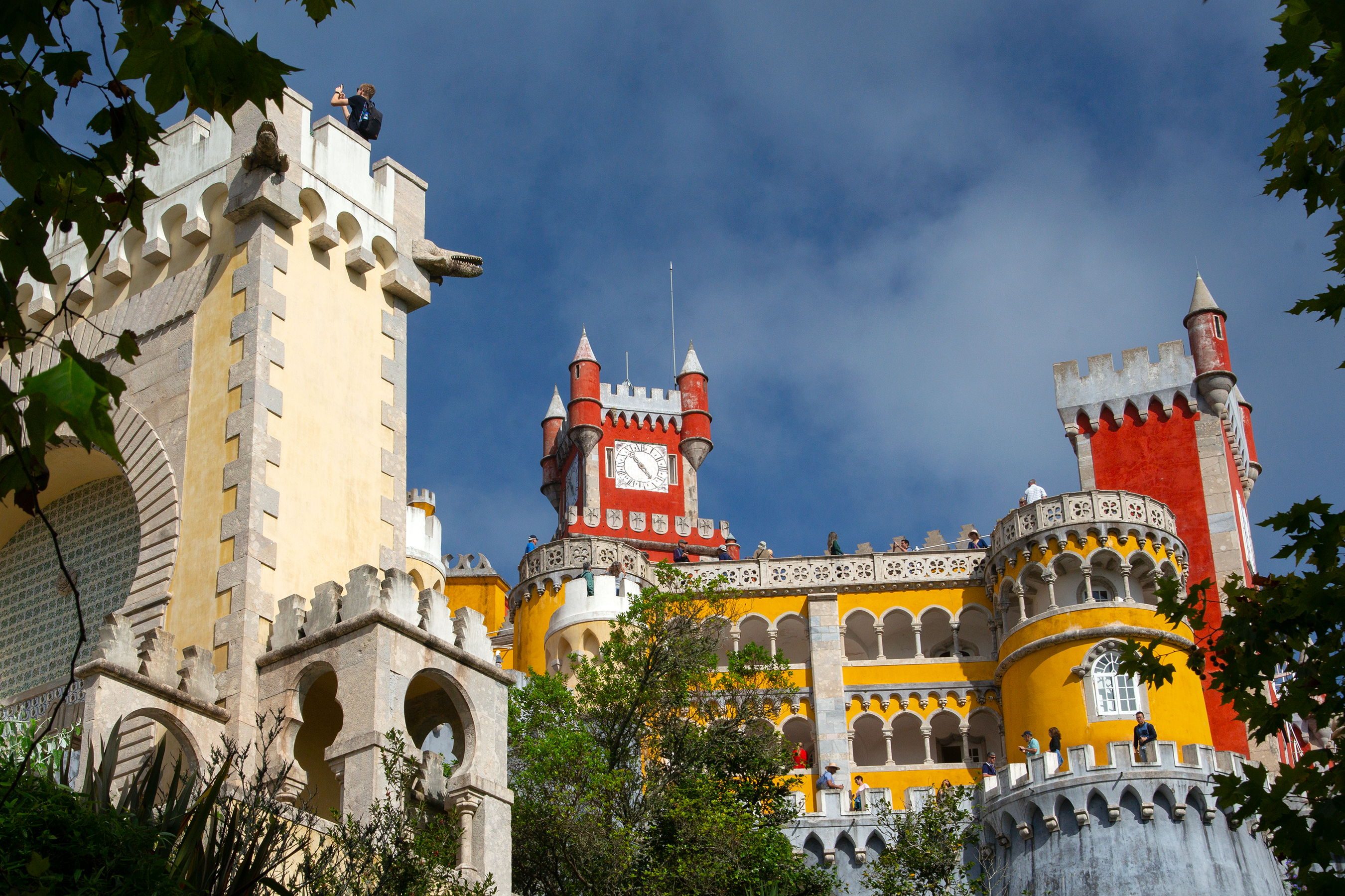
The Pena Palace has a profusion of styles much in accordance with the exotic taste of the Romanticism. The intentional mixture of eclectic styles includes the Neo-Gothic, Neo-Manueline, Neo-Islamic and Neo-Renaissance. Much of this has been evident since major renovations in the 1840s. References to other prominent Portuguese buildings, such as the Belém Tower, are also present.
Almost the entire palace stands on rock in the Sintra Mountains. Structurally, it can be divided in four sections:
- the foundations and its enveloping walls, with two gateways (one of which is protected by a drawbridge)
- the restored structure of the old convent, and the clock tower
- the Arches Yard in front of the chapel, with its wall of Moorish arches
- the palatial zone and its cylindric bastion, with interiors decorated in the cathédrale style.
Convent section and clock tower
As many elements as possible were preserved of the remains of the Hieronymite convent including the cloister, the dining room, the sacristy, and the Manueline-Renaissance chapel. All were embedded in a new section that featured a wide terrace and a clock tower. The Queen's Terrace is perhaps the best spot for obtaining an overall picture of the architecture of the palace. The terrace features a sundial cannon that used to fire every day at noon. The clock tower was completed in 1843.
Interior
The interiors of the Pena Palace were adapted to serve as the Summer residence of the royal family. It has amazing stuccos, painted walls in trompe-l'œil and various revetments in tile from the 19th century, forming part of the numerous royal collections. Palacio Nacional da Pena, Sintra, Portugal, 2019-05-25, DD 133.jpg|The Chapel Palacio Nacional da Pena, Sintra, Portugal, 2019-05-25, DD 134-136 HDR.jpg|The Royal Dining Room Image:Sintra, Palácio Nacional da Pena, Salão Nobre (2).jpg|The Noble Room Palacio Nacional da Pena, Sintra, Portugal, 2019-05-25, DD 153-155 HDR.jpg|The Kitchen
Park

The Pena Park is a vast forested area completely surrounding the Pena Palace, spreading for over 200 hectares of uneven terrain. The park was created at the same time as the palace by King Ferdinand II, who was assisted in the task by the Baron von Eschwege and the Baron von Kessler. The exotic taste of the Romanticism was applied to the park as it was to the palace. The King ordered trees from diverse, distant lands to be planted there. Those included North American sequoia, Lawson's cypress, magnolia and Western redcedar, Chinese ginkgo, Japanese Cryptomeria, and a wide variety of ferns and tree ferns from Australia and New Zealand, concentrated in the Queen's Fern Garden (Feteira da Rainha). The park has a labyrinthic system of paths and narrow roads, connecting the palace to the many points of interest throughout the park, as well as to its two gated exits.
Gallery
Palacio Nacional da Pena, Sintra, Portugal, 2019-05-25, DD 147.jpg|Stained glass window in the great hall, Pena Palace Palacio Nacional da Pena, Sintra, Portugal, 2019-05-25, DD 139.jpg|Detail of a gargoyle Palacio Nacional da Pena, Sintra, Portugal, 2019-05-25, DD 131.jpg|Neo-Manueline facade Palácio da Pena 1.jpg|Pena Palace viewed through the arch of the Seteais Palace Sintra, Palácio Nacional da Pena, relógio de sol (2).jpg|Sundial cannon clock in the Queens's Terrace Sintra, Palácio Nacional da Pena, Pátio dos Arcos (28).jpg|The Arches Yard, chapel and clock tower Courtyard Archway and Baskets, Palacio da Pena.jpg|Yellow courtyard archway with stone baskets Tiled Window, Palácio da Pena.jpg|Moorish tiles surrounding a large arch window Triton and bay window at Palácio Nacional da Pena.jpg|The depiction of a mythological triton, symbolizing the allegory of creation of the world Pena Palace Panorama.jpg|Pena Palace wide view from close to structure
References
References
- Jain, Arpit. (2023-02-21). "Pena Palace Inside: A Journey through Royal Splendor".
This article was imported from Wikipedia and is available under the Creative Commons Attribution-ShareAlike 4.0 License. Content has been adapted to SurfDoc format. Original contributors can be found on the article history page.
Ask Mako anything about Pena Palace — get instant answers, deeper analysis, and related topics.
Research with MakoFree with your Surf account
Create a free account to save articles, ask Mako questions, and organize your research.
Sign up freeThis content may have been generated or modified by AI. CloudSurf Software LLC is not responsible for the accuracy, completeness, or reliability of AI-generated content. Always verify important information from primary sources.
Report