From Surf Wiki (app.surf) — the open knowledge base
Peking duck
Chinese roast duck dish

Chinese roast duck dish
| Field | Value |
|---|---|
| title | Peking duck |
| pic | File:Peking Duck, 2014 (02).jpg |
| piccap | Peking duck carved for show |
| picsize | 300px |
| t | 北京烤鴨 |
| s | 北京烤鸭 |
| l | Beijing roast duck |
| p | Běijīng kǎoyā |
| tp | Běijing kǎo-ya |
| w | |
| bpmf | ㄅㄟˇ ㄐㄧㄥ ㄎㄠˇ ㄧㄚ |
| poj | Pak-kian kho ah |
| j | bak1 ging1 haau1 aap3 |
| mi | |
| ci |
the Chinese cuisine dish
Peking duck is a dish from Beijing that has been prepared since the Imperial era. The meat is characterized by its thin, crispy skin, with authentic versions of the dish serving mostly the skin and little meat, sliced in front of the diners by the cook. Ducks bred especially for the dish are slaughtered after 65 days and seasoned before being roasted in a closed or hung oven. The meat is often eaten with spring onion, cucumber, and sweet bean sauce, with pancakes rolled around the fillings. Aromatic duck is a similar dish to Peking duck and is popular in the United Kingdom and Ireland.
History
Ducks have been roasted in China since the Southern and Northern dynasties.{{cite web |access-date = 10 September 2007}} A variation of roast duck was prepared by the emperor in the Mongol-led Yuan dynasty. The dish, originally named "shāo yāzi" (燒鴨子), was mentioned in the Complete Recipes for Dishes and Beverages (飲膳正要) manual in 1330 by Hu Sihui (忽思慧), an inspector of the imperial kitchen.{{cite web |access-date = 10 September 2007 |archive-url = https://web.archive.org/web/20071113134935/http://big5.xinhuanet.com/gate/big5/news.xinhuanet.com/travel/2004-04/08/content_1407734.htm |archive-date = 13 November 2007 |access-date=10 September 2007 |archive-url=https://web.archive.org/web/20060822125817/http://www.adelaidereview.com.au/_archives.php?subaction=showfull&id=1113527786&archive=1114740592&start_from=&ucat=& |archive-date=22 August 2006 |access-date=10 September 2007 |archive-url=https://web.archive.org/web/20070825133126/http://www.silkroadcn.com/beijing/beijingduck.htm |archive-date=25 August 2007 |access-date = 10 September 2007 |archive-url = https://web.archive.org/web/20081221130455/http://english.qianlong.com/article.jsp?oid=21705469 |archive-date = 21 December 2008
By the Qianlong period (1736–1796) of the Qing dynasty, the popularity of Peking duck spread to the upper classes, inspiring some poets and scholars who enjoyed the dish. For instance, one verse of "Dūmén zhúzhīcí", a local Beijing poem, was "Fill your plates with roast duck and suckling pig".{{cite web |access-date = 10 September 2007}} "Read001""...两绍三烧要满壶,挂炉鸭子与烧猪..."——杨米人《都门竹枝词》{{cite web |access-date = 26 November 2017}}
In 1864, the Quanjude (全聚德) restaurant was established in Beijing. Yang Quanren (楊全仁), the founder of Quanjude, developed the hung oven to roast ducks.
By the mid-20th century, Peking duck had become a national symbol of China, favored by tourists and diplomats alike. For example, Henry Kissinger, the secretary of state of the United States, met Premier Zhou Enlai in the Great Hall of the People on 10 July 1971, during his first (secret) visit to China. After a round of inconclusive talks in the morning, the delegation was served Peking duck for lunch, which became Kissinger's favourite.{{cite web |access-date = 14 September 2007}} The Americans and Chinese issued a joint statement the following day, inviting President Richard Nixon to visit China in 1972. Following Zhou's death in 1976, Kissinger paid another visit to Beijing to savor Peking duck.{{cite web |access-date = 14 September 2007 |archive-url = https://web.archive.org/web/20071013142208/http://quanjude.com.cn/historystory_info.php?auto_id=139 |archive-date = 13 October 2007
Two notable restaurants in Beijing which serve this dish are Quanjude and Bianyifang, both centuries-old establishments which have become household names, each with their own style: Quanjude is known for using the hung oven roasting method, while Bianyifang uses the oldest technique of closed oven roasting.{{cite news|author-last1=Sun|author-first1=Celine|quote=Now the owners of the 148-year-old restaurant plan to diversify into a multi-brand catering service provider that taps both high-end and mass markets.|title = Roast duck restaurant Quanjude looks at multi-brand expansion |work = South China Morning Post |date = 4 February 2013 |url = https://www.scmp.com/business/companies/article/1142803/roast-duck-restaurant-quanjude-looks-multi-brand-expansion |access-date = 23 April 2014}}
Peking duck is one of the representatives of gourmet Chinese food and has become one of the essential experiences for many foreign politicians and tourists.
Preparation
Raising the duck
The ducks used to prepare Peking duck originated in Nanjing. They were large, had black feathers, and lived in the canals that linked the city to major waterways.
With the relocation of the Chinese capital to Beijing, supply barge traffic increased in that area. Often these barges spilled water into side-canals, providing a habitat for the ducks. By the time of adoption of five-spice powder, a new breed of duck had been domesticated by Chinese farmers.
Newly hatched ducks are raised in a free-range environment for the first 45 days of their lives, and force-fed 4 times a day for the next 15–20 days, resulting in ducks that weigh 5 -. |trans-title = The origins of Chinese Roast Duck |script-title=zh:访古探幽:中国烤鸭的由来 |access-date = 12 September 2007 |archive-url=https://web.archive.org/web/20060720234849/http://www.singtaonet.com/health_drinking/heal_sp/t20051231_108968.html|archive-date=2006-07-20 |access-date = 12 September 2007 |archive-date = 1 February 2009 |archive-url = https://web.archive.org/web/20090201062027/http://mypcera.com/meishi/new/dish/beijing/53057.html |url-status = dead
Force-feeding is necessitated by the slow growth rate of ducks as well as the traditional requirements for fat content. It leads to relatively fast growth at the cost of high rates of dead and otherwise unusable ducks (each amounting to about 20%) as well as poor feed conversion. After all, it is unrealistic to expect a duck to swallow 600 g of food daily without issue, given that a duck normally eats 200 g of food per day when left alone. Newer broiler-type Peking duck breeds mature without the need of force-feeding, which reduces animal suffering and frees up human labor: each laborer could raise 500 force-fed ducks or 5,000 non-force-feed ducks.
Two main breeds are available: a fattier breed for those preferring the traditional taste and a leaner breed with large chest muscles for younger palates. The lean type matures in 40 days and reaches 3.2 kg. It has higher feed-conversion compared to the fattier type. As of 2021, at least 95% of ducks used in Beijing needed no force-feeding.
Cooking the duck

Fattened ducks are killed, plucked, eviscerated and rinsed thoroughly with water. Air is pumped under the skin through the neck cavity to separate the skin from the fat. The duck is then blanched in boiling hot water for two to three minutes before it is hung up to dry. This tightens the skin. While it is hung, the duck is glazed with a layer of syrup with honey, and the duck's inside is rinsed once more with water. A second layer of glaze/marinade of soy sauce, five-spice powder, and more maltose is then applied inside and out, and the duck is left to stand for 24 hours in a cool, dry place (or a refrigerator). It is then roasted in an oven until the skin turns shiny brown.
Besides two traditional methods to prepare Peking duck, recipes have been compiled by chefs all around the world to produce the dish at home.
Closed-oven style
Peking duck is traditionally roasted in a closed oven ( mènlú). Bianyifang, a restaurant in Beijing, China, is famous for keeping this tradition. The closed oven is built of brick and fitted with metal griddles (). The oven is preheated by burning Gaoliang sorghum straw () at the base. The duck is placed in the oven immediately after the fire burns out, allowing the meat to be slowly cooked through the convection of heat within the oven. Controlling the fuel and the temperature is the main skill. In closed-oven style, duck meat is combined well with the fat under the skin, and therefore is juicy and tender.
Open-oven style
The open oven () was developed in the imperial kitchens during the Qing dynasty and adopted by the Quanjude restaurant chain. It is designed to roast up to 20 ducks at the same time with an open fire fueled by hardwood from peach or pear trees. The ducks are hung on hooks above the fire and roasted at a temperature of 270 C for 30–40 minutes. While the ducks are roasting, the chef may use a pole to dangle each duck closer to the fire for 30-second intervals. In open-oven style, the fat is usually melted during the cooking process, so the skin is crispy.
Serving
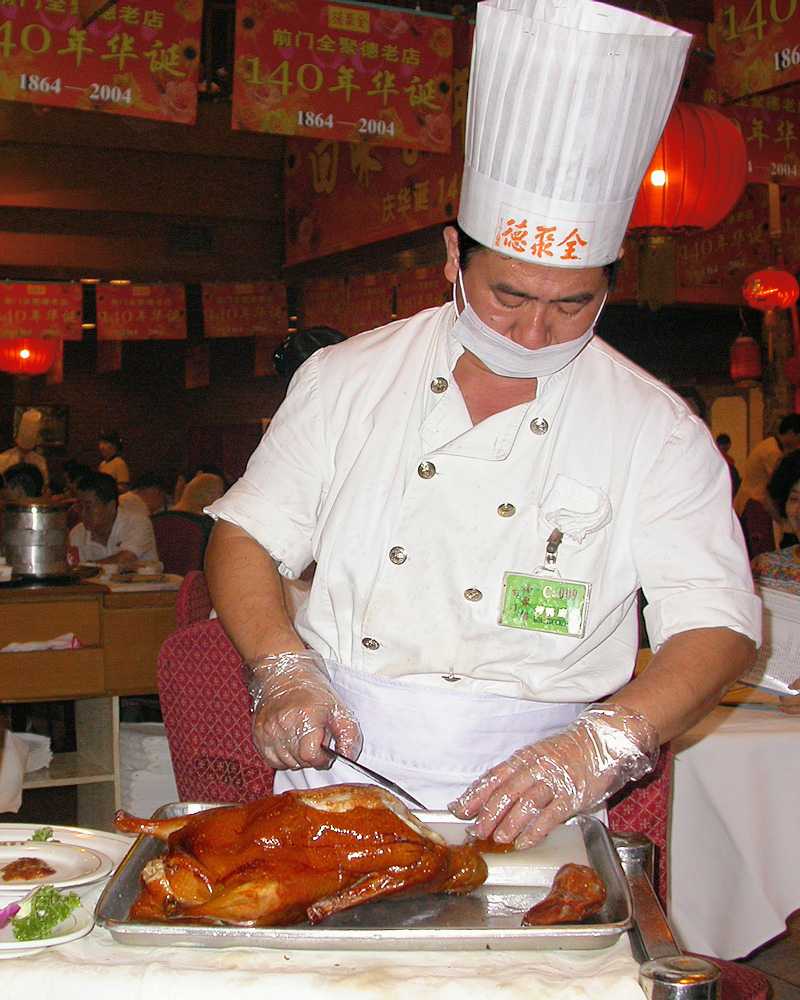
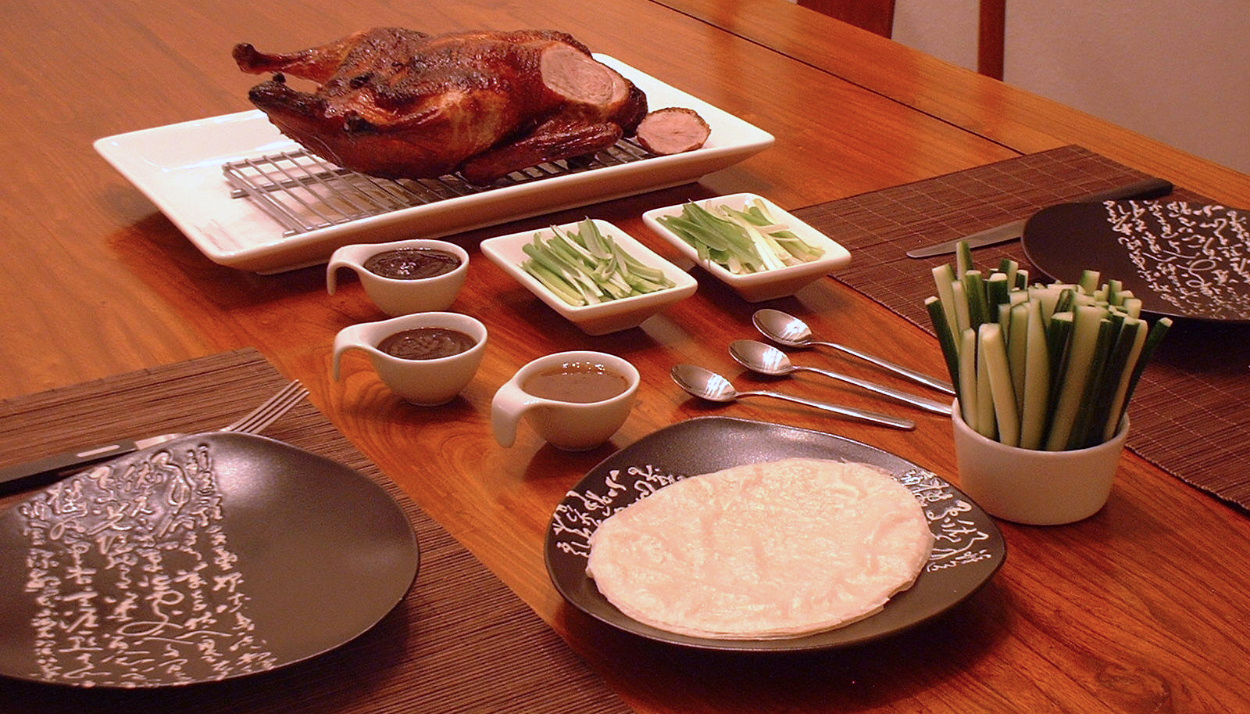
Peking duck is traditionally carved in front of the guests and served in three stages. First, slices of duck skin are served with sugar and sweet bean sauce as a dip. Duck skin is best enjoyed hot and crisp to the bite. The meat is then served with steamed pancakes () and an assortment of vegetable dishes, typically julienned cucumber and spring onion. Traditionally, diners dip slices of duck into the condiments and wrap into the pancake with cucumber and any other ingredients. The wrap is then eaten by hand or with chopsticks. The carved duck (鸭架) – the remainder of the roast duck, with choice cuts removed – can be cooked in three ways. The traditional way is in a broth with ingredients such as Chinese cabbage and soft tofu. The carved duck can also be chopped and stir-fried in sweet bean sauce, or rapidly sautéed and served with salt and pepper (椒鹽). Otherwise, the carved duck is packed to be taken home by the customers.{{cite news |access-date = 17 September 2007}}{{cite web |access-date = 18 September 2007 |archive-url = https://web.archive.org/web/20071112110557/http://news.xinhuanet.com/food/2005-04/27/content_2882835.htm |archive-date = 12 November 2007
Reheating
Whole Peking ducks can be ordered as takeaway. The ducks can be reheated at home with an oven or stovetop. When an oven is used, the duck is heated at a temperature of 150 C for 20 minutes, and then at 160 C for another 10 minutes. The stove method involves submerging the duck in boiling water before placing it on a griddle 70 cm above the cooking fire. The water is replaced every 3–4 minutes until the duck is piping hot. To reheat the Peking duck with oil, the duck is sliced into thin pieces and placed in a strainer held over a wok of hot oil. The duck is then rinsed several times with the oil.
Notable restaurants
A number of restaurants in Beijing specialise in Peking duck. Examples include Quanjude, Bianyifang, Changan Yihao (長安一號), Dayali, Siji Minfu(四季民福), Beijing Xiaowangfu (北京小王府) and Dadong Kaoyadian (大董烤鴨店).{{cite web |access-date = 4 October 2007 |archive-url = https://web.archive.org/web/20071024191036/http://news.xinhuanet.com/food/2004-08/25/content_1879693.htm |archive-date = 24 October 2007 |access-date = 4 October 2007 |url-status = usurped |archive-url = https://web.archive.org/web/20071225044513/http://www.btmbeijing.com/contents/en/business/2006-04/branding/bianyifang |archive-date = 25 December 2007 |access-date = 3 October 2007}}
Duck Chang's Restaurant, established in 1975 in Virginia, United States, was the first Chinese restaurant to prepare and serve Peking duck without a 24-hour advanced notice. In 2018, the James Beard Foundation awarded Sun Wah BBQ in Chicago, Illinois, with their America's Classics award, specifically citing Sun Wah's three-course "Beijing Duck Feast" in their announcement of the award.{{cite news|url= https://www.chicagotribune.com/dining/ct-food-sun-wah-bbq-james-beard-award-20180118-story.html |access-date=24 July 2020}}
Crispy aromatic duck
Crispy aromatic duck (香酥鴨 xiāng sū yā) is a similar dish to Peking duck. It is popular in the United Kingdom,{{cite web |access-date = 5 October 2007 |archive-url = https://web.archive.org/web/20090202091552/http://www.cherryvalley.co.uk/our-company/media-centre/press-releases/savour-the-success-from-aromatic |archive-date = 2 February 2009 |access-date = 1 October 2011 |archive-url = https://web.archive.org/web/20110929121858/http://www.dimsum.co.uk/food/crispy-aromatic-duck-and-other-british-inventions.html |archive-date = 29 September 2011
The duck is first marinated with spices, then steamed until tender, and finally deep fried until crispy.{{cite web |access-date=5 October 2007 |archive-url=https://web.archive.org/web/20070907120526/http://www.bbc.co.uk/food/recipes/database/crispyaromaticduck_4290.shtml |archive-date=7 September 2007 |access-date = 5 October 2007 |archive-date = 22 February 2014 |archive-url = https://web.archive.org/web/20140222022211/http://www.beijingmadeeasy.com/chinese-food/peking-duck
In Germany, some Asian fusion restaurants also serve crispy aromatic duck (Knusprige Ente), sometimes also labeled as Peking duck (Peking-Ente, also Pekingente). The duck is marinated with spices and deep-fried, served together with stir-fried vegetables (Wokgemüse) over fried noodles or with rice.
The traditional way of eating is to have the roasted duck carved into slices by the waiter, separate the duck skin and duck meat, and dip a little duck skin into each slice. Diners often wrap slices of duck meat in pancakes, and add sweet bean sauce, green onions, cucumber strips and other ingredients to make it a unified meal.
Gallery
File:全聚德烤房.JPG| File:Carving up our duck.jpg File:Gastronomia china-Pato a la pekinesa5251.JPG File:Peking Duck 4.jpg File:Peking Duck.jpg File:Accompagnement pour canard laqué.JPG File:Canard laqué pret a etre mangé.JPG File:Peking_Duck,_in_a_restaurant_in_Peking.jpg File:Peking Duck 2.jpg File:Canard laqué.JPG File:Peking duck by Mr Wabu in Beijing.jpg File:Peking duck wrap.jpg
Explanatory notes
References
References
- "Peking duck". [[Encyclopædia Britannica]].
- "A Cultural Classic: Peking Duck". [[Globe Trekker]].
- (5 August 2008). "Beijing gets its ducks in a row for heavenly roast". [[Reuters]].
- (26 June 2013). "Bianyifang serves up new restaurants". [[China Daily]].
- (17 December 2019). "Why is Duck so Special to Chinese Cuisines?".
- (March 18, 2021). "随着品种不断改良 现在95%以上北京烤鸭不再用“填鸭”". The Beijing News.
- Bryant, Simon. "Peking Duck 101". ABC Adelaide.
- (2018). "Current Status of the Beekeeping Industry in China". Springer Singapore.
- (8 July 2021). "Peking duck: the complex history of a Chinese classic".
- "Quanjude Roast Duck". Golden Lawyer.
- (1 June 1970). "Beijing cuisine: Peking Duck Recipe (北京菜: 北京烤鴨)". Social Work Hong Kong.
- [[Liang Shih-chiu. Liang, Shih-Chiu]]. "Roast duck" (烧鸭). in Jiang H. (ed.) ''Liang Shiqiu's Selected Proses'' (2000). Hangzhou:Zhejiang Literary Press. {{ISBN. 7-5339-0562-8
- "Peking Duck Restaurant". pekingduck.com.
This article was imported from Wikipedia and is available under the Creative Commons Attribution-ShareAlike 4.0 License. Content has been adapted to SurfDoc format. Original contributors can be found on the article history page.
Ask Mako anything about Peking duck — get instant answers, deeper analysis, and related topics.
Research with MakoFree with your Surf account
Create a free account to save articles, ask Mako questions, and organize your research.
Sign up freeThis content may have been generated or modified by AI. CloudSurf Software LLC is not responsible for the accuracy, completeness, or reliability of AI-generated content. Always verify important information from primary sources.
Report