From Surf Wiki (app.surf) — the open knowledge base
Peki'in Synagogue
Former synagogue in Peki'in, Israel

Former synagogue in Peki'in, Israel
| Field | Value |
|---|---|
| name | Peki'in Synagogue |
| native_name | |
| image | עץ התות בבית הכנסת העתיק בפקיעין.jpg |
| image_upright | 1.4 |
| caption | Entrance to the former synagogue, with a large mulberry tree, in 2019 |
| religious_affiliation | Judaism (former) |
| festival | |
| organisational_status | Synagogue (1873–2005) |
| consecration_year | 1873 |
| functional_status | Inactive |
| location | Peki'in, Northern District |
| country | Israel |
| map_type | Israel northwest |
| map_size | 250 |
| map_relief | 1 |
| map_caption | Location of the former synagogue in the northwest part of the Northern District |
| coordinates | |
| architecture_type | Synagogue architecture |
| funded_by | Rabbi Rafael Halevy of Beirut |
| year_completed | 1873 |
| date_demolished | |
| dome_quantity | One |
| materials | Stone |
| elevation_m | |
| module |
The Peki’in Synagogue (), is a former Jewish congregation and synagogue located in the centre of Peki'in, in the Northern District of Israel. The current building was erected in 1873, on the site of older ones. The site is also said to be where Rabbi Joshua ben Hananiah established his beth midrash in antiquity.
The synagogue, not usually active as of 2005, is kept by Margalit Zinati (born 1931). Zinati is a member of a Jewish family who have lived for centuries in Peki'in, reportedly since the time of the Second Temple. Zinati, the last Jewish woman in Peki'in, was honoured for her work on the 70th Independence Day in 2018, and her family home is run as a heritage site by the Education Department of the World Zionist Organization (WZO).
History
Establishment
The current structure dates from 1873, according to a commemorative plaque. This structure replaced an earlier one destroyed by an earthquake roughly three decades prior. Funding for the construction, attested to on a plaque commemorating the donation, was given by Rabbi Rafael Halevy from Beirut, possibly allowing for its completion in Nissan 30 of the year Tarlag (according to the Hebrew calendar), equivalent to April 27, 1873. It was a tall, white bricked, domed building against a blue sky.
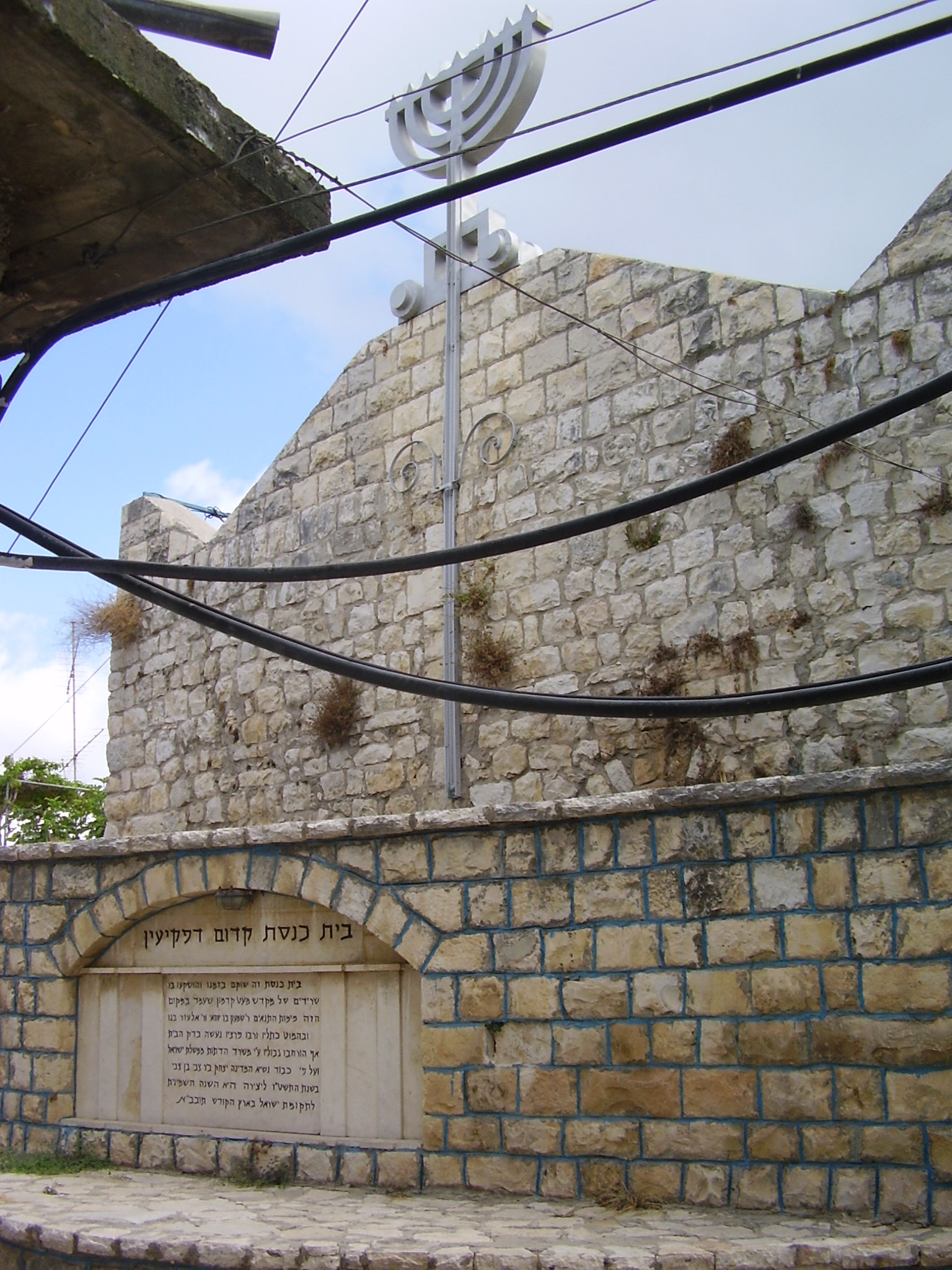
According to local tradition, the synagogue was built on the site of the beth midrash (religious school) where Rabbi Joshua ben Hananiah taught before the Bar Kokhba revolt, and Rabbi Shimon bar Yochai after it. Scholars, however, disagree on whether the cave and town known from the life story of Shimon bar Yochai can be identified with modern Peki'in.
Local elders told Ben Zvi that the present structure differs from its predecessor; the original synagogue featured a wood ceiling, whereas the current one is topped by a stone dome.
Later history
In 1921/22, Yitzhak Ben-Zvi reported that prayers were held in the synagogue on Shabbat and holidays. The synagogue housed seven kosher Torah scrolls and four that were pasul. It also functioned as a school for children.
In 1955, the Israeli Ministry of Religious Affairs renovated the building at the request of by Ben-Zvi, who was then President of Israel. The Second Series of the Israeli new shekel (NIS), put in circulation in 1999 and phased out in the 2010s, features on the 100 NIS banknote a portrait of Ben-Zvi (front), and the Peki'in synagogue along with a view of the village (back).
Archaeological findings
Carved stones from ancient synagogue
In 1926 and 1930 two old stone tablets were uncovered, reused in the walls of the modern synagogue. One depicts a menorah flanked by a lulav, etrog, shofar, and incense shovel. The second one, of higher craftsmanship, depicts a Torah shrine. A third stone contains a fragmentary relief of a grapevine, found in secondary use in a modern village house. All three have been dated between the late 2nd century CE and the early 3rd. It has been suggested that the second stone may have come from another, now disappeared Galilean synagogue from Khirbet Tiriya or Tiriha. Further decorated stones believed to originate from an ancient synagogue were reused in modern buildings in Peki'in. The 2nd-3rd century date for the main three decorated stones is based on a publication by Eliezer Sukenik from 1931 and a gazetteer by from 1977.
Ancient inscriptions
In February 2017, the Council for Conservation of Heritage Sites in Israel uncovered an 1,800-year-old limestone capital. Engraved on it are two Hebrew inscriptions dating to the Roman period. The column was found upside down in the building's courtyard. According to the IAA's regional inspector, "A preliminary analysis of the engravings suggests that these are dedicatory inscriptions honoring donors to the synagogue." Uriel Rosenboym, director of Beit Zinati (the WZO Jewish heritage site), exclaimed that "No one can argue with the written artifact. There was an ancient synagogue here and the synagogue was built in its current form in recent centuries."
Gallery
Israël_-_Peki'in._Het_dorp_Peki'in_in_Opper_Galilea._255-3763.jpg|The Peki'in synagogue in 1963 100 NIS Bill Obverse & Reverse.jpg|100 NIS banknote, printed from 1999 until 2017. The verso (on the left) shows the synagogue and a view of the Peki'in village. Pekiin tablet.jpg|Stone tablet found at the synagogue
References
References
- Ben-Zvi, Itzhak. (1967). "שאר ישוב: מאמרים ופרקים בדברי ימי הישוב העברי בא"י ובחקר המולדת". none.
- "Cities: Peki'in (Buke'a)". Israel Ministry of Tourism.
- (2018). "Event in honor of Ms. Margalit Zinati". WZO Education Department.
- (2024-01-22). "ה'תרל"ג". ויקיפדיה.
- Ben-Zvi, Itzhak. (1967). "שאר ישוב: מאמרים ופרקים בדברי ימי הישוב העברי בא"י ובחקר המולדת". none.
- Schuster, Ruth. (22 February 2017). "1,800-year-old Hebrew Donor Plaques Found in Synagogue in Northern Israel". Haaretz.
- Eli Ashkenazi. (25 July 2012). "Researchers race to document vanishing Jewish heritage of Galilee Druze village". Haaretz.
- "Second Series of the New Sheqel: NIS 100". [[Bank of Israel]].
- Chiat, Marilyn Joyce Segal. (1982). "Handbook of Synagogue Architecture". Scholars Press.
- "Israel Antiquities Authority".
- "1,800-year-old Hebrew stone inscriptions found in ancient Galilee synagogue". The Jerusalem Post.
This article was imported from Wikipedia and is available under the Creative Commons Attribution-ShareAlike 4.0 License. Content has been adapted to SurfDoc format. Original contributors can be found on the article history page.
Ask Mako anything about Peki'in Synagogue — get instant answers, deeper analysis, and related topics.
Research with MakoFree with your Surf account
Create a free account to save articles, ask Mako questions, and organize your research.
Sign up freeThis content may have been generated or modified by AI. CloudSurf Software LLC is not responsible for the accuracy, completeness, or reliability of AI-generated content. Always verify important information from primary sources.
Report