From Surf Wiki (app.surf) — the open knowledge base
Peine forte et dure
Legal method of coercion, using torture
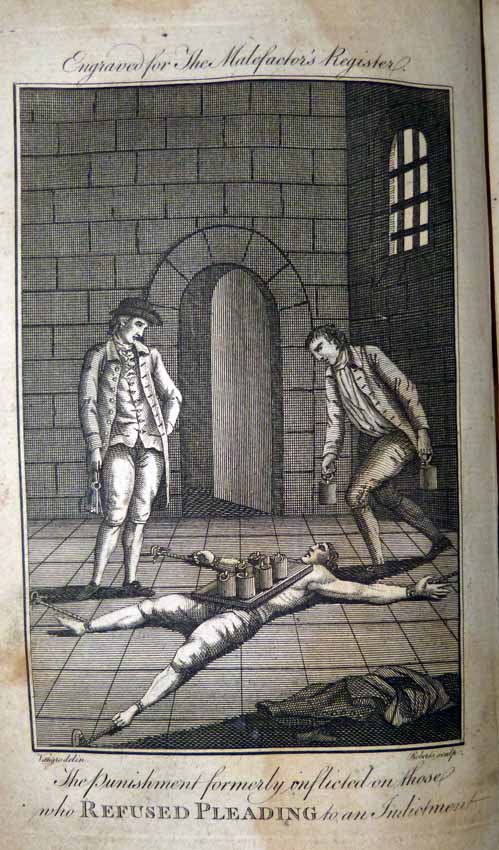
Legal method of coercion, using torture
Peine forte et dure (Law French for "hard and forceful punishment") was a method of torture formerly used in the common law legal system, in which a defendant who refused to plead ("stood mute") would be subjected to having heavier and heavier stones placed upon their chest until a plea was entered, or death resulted.
Many defendants charged with capital offences would refuse to plead in order to avoid forfeiture of property. If the defendant pleaded either guilty or not guilty and was executed, their heirs would inherit nothing, their property escheating to the state. If they refused to plead their heirs would inherit their estate, even if they died in the process.
Legal background
At the beginning of the thirteenth century, criminal cases in England could be tried either by ordeal or by judicial combat. Priests were involved in trials by ordeal, e.g. in heating the iron which the accused had to hold (and possibly letting it cool before the accused had to seize it). In 1215 the Fourth Lateran Council forbade clergy from participating in ordeals. The problem which this created for the legal system was solved by allowing the accused to submit to trial by jury as an alternative to trial by battle (which was not available for women or those accused by the community). But as trial by combat remained a (theoretical) option, the accused could not be forced into a jury trial; he had to submit to it voluntarily by entering a plea seeking judgment from the court; otherwise he was remanded back to prison.
Obviously, a criminal justice system that could punish only those who had volunteered for possible punishment was unworkable; a means was needed to coerce them into entering a plea. Alternatively, individuals were frequently tried under Admiralty law, as observed by Henry de Bracton.
The "Standing Mute Act 1275" (3 Edw. 1 c. 12; unofficial short title derived from its subject matter as listed by the Chronological Table of the Statutes), part of the 1275 Statute of Westminster passed by Edward I, sought to resolve this problem:
The words of the statute – prison forte et dure – meant a harsh regime and a meagre diet:
By the 1300s the words of the statute had been corrupted to peine forte et dure. This took the form of "pressing" the accused with weights. The procedure was recorded by a 15th-century witness as follows:
"Pressing to death" might take several days, and not necessarily with a continued increase in the load. The Frenchman Guy Miege, who from 1668 taught languages in London, wrote the following about the English practice:
Peine forte et dure was abolished in the Kingdom of Great Britain in 1772 by the Felony and Piracy Act 1772, with the last known actual use of the practice having been in 1741. From 1772 refusing to plead was deemed to be equivalent to pleading guilty, but this was changed in 1827 by the Criminal Law Act 1827 to being deemed a plea of not guilty – which is now the case in all common law jurisdictions.
Cases
The most infamous case in England was that of Roman Catholic martyr St Margaret Clitherow, who (in order to avoid a trial in which her own children would be obliged to give evidence and could be tortured) was pressed to death on 25 March 1586, after refusing to plead to the charge of having harboured Catholic priests in her house. She died together with her unborn child within fifteen minutes under a weight of at least 7 long cwt. Several hardened criminals yielded to the torture: William Spiggot (1721) remained mute for about half an hour under 350 lb, but pleaded to the indictment when an extra 50 lb were added; Edward Burnworth (1726) pleaded after an hour and three minutes at 422 lb. Others, such as Major Strangways (1658) and John Weekes (1731), refused to plead, even under 400 lb, and were killed when bystanders, out of mercy, sat on them.
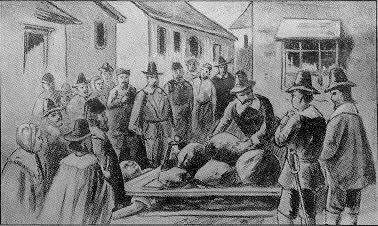
In America, Giles Corey was pressed to death between 17 and 19 September 1692, during the Salem witch trials, after he refused to enter a plea in the judicial proceeding. According to legend, his last words as he was being crushed were "More weight", and he was thought to have been killed as the weight was applied. This is referred to in Arthur Miller's political drama The Crucible, where Giles Corey is pressed to death after refusing to plead "aye or nay" to the charge of witchcraft. In the film version of this play, the screenplay of which was also by Miller, Corey is crushed to death for refusing to reveal the name of a source of information.
References
References
- Baker, John H.. (1990). "An Introduction to English Legal History". Butterworths.
- (1990). "An Introduction to English Legal History". Butterworth.
- Blackstone, William. (1769). "[[Commentaries on the Laws of England]]".
- de Bracton, Henry. (May 2024). ["On the Laws and Customs of England"](https://amesfoundation.law.harvard.edu/Bracton/ }}{{Failed verification).
- (1878). "Chronological Table and Index of the Statutes". [[Eyre & Spottiswoode]].
- Marks, Alfred. (1908). "Tyburn Tree: Its History and Annals".
- Baker, John H.. (1990). "An Introduction to English Legal History". Butterworths.
- (1851). "Curiosities of Cowell's 'Interpreter'".
- (19 September 2023). "The enterprising and tenacious Guy Miège: four dictionaries from 1677 to 1688".
- Miege, G.. (1715). "The present state of Great-Britain and Ireland". J. H. (Humphreys?), A. Bell, R. Smith, and J. Round.
- [https://en.wikisource.org/wiki/Felony_and_Piracy_Act_1772 Felony and Piracy Act 1772] – via Wikisource.
- "Drugs, Crime and Social Policy". Allyn and Bacon.
- "Mackenzie, The Practise of Peine Forte et Dure in 16th and 17th Century England".
This article was imported from Wikipedia and is available under the Creative Commons Attribution-ShareAlike 4.0 License. Content has been adapted to SurfDoc format. Original contributors can be found on the article history page.
Ask Mako anything about Peine forte et dure — get instant answers, deeper analysis, and related topics.
Research with MakoFree with your Surf account
Create a free account to save articles, ask Mako questions, and organize your research.
Sign up freeThis content may have been generated or modified by AI. CloudSurf Software LLC is not responsible for the accuracy, completeness, or reliability of AI-generated content. Always verify important information from primary sources.
Report