From Surf Wiki (app.surf) — the open knowledge base
Peeblesshire
.jpg)
| Field | Value | ||||
|---|---|---|---|---|---|
| name | Peeblesshire | ||||
| native_name_lang | |||||
| settlement_type | Historic county | ||||
| image_skyline | {{multiple image | border=infobox | total_width=260 | image_style=border:1; | perrow=1/3/3/2 |
| image1 | Tweed Bridge, Peebles.jpg | ||||
| caption1 | The Tweed Bridge and Peebles Old Parish Church | ||||
| image2 | Above Winter View.jpg | ||||
| caption2 | Great Polish Map of Scotland | ||||
| image3 | Traquair House courtyard with warrior.jpg | ||||
| caption3 | Traquair House | ||||
| image4 | Old Toll House and St Andrew's Church, West Linton - geograph.org.uk - 6011316.jpg | ||||
| caption4 | West Linton | ||||
| image5 | Entering Innerleithen - geograph.org.uk - 1150302.jpg | ||||
| caption5 | Innerleithen | ||||
| flag_size | 150px | ||||
| flag_link | Flag of Peeblesshire | ||||
| image_map | File:Peeblesshire-Scotland.svg | ||||
| subdivision_type | Country | ||||
| subdivision_name | Scotland | ||||
| seat_type | County town | ||||
| seat | Peebles | ||||
| unit_pref | UK | ||||
| area_total_sq_mi | 548 | ||||
| area_total_km2 | 548 sqmi | ||||
| area_note | Ranked 16th of 34 | ||||
| population_density_km2 | auto | ||||
| postal_code_type | Chapman code | ||||
| postal_code | PEE | ||||
| website |
Peeblesshire (), alternately the County of Peebles or Tweeddale, is a historic county of Scotland. Its county town is Peebles, and it borders Midlothian to the north, Selkirkshire to the east, Dumfriesshire to the south, and Lanarkshire to the west.
History
The origins of Peeblesshire are obscure, but it became a shire sometime around the twelfth century, covering part of the historic district or province of Tweeddale. The southern part of Tweeddale became the sheriffdom of Selkirkshire, also known as Ettrick Forest, whilst the northern part of Tweeddale was initially divided into two sheriffdoms, based at Peebles and Traquair, before those two were united as the single shire of Peebles, or Peeblesshire, around 1304. From then on the shires gradually became the more important areas for administration; the old provinces were not abolished as such, but their importance diminished.
Peeblesshire County Council was created in 1890 under the Local Government (Scotland) Act 1889, which established elected county councils across Scotland. The council held its first meeting on 22 May 1890 at the courthouse on High Street in Peebles, also known as County Hall, which had been built in 1844–1848 as a sheriff court and meeting place for the Commissioners of Supply, the main administrative body for the county prior to the creation of the county council.

The county council continued to be based at the courthouse until 1935 when it moved to County Buildings on Rosetta Road in Peebles.
Peeblesshire County Council was abolished in 1975 under the Local Government (Scotland) Act 1973, which reorganised local government in Scotland into upper-tier regions and lower-tier districts. Peeblesshire became part of the Borders region and Tweeddale district, the latter having the same boundaries as the pre-1975 county of Peeblesshire. The last lord-lieutenant for the county of Peeblesshire became the first Lord Lieutenant of Tweeddale.
The Borders region and its four districts, including Tweeddale, were abolished in 1996, merging to form the present Scottish Borders council area. The area of the pre-1996 Tweeddale district (and therefore the same area as pre-1975 Peeblesshire) continues to be used as a lieutenancy area under the name of Tweeddale.
Coat of arms
The coat of arms of the county, which was matriculated by the Lord Lyon in 1931, ia as follows: Quarterly, 1st sable five fraises (strawberry leaves) argent; 2nd azure, a horse's head couped argent; 3rd vert, a fleece or; 4th or, fretty gules, on a chief embattled of the last, two thunderbolts of the first. The arms are supported by two salmon proper, and the crest is a Border cavalryman. The motto is ONWARD TWEEDDALE. The first quarter is the arms of Fraser of Oliver Castle, a prominent local laird; the second, that of Horsburgh, another prominent local laird; the third, a reference to the area's wool industry; and the fourth, that of M. G. (later Sir Michael) Thorburn of Glenormiston, who was sheriff of Peebles at the time of the arms' matriculation.
Geography
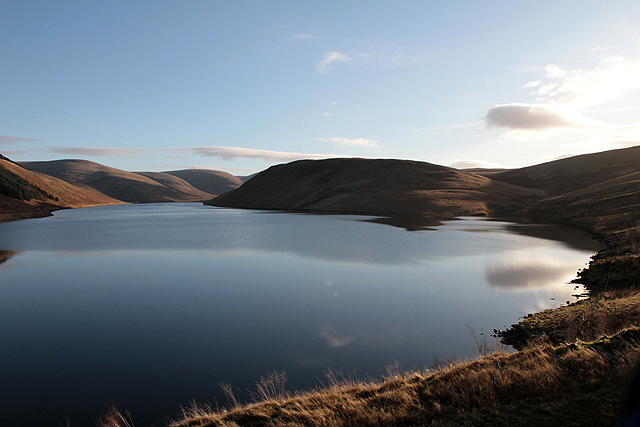

The county is landlocked and forms part of the Southern Uplands geographic region of Scotland. There are few settlements and the county consists mostly of low hill country, including parts of the Pentland Hills and Moorfoot Hills, with the highest point being Broad Law at 840 m (2,760 ft). The river Tweed is the chief river, flowing in a crescent shape through the county. Bodies of water in Peeblesshire include the Baddinsgill Reservoir, West Water Reservoir and Portmore Loch in the north and the Megget Reservoir, Talla Reservoir and Fruid Reservoir in the south.
Transport

The county was formerly served by the Peebles Railway and the Symington, Biggar and Broughton Railway, however these lines closed in the 1950s-60s and there are now no active railways in the county.
Settlements
- Blyth Bridge
- Broughton
- Cardrona
- Carlops
- Drumelzier
- Eddleston
- Innerleithen
- Kilbucho
- Kingledoors
- Kirkbryde
- Lyne
- Mossfennan
- Peebles
- Polmood
- Romannobridge
- Skirling
- Stanhope
- Traquair
- Tweedsmuir
- Walkerburn
- West Linton
Civil parishes

- Broughton, Glenholm and Kilbucho (union of Broughton, Glenholm and Kilbucho in 1794)
- Drumelzier
- Eddleston
- Innerleithen
- Kirkurd
- Linton or West Linton
- Lyne (formerly Lyne and Megget; Megget, an ancient parish which was united to Lyne in 1621, was transferred to the Selkirkshire parish of Yarrow in 1891)
- Manor
- Newlands
- Peebles
- Skirling
- Stobo
- Traquair
- Tweedsmuir (separated from Drumelzier in 1643) The parish of Kailzie existed until 1674, when it was suppressed, parts going to Innerleithen and parts going to Traquair.
Community councils
Community councils:
- Carlops
- Eddleston
- Innerleithen and District
- Lamancha, Newlands and Kirkurd
- Manor, Stobo and Lyne
- Royal Burgh of Peebles and District
- Skirling
- Tweedsmuir
- Upper Tweed
- Walkerburn
- West Linton
Gallery
File:Stobo Castle, Scottish Borders.JPG|Stobo Castle File:Blyth Bridge.jpg|Blyth Bridge File:Kilbucho Church.jpg|Ruins of Kilbucho Church File:Barony Castle Hotel, Eddleston near Peebles, Scotland.JPG|Barony Castle in Eddleston, which contains the Great Polish Map of Scotland File:Entrance to Neidpath Castle - geograph.org.uk - 778154.jpg|Neidpath Castle in Peebles
References
References
- "Genuki - Peeblesshire".
- (1864). "A History of Peeblesshire". William and Robert Chalmers.
- "Scottish Counties and Parishes: their history and boundaries on maps".
- (24 May 1890). "Peebles County Council". Peeblesshire Advertiser.
- {{Historic Environment Scotland
- {{Historic Environment Scotland
- "Part II: 1900 - 1950 History of Peebles".
- {{cite legislation UK. (1973)
- {{cite legislation UK. (1975)
- {{cite legislation UK. (1994)
- {{cite legislation UK. (1996)
- Urquhart, R.M.. "Scottish Burgh and County Heraldry". Heraldry Today.
- "The Imperial gazetteer of Scotland; or, Dictionary of Scottish topography".
- "Broughton".
- GENUKI. "Genuki: Tweedsmuir (parish), Peebles-shire".
- "Kailzie".
- Scottish Borders Council: Scheme for the Establishment of Community Councils (under Local Government etc. (Scotland) Act 1994) www.scotborders.gov.uk/info/20015/your_council/643/community_councils retrieved June 2016
This article was imported from Wikipedia and is available under the Creative Commons Attribution-ShareAlike 4.0 License. Content has been adapted to SurfDoc format. Original contributors can be found on the article history page.
Ask Mako anything about Peeblesshire — get instant answers, deeper analysis, and related topics.
Research with MakoFree with your Surf account
Create a free account to save articles, ask Mako questions, and organize your research.
Sign up freeThis content may have been generated or modified by AI. CloudSurf Software LLC is not responsible for the accuracy, completeness, or reliability of AI-generated content. Always verify important information from primary sources.
Report