From Surf Wiki (app.surf) — the open knowledge base
Peanut oil
Vegetable oil derived from peanuts
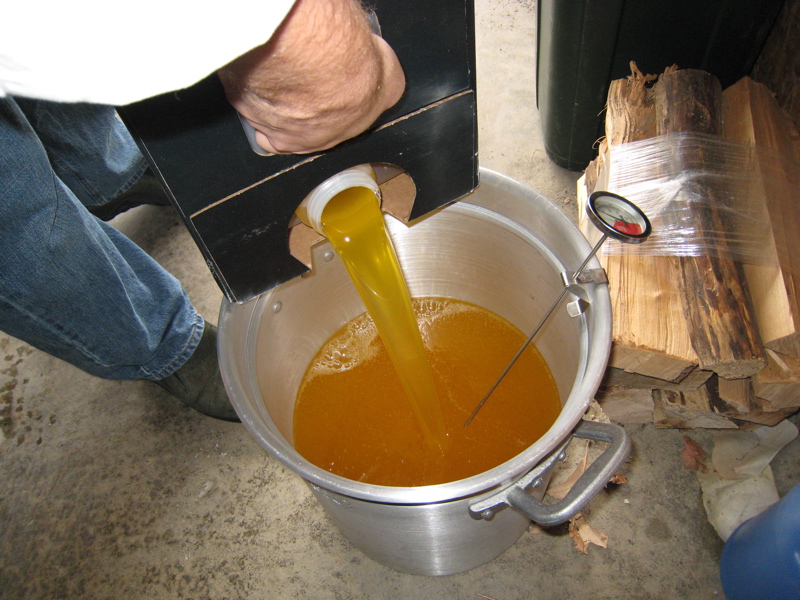
Vegetable oil derived from peanuts
Peanut oil, also known as groundnut oil or arachis oil, is a vegetable oil derived from peanuts. The oil usually has a mild or neutral flavor but, if made with roasted peanuts, has a stronger peanut flavor and aroma. It is often used in American, Chinese, Indian, African and Southeast Asian cuisine, both for general cooking and in the case of roasted oil, for added flavor. Peanut oil has a high smoke point relative to many other cooking oils, so it is commonly used for frying foods.
History
| World | 4.75 |
|---|
Due to war shortages of other oils, the use of readily available peanut oil increased in the United States during World War II.
Production
In 2021, world production of peanut oil (reported as groundnut oil) was 4.75 million tonnes, led by China with 39% of the total (table). India was a major secondary producer.
Uses
Unrefined peanut oil is used as a flavorant for dishes akin to sesame oil. Refined peanut oil is commonly used for frying volume batches of foods like French fries and has a smoke point of 450 °F/232 °C.
Unrefined peanut oil is commonly used for cooking due to its natural flavor and nutritional benefits. It's also used in skincare products for its moisturizing properties.
Unrefined peanut oil is often used in salad dressings and marinades for its rich, nutty taste.
Biodiesel
At the 1900 Paris Exhibition, the Otto Company, at the request of the French Government, demonstrated that peanut oil could be used as a source of fuel for the diesel engine; this was one of the earliest demonstrations of biodiesel technology.
Crude peanut oil can be filtered and placed in a reaction tank with methanol and sodium hydroxide to yield methyl ester - the Biodiesel fuel.
Other uses
Peanut oil, as with other vegetable oils, can be used to make soap by the process of saponification. Peanut oil is safe for use as a massage oil.
Composition
The oil is 93% fat, composed of oleic acid, a monounsaturated fat (57% of total), linoleic acid, a polyunsaturated fat (20%), and palmitic acid, a saturated fat (16%).
Nutritional content
In a reference amount of 100 g, peanut oil is a rich source of vitamin E, providing 101% of the Daily Value (table). There is no protein or carbohydrate content, and no other micronutrients in significant amounts (table).
Health issues
Toxins
If quality control is neglected, peanuts that contain the mold that produces highly toxic aflatoxin can end up contaminating the oil derived from them.
Allergens
Those allergic to peanuts can consume highly refined peanut oil, but should avoid first-press, organic oil. Most highly refined peanut oils remove the peanut allergens and have been shown to be safe for "the vast majority of peanut-allergic individuals". However, cold-pressed peanut oils may not remove the allergens and thus could be highly dangerous to people with peanut allergy.
Since the degree of processing for any particular product is often unclear, many believe that "avoidance is prudent".
References
References
- "Peanut Oil - Uses, Health Benefits & Nutrition".
- (2011). "Changes in Volatile Compounds of Peanut Oil during the Roasting Process for Production of Aromatic Roasted Peanut Oil". Journal of Food Science.
- "USA-Grown Peanut Sources - Peanut Oil". National Peanut Board.
- "What Does Smoke Point Mean?".
- (2024). "Production of peanut oil in 2021; Pick lists by Crops/Regions/Production Quantity/Year". United Nations, [[Food and Agriculture Organization Corporate Statistical Database]].
- [https://books.google.com/books?id=ngwEAAAAMBAJ&dq=%22peanut+oil%22&pg=PT70 "The Peanut Situation" (Dec 12, 1942) ''The Billboard'']
- [https://www.thespruce.com/smoking-points-of-fats-and-oils-1328753 The Smoke Point of Fats & Oils] {{Webarchive. link. (26 February 2018 - TheSpruce.com)
- (2010). "Peanut Biodiesel". Boiled Peanut World.
- [http://www.soap-making-resource.com/saponification-table.html "Saponification Table Plus The Characteristics of Oils in Soap", Soap Making Resource]
- (28 April 2021). "Peanut oil per 100 grams". FoodData Central, [[Agricultural Research Service]], [[United States Department of Agriculture]].
- (29 December 2011). "Aflatoxin suspected in cooking oil". United Press International.
- [https://web.archive.org/web/20170918012143/https://www.foodallergy.org/common-allergens/peanut Common Allergens - Peanut] FARE (FoodAllergy.org)
- "Peanut Oil".
- (2000). "Allergenicity of refined vegetable oils". [[Food and Chemical Toxicology]].
- (1997). "Randomised, double blind, crossover challenge study of allergenicity of peanut oils in subjects allergic to peanuts". BMJ.
- "Peanut Allergy". [[Food Allergy Initiative]].
- Carlson, Margaret. (13 January 2012). "Deaths Show Schools Need Power of the EpiPen: Margaret Carlson". Bloomberg.
This article was imported from Wikipedia and is available under the Creative Commons Attribution-ShareAlike 4.0 License. Content has been adapted to SurfDoc format. Original contributors can be found on the article history page.
Ask Mako anything about Peanut oil — get instant answers, deeper analysis, and related topics.
Research with MakoFree with your Surf account
Create a free account to save articles, ask Mako questions, and organize your research.
Sign up freeThis content may have been generated or modified by AI. CloudSurf Software LLC is not responsible for the accuracy, completeness, or reliability of AI-generated content. Always verify important information from primary sources.
Report