From Surf Wiki (app.surf) — the open knowledge base
Paulownia tomentosa
Species of deciduous tree classified in its own family
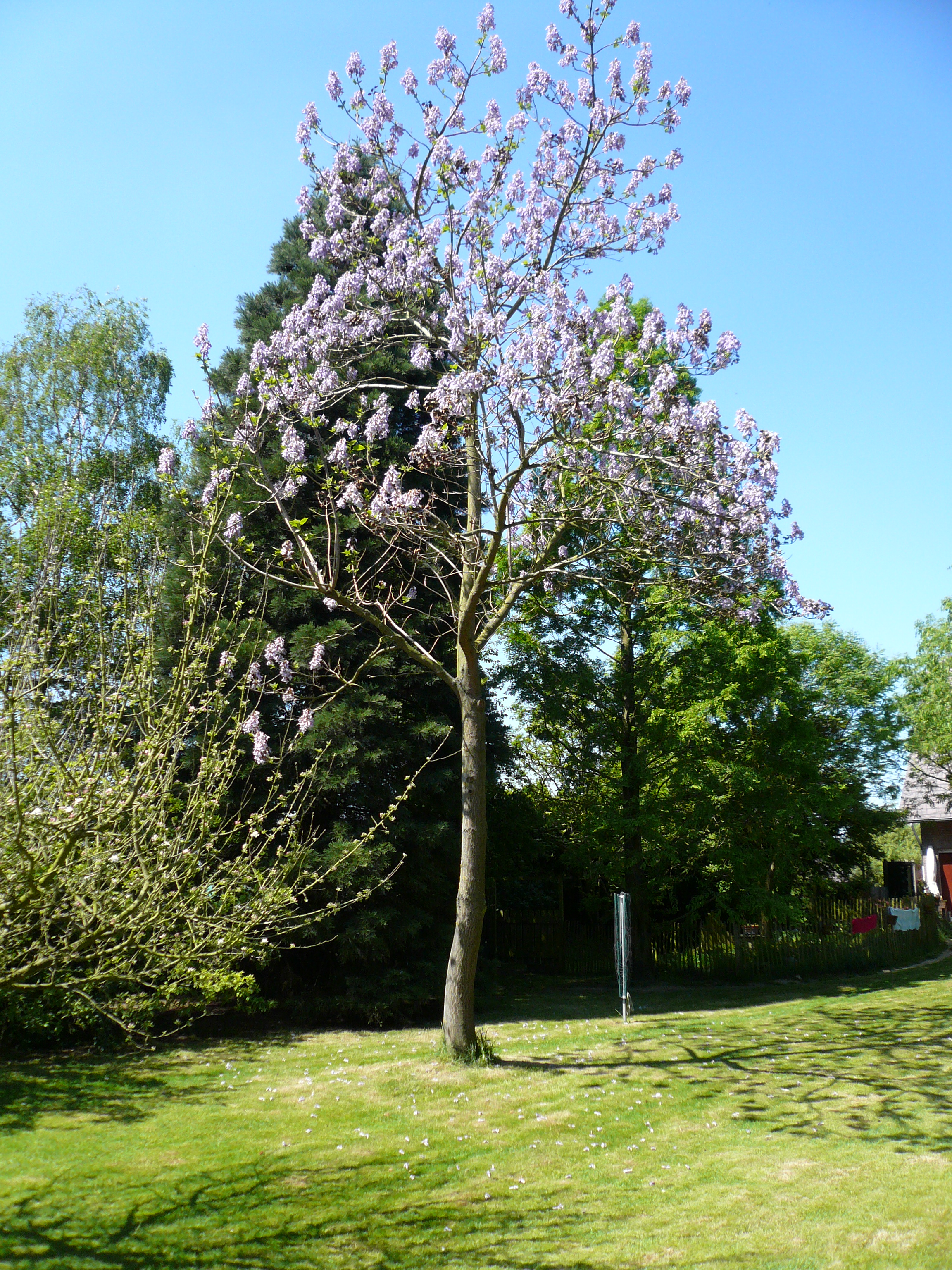
Species of deciduous tree classified in its own family
Paulownia tomentosa, common names princess tree, empress tree, or foxglove-tree, is a deciduous hardwood tree in the family Paulowniaceae, native to central and eastern China and the Korean Peninsula. even though it might be able to successfully get established through seeds only under ideal conditions. P. tomentosa has also been introduced to Western and Central Europe, and is establishing itself as a naturalised species there as well.
Etymology
The generic name Paulownia honours Anna Pavlovna of Russia, who was Queen Consort of the Netherlands from 1840 to 1849. The specific epithet tomentosa is a Latin word meaning 'covered in hairs'.
Description

This tree grows 10 - tall, with large heart-shaped to five-lobed leaves 15 - across, arranged in opposite pairs on the stem. On young growth, the leaves may be in whorls of three and be much bigger than the leaves on more mature growth. The leaves on stump shoots can achieve remarkable size; leaves 98 cm wide and almost as long have been reported. The leaves can be mistaken for those of the catalpa.
The very fragrant flowers, large and violet-blue in colour are produced before the leaves in early spring, on panicles 10–30 cm long, with a tubular purple corolla 4–6 cm long resembling a foxglove flower. The fruit is a dry egg-shaped capsule 3–4 cm long, containing numerous tiny seeds. The seeds are winged and disperse by wind and water. Pollarded trees do not produce flowers, as these form only on mature wood.
Paulownia tomentosa requires full sun for proper growth. It is tolerant of pollution and can tolerate many soil types. It can also grow from small cracks in pavements and walls. Paulownia can survive wildfires because the roots can regenerate new, very fast-growing stems.
P. tomentosa is drought-resistant and thrives in barren soil, particularly suitable for cold and arid regions. Its main trunk is short, and its growth rate is relatively slow after it reaches maturity.
Range
Native range
P. tomentosa is native to much of central and eastern China

Introduced range
Europe
In August 2021 the EPPO added P. tomentosa to its Alert List, not due to any particular known problem within Europe, but as a step to begin assessing whether it should be regarded as a problematic invader.
- Austria, Belgium, Poland, Czech Republic, France (including Corsica), Germany, Hungary, Italy (including Sardinia and Sicily), Slovenia, Switzerland, United Kingdom
Africa
- South Africa
North America
United States
- Alabama, Arkansas, Connecticut, Delaware, Florida, Georgia, Hawaii, Kentucky, Louisiana, Maryland, Massachusetts, Minnesota, Mississippi, Missouri, New Jersey, New York, North Carolina, Ohio, Oklahoma, Oregon, Pennsylvania, South Carolina, Tennessee, Texas, Virginia, Washington, West Virginia
Oceania
- New Zealand
Asian introduced range
- Japan
Uses
Paulownia tomentosa is cultivated as an ornamental tree in parks and gardens. It has gained the Royal Horticultural Society's Award of Garden Merit.{{cite web
Because of its tolerance and flexibility, Paulownia functions ecologically as a pioneer plant. Its nitrogen-rich leaves provide good fodder and its roots prevent soil erosion. Eventually, Paulownia is succeeded by taller trees that shade it and in whose shade it cannot thrive.
The characteristic large size of the young growth is exploited by gardeners: by pollarding the tree and ensuring there is vigorous new growth every year, massive leaves are produced (up to 60 cm across). These are popular in the modern style of gardening which uses large-foliaged and "architectural" plants.
The soft, lightweight seeds were commonly used as a packing material by Chinese porcelain exporters in the 19th century, before the development of polystyrene packaging. Packing cases would often leak or burst open in transit and scatter the seeds along rail tracks. The magnitude of the numbers of seeds used for packaging, together with seeds deliberately planted for ornament, has allowed the species to be viewed as an invasive species in areas where the climate is suitable for its growth, notably Japan and the eastern United States.
In Japan, it is customary to plant seeds of the tree when a couple has a daughter; it is said that by the time the daughter is in her older teens or at the peak of adulthood when she is ready to marry, the tree by this time has also grown to maturity, which is then felled and made into a tansu dresser as a wedding gift. The timber is used in making instruments, as well.
P. tomentosa has been suggested as a plant to use in carbon capture projects. P. tomentosa has large leaves that readily absorb pollutants, and also has value in timber and aesthetics, adding to interest surrounding its use in carbon capture.
Inaccurate citation practices have led to circulating claims that P. tomentosa performs C4 carbon fixation. However, this species does not fulfill the experimental criteria necessary to demonstrate C4 photosynthesis.
Composition
Some geranyl flavonoids can be found in P. tomentosa. Verbascoside can also be produced in hairy roots cultures of P. tomentosa.
Pictures
File:2014-05-17 08 51 56 Royal Empress Tree blossoms along Federal City Road in Ewing, New Jersey.JPG|alt=Flowers File:PaulowniaTomentosaTrunk.jpg|alt=Trunk File:Paulownia tomentosa bark 3.jpg|alt=Trunk bark File:PaulowniaTomentosaFruit.jpg|alt=Fruit File:PaulowniaTomentosaShell.jpg|Spent fruit File:Paulownia tomentosa (6).JPG|alt=Leaf File:Baden-Baden-Paulownia tomentosa-14-Blauglockenbaum-2020-gje.jpg|alt=Young tree File:Baden-Baden-Paulownia tomentosa-40-Blauglockenbaum-Bluete-2012-gje.jpg|alt=Flowers File:Paulownia sapling.jpg|alt=Sapling|New growth on second-year sapling File:Paulownia tomentosa Paulownia puszysta 2018-09-02 02.jpg|Flower buds File:PaulowniaTimber.JPG|Timber File:Mature Foxglove Tree in Bute Park Cardiff, Wales, 2025.jpg|Image showing a Large Mature Foxglove Tree in flower on May 4, 2025 in Bute Park, Wales, UK. Human for scale.
References
References
- (2024). "''Paulownia tomentosa''".
- {{PLANTS
- {{BSBI 2007
- "''Paulownia tomentosa'' Seeds".
- "''Paulownia tomentosa'' {{!}} Manual of the Alien Plants of Belgium".
- "Oxford University Plants 400: ''Paulownia tomentosa''".
- Coombes, Allen J.. (2012). "The A to Z of plant names". Timber Press.
- Harrison, Lorraine. (2012). "RHS Latin for gardeners". Mitchell Beazley.
- "image comparing large and small trees".
- Prouty, W.F.. (August 26, 1921). "A More Phenomenal Shoot". Science.
- (2012). "Trees". [CollinsGem].
- (2004). "Tree Crops for Marginal Farmland: ''Paulownia'', With a Financial Analysis (PB1465)". The University of Tennessee.
- Bonner, F. T.. (December 1990). "Agriculture Handbook 654: Silvics of North America". Forest Service, United States Department of Agriculture.
- (1979). "中国植物志". 科学出版社.
- "RHS Plant Selector - ''Paulownia tomentosa''".
- Tom Remaley. (2006-06-27). "Princess tree". Plant Conservation Alliance's Alien Plant Working Group Least Wanted.
- (2020-11-05). "Paulownia tomentosa: the miracle tree?". Thunder Said Energy.
- Proceedings of the 2nd International Conference on Green Energy Conversion. [https://books.google.com.om/books?id=0UgvEQAAQBAJ&pg=PA382&dq=%22Paulownia+tomentosa%22%2B%22carbon%22&hl=en&newbks=1&newbks_redir=0&sa=X&ved=2ahUKEwiLt9z_h46MAxUoT6QEHeeRGJIQ6AF6BAgGEAM#v=onepage&q=%22Paulownia%20tomentosa%22%2B%22carbon%22&f=false Page 382]"And among the solutions often mentioned, there is reforestation, the idea is to plant green curtains around the plant (trees that store carbon) to offset our CO2 emissions. We note for example : Paulownia Tomentosa, Bamboo, Iroko ...".
- Climate Crisis Changed: The Intergovernmental Panel on Climate Change. [https://books.google.com.om/books?id=byr5EAAAQBAJ&pg=PA4&dq=%22year+,+but+a+single+hectare+of+these+trees%22&hl=en&newbks=1&newbks_redir=0&sa=X&ved=2ahUKEwjPk9Tii46MAxWRRKQEHVn7LZoQ6AF6BAgFEAM#v=onepage&q=%22year%20%2C%20but%20a%20single%20hectare%20of%20these%20trees%22&f=false Page 4] "...And the fast-growing Empress tree (Paulownia tomentosa) not only grows ten to twenty feet tall in its first year, but a single hectare of these trees can sequester up to 103 tons of CO - yr - 1 due to photosynthesis"
- (2023). "C4 photosynthesis in ''Paulownia''? A case of inaccurate citations". Plants, People, Planet.
- (2007). "C-geranyl compounds from ''Paulownia tomentosa'' fruits". Journal of Natural Products.
- (1998). "Establishment of transformed root cultures of ''Paulownia tomentosa'' for verbascoside production". Journal of Plant Physiology.
- "''Paulownia tomentosa'' (Thunberg) Steudel, Nomencl. Bot. 2: 278. 1841". [[Flora of China (series).
- (2014). "Princess Tree / Empress Tree". Texas Invasive Species Institute.
- National Invasive Species Information Center. "Princess Tree". [[United States Department of Agriculture]].
- (23 March 2021). "Empress Splendor trees and Invasiveness". worldtree.
This article was imported from Wikipedia and is available under the Creative Commons Attribution-ShareAlike 4.0 License. Content has been adapted to SurfDoc format. Original contributors can be found on the article history page.
Ask Mako anything about Paulownia tomentosa — get instant answers, deeper analysis, and related topics.
Research with MakoFree with your Surf account
Create a free account to save articles, ask Mako questions, and organize your research.
Sign up freeThis content may have been generated or modified by AI. CloudSurf Software LLC is not responsible for the accuracy, completeness, or reliability of AI-generated content. Always verify important information from primary sources.
Report