From Surf Wiki (app.surf) — the open knowledge base
Patrick Joseph Hayes
American cardinal (1867–1938)

American cardinal (1867–1938)
| Field | Value |
|---|---|
| type | Cardinal |
| honorific-prefix | His Eminence |
| name | Patrick Joseph Hayes |
| title | Cardinal, Archbishop of New York |
| image | F. W. Wright, Patrick J. Hayes 1918.jpg |
| archdiocese | New York |
| appointed | March 10, 1919 |
| enthroned | March 19, 1919 |
| ended | September 4, 1938 |
| predecessor | John Murphy Farley |
| successor | Francis Spellman |
| ordination | September 8, 1892 |
| ordained_by | Michael Corrigan |
| consecration | October 28, 1914 |
| consecrated_by | John Murphy Farley |
| cardinal | March 24, 1924 |
| created_cardinal_by | Pius XI |
| rank | Cardinal-Priest |
| other_post | Cardinal-Priest of Santa Maria in Via |
| Vicar Apostolic for the United States Armed Forces | |
| previous_post | |
| birth_date | |
| birth_place | New York City, New York, U.S. |
| death_date | |
| death_place | Monticello, New York, U.S. |
| buried | St. Patrick's Cathedral, New York |
| coat_of_arms | Coat of arms of Patrick Joseph Hayes.svg |
| motto | Domine Mane Nobiscum |
| (Stay With Us O Lord) |
| honorific-prefix = His Eminence | honorific-suffix = Vicar Apostolic for the United States Armed Forces (Stay With Us O Lord)
Patrick Joseph Hayes (November 20, 1867 – September 4, 1938) was an American Catholic prelate who served as Archbishop of New York from 1919 until his death. He was elevated to the cardinalate in 1924.
Early life and education
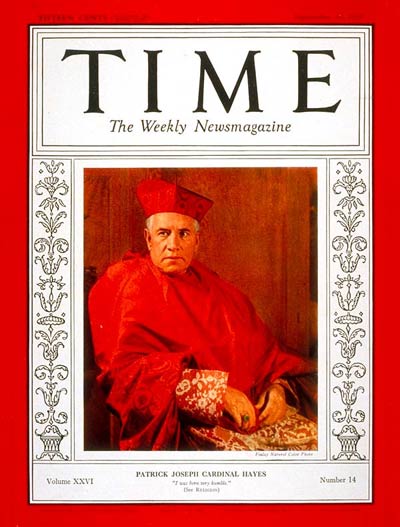
Patrick Hayes was born in the Five Points section of Manhattan to Daniel Hayes and Mary Gleason. In his own words, Hayes "was born very humble and, I may say, of poor people." A younger brother, John, was born in 1870. Hayes' mother died in June 1872, and his father later remarried around 1876; a half-sister, Anastasia, was also born that year. At age 15, he was sent to live with his aunt and uncle, who ran a grocery store where Hayes then worked.
After attending La Salle Academy, Hayes studied at Manhattan College, where he excelled at philosophy and the classics and obtained a Bachelor of Arts degree with high honors in 1888. At Manhattan, he also befriended George Mundelein, who would later become Archbishop of Chicago. Hayes then attended St. Joseph's Seminary in Troy.
Priesthood
Hayes was ordained to the priesthood by Archbishop Michael Corrigan on September 8, 1892. He was then sent for further studies at the Catholic University of America in Washington, D.C., earning a Licentiate of Sacred Theology in 1894.
Upon his return to New York City, Hayes was appointed Curate at St. Gabriel's Church on the Lower East Side, where he served under its pastor, John Murphy Farley (whom he would later succeed as Archbishop of New York). Hayes, following Farley's elevation to the episcopacy, served as his private secretary from 1895 to 1903, thereafter he was appointed chancellor of the Archdiocese and Rector of the Cathedral College. He was named Domestic Prelate of His Holiness on October 15, 1907.
Early episcopal career
Auxiliary Bishop of New York
On July 3, 1914, Hayes was appointed Auxiliary Bishop of New York and Titular Bishop of Thagaste by Pope Pius X. He received his episcopal consecration on the following October 28 from Cardinal Farley, with Bishops Henry Gabriels and Thomas Cusack serving as co-consecrators, at St. Patrick's Cathedral.
Bishop for the Military Services
Hayes was later named Vicar Apostolic of Military, USA, on November 24, 1917. Serving as head of the American military ordinariate during World War I, he recruited hundreds of priests as commissioned officers or chaplains. He was also one of the four episcopal members of the executive committee of the National Catholic War Council.
Archbishop of New York
Following the death of Cardinal Farley in September 1918, Hayes was appointed by Pope Benedict XV as the fifth Archbishop of New York on March 10, 1919. He founded the archdiocesan Catholic Charities in 1920, and subsequently became known as "the Cardinal of Charities." He had the first convention of the American Birth Control League raided, and later called its members "prophets of decadence". He welcomed the election of Éamon de Valera as President of the Irish Republic and contributed $1,000 to Sinn Féin.
Cardinal
Pope Pius XI created him Cardinal Priest of Santa Maria in Via in the consistory of March 24, 1924. It was speculated that the Pope delayed his elevation to the Sacred College of Cardinals because a group affiliated with New York's St. Patrick's Cathedral had stoned the Union Club for flying a British flag, but Pius nevertheless warmly greeted Hayes at the consistory as "dear little brother".
The cardinal opposed Prohibition, backed legislation to limit indecency on the stage, and endorsed unemployment relief during the Great Depression. Commenting on the Depression in 1931, he stated, "The American people are experiencing a return to religion following a period of carelessness and cynicism marked by the prosperity of the land...Now they are returning when they find they are in need of something greater than the material in facing adversity and stress."
After the Rev. Charles Coughlin praised the former Mayor Jimmy Walker in New York, Hayes, who had earlier denounced Walker for his perceived lack of morality, ruled that no ecclesiastical visitor might address a religious gathering without the cardinal's permission.
On June 24, 1924, he offered the invocation at the opening of the 1924 Democratic National Convention. He used his Tammany Hall connections to line up Democratic support in Congress for legislation protecting Catholic schools in the Philippines in 1932. During the Spanish Civil War, Hayes was outspoken in his support for the fascist-nationalist forces of General Franco, "claiming that 'Loyalists are controlled by radicals and communists'."
Hayes had a summer house in the Catskill Mountains, near St. Joseph's camp, maintained by the Amityville Dominican nuns; he once encountered a group of Klansmen there.
Death and legacy
In September 1938, Hayes died from a heart attack, caused by coronary thrombosis, in Monticello, New York, at age 70.
Cardinal Hayes High School in The Bronx is named after him.
Images
References
References
- Miranda, Salvador. "Hayes, Joseph". The Cardinals of the Holy Roman Church.
- "Hayes, Patrick Joseph". Dictionary of American Biography.
- "Patrick Joseph Cardinal Hayes". Catholic-Hierarchy.org.
- (September 30, 1935). "Catholics in Cleveland". [[Time Magazine]].
- Hayes, Patrick. (November 14, 1921). "Christmas Pastoral Letter of Archbishop Hayes". [[Catholic Family News]].
- (February 18, 1935). "Birth Control's 21st". [[Time Magazine]].
- ""Sanger, Censorship, and the Catholic Church – The Latest Battle in a Long War," #6, Winter 1993/4". Margaret Sanger Papers Project.
- (March 16, 1931). "Roman Senator". [[Time Magazine]].
- (December 11, 1933). "Priest in Politics". [[Time Magazine]].
- Official Report of the Proceedings of the Democratic National Convention, published by the Democratic National Committee (1924)
- Morris, Charles R.. (May 12, 2000). "Politicians of the Cloth". [[The New York Times]].
- McGreevy, John T.. (2004-09-17). "Catholicism and American Freedom: A History". W. W. Norton & Company.
- "Hemingway and the Fascist Salute — Watchtower ONLINE LIBRARY".
- (September 12, 1938). "Death of Hayes". [[Time Magazine]].
This article was imported from Wikipedia and is available under the Creative Commons Attribution-ShareAlike 4.0 License. Content has been adapted to SurfDoc format. Original contributors can be found on the article history page.
Ask Mako anything about Patrick Joseph Hayes — get instant answers, deeper analysis, and related topics.
Research with MakoFree with your Surf account
Create a free account to save articles, ask Mako questions, and organize your research.
Sign up freeThis content may have been generated or modified by AI. CloudSurf Software LLC is not responsible for the accuracy, completeness, or reliability of AI-generated content. Always verify important information from primary sources.
Report