From Surf Wiki (app.surf) — the open knowledge base
Passports of the European Union
Passports issued by European Union member states

Passports issued by European Union member states
Passports issued by the 27 member states of the European Union follow a common design and confer the rights of EU citizenship on their holders. The EU itself does not issue ordinary passports.
The design includes a burgundy cover (recommended by the EU; all member states except Croatia follow this recommendation). The front is stamped in the official language(s) of the issuing country, and sometimes also in English and French, with the title "European Union". This is followed by the name of the member state, the state's coat of arms, the word "PASSPORT", and the biometric passport symbol at the bottom centre of the cover.
Some member states also issue non-EU passports to people who hold a nationality that does not grant EU citizenship, such as Danish nationals resident in the Faroe Islands.
Separately, the European Commission issues the European Union Laissez-Passer to members and certain officials of its institutions.
Use
With a valid passport, EU citizens are entitled to exercise the right of free movement (meaning they do not need a visa, a certain amount of money, or a certain reason to travel freely and no residence permit for settling) in the European Economic Area (European Union, Iceland, Liechtenstein, and Norway), Switzerland and, before 31 December 2020 in the United Kingdom.
The passports of EU citizens are not stamped when entering and leaving the Schengen Area.
When going through border controls to enter an aforementioned country, citizens possessing valid biometric passports are sometimes able to use automated gates instead of immigration counters. For example, when entering the United Kingdom, at major airports, holders of EU biometric passports who are twelve years of age or older can use ePassport gates, whilst all other EU citizens (such as those using a national identity card or a non-biometric passport) and some non-EEA citizens must use an immigration counter. Anyone travelling with children under the age of 12 must also use an immigration counter.
As an alternative to holding a passport, EU citizens can also use a valid national identity card to exercise their right of free movement within the EEA and Switzerland. Strictly speaking, it is not necessary for an EU citizen to possess a valid passport or national identity card to enter the EEA or Switzerland. In theory, if an EU citizen outside of both the EEA and Switzerland can prove their nationality by any other means (e.g. by presenting an expired passport or national identity card, or a citizenship certificate), they must be permitted to enter the EEA or Switzerland. An EU citizen who is unable to demonstrate their nationality satisfactorily must nonetheless be given 'every reasonable opportunity' to obtain the necessary documents or to have them delivered within a reasonable period of time.
Common design features
EU member states have harmonized passport designs since the 1980s. Most ordinary passports use a common layout: a burgundy cover with the words "European Union" and the name of the issuing state. Variants such as passport cards, diplomatic, service, and emergency passports are not standardized. Ireland is the only state to issue a passport card.
Since 28 February 2008, passports must contain fingerprint data. Croatia, which joined the EU in 2013, retained a dark blue cover when it updated its passport on 3 August 2015, making it the only member state not to use burgundy.
Council resolutions and EU regulations have guided the process:
- Resolution of 23 June 1981 on a uniform passport design
- Supplementary resolutions of 30 June 1982, 14 July 1986, 10 July 1995, and 8 June 2004
- Resolution of 17 October 2000 on passport security
- Council Regulation (EC) No 2252/2004 of 13 December 2004 on biometric standards
- Regulation (EC) No 444/2009 of 28 May 2009 amending Regulation 2252/2004
Under Regulation 2252/2004, all EU passports must include a facial image and two fingerprints, except for children under 12 and people unable to provide them. Denmark and Ireland are exempt from the fingerprint rule, though Irish passports include other biometric data.
Format
Passports follow the ISO 216 B7 format (ID-3, 88 × 125 mm). Most contain 32 pages; Finland issues 42 and Italy 48.
Cover
The cover normally shows, in order: "EUROPEAN UNION" (before 1997: "EUROPEAN COMMUNITY"), the name of the issuing state, the word "PASSPORT", the Biometric Passport symbol, and the state emblem. Placement of the emblem varies: above the text in some states, centred in others.
Identification page
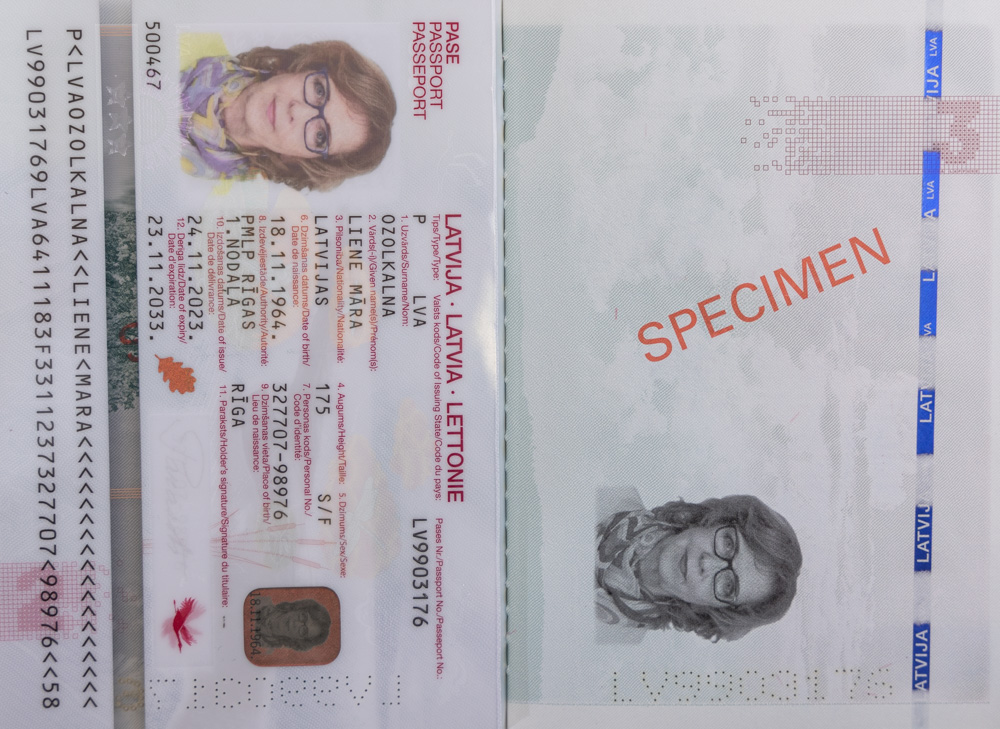
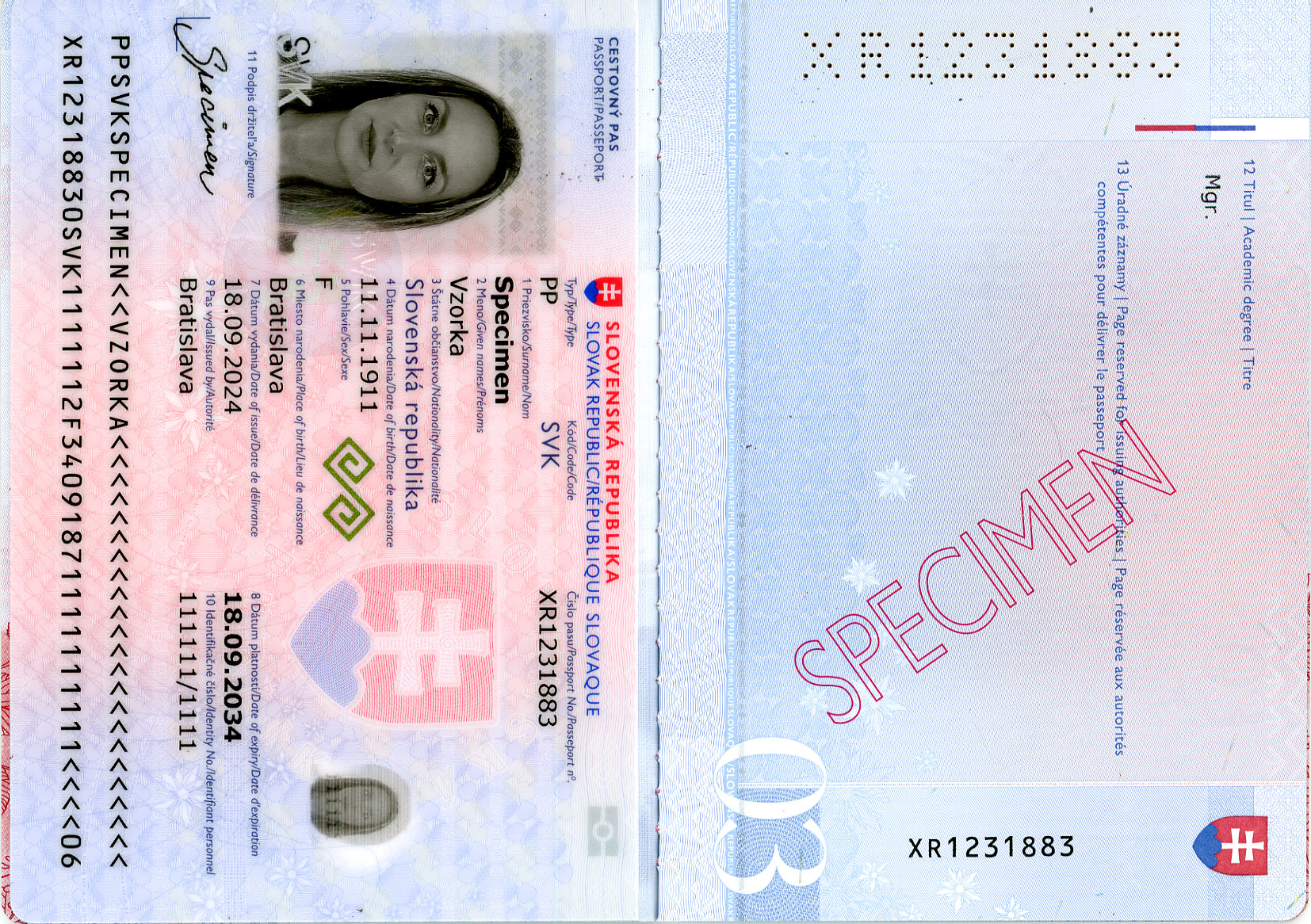
The identification page presents information in the issuing state’s official language(s), plus English and usually French. Each field is numbered and explained in an index elsewhere in the booklet. The page includes the passport type ("P"), issuing country (ISO 3166-1 alpha-3) code, and passport number. The left side carries the main photo. Some passports also give height and a secondary security photo.
Irish passports show the county of birth for people born on the island of Ireland, and a three-letter country code for citizens born abroad.
Machine-readable zone
All biometric passports contain a machine-readable zone (MRZ) that repeats the main data in a restricted format of A–Z letters, digits, and the symbol "
Different transliterations can create multiple spellings of the same name (e.g. Müller / Mueller / Muller). Some states add the alternative spelling elsewhere in the passport. It is generally recommended to use the MRZ spelling for visas and airline tickets. The MRZ allows up to 39 characters.
Additional pages
Other pages may record residence, height, eye colour, passport extensions, or a birth name. Family passports can include details and photos of a spouse or children. Further pages are reserved for official notes, translations of field numbers, visas, and entry or exit stamps. The inside back cover may contain notes from the issuing state.
EU Member States' Passports
| Member state | Passport cover | Biodata page | Cost | Validity | Issuing authority | Latest version | ||
|---|---|---|---|---|---|---|---|---|
| Austria Austria | [[File:Passport of Austria (2024).png | 100px]] | [[File:Passport of Austria (2024) data page.jpg | 100px]] | Municipal offices; Austrian embassies and consulates | |||
| Belgium Belgium | [[File:2022 Passeport Belge.jpg | 100px]] | [[File:Belgian passport - 2022 update.png | 100px]] | Communes; Belgian embassies and consulates | |||
| Bulgaria Bulgaria | [[File:Passportbg.jpg | 100px]] | image | Ministry of Interior | ||||
| Croatia Croatia | [[File:Croatian biometric passport.jpg | 100px]] | [[File:Croatian passport data page.jpg | 100px]] | Ministry of the Interior | |||
| Cyprus Cyprus | [[File:Cypriot passport.png | 100px]] | image | Civil Registry and Migration Department; Embassies and High Commissions | ||||
| Czech Republic Czech Republic | [[File:Czech passport 2007 cover.jpg | 100px]] | [[File:Czech passport 2006 MRZ data.jpg | 100px]] | Town halls; Consulates | |||
| Denmark Denmark | [[File:DK Passport Cover.jpg | 100px]] | image | Municipalities | ||||
| Estonia Estonia | [[File:Eesti pass 2021.jpg | 100px]] | [[File:Eesti biodata 2021.jpg | 100px]] | Police and Border Guard Board | |||
| Finland Finland | [[File:Finland passport 2023.jpg | 100px]] | [[File:Finland biodata.png | 100px]] | Police of Finland | |||
| Finland, Åland Åland Islands | [[File:Åland passport.jpg | 100px]] | [[File:Finland biodata.png | 100px]] | Police of Åland | |||
| France France | [[File:French Passport Cover.svg | 100px]] | image | Town halls; French consulates | ||||
| Germany Germany | [[File:Deutscher Reisepass (2024) - Cover.jpg | 100px]] | [[File:Deutscher Reisepass (2024) - Passkartendatenseite.jpg | 100px]] | Municipal offices; Embassies and consulates | |||
| Greece Greece | [[File:Greek_Passport.svg | 100px]] | image | National Passport Centre | ||||
| Hungary Hungary | [[File:Hungarian Passport Cover.jpg | 100px]] | [[File:Hungarian passport biodata page.png | 100px]] | Registration Office | |||
| Ireland Ireland | [[File:Eirepas.JPG | 100px]] | Passport Service, Department of Foreign Affairs | |||||
| Italy Italy | [[File:Italian biometric passport.jpg | 100px]] | image | Italian State Police; Poste Italiane; Consulates/embassies | ||||
| Latvia Latvia | [[File:LR Pase.jpg | 100px]] | image | Office of Citizenship and Migration Affairs | ||||
| Lithuania Lithuania | [[File:pasas2008.gif | 100px]] | image | Migration Department, Ministry of the Interior | ||||
| Luxembourg Luxembourg | [[File:Luxembourgish Passport Front Cover.jpg | 100px]] | [[File:Luxembourgish Passport Biodata.jpg | 100px]] | Bureau des passeports | |||
| Malta Malta | image | image | Identity Malta; Embassies/High Commissions | |||||
| Netherlands Netherlands | [[File:Nederlanden paspoort 2011.jpg | 100px]] | [[File:Dutch_passport_specimen_issued_9_March_2014.jpg | 100px]] | Municipalities; Ministry of Foreign Affairs | |||
| Poland Poland | [[File:PolishPassport2018.png | 100px]] | [[File:PL Passport data page 2018 series.jpg | 100px]] | Provincial governors; Consuls | |||
| Portugal Portugal | [[File:Portuguese Passport Cover.jpg | 100px]] | image | Portuguese consulates | ||||
| Romania Romania | [[File:New Romanian Passport.jpg | 100px]] | [[File:Romanian passport 2024 model datapage.jpg | 100px]] | Ministry of Internal Affairs | |||
| Slovakia Slovakia | [[File:Slovak passport biometric.jpg | 100px]] | image | Ministry of Interior | ||||
| Slovenia Slovenia | [[File:Passport of Republic of Slovenia.jpg | 100px]] | image | Ministry of the Interior | ||||
| Spain Spain | image | image | National Police Corps of Spain | |||||
| Sweden Sweden | [[File:Nya svensk pass.png | 100px]] | [[File:Svensk pass biodatakort.png | 100px]] | Swedish Police Authority; Embassies and consulates |

Former passports of the European Union
Following the UK's withdrawal from the European Union in January 2020, the UK and Gibraltar ceased to issue EU passports. British passports have now returned to their previous navy blue design, which first appeared in 1921. Non EU navy blue passports were first issued in March 2020, unlike previous designs the biodata page is now made of polycarbonate.
While in the transition period, UK and Gibraltar passport were considered de facto EU passports, conferring their holders the rights of EU citizens. After the end of the transition period on 1 January 2021, all UK passports now have lost this status.
Prior to the introduction of the blue UK passport in March 2020, the British passports conformed to the EU standard design. Between March 2019 and March 2020, passports were issued without the 'EUROPEAN UNION' header.
| Former Member state or territory | Date of EU | Passport cover | Biodata page | Validity | Issuing authority | Latest version | ||||||
|---|---|---|---|---|---|---|---|---|---|---|---|---|
| UK United Kingdom | 31 January 2020 | [[File:British Passport December 2025.svg | frameless | 100px]] | HM Passport Office | December 2025 | ||||||
| [[File:British Passport.svg | alt= | frameless | 168x168px]] | Link to image | ||||||||
| UK Gibraltar Gibraltar | [[File:British Passport Series C (Gibraltar).jpg | alt= | frameless | 168x168px]] | [[File:British Passport Series C Data Page (Gibraltar).jpg | alt= | frameless | 168x168px]] | Gibraltar Civil Status and Registration Office | |||
| [[File:British passport (Gibraltar).jpg | alt= | frameless | 168x168px]] |
Passport rankings

As of December 2025, the Henley Passport Index ranked passports by the number of countries and territories their holders could enter without a visa or with visa on arrival. In the European Union, Belgium, Denmark, Finland, France, Germany, Ireland, Italy, Luxembourg, Netherlands, and Spain were tied for the highest ranking, while Singapore held the top global position.
European Union member states
| Country | Destinations (visa-free or visa on arrival) |
|---|---|
| Austria | 186 |
| Belgium | 187 |
| Bulgaria | 179 |
| Croatia | 184 |
| Cyprus | 178 |
| Czech Republic | 184 |
| Denmark | 187 |
| Estonia | 184 |
| Finland | 187 |
| France | 187 |
| Germany | 187 |
| Greece | 186 |
| Hungary | 185 |
| Ireland | 187 |
| Italy | 187 |
| Latvia | 183 |
| Lithuania | 182 |
| Luxembourg | 187 |
| Malta | 185 |
| Netherlands | 187 |
| Poland | 185 |
| Portugal | 186 |
| Romania | 179 |
| Slovakia | 185 |
| Slovenia | 185 |
| Spain | 187 |
| Sweden | 186 |
Selected non-EU and EEA countries
| Country | Destinations (visa-free or visa on arrival) |
|---|---|
| Japan | 189 |
| Norway | 186 |
| Switzerland | 187 |
| United Kingdom | 184 |
| United States | 180 |
| Iceland | 181 |
| Liechtenstein | 182 |
Multiple and simultaneous passports
Same country
Some EU countries, such as Germany, France, Ireland and Malta, allow their citizens to have several passports at once to circumvent certain travel restrictions. This can be useful if wanting to travel while a passport remains at a consulate while a visa application is processed, or wanting to apply for further visas while already in a foreign country. It can also be needed to circumvent the fact that visitors whose passports show evidence of a visit to Israel are not allowed to enter some Arab League nations
Multiple citizenship
Each EU member state can make its own citizenship laws, so some countries allow dual or multiple citizenship without any restrictions (e.g. France, Ireland, Italy, Sweden, Czech Republic, Denmark), some allow multiple citizenships but ignore existence of other citizenships within their borders (e.g. Poland), some regulate/restrict it (e.g. Austria, the Netherlands), and others allow it only in exceptional cases (e.g. Lithuania) or only for citizens by descent (e.g. Croatia, Estonia, Slovenia, Spain).
Emergency passports
Decision 96/409/CSFP of the Representatives of the Governments of the Member States meeting within the Council of 25 June 1996 on the establishment of an emergency travel document decided that there would be a standard emergency travel document (ETD).
ETDs are issued to European Union citizens for a single journey back to the EU country of which they are a national, to their country of permanent residence or, in exceptional cases, to another destination (inside or outside the Union). The decision does not apply to expired national passports; it is specifically restricted to cases where valid and unexpired passports have been lost, stolen, destroyed, or are temporarily unavailable (i.e. left somewhere else by accident).
Embassies and consulates of EU countries different to the applicant may issue emergency travel documents if
- the applicant is an EU national whose passport or travel document has been lost, stolen, destroyed, or is temporarily unavailable;
- the applicant is in a country in which the EU country of which they are a national has no accessible diplomatic or consular representation able to issue a travel document or in which the EU country in question is not otherwise represented;
- clearance from the authorities of the applicant's country of origin has been obtained.
Right to consular protection in non-EU countries
As a consequence of citizenship of the European Union, when in a non-EU country, EU citizens whose country maintains no diplomatic mission there have the right to consular protection and assistance from a diplomatic mission of any other EU country present in the non-EU country.
Other EEA passports and Swiss passports
Main article: Passports of the EFTA member states
Like passports issued by EU member states, passports of other EEA states – Iceland, Liechtenstein, and Norway – as well as of Switzerland, can also be used to exercise the right of free movement within the European Economic Area and Switzerland.
As part of the Schengen agreement, passports and travel documents issued by member states shall comply with minimum security standards, and passports must incorporate a storage medium (a chip) that contains the holder's facial image and fingerprints. This obligation does not apply to identity cards or to temporary passports and travel documents with a validity of one year or less. Iceland, Norway, Switzerland, and Liechtenstein are bound by the rules (whereas Ireland is not), as Regulation (EC) No 2252/2004 constitutes a development of provisions of the Schengen acquis within the meaning of the Agreement concluded by the Council of the European Union and Iceland and Norway, the agreement concluded by the European Union, the European Community and the Swiss Confederation, and the Protocol signed between the European Union, the European Community, the Swiss Confederation and the Principality of Liechtenstein on the accession of the Principality of Liechtenstein to the Agreement between the European Union, the European Community and the Swiss Confederation, concerning the association of the four States with the implementation, application and development of the Schengen acquis .
Notes
References
References
- "EUR-Lex - 41981X0919 - EN".
- "L_2004385EN.01000101.xml".
- European Council [http://eur-lex.europa.eu/legal-content/EN/TXT/HTML/?uri=CELEX:32013R1417&from=HU regulations] covering the issue of EULF documents, dated 17 December 2013, accessed 11 October 2016.
- [http://eur-lex.europa.eu/legal-content/EN/ALL/?uri=CELEX:22007D0158 Decision of the EEA Joint Committee No 158/2007 of 7 December 2007 amending Annex V (Free movement of workers) and Annex VIII (Right of establishment) to the EEA Agreement], EUR-Lex. Retrieved 24 November 2015.
- Regulation (EU) 2016/399 of the European Parliament and of the Council of 9 March 2016 on a Union Code on the rules governing the movement of persons across borders (Schengen Borders Code), Article 11 ([https://eur-lex.europa.eu/legal-content/EN/TXT/?uri=celex%3A32016R0399 OJ L 77, 23 March 2016, p. 1–52])
- Practical Handbook for Border Guards, Part II, Section I, Point 6.2 ([https://ec.europa.eu/home-affairs/sites/homeaffairs/files/e-library/documents/policies/borders-and-visas/schengen/docs/c2019-7131-annex.pdf C (2019) 7131])
- "Entering the UK : At border countrol". [[UK Border Force]].
- (22 November 2013). "Entry clearance basics (entry clearance guidance) - GOV.UK".
- Article 5(4) of the Citizens' Rights Directive 2004/38/EC ([https://eur-lex.europa.eu/eli/dir/2004/38/oj L 158, pp. 77–123])
- Practical Handbook for Border Guards, Part II, section I, point 2.9 ([https://ec.europa.eu/home-affairs/sites/homeaffairs/files/e-library/documents/policies/borders-and-visas/schengen/docs/c2019-7131-annex.pdf C (2019) 7131])
- Judgment of the [[European Court of Justice]] [http://eur-lex.europa.eu/LexUriServ/LexUriServ.do?uri=CELEX:62003CJ0215:EN:HTML of 17 February 2005, Case C 215/03, Salah Oulane vs. Minister voor Vreemdelingenzaken en Integratie]
- "Processing British and EEA Passengers without a valid Passport or Travel Document".
- (6 December 2016). "Document security - Migration and Home Affairs - European Commission".
- (15 February 2016). "Croatian Passport the 'Blue' Sheep of the 'Burgundy' EU Family".
- "REGULATION (EC) No 444/2009 OF THE EUROPEAN PARLIAMENT AND OF THE COUNCIL".
- (29 December 2004). "Council Regulation (EC) No 2252/2004 of 13 December 2004". Official Journal of the European Union.
- "Document: FIN-AO-06001".
- "Note tecniche nuovo passaporto".
- "Henley Passport Index". Henley & Partners.
- "Emergency travel document (ETD)". [[European Union]].
- (6 June 2009). "Regulation (EC) No 444/2009 of the European Parliament and of the Council of 28 May 2009 amending Council Regulation (EC) No 2252/2004 on standards for security features and biometrics in passports and travel documents issued by Member States".
This article was imported from Wikipedia and is available under the Creative Commons Attribution-ShareAlike 4.0 License. Content has been adapted to SurfDoc format. Original contributors can be found on the article history page.
Ask Mako anything about Passports of the European Union — get instant answers, deeper analysis, and related topics.
Research with MakoFree with your Surf account
Create a free account to save articles, ask Mako questions, and organize your research.
Sign up freeThis content may have been generated or modified by AI. CloudSurf Software LLC is not responsible for the accuracy, completeness, or reliability of AI-generated content. Always verify important information from primary sources.
Report