From Surf Wiki (app.surf) — the open knowledge base
Passed pawn
Pawn with no opposing pawns to prevent it from advancing to the eighth rank
Pawn with no opposing pawns to prevent it from advancing to the eighth rank
|tright | | | | | | | | | | | | | | | | | | | | | | | | |pd | |pl| | |pl|pd| |pl | | |pl|pd| |pl|pl| | | | | | | | | | | | | | | | | | | | | | | | | |White's pawns on b5, c4, and e5 are passed pawns. Black's pawn on d4 is passed.
In chess, a passed pawn is a pawn with no opposing pawns to prevent it from advancing to the eighth ; i.e. there are no opposing pawns in front of it on either the same or adjacent files. A passed pawn is sometimes colloquially called a passer. Passed pawns are advantageous because only the opponent's pieces can stop them from promoting.
In the diagram, the white pawns on b5, c4, and e5 are passed pawns, and Black's pawn on d4 is a passed pawn. If Black plays ...fxg4, then the black pawn on g4 will be passed, as well as White's pawn on f4.
Protected passed pawn
| tright |Botvinnik vs. Capablanca, 1938 | | | | | | | | |pd| | | |qd| |kd|pd | |pd| | |pl|nd|pd| | | | |pd|ql| | | | | |pd|pl| | | | | |nd|pl| | | |nl| | |bl| | | | |pl|pl | | | | | | |kl| | White to play A passed pawn that is protected by its own pawns is called a protected passed pawn. In the first diagram in this article, the pawns on the b- and e-files are protected passed pawns. Two or more passed pawns on adjacent files are called connected passed pawns (see connected pawns), and they are very strong. In the diagram at the top, White's b- and c-pawns are connected passed pawns. A pair of connected passed pawns is sometimes called a steamroller. It is often strategically advantageous for the side with connected passed pawns to place them on the same rank and then advance them in tandem, because this makes them more difficult to .
Sometimes, pieces are sacrificed so that a pawn can have a clear path to promotion on the eighth rank. In the example illustrated (Mikhail Botvinnik–José Capablanca, AVRO 1938), in order to capitalize on the passed pawn on e6 and break its blockade by Black's queen, White continued :30. Ba3 Qxa3 31. Nh5+! gxh5 32. Qg5+ Kf8 33. Qxf6+ guaranteeing the e-pawn's promotion. The passed pawn's value is well worth the sacrifice of the bishop in order to clear its path to promotion. The only pieces preventing the e-pawn's promotion are the black queen and knight, and once they are gone, the pawn has a free path to promote. Black's pawns are also helpless to stop it.
Outside passed pawn
|tright |Fischer vs. Larsen, 1971 | | | | | | | | | | | | |kd|pd| | | | | | | | |pd| | | | | | | | |pd |pl| | | | | | | | | |kl| | | |pl| | | | | | | | |pl | | | | | | | | |White to move wins because of the outside passed pawn.
An outside passed pawn is a passed pawn that is separated by several files from the rest of the pawns and deflects the opposing king (and sometimes other pieces) from the defense of its other pawns. Such a pawn often constitutes a strong advantage for its owner because the opposing king does not have the range to cover both sides of the board.
In the diagrammed position from the fifth game of the 1971 Candidates match between Bobby Fischer and Bent Larsen, the outside passed pawn on the a-file confers White a winning advantage, even though is equal. The pawn will force Black's king to keep it from queening, leaving White's king free to capture Black's remaining pawns and win the game. White wins with: :41. Kd4 Kd6 :42. a5 f6 :43. a6 Kc6 :44. a7 Kb7 :45. Kd5 h4 If 45...f5 46.h4 wins. :46. Ke6 1–0
|tright |Levenfish & Smyslov, 1957 |rl| | | | | | | | | | | | | |kd| |pl| | | | | |pd| | | | | | |pd| |pd | | | | | |pl| |pl |rd| | | | | |pl| | | | | | |kl| | | | | | | | | | |White to play, draw An outside passed pawn is also powerful in an endgame with . It is not so powerful in an endgame with rooks if the opposing rook can get behind the pawn (see diagram), as in the Tarrasch rule.
Passed pawns in the endgame
|tleft | | | | | | | | | | | | | | |pd|pd|pd | | | | | | | | | | | | | |pl|pl|pl | | | | | | | | | | | | | | |kd| | | | | | | | | | | | | | | |kl| |White, on move, creates a passed pawn and wins. Passed pawns are particularly important, often of decisive significance, in the endgame. The position illustrated provides a dramatic example of this. White has no passed pawns and seems to be in desperate straits, since Black's king threatens to fork all of White's pawns with ...Kg4. In fact, White by means of a sacrificial combination creates a passed pawn and wins:
1. g6 fxg6 :Or 1...hxg6 2.f6! gxf6 3.h6!
2. h6! gxh6 3. f6! :And White's newly created passed pawn will queen.
If it is Black's move, they must avoid this combination by playing 1... g6! (not 1...f6 2.h6!, nor 1...h6 2.f6!).
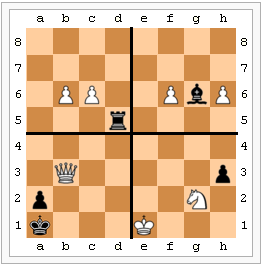
Since passed pawns have no opposing pawns to stop them, the threat of queening often forces the opponent to use a piece to block or capture the pawn, wasting valuable time and immobilizing material or possibly even losing it (as when a defender of the blocking piece is forced to move). Indeed, the value of a far-advanced passed pawn or pawn group is often equal to or even greater than that of a piece. Four examples of this are seen in the subdivided diagram. In the upper-left quadrant of the board, White's connected passed pawns on the sixth rank are superior to Black's rook. Even if on move, Black cannot stop one of White's pawns from queening. Similarly, in the upper-right quadrant, Black's bishop cannot hold back both of White's pawns. White queens a pawn after 1. f7 (1.h7 also works) Bxf7 2. h7 followed by 3. h8=Q. In the lower-left quadrant, White's queen cannot stop Black's pawn from queening without stalemating Black. The lower-right quadrant highlights how awkward a knight is in dealing with a passed pawn, especially a rook pawn. White's knight is actually worse than useless in trying to stop Black's pawn. It cannot do so itself, and if White's king (which could catch the pawn if the knight were not there) approaches with 1. Kf2 (hoping for 1...hxg2 2.Kxg2), Black plays 1... h2! and 2... h1=Q.
|tleft | |kd| | | | | | | |bd| |pl| | | | | |kl|pl| | | | | | | | | | | | |qd| | | | | | | | | | | | | | | | | | | | | | | | | | | | | |nd| | | |Position after 9.c7 White's two connected passed pawns defeat Black's army.
A striking (albeit very unusual) example of the power of passed pawns is seen in the conclusion of an endgame study by Leopold Mitrofanov (see diagram). Black, with a queen, bishop, and knight, is helpless against White's two passed pawns, which threaten both 10.b7 and 10.c8=Q+ Bb8 11.b7#.
Quotes
- "A passed pawn is a criminal which should be kept under lock and key. Mild measures, such as police surveillance, are not sufficient." — Aron Nimzowitsch
References
Bibliography
- {{Citation
- {{Citation
- {{citation
- {{Citation
it:Termini scacchistici#Pedone passato
References
- "Mikhail Botvinnik vs Jose Raul Capablanca (1938)".
- "Robert James Fischer vs Bent Larsen (1971)".
- {{Harvcol. Müller. Pajeken. 2008
- {{Harvcol. Müller. Pajeken. 2008
- {{Harvcol. Levenfish. Smyslov. 1971
- http://www.chesscorner.com/quotes/chess_quotes.htm Nimzowitsch quote
This article was imported from Wikipedia and is available under the Creative Commons Attribution-ShareAlike 4.0 License. Content has been adapted to SurfDoc format. Original contributors can be found on the article history page.
Ask Mako anything about Passed pawn — get instant answers, deeper analysis, and related topics.
Research with MakoFree with your Surf account
Create a free account to save articles, ask Mako questions, and organize your research.
Sign up freeThis content may have been generated or modified by AI. CloudSurf Software LLC is not responsible for the accuracy, completeness, or reliability of AI-generated content. Always verify important information from primary sources.
Report