From Surf Wiki (app.surf) — the open knowledge base
Parque Batlle

| Field | Value |
|---|---|
| name | Parque Batlle–Villa Dolores |
| settlement_type | Barrio and park |
| image_skyline | La Carreta 4.JPG |
| image_caption | Monumento La Carreta |
| image_map | Parque Batlle, Montevideo.png |
| map_caption | Street map of Parque Batlle–Villa Dolores |
| image_map1 | Montevideo Parque Batlle.png |
| map_caption1 | Map of Montevideo highlighting the barrio |
| subdivision_type | Country |
| subdivision_name | Uruguay |
| subdivision_type1 | Department |
| subdivision_name1 | Montevideo Department |
| subdivision_type2 | City |
| subdivision_name2 | Montevideo |
| coordinates | |
| website | www.parquebatlle.tk |
Parque Batlle (, ), formerly Parque de los Aliados (Allied Park), is a barrio (neighbourhood or district) and a major public central park in Uruguay's capital city of Montevideo. It is named in honour of José Batlle y Ordóñez, President of Uruguay from 1903-1907 and 1911–1915.
Location
The barrio is located south of Avenida Italia and north of Rivera Avenue and includes the districts Belgrano, Italiano, Villa Dolores and the park area. It borders the barrios Tres Cruces to the west and north, La Blanqueada and Unión to the north, Buceo to the east and Pocitos to the south.
The park covers an area of 60 ha and is considered the "lung" of Montevideo owing to the large variety of trees planted here. It is home to the Estadio Centenario national football stadium, as well as the national monument "La Carreta".
History
In 1907, Pablo Nereo Gabriel Antonio Pereira (1838–1906) donated eleven acres of his land, which was then named after him as "Campo Pereira," for a building a park, to the Economic Management Board, and the idea of a park was created by an Act of March 1907 which also projected wide boulevards and avenues.
The barrio
Parque Batlle is counted as one of the seven coastal barrios, along with Punta Carretas, Pocitos, Buceo, Malvín, Punta Gorda and Carrasco. It is characterized as being of high population density and most of the households are of medium-high- or high-income. According to Administración Nacional de Educación Pública (ANEP) of Uruguay, the Parque Batlle school district, Villa Dolores, was ranked 55 of 60 for the period of 1990–1999.

The park
Along with Parque Prado and Parque Rodó, Batlle is one of three large parks that dominate Montevideo. The park contains the 70,000 seat Estadio Centenario, built for the first soccer world cup in 1930, which is both the national football stadium and it contains a football museum. There is also the Tabaré Athletic Club which is occasionally made over as a carnival theatre using impermanent materials. The Municipal Velodrome, two smaller stadiums (the Parque Palermo and the Parque Luis Méndez Piana), and a target shooting facility are additional attractions. It is an ideal place for walking, hiking or exercise and enjoy the fresh air provided by the wooded area.
Villa Dolores and the Zoo of Montevideo
Villa Dolores is a district of Parque Batlle. It took its name from the original Villa of Don Alejo Rossell y Rius and of Doña Dolores Pereira de Rossel who started there a private collection of animals which became a zoological garden. It was passed to the city in 1919, and in 1955 the Planetarium of Montevideo was built within its premises.
Monuments

In 1934, "La Carreta", a bronze monument on granite base by José Belloni was introduced. The monument, one of several statues in the park, is located on Avenida Lorenzo Merola near Estadio Centenario and depicts yoked oxen pulling a loaded wagon. It was designated a national monument in 1976. Another statue in the same side of the park is a bronze copy of the Discobolus of Myron.
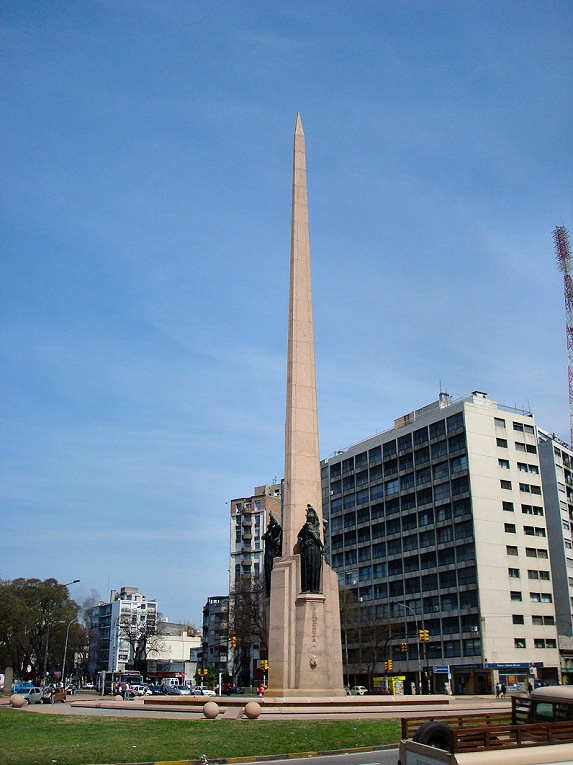
On the West side of Parque Batlle, on Artigas Boulevard, there is the Obelisk of Montevideo, a monument dedicated to those who created the first Constitution and inaugurated in 1938. It is a monumental work of the sculptor José Luis Zorrilla de San Martín (1891–1975). It is a three-sided obelisk made of granite, 40 m tall with 3 bronze statues on its sides, representing "Law", "Liberty" and "Force." It has a hexagonal water fountain around it with six spheres on its outer circumference. It is located at the intersection of 18 de Julio and Artigas Boulevard avenues, in Montevideo, at the entrance of the Parque Batlle area. It is a National Heritage Site since 1976.
Notable buildings
Apart from the stadium, the area around the park has many buildings notable for their architecture and style. Among them are several hospitals, the biggest of which is the Hospital de Clínicas of the Faculty of Medicine of the University of the Republic and a Site of Municipal Interest since 1995, the Italian Hospital and Pereira Rossell Hospital (next to the obelisk), the Hospital Británico, a National Heritage Site since 1975, the Sanatorio Americano, Médica Uruguaya to the west of the northwest point of the park and others. Two other National Heritage Sites, both opposite the Estadio Centenario, are Conedor Universitario No. 2 (the Canteen of the University) and the Instituto de Higiene.
Places of worship
- Parish Church of St Ignatius of Loyola, Alejo Rossell y Rius 1613 (Roman Catholic, Jesuites)
References
References
- "El Parque Batlle". detubarrio.com.
- "José Batlle y Ordóñez | president of Uruguay".
- "Parque Batlle".
- Prensa, Comunicación y Relaciones Públicas. "Parque Batlle". Government of Montevideo.
- Couriel, Jack. (2010). "De cercanías a lejanías. Fragmentación sociourbana del Gran Montevideo". Ediciones Trilce.
- World Bank. (2009). "The Quality of Life in Latin American Cities: Markets and Perception". World Bank Publications.
- Centro de Investigación y Promoción Educativa y Social. (2005). "Brechas de aprendizaje en Uruguay: el caso Carrasco Norte". Ediciones Trilce.
- Finzer, p. 11
- Burford, Tim. (2010). "Uruguay". Bradt Travel Guides.
- Remedi, Gustavo. (2004). "Carnival theater: Uruguay's popular performers and national culture". U of Minnesota Press.
- Finzer, p. 103
- (January 19, 2010). "Zoologico Villa Dolores". montevideo.gub.uy.
- "Planetario". montevideo.gub.uy.
- (November 18, 2009). "Monumento a La Carreta en el Parque Batlle". turismoenuruguay.com.uy.
- Box, Ben. (2003). "The South American handbook". Footprint Travel Guides.
- (November 21, 2009). "Obelisco a los Constituyentes". montevideo.gub.uy.
This article was imported from Wikipedia and is available under the Creative Commons Attribution-ShareAlike 4.0 License. Content has been adapted to SurfDoc format. Original contributors can be found on the article history page.
Ask Mako anything about Parque Batlle — get instant answers, deeper analysis, and related topics.
Research with MakoFree with your Surf account
Create a free account to save articles, ask Mako questions, and organize your research.
Sign up freeThis content may have been generated or modified by AI. CloudSurf Software LLC is not responsible for the accuracy, completeness, or reliability of AI-generated content. Always verify important information from primary sources.
Report