From Surf Wiki (app.surf) — the open knowledge base
Parliament House, Helsinki
Finnish legislative meeting place

Finnish legislative meeting place
| Field | Value |
|---|---|
| name | Parliament House |
| native_name | Eduskuntatalo |
| Riksdagshuset | |
| image | File:Eduskuntatalo 20211025.jpg |
| image_size | 260px |
| building_type | Governmental |
| architectural_style | Nordic Classicism |
| address | Mannerheimintie 30 |
| location | Etu-Töölö, Helsinki, Finland |
| owner | Finnish Government |
| coordinates | |
| start_date | 1926 |
| completion_date | 7 March 1931 |
| height | 25 m |
| floor_count | 6 |
| main_contractor | Finnish Government |
| architect | Johan Sigfrid Sirén |
Riksdagshuset
The Parliament House ( , ) is the seat of the Parliament of Finland. It is located in the Finnish capital Helsinki, in the district of Etu-Töölö.
History
In 1923, a competition was held to choose a site for a new parliament house. Arkadianmäki, a hill beside what is now Mannerheimintie, was chosen as the best place to build on.
The architectural competition which was held in 1924 was won by the firm of Borg–Sirén–Åberg with a proposal called Oratoribus (Latin for "for the speakers"). Johan Sigfrid Sirén (1889–1961), who was mainly responsible for preparing the proposal, was given the task of designing Parliament House. The building was constructed between 1926–1931 and was officially inaugurated on March 7, 1931. Ever since then, and especially during the Winter War and Continuation War, it has been the scene of many key moments in the nation's politics.
On September 25, 2024, the Finnish Extinction Rebellion and Swedish Återställ Våtmarker sprayed red paint on the pillars of Parliament House as a protest against the coal-industry.
On August 19, 2025, incumbent MP Eemeli Peltonen was reported to have died from suicide inside the building.
Architecture and features

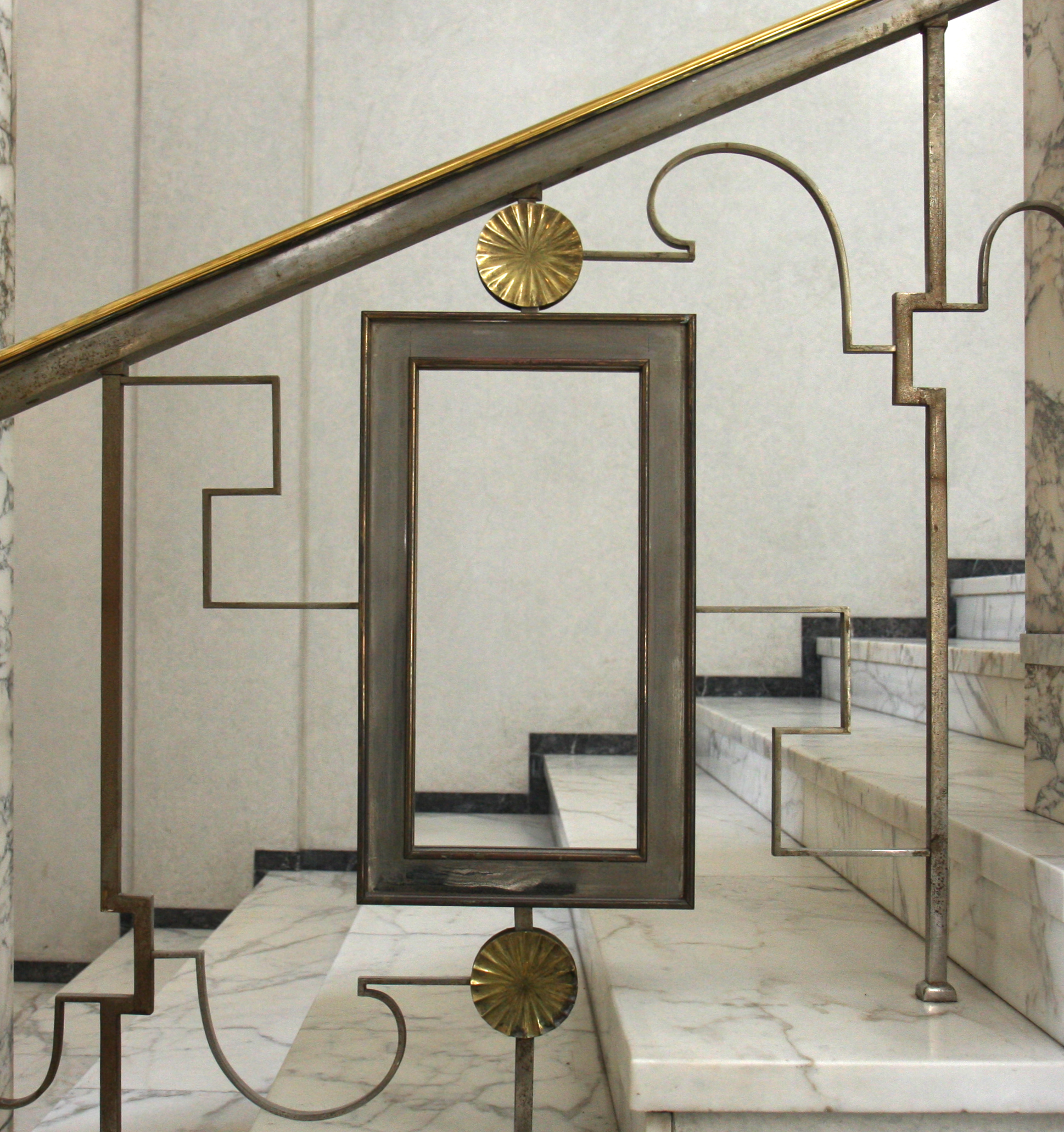
Sirén designed Parliament House in a stripped classical architectural style, combining Neoclassicism with early twentieth century modernism. Sirén's combination of simplified columns and balusters with uncomplicated planar geometry bears comparison to similar explorations by Erik Gunnar Asplund and Jože Plečnik. The façade is lined by fourteen columns with Corinthian capitals, all made from red granite from Kalvola.
The building has six floors, each of which are unique. Five of the floors are connected by a white marble staircase and paternoster lifts. The most important for visitors looking to visit are the main lobby, the stately debate chamber (Session Hall) and the large reception hall (State Hall).
Notable later additions to the building include the library annex, completed in 1978, and a separate office block, Finnish Parliament Annex (), completed in 2004, the necessity of which was an object of some controversy.
Floors of the Parliament House
First floor
The first floor contains the main lobby, the Speaker's reception rooms, the newspaper room, the information service, the documents office, the messenger centre, the copying room, the restaurant, and some separate function rooms. At both ends of the lobby are marble staircases leading up to the fifth floor.
Second floor
The second floor, also known as the main floor, is centered on the plenary chamber. Its galleries have seats for the public, the press, and diplomats. Also located on this floor are the reception hall (the Hall of State), the Speaker's Corridor, the Government Corridor, the cafeteria, and adjacent function rooms.
Third floor
The third floor includes facilities for the information unit and the media, and provides direct access to the press gallery of the plenary chamber. The Minutes Office and a number of committee rooms are also located here.
Fourth floor
The fourth floor is reserved for committees. Its largest rooms are the Grand Committee room and the Finance Committee room.
Fifth floor
The fifth floor contains meeting rooms and offices for the parliamentary groups.
Sixth floor
Additional offices for the parliamentary groups are located on the sixth floor, along with additional facilities for the media.
Statues of the former presidents
Most of the statues of former presidents of the Republic of Finland have been placed in the vicinity of the Parliament House. On the lawn in front of the house is the statue of Kaarlo Juho Ståhlberg from 1959 and the statue of Pehr Evind Svinhufvud from 1961, both carved by Wäinö Aaltonen, the former on the north and the latter on the south. In the same block, in the Parliament Park immediately north of the Parliament House, there is a statue of Kyösti Kallio from 1962, carved by his son Kalervo Kallio.
Sightseeing
Public guided tours are arranged on Thursdays at 11 a.m. Tours are free, but require an advance booking. One can also watch plenary visits on Tuesdays and Wednesdays at 2 p.m., Thursdays at 4 p.m. and Fridays at 1 p.m. The Thursday plenary sessions open with Question Time. The plenary session on Friday normally lasts 30 minutes at most. There are no plenary sessions during the election break.
Gallery
|Eduskuntatalo 2 2020-03-23.jpg|Aerial view of Parliament House |ParliamentHouseStatueHelsinki.jpg|Statue of P. E. Svinhufvud by Wäinö Aaltonen |Eduskuntatalo pääaula.jpg|Entrance lobby |Paternoster Eduskuntatalo.jpg|Paternoster lift (there is also a normal elevator) |Eduskuntalo 210819 03.jpg|White marble staircase |Eduskuntalo 210819 08.jpg|Curved staircase |Eduskuntalo 210819 04.jpg|State Hall
|Eduskunta istuntosali.jpg|Session Hall (the statues are ** by Wäinö Aaltonen) |Eduskunnan lisärakennus, ruokala.jpg|Cafeteria of the Finnish Parliament Annex|File:Siren mosaiikki.jpg|Floor mosaics present in the elevator lobbies|File:Valtiosali.jpg|State Hall from a different angle|File:Eduskuntatalo (Finnish Parliament building).JPG|Exterior wall|width=180|File:Eduskuntatalon toinen kerros.jpg|Floor plan of the second floor. In the middle is the State Hall, the Session Hall and the speakers' rooms, on the left is the cafeteria and one of the three meeting rooms specifically reserved for female MPs. On the right, the meeting rooms reserved for the use of the parliamentary councils. Four patios are located on both sides of the Parliamentary House's Session Hall.}}
Notes
References
References
- "Parliament House, Helsinki, Finland - SpottingHistory".
- (4 March 2019). "Eduskuntatalon historiaa". Helsingin Sanomat.
- (28 December 2018). "Ullakolla asui koditon, sydänkohtaus kirjattiin pöytäkirjaan ja aulassa nuori nainen ampui itsensä – Eduskuntatalo on täynnä tarinoita, joita harvat tuntevat". Yle.
- (27 May 2016). "Eduskuntatalon rakentaminen 1926–1931 rakennusmestarin kokemana".
- (2024-09-25). "Environmental protesters splatter Parliament House pillars with red paint".
- (2025-08-19). "Kansanedustaja Eemeli Peltonen on kuollut – Iltalehden mukaan kyseessä on itsemurha".
- "Eduskunnan talot ja taide".
- link. (2016-04-12 Helsingin taidemuseon Julkiset veistokset (in Finnish))
- link. (2005-11-01 Helsingin taidemuseon Julkiset veistokset (in Finnish))
- link. (2018-05-03 Helsingin taidemuseon Julkiset veistokset (in Finnish))
- (11 March 2020). "Sauli Niinistön rintakuva odottaa tekijäänsä – eduskunnassa käsiteltiin puuttuvaa patsasta". Demokraatti.
This article was imported from Wikipedia and is available under the Creative Commons Attribution-ShareAlike 4.0 License. Content has been adapted to SurfDoc format. Original contributors can be found on the article history page.
Ask Mako anything about Parliament House, Helsinki — get instant answers, deeper analysis, and related topics.
Research with MakoFree with your Surf account
Create a free account to save articles, ask Mako questions, and organize your research.
Sign up freeThis content may have been generated or modified by AI. CloudSurf Software LLC is not responsible for the accuracy, completeness, or reliability of AI-generated content. Always verify important information from primary sources.
Report