From Surf Wiki (app.surf) — the open knowledge base
Paratonia
Muscular disorder
Muscular disorder
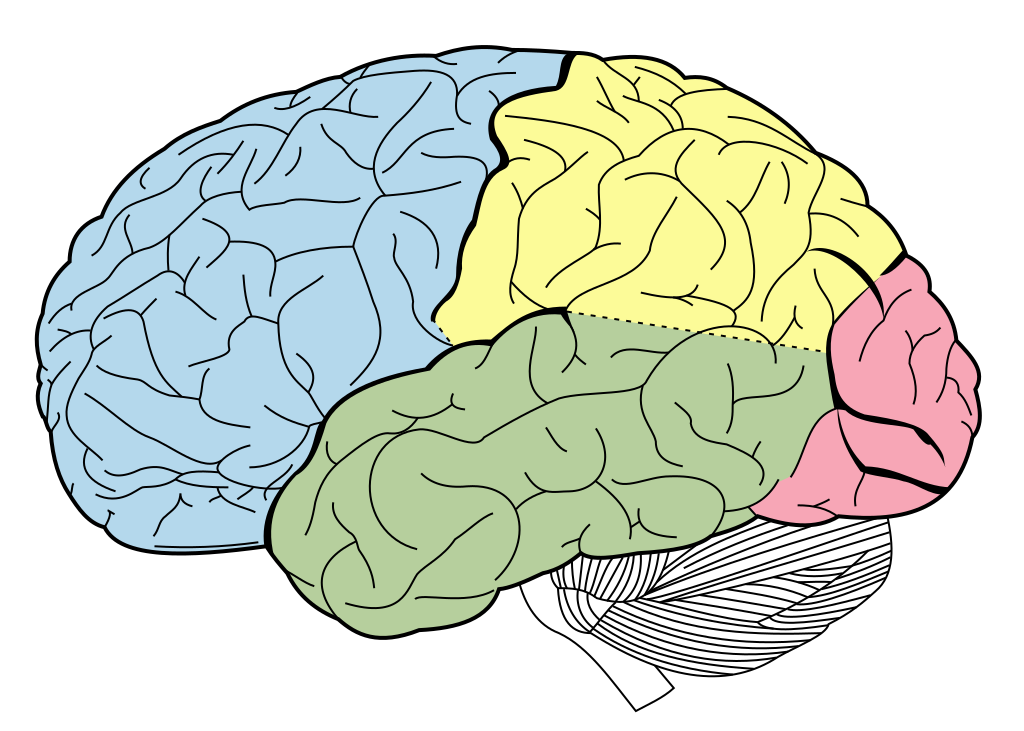
Paratonia is the inability to relax muscles during muscle tone assessment. There are two types of paratonia: oppositional and facilitatory. Oppositional paratonia ("gegenhalten") occurs when subjects involuntarily resist passive movements, while facilitatory paratonia ("mitgehen") occurs when subjects involuntarily assist with passive movements. Both types of paratonia have been associated with cognitive impairment or mental disorders, particularly in relation to frontal lobe dysfunction. Paratonia is frequently encountered in association with dementia.
Paratonia can be assessed with rating scales during clinical examination. Paratonia scale is a semi-quantitative score to rate the amount of oppositional and facilitatory paratonia separately. Kral modified procedure is a more objective semi-quantitative rating of upper limb facilitatory paratonia easily applicable while patients are seated. The Paratonia Assessment Instrument (PAI) was also used in a physiotherapic setting for the assessment of oppositional paratonia.
In 2017 facilitatory and oppositional paratonia have been assessed with surface electromyography, allowing a quantitative measure and better characterization of paratonia. Recording paratonia with electromyography on elbow flexor and extensors during repetitive continuous or discontinuous elbow movements may help distinguish paratonia from other forms of altered muscle tone. Both facilitatory and oppositional paratonia increase during continuous flexion and extension movements, moreover, oppositional paratonia increases with movement velocity. Spasticity also is velocity-dependent, but, differently from oppositional paratonia, if repeatedly elicited decreases instead of increasing. Conversely, parkinsonian rigidity is independent from movement velocity and probably also from movement repetition.
References
References
- Dupré, E. (1910). "Débilité mentale et débilité motrice associées". Revue Neurologique (Paris).
- Kral, VA. (1949). "Ueber eine iterative Bewegunsstörung bei Stirnhirnläsionen". Monatsschrift für Psychiatrie und Neurologie.
- Mumenthaler, M. (February 2017}} {{ISBN missing). "Neurology". Thieme.
- Fogel, Barry S.. (2015). "Psychiatric Care of the Medical Patient". Oxford University Press.
- (1998-10-01). "Facilitory paratonia and frontal lobe functioning". [[Neurology (journal).
- (2000-01-01). "Movement disorders in Alzheimer's disease: more rigidity of definitions is needed". [[Movement Disorders (journal).
- (2002-12-01). "Subcortical vascular disease and functional decline: a 6-year predictor study". [[Journal of the American Geriatrics Society]].
- (2005-09-01). "Primitive reflexes and cognitive function". [[Arquivos de Neuro-Psiquiatria]].
- (2007). "Prevalence and Impact of Paratonia in Alzheimer Disease in a Multiracial Sample". [[The American Journal of Geriatric Psychiatry]].
- (2020). "Paratonia in Dementia: A Systematic Review.". Journal of Alzheimer's Disease.
- (2011-09-01). "Prevalence, incidence and risk factors of paratonia in patients with dementia: a one-year follow-up study". International Psychogeriatrics.
- (2008-08-01). "Diagnosing paratonia in the demented elderly: reliability and validity of the Paratonia Assessment Instrument (PAI)". International Psychogeriatrics.
- (2016-12-20). "Electromyographic assessment of paratonia". [[Experimental Brain Research]].
- (2014-10-30). "Pathophysiology of Spasticity: Implications for Neurorehabilitation". [[BioMed Research International]].
- (2016-09-04). "Reduction of Elbow Flexor and Extensor Spasticity Following Muscle Stretch". [[Neurorehabilitation and Neural Repair]].
- (1992-08-01). "Relationship between electromyographic activity and clinically assessed rigidity studied at the wrist joint in Parkinson's disease". Brain: A Journal of Neurology.
This article was imported from Wikipedia and is available under the Creative Commons Attribution-ShareAlike 4.0 License. Content has been adapted to SurfDoc format. Original contributors can be found on the article history page.
Ask Mako anything about Paratonia — get instant answers, deeper analysis, and related topics.
Research with MakoFree with your Surf account
Create a free account to save articles, ask Mako questions, and organize your research.
Sign up freeThis content may have been generated or modified by AI. CloudSurf Software LLC is not responsible for the accuracy, completeness, or reliability of AI-generated content. Always verify important information from primary sources.
Report