From Surf Wiki (app.surf) — the open knowledge base
Parasailor

The Parasailor and Parasail are patented and trademarked variants of a spinnaker sail for yachts. They were designed for cruising couples and short-handed crews and are considered to be easy to handle and well tempered. These sails make it possible to use one sail as spinnaker and Gennaker. These sails can be used between 70 and 180 degrees to the wind. Relieving the pressure on the bow and the stabilizing effect of the Parasailor and Parasail improve the effect of the rudder and decrease the rudder throws needed.
The Parasailor has a double-layer wing which inflates as the wind fills the sail. This acts like a soft batten, holding the sail out and actively re-opening the collapsed leech. The wing generates a lift that raises the bow of the boat, and also ensures that there is no loss of propulsion. Thanks to this lift, any yawing by the boat is prevented, making a much more comfortable ride. Even if the Parasailor has collapsed after a sudden strong wind shift, the spreading movement of the wing supports the re-opening once the wind has shifted back again.
Parasail
The Parasail was developed as a variant of the Parasailor and is meant to be used in light winds. With a claimed minimal tendency to roll, it is said to be ideal for small crews. It can be used with a spinnaker pole, but it's not necessary. The Parasail has a single-skinned wing as opposed to the double-layer wing of the Parasailor.
Parasailor and Parasail Compared
| Parasailor | Parasail |
|---|---|
| Boat Size | From Approx. 30 ft |
| Wing Type | Volume Wing (3D) |
| Intrinsic Stability | Very High |
| Minimum Wind Speed | 5 kts |
| Works on Autopilot | Yes |
| Spinnaker Pole Required | No (but possible) |
Wing Technology
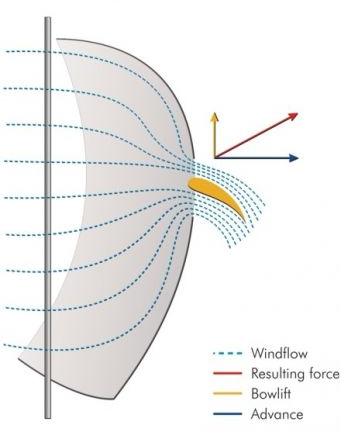
A tailwind fills the sail and propels the yacht forward. Part of the pressure escapes through the opening in the sail behind which the wing has been fitted in such a way that the air flows past, above and below it. Thanks to the shape of the wing and the angle at which the air flows towards it (with the angle optimized for efficiency), the air on the upper surface of the wing accelerates faster than the air flowing over the lower surface. The resultant increase in pressure on the lower surface compared to the upper surface causes the wing to lift, helping to stabilize the sail.
Notes
References
- "ISTEC Parasailor".
- "Parasailor".
- "Parasailor: An Agreeable Companion".
- "Parasailor and Parasail Compared".
This article was imported from Wikipedia and is available under the Creative Commons Attribution-ShareAlike 4.0 License. Content has been adapted to SurfDoc format. Original contributors can be found on the article history page.
Ask Mako anything about Parasailor — get instant answers, deeper analysis, and related topics.
Research with MakoFree with your Surf account
Create a free account to save articles, ask Mako questions, and organize your research.
Sign up freeThis content may have been generated or modified by AI. CloudSurf Software LLC is not responsible for the accuracy, completeness, or reliability of AI-generated content. Always verify important information from primary sources.
Report