From Surf Wiki (app.surf) — the open knowledge base
Paranthropus boisei
Extinct species of hominin of East Africa

Extinct species of hominin of East Africa
- Australopithecus boisei
- P. aethiopicus?
Paranthropus boisei is a species of australopithecine from the Early Pleistocene of East Africa about 2.5 to 1.15 million years ago. The holotype specimen, OH 5, was discovered by palaeoanthropologist Mary Leakey in 1959 at Olduvai Gorge, Tanzania and described by her husband Louis a month later. It was originally placed into its own genus as "Zinjanthropus boisei", but is now relegated to Paranthropus along with other robust australopithecines. However, it is also argued that Paranthropus is an invalid grouping and synonymous with Australopithecus, so the species is also often classified as Australopithecus boisei.
Robust australopithecines are characterised by heavily built skulls capable of producing high stresses and bite forces, and some of the largest molars with the thickest enamel of any known ape. P. boisei is the most robust of this group. Brain size was about 450–550 cc, similar to other australopithecines. Some skulls are markedly smaller than others, which is taken as evidence of sexual dimorphism where females are much smaller than males, though body size is difficult to estimate given only one specimen, OH** 80, definitely provides any bodily elements. The presumed male OH **80 may have been 156 cm tall and 61.7 kg in weight, and the presumed female KNM-ER 1500 124 cm tall (though its species designation is unclear). The arm and hand bones of OH 80 and KNM-ER 47000 suggest P. boisei was arboreal to a degree.
P. boisei was originally believed to have been a specialist species of hard foods, such as nuts, due to its heavily built skull, but it was more likely a generalist feeder of predominantly abrasive C4 plants, such as grasses or underground storage organs. Like gorillas, the apparently specialised adaptations of the skull may have only been used with less desirable fallback foods, allowing P. boisei to inhabit a wider range of habitats than gracile australopithecines. P. boisei may have been able to make Oldowan stone tools and butcher carcasses. P. boisei mainly inhabited wet, wooded environments, and coexisted with H. habilis, H. rudolfensis and H. ergaster/erectus. These were likely preyed upon by the large carnivores of the time, including big cats, crocodiles, and hyenas.
Research history
Discovery
Palaeoanthropologists Mary and Louis Leakey had conducted excavations in Tanzania since the 1930s, though work was postponed with the start of World War II. They returned in 1951, finding mostly ancient tools and fossils of extinct mammals for the next few years. In 1955, they unearthed a hominin baby canine and large molar tooth in Olduvai Gorge, catalogue ID Olduvai Hominin (OH) 3.
On the morning of July 17, 1959, Louis felt ill and stayed at camp while Mary went out to Bed I's Frida Leakey Gully. Sometime around 11:00 a.m., she noticed what appeared to be a portion of a skull poking out of the ground, OH 5. The dig team created a pile of stones around the exposed portion to protect it from further weathering. Active excavation began the following day; they had chosen to wait for photographer Des Bartlett to document the entire process. The partial cranium was fully unearthed August 6, though it had to be reconstructed from its fragments which were scattered in the scree. Louis published a short summary of the find and context the following week.
Louis determined OH 5 to be a subadult or adolescent based on dental development, and he and Mary nicknamed it "Dear Boy". After they reconstructed the skull and jaws, newspapers began referring to it as "Nutcracker Man" due to the large back teeth and jaws which gave it a resemblance to vintage nutcrackers. South African palaeoanthropologist Phillip Tobias, a colleague of the Leakeys, has also received attribution for this nickname. The cranium was taken to Kenya after its discovery and was there until January 1965 when it was placed on display in the Hall of Man at the National Museum of Tanzania in Dar es Salaam.
Other specimens
Louis preliminarily supposed OH 5 was about half a million years old, but in 1965, American geologists Garniss Curtis and Jack Evernden dated OH 5 to 1.75 million years ago using potassium–argon dating of anortoclase crystals from an overlying tuff (volcanic ash) bed. Such an application of geochronology was unprecedented at the time.

The first identified jawbone, Peninj 1, was discovered Lake Natron just north of Olduvai Gorge in 1964. Especially from 1966 to 1975, several more specimens revealing facial elements were reported from the Shungura Formation, Ethiopia; Koobi Fora and Chesowanja, Kenya; and Omo and Konso, Ethiopia. Among the notable specimens found include the well preserved skull KNM-ER 406 from Koobi Fora in 1970. In 1999, a jawbone was recovered from Malema, Malawi, extending the species' southernmost range over 2000 km from Olduvai Gorge. In 2015, based on OH 80, American palaeoanthropologist Michael Lague recommended assigning the isolated humerus specimens KNM-ER 739, 1504, 6020 and 1591 from Koobi Fora to P. boisei. In 2020, the first associated hand bones were reported, KNM-ER 47000 (which also includes a nearly complete arm), from Ileret, Kenya.
Naming
The remains were clearly australopithecine (not of the genus Homo), and at the time, the only australopithecine genera described were Australopithecus by Raymond Dart and Paranthropus (the South African P. robustus) by Robert Broom, and there were arguments that Paranthropus was synonymous with Australopithecus. Louis believed the skull had a mix of traits from both genera, briefly listing 20 differences, and so used OH 5 as the basis for the new genus and species "Zinjanthropus boisei" on August 15, 1959. The genus name derives from the medieval term for East Africa, "Zanj", and the specific name was in honour of Charles Watson Boise, the Leakeys' benefactor.
Soon after, Louis presented "Z." boisei to the 4th Pan-African Congress on Prehistory in Léopoldville, Belgian Congo (now Kinshasa, Democratic Republic of the Congo). In 1960, American anthropologist John Talbot Robinson pointed out that the supposed differences between "Zinjanthropus" and Paranthropus are due to OH 5 being slightly larger, and so recommended the species be reclassified as P. boisei. Louis rejected Robinson's proposal. Following this, it was debated if P. boisei was simply an East African variant of P. robustus until 1967 when South African palaeoanthropologist Phillip V. Tobias gave a far more detailed description of OH 5 in a monograph (edited by Louis). Tobias and Louis still retained "Zinjanthropus", but recommended demoting it to subgenus level as Australopithecus ("Zinjanthropus") boisei, considering Paranthropus to be synonymous with Australopithecus.
Classification
The genus Paranthropus (otherwise known as "robust australopithecines") typically includes P. boisei, P. aethiopicus and P. robustus. It is debated if Paranthropus is a valid natural grouping (monophyletic) or an invalid grouping of similar-looking hominins (paraphyletic). Because skeletal elements are so limited in these species, their affinities with each other and to other australopithecines is difficult to gauge with accuracy. The jaws are the main argument for monophyly, but such anatomy is strongly influenced by diet and environment, and could in all likelihood have evolved independently in P. boisei and P. robustus. Proponents of monophyly consider P. aethiopicus to be ancestral to the other two species, or closely related to the ancestor. Proponents of paraphyly allocate these three species to the genus Australopithecus as A. boisei, A. aethiopicus and A. robustus.
Before P. boisei was described (and P. robustus was the only member of Paranthropus), Broom and Robinson continued arguing that P. robustus and A. africanus (the then only known australopithecines) were two distinct lineages. However, remains were not firmly dated, and it was debated if there were indeed multiple hominin lineages or if there was only 1 leading to humans. In 1975, the P. boisei skull KNM-ER 406 was demonstrated to have been contemporaneous with the H. ergaster/erectus skull KNM ER 3733, which is generally taken to show that Paranthropus was a sister taxon to Homo, both developing from some Australopithecus species, which at the time only included A. africanus. In 1979, a year after describing A. afarensis from East Africa, anthropologists Donald Johanson and Tim D. White suggested that A. afarensis was instead the last common ancestor between Homo and Paranthropus, and A. africanus was the earliest member of the Paranthropus lineage or at least was ancestral to P. robustus, because A. africanus inhabited South Africa before P. robustus, and A. afarensis was at the time the oldest-known hominin species at roughly 3.5 million years old. Now, the earliest known South African australopithecine ("Little Foot") dates to 3.67 million years ago, contemporaneous with A. afarensis.
Such arguments are based on how one draws the hominin family tree, and the exact classification of Australopithecus species with each other is quite contentious. For example, if the South African A. sediba (which evolved from A. africanus) is considered the ancestor or closely related to the ancestor of Homo, then this could allow for A. africanus to be placed more closely related to Homo than to Paranthropus. This would leave the Ethiopian A. garhi as the ancestor of P. aethiopicus instead of A. africanus (assuming Paranthropus is monophyletic, and that P. aethiopicus evolved at a time in East Africa when only A. garhi existed there).
|main-footer=Three example family trees with P. boisei (note, they are not absolute) Because P. boisei and P. aethiopicus are both known from East Africa and P. aethiopicus is only confidently identified from the skull KNM WT 17000 and a few jaws and isolated teeth, it is debated if P. aethiopicus should be subsumed under P. boisei or if the differences stemming from archaicness justifies species distinction. The terms P. boisei sensu lato ("in the broad sense") and P. boisei sensu stricto ("in the strict sense") can be used to respectively include and exclude P. aethiopicus from P. boisei when discussing the lineage as a whole.
P. aethiopicus is the earliest member of the genus, with the oldest remains, from the Ethiopian Omo Kibish Formation, dated to 2.6 million years ago (mya) at the end of the Pliocene. The oldest P. boisei remains date to about 2.3 mya from Malema. The youngest record of P. boisei comes Olduvai Gorge (OH 80) about 1.34 mya;
Anatomy
Skull
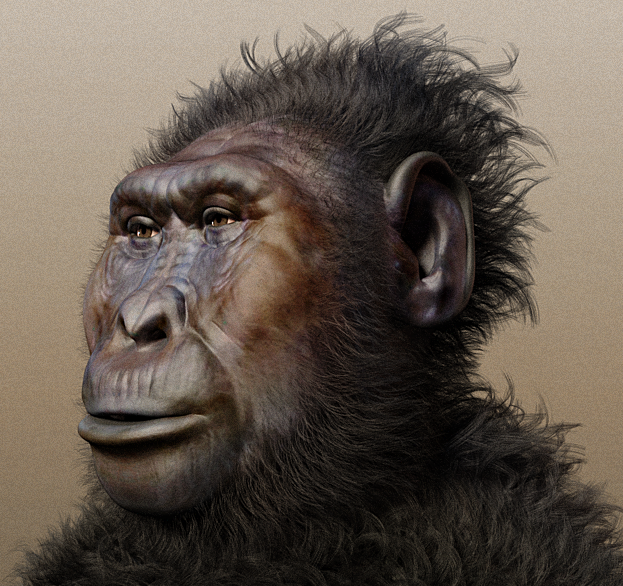
P. boisei is the most robust of the robust australopithecines, whereas the South African P. robustus is smaller with comparatively more gracile features. The skull features large rough patches (rugosities) on the cheek and jawbones, and males have pronounced sagittal (on the midline) and temporonuchal (on the back) crests, which indicate a massive masseter muscle (used in biting down) placed near the front of the head (increasing mechanical advantage). This is typically considered to be evidence of a high bite force.
The incisors and canines are reduced, which would hinder biting off chunks of large food pieces. In contrast, the cheek teeth of both sexes are enormous (postcanine megadontia), and the greater surface area would have permitted the processing of larger quantities of food at once. The molars are bunodont, featuring low and rounded cusps. The premolars resemble molars (are molarised), which may indicate P. boisei required an extended chewing surface for processing a lot of food at the same time. The enamel on the cheek teeth are among the thickest of any known ape, which would help resist high stresses while biting.

Brain and sinuses
In a sample of 10 P. boisei specimens, brain size varied from 444–545 cc with an average of 487.5 cc. However, the lower-end specimen, Omo L338‐y6, is a juvenile, and many skull specimens have a highly damaged or missing frontal bone which can alter brain volume estimates. The brain volume of australopithecines generally ranged from 400–500 cc, and for contemporary Homo 500–900 cc.
Regarding the dural venous sinuses, in 1983, American neuroanthropologist Dean Falk and anthropologist Glenn Conroy suggested that, unlike A. africanus or modern humans, all Paranthropus (and A. afarensis) had expanded occipital and marginal (around the foramen magnum) sinuses, completely supplanting the transverse and sigmoid sinuses. In 1988, Falk and Tobias demonstrated that hominins can have both an occipital/marginal and transverse/sigmoid systems concurrently or on opposite halves of the skull, such as with the P. boisei specimen KNM-ER 23000.

In 1983, French anthropologist Roger Saban stated that the parietal branch of the middle meningeal artery originated from the posterior branch in P. boisei and P. robustus instead of the anterior branch as in earlier hominins, and considered this a derived characteristic due to increased brain capacity. It has since been demonstrated that the parietal branch could originate from either the anterior or posterior branches, sometimes both in a single specimen on opposite sides of the skull as in KNM-ER 23000 and OH 5.
Postcranium
The wide range of size variation in skull specimens seems to indicate a great degree of sexual dimorphism with males being notably bigger than females. However, it is difficult to predict with accuracy the true dimensions of living males and females due to the lack of definitive P. boisei skeletal remains, save for the presumed male OH 80. Based on an approximation of 400 mm for the femur before it was broken and using modern humanlike proportions (which is probably an unsafe assumption), OH 80 was about 156.3 cm tall in life. The femoral head, the best proxy for estimating body mass, is missing, but using the shaft, OH 80 weighed about 50 kg assuming humanlike proportions, and 61.7 kg using the proportions of a non-human ape. which would be consistent with the argument of sexual dimorphism,

Instead, the OH 80 femur, more like H. erectus femora, is quite thick, features a laterally flattened shaft, and indicates similarly arranged gluteal, pectineal and intertrochanteric lines around the hip joint. Nonetheless, the intertrochanteric line is much more defined in OH 80, the gluteal tuberosity is more towards the midline of the femur, and the mid-shaft in side-view is straighter, which likely reflect some difference in load-bearing capabilities of the leg. Unlike P. robustus, the arm bones of OH 80 are heavily built, and the elbow joint shows similarities to that of modern gibbons and orangutans. This could either indicate that P. boisei used a combination of terrestrial walking as well as suspensory behaviour, or was completely bipedal but retained an ape-like upper body condition from some ancestor species due to a lack of selective pressure to lose them. In contrast, the P. robustus hand is not consistent with climbing. The hand of KNM-ER 47000 shows Australopithecus-like anatomy lacking the third metacarpal styloid process (which allows the hand to lock into the wrist to exert more pressure), a weak thumb compared to modern humans, and curved phalanges (finger bones) which are typically interpreted as adaptations for climbing. Nonetheless, despite lacking a particularly forceful precision grip like Homo, the hand was still dextrous enough to handle and manufacture simple tools.
Palaeobiology
Diet
In 1954, Robinson suggested that the heavily built skull of Paranthropus (at the time only including P. robustus) was indicative of a specialist diet specifically adapted for processing a narrow band of foods. Because of this, the predominant model of Paranthropus extinction for the latter half of the 20th century was that it was unable to adapt to the volatile climate of the Pleistocene, unlike the much more adaptable Homo.
However, in 1981, English anthropologist Alan Walker found that the microwearing patterns on the molars were inconsistent with a diet high in hard foods, and were effectively indistinguishable from the pattern seen in the molars of fruit-eating (frugivorous) mandrills, chimpanzees and orangutans. The microwearing on P. boisei molars is different from that on P. robustus molars, and indicates that P. boisei, unlike P. robustus, very rarely ever ate hard foods. Carbon isotope analyses report a diet of predominantly C4 plants, such as low quality and abrasive grasses and sedges, a finding bolstered by more indirect evidence that P. boisei went extinct during a time of significant shrinkage of C4 grasslands in Africa. Thick enamel is consistent with grinding abrasive foods. The microwear patterns in P. robustus have been thoroughly examined, and suggest that the heavy build of the skull was only relevant when eating less desirable fallback foods. A similar scheme may have been in use by P. boisei. Such a strategy is similar to that used by modern gorillas, which can sustain themselves entirely on lower quality fallback foods year-round, as opposed to lighter built chimps (and presumably gracile australopithecines) which require steady access to high quality foods.

In 1980, anthropologists Tom Hatley and John Kappelman suggested that early hominins (convergently with bears and pigs) adapted to eating abrasive and calorie-rich underground storage organs (USOs), such as roots and tubers. Since then, hominin exploitation of USOs has gained more support. In 2005, biological anthropologists Greg Laden and Richard Wrangham proposed that Paranthropus relied on USOs as a fallback or possibly primary food source, and noted that there may be a correlation between high USO abundance and hominin occupation. In this model, P. boisei may have been a generalist feeder with a predilection for USOs, and may have gone extinct due to an aridity trend and a resultant decline in USOs in tandem with increasing competition with baboons and Homo. Like modern chimps and baboons, australopithecines likely foraged for food in the cooler morning and evening instead of in the heat of the day.
Technology
By the time OH 5 was discovered, the Leakeys had spent 24 years excavating the area for early hominin remains, but had instead recovered mainly other animal remains as well as the Oldowan stone tool industry. Because OH 5 was associated with the tools and processed animal bones, they presumed it was the toolmaker. Attribution of the tools was promptly switched to the bigger-brained H. habilis upon its description in 1964. In 2013, OH 80 was found associated with a mass of Oldowan stone tools and animal bones bearing evidence of butchery. This could potentially indicate P. boisei was manufacturing this industry and ate meat to some degree.
Additionally, the Early Stone Age of Africa coincides with simple bone tools. In South Africa, these are unearthed in the Cradle of Humankind and are largely attributed to P. robustus. In East Africa, a few have been encountered at Olduvai Gorge Beds I–IV, occurring over roughly 1.7 to 0.8 million years ago, and are usually made of limb bones and possibly teeth of large mammals, most notably elephants. The infrequency of such large animals at this site may explain the relative rarity of bone tools. The toolmakers were modifying bone in much the same way as they did with stone. Though the Olduvan bone tools are normally ascribed to H. ergaster/erectus, the presence of both P. boisei and H. habilis obfuscates attribution.
Social structure
In 1979, American biological anthropologist Noel T. Boaz noticed that the relative proportions between large mammal families at the Shungura Formation are quite similar to the proportion in modern-day across sub-Saharan Africa. Boaz believed that hominins would have had about the same population density as other large mammals, which would equate to 0.006–1.7 individuals per square kilometre (0.4 square mile). Alternatively, by multiplying the density of either bovids, elephants, or hippos by the percentage of hominin remains out of total mammal remains found at the formation, Boaz estimated a density of 0.001–2.58 individuals per square kilometre. Biologist Robert A. Martin considered population models based on the number of known specimens to be flimsy. In 1981, Martin applied equations formulated by ecologists Alton S. Harestad and Fred L. Bunnel in 1979 to estimate the home range and population density of large mammals based on weight and diet, and, using a weight of 52.4 kg, he got: 130 ha and 0.769 individual per square kilometre if herbivorous; 1295 ha and 0.077 individual if omnivorous; and 287819 ha and 0.0004 individual if carnivorous. For comparison, he calculated 953 ha and 0.104 individual per square kilometre for omnivorous, 37.5 kg chimps.

A 2017 study postulated that, because male non-human great apes have a larger sagittal crest than females (particularly gorillas and orangutans), the crest may be influenced by sexual selection in addition to supporting chewing muscles. Further, the size of the sagittal crest (and the gluteus muscles) in male western lowland gorillas has been correlated with reproductive success. They extended their interpretation of the crest to the males of Paranthropus species, with the crest and resultantly larger head (at least in P. boisei) being used for some kind of display. This contrasts with other primates which flash the typically engorged canines in agonistic display (the canines of Paranthropus are comparatively small). However, it is also possible that male gorillas and orangutans require larger temporalis muscles to achieve a wider gape to better display the canines.
Development
Australopithecines are generally considered to have had a faster, apelike growth rate than modern humans largely due to dental development trends. Broadly speaking, the emergence of the first permanent molar in early hominins has been variously estimated anywhere from 2.5 to 4.5 years of age, which all contrast markedly with the modern human average of 5.8 years. The tips of the mesial cusps of the 1st molar (on the side closest to the premolar) of KNM-ER 1820 were at about the same level as the cervix (where the enamel meets the cementum) of its non-permanent 2nd premolar. In baboons, this stage occurs when the 1st molar is about to erupt from the gums. The tooth root is about 5 mm, which is similar to most other hominins at this stage. In contrast, the root of the P. robustus specimen SK 62 was 6 mm when emerging through the dental alveolus (an earlier stage of development than gum emergence), so, unless either specimen is abnormal, P. robustus may have had a higher tooth-root formation rate. The specimen's 1st molar may have erupted 2–3 months before death, so possibly at 2.7–3.3 years of age. In modern apes (including humans), dental development trajectory is strongly correlated with life history and overall growth rate, but it is possible that early hominins simply had a faster dental trajectory and slower life history due to environmental factors, such as early weaning age exhibited in modern indriid lemurs.
Palaeoecology
P. boisei remains have been found predominantly in what were wet, wooded environments, such as wetlands along lakes and rivers, wooded or arid shrublands, and semi-arid woodlands, Its abundance likely increased during precession-driven periods of relative humidity while being more rare during intervals of aridity. During the Pleistocene, there seems to have been coastal and montane forests in Eastern Africa. More expansive river valleys–namely the Omo River Valley–may have served as important refuges for forest-dwelling creatures. Being cut off from the forests of Central Africa by a savanna corridor, these East African forests would have promoted high rates of endemism, especially during times of climatic volatility. Australopithecines and early Homo likely preferred cooler conditions than later Homo, as there are no australopithecine sites that were below 1000 m in elevation at the time of deposition. This would mean that, like chimps, they often inhabited areas with an average diurnal temperature of 25 C, dropping to 10 or at night.
P. boisei coexisted with H. habilis, H. rudolfensis and H. ergaster/erectus, but it is unclear how they interacted. To explain why P. boisei was associated with Oldowan tools despite not being the tool maker, Louis Leakey and colleagues, when describing H. habilis in 1964, suggested that one possibility was P. boisei was killed by H. habilis, perhaps as food. However, when describing P. boisei 5 years earlier, he said, "There is no reason whatever, in this case, to believe that the skull [OH 5] represents the victim of a cannibalistic feast by some hypothetical more advanced type of man." OH 80 seems to have been eaten by a big cat. The leg OH 35, which either belongs to P. boisei or H. habilis, shows evidence of leopard predation. Other likely Oldowan predators of great apes include the hunting hyena Chasmaporthetes nitidula, the sabertoothed cats Dinofelis and Megantereon, and the crocodile Crocodylus anthropophagus. P. boisei was also the probable origin of genital herpes (HSV-2) in modern humans. They likely contracted the disease by consuming infected chimp meat. The disease then spread from P. boisei to Homo erectus the same way, as interactions between the two species would have been common around sources of water. An infection of cold sores (HSV-1), may have provided an initial layer of protection from HSV-2, until the disease "adapted to a different mucosal niche".
References
Bibliography
References
- (2020-05-29). "Hominin Taxic Diversity".
- {{harvnb. Leakey. 1979
- {{harvnb. Lewin. Foley. 2004
- Tobias, P. V.. (2009). "The First Humans – Origin and Early Evolution of the Genus ''Homo''". Springer, Dordrecht.
- {{harvnb. Bowman-Kruhm. 2005
- {{harvnb. Leakey. 1965
- {{harvnb. Morell. 1995
- {{harvnb. Leakey. 1979
- {{harvnb. Cela-Conde. Ayala. 2007
- {{harvnb. Morell. 1995
- {{harvnb. Leakey. 1959
- {{harvnb. Cracraft. Donoghue. 2004
- {{harvnb. Deacon. 1999
- {{harvnb. Cachel. 2006
- {{harvnb. Bowman-Kruhm. 2005
- {{harvnb. Staniforth. 2009
- (1965). "The Potassium-Argon Dating of Late Cenozoic Rocks in East Africa and Italy [and Comments and Reply]". Current Anthropology.
- Gilbert, W. H.. (2013). "Garniss Curtis (1919–2012): Dating Our Past". PLOS Biology.
- (1974). "Journal of Eastern African Research and Development". East African Literature Bureau.
- Virginia Morell. (11 January 2011). "Ancestral Passions: The Leakey Family and the Quest for Humankind's Beginnings". Simon and Schuster.
- Lague, M. R.. (2015). "Taxonomic identification of Lower Pleistocene fossil hominins based on distal humeral diaphyseal cross-sectional shape". PeerJ.
- (2020). "The upper limb of ''Paranthropus boisei'' from Ileret, Kenya". Journal of Human Evolution.
- He initially considered the name "''Titanohomo mirabilis''" ("wonderful Titan-like man").{{harvnb. Johanson. Edgar. 1996
- {{harvnb. Morell. 1995
- Dart made his now famous joke, "... what would have happened if [the ''A. africanus'' specimen] [[Mrs. Ples]] had met Dear Boy one dark night." At the time of discovery, there was resistance to erecting completely new genera based on single specimens, and the Congress largely rejected "''Zinjanthropus''".Morell, Virginia. "Ancestral Passions: The Leakey Family and the Quest for Humankind's Beginnings". Touchstone, 2011. p. 193
- Robinson, J. T.. (1960). "The affinities of the new Olduvai australopithecines". Nature.
- (1979). "A Systematic Assessment of Early African Hominids". Science.
- (2019). "The skull of StW 573, a 3.67 Ma ''Australopithecus prometheus'' skeleton from Sterkfontein Caves, South Africa". Journal of Human Evolution.
- McNulty, K. P.. (2016). "Hominin Taxonomy and Phylogeny: What's In A Name?". Nature Education Knowledge.
- (2019). "Relevance of the eastern African coastal forest for early hominin biogeography". Journal of Human Evolution.
- (2007). "The Evolution of ''Zinjanthropus boisei''". Evolutionary Anthropology.
- (1994). "''Paranthropus boisei'': an example of evolutionary stasis?". American Journal of Physical Anthropology.
- (1981). "Tooth Size and Shape and their Relevance to Studies of Hominid Evolution". Philosophical Transactions of the Royal Society B.
- (2004). "Patterns of resource use in early ''Homo'' and ''Paranthropus''". Journal of Human Evolution.
- (2001). "Comparative context of Plio-Pleistocene hominin brain evolution". Journal of Human Evolution.
- Hawks, J.. (2011). "No brain expansion in ''Australopithecus boisei''". American Journal of Physical Anthropology.
- Tobias, P. V.. (1987). "The brain of ''Homo habilis'': A new level of organization in cerebral evolution". Journal of Human Evolution.
- McHenry, H. M.. (1988). "Evolutionary History of the "Robust" Australopithecines". Routledge.
- Saban, R.. (1983). "Les veines méningées moyennes des Australopithèques". Bulletins et Mémoires de la Société d'Anthropologie de Paris.
- (1993). "New ''Australopithecus boisei'' calvaria from East Lake Turkana, Kenya". American Journal of Physical Anthropology.
- Walker, A.. (1981). "Diet and teeth: Dietary hypotheses and human evolution". Philosophical Transactions of the Royal Society B.
- (April 2008). "Dental Microwear and Diet of the Plio-Pleistocene Hominin ''Paranthropus boisei''". [[PLoS ONE]].
- (2005). "Dental microwear texture analysis shows within-species diet variability in fossil hominins". Nature.
- (2011). "Diet of ''Paranthropus boisei'' in the early Pleistocene of East Africa". Proceedings of the National Academy of Sciences.
- (30 March 2021). "Contracting eastern African C4 grasslands during the extinction of Paranthropus boisei". [[Scientific Reports]].
- (1980). "Bears, pigs, and Plio-Pleistocene hominids: A case for the exploitation of belowground food resources". Human Ecology.
- (2005). "The rise of the hominids as an adaptive shift in fallback foods: Plant underground storage organs (USOs) and australopith origins". Journal of Human Evolution.
- (2010). "HOMINIDS: An agent-based spatial simulation model to evaluate behavioral patterns of early Pleistocene hominids". Ecological Modelling.
- (2014). "Baboon Feeding Ecology Informs the Dietary Niche of ''Paranthropus boisei''". PLOS ONE.
- (2020). "Bone tools from Beds II–IV, Olduvai Gorge, Tanzania, and implications for the origins and evolution of bone technology". Journal of Human Evolution.
- Boaz, N. T.. (1979). "Early Hominid Population Densities: New Estimates". Science.
- Martin, R. A.. (1981). "On extinct hominid population densities". Journal of Human Evolution.
- (2017). "Sagittal crest formation in great apes and gibbons". Journal of Anatomy.
- (2012). "Life-History Inference in the Early Hominins ''Australopithecus'' and ''Paranthropus''". International Journal of Primatology.
- (2011). "Hominin palaeoecology in late Pliocene Malawi: first insights from isotopes (13C, 18O) in mammal teeth". South African Journal of Science.
- (15 June 2019). "Aquatic biomarkers record Pleistocene environmental changes at Paleolake Olduvai, Tanzania". [[Palaeogeography, Palaeoclimatology, Palaeoecology]].
- Bobe, R.. (2006). "The evolution of arid ecosystems in eastern Africa". Journal of Arid Environments.
- (2016). "Bipedality and hair loss in human evolution revisited: The impact of altitude and activity scheduling". Journal of Human Evolution.
- (1964). "A New Species of the Genus ''Homo'' from Olduvai Gorge". Nature.
- de la Torre, I.. (2011). "The origins of stone tool technology in Africa: a historical perspective". Philosophical Transactions of the Royal Society B.
- (2019). "Who ate OH80 (Olduvai Gorge, Tanzania)? A geometric-morphometric analysis of surface bone modifications of a ''Paranthropus boisei'' skeleton". Quaternary International.
- (2012). "Crocodylian and mammalian carnivore feeding traces on hominid fossils from FLK 22 and FLK NN 3, Plio-Pleistocene, Olduvai Gorge, Tanzania". Journal of Human Evolution.
- (2000). "The hunters and the hunted revisited". Journal of Human Evolution.
- (2010). "A New Horned Crocodile from the Plio-Pleistocene Hominid Sites at Olduvai Gorge, Tanzania". PLOS ONE.
- Underdown, Simon J.. (2017-07-01). "Network analysis of the hominin origin of Herpes Simplex virus 2 from fossil data". Virus Evolution.
This article was imported from Wikipedia and is available under the Creative Commons Attribution-ShareAlike 4.0 License. Content has been adapted to SurfDoc format. Original contributors can be found on the article history page.
Ask Mako anything about Paranthropus boisei — get instant answers, deeper analysis, and related topics.
Research with MakoFree with your Surf account
Create a free account to save articles, ask Mako questions, and organize your research.
Sign up freeThis content may have been generated or modified by AI. CloudSurf Software LLC is not responsible for the accuracy, completeness, or reliability of AI-generated content. Always verify important information from primary sources.
Report