From Surf Wiki (app.surf) — the open knowledge base
Parallel harmony
Musical voice leading practice

Musical voice leading practice
In music, parallel harmony, also known as harmonic parallelism, harmonic planing or parallel voice leading, is the parallel movement of two or more melodies (see voice leading).
Effects
When all voices between chords move in parallel motion, this generally reduces or negates the effect of harmonic progression. However, "occasionally chords such as the tonic and dominant may create the sense of harmonic progression".
Illustrative example
Lines with parallel harmony can be viewed as a series of chords with the same intervallic structure. Parallel means that each note within the chord rises or falls by the same interval.
Examples from works
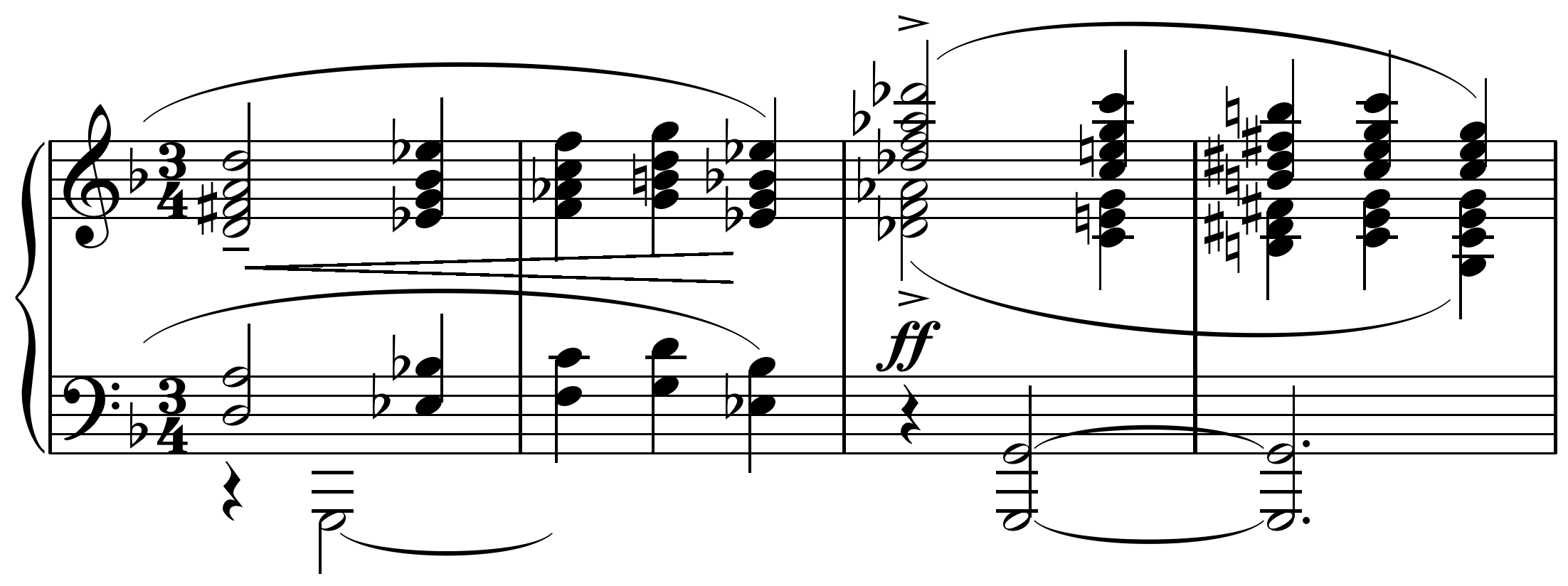
{
\new PianoStaff
\new Staff
\relative c' {
r2 (\ff
2. 4
2 2)
}
\new Staff
\new Voice \relative c {
\stemUp \clef bass \key c \major \time 3/2 \tempo "Sonore sans dureté"
r2 ^(
2. 4
2 )
}
\new Voice \relative c, {
\stemDown
c1.-^--~\markup { \italic "8vb" } c~ c
}
}
Prominent examples include:
- Claude Debussy's Beau soir (1880), Prélude à l'après-midi d'un faune (1894), Nocturnes (1899), La Mer (1905), La cathédrale engloutie, "Voiles", "Feuilles mortes"
- Maurice Ravel's Daphnis and Chloë Suite No. 2 (1913), "Menuet" from Le Tombeau de Couperin
- Erik Satie's Le Fils des étoiles (1892)
- Igor Stravinsky's The Rite of Spring (1913)
- Olivier Messiaen's music features abundant planing
- Richard Strauss's Elektra (1909)
- Arnold Schoenberg's Pierrot lunaire, "Columbine" (1914)
- William Schuman's Three Score Set for Piano (1944)
- John Williams's "Rebel Fanfare" from Star Wars
In the Schuman example (Three Score Set for Piano), the inversions of the chords suggest a bichordal effect.
In the example on the top right, we see a series of quartal chords in parallel motion, in which the intervallic relationship between each consecutive chord member, in this case a minor second, is consistent. Each note in the chord falls by one semitone in each step, from F, B, and E in the first chord to D, G, and C in the last.
Usage in electronic music
Parallel harmony is frequently used in house music and other electronic music genres. Historically, this resulted from producers sampling chords from soul or jazz and then playing them at different pitches, or using "chord memory" feature from classic polyphonic synthesizers. Modern digital audio workstations offer similar chord-generating tools for achieving parallel harmony.
References
Bibliography
- {{cite book
References
- [[David Cope. Cope, David]] (2000). ''New Directions in Music'', p. 6. {{ISBN. 1-57766-108-7.
- Kliewer, Vernon (1975). "Melody: Linear Aspects of Twentieth-Century Music", ''Aspects of Twentieth-Century Music'', pp. 332–333. Wittlich, Gary (ed.). Englewood Cliffs, New Jersey: Prentice-Hall. {{ISBN. 0-13-049346-5.
- "Parallel Harmony".
This article was imported from Wikipedia and is available under the Creative Commons Attribution-ShareAlike 4.0 License. Content has been adapted to SurfDoc format. Original contributors can be found on the article history page.
Ask Mako anything about Parallel harmony — get instant answers, deeper analysis, and related topics.
Research with MakoFree with your Surf account
Create a free account to save articles, ask Mako questions, and organize your research.
Sign up freeThis content may have been generated or modified by AI. CloudSurf Software LLC is not responsible for the accuracy, completeness, or reliability of AI-generated content. Always verify important information from primary sources.
Report