From Surf Wiki (app.surf) — the open knowledge base
Parachute mine
World War 2 naval mine dropped from aircraft by parachute
World War 2 naval mine dropped from aircraft by parachute
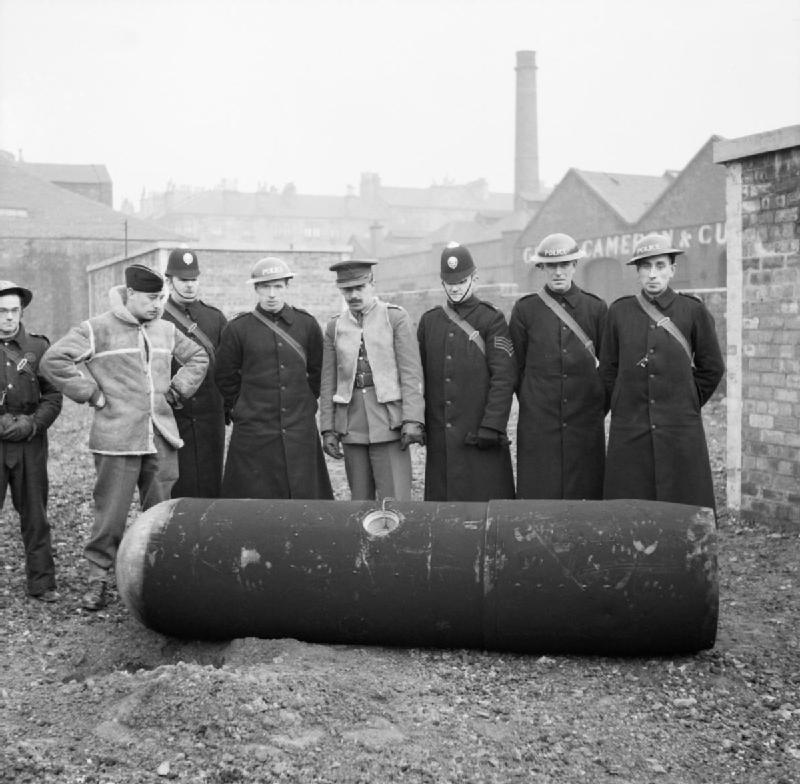
A parachute mine is a naval mine dropped from an aircraft by parachute. They were mostly used in the Second World War by the Luftwaffe and initially by the Royal Air Force (RAF) Bomber Command. Frequently, they were dropped on land targets.
History
Luftwaffe
During the Second World War, the Luftwaffe used a number of different kinds of parachute mines. The Luftmine A (LMA) and Luftmine B (LMB) weighed 500 kg and 1000 kg respectively. The LMA was 5 ft in length and the LMB 8 ft.
.jpg)
After the parachute opened, the mine would descend at around 40 mph. If it came down on land, a clockwork mechanism would detonate the mine 25 seconds after impact. If the mine landed in water it would sink to the bottom. If the depth was greater than 8 ft, water pressure and the dissolving of a water–soluble plug would deactivate the clockwork time-detonator, and activate an anti-shipping detonator. These were initially magnetic detonators but later, acoustic or magnetic/acoustic detonators could be fitted. The Luftwaffe began dropping mines in British waters in November 1939, using Heinkel He 115 seaplanes and Heinkel He 111 land–based bombers. The new British cruiser, HMS Belfast, was damaged by a parachute mine on 21 November in the Firth of Forth, while the destroyer HMS Gipsy was damaged at Harwich on the same night.
The threat to shipping posed by magnetic detonators was effectively negated after a German parachute mine was captured intact when it landed in mud in the Thames Estuary. Thereafter, a ship's magnetic field could be counteracted by a process called degaussing. This involved either the installation of electric wires around the inside of the hull, or for smaller vessels, by passing an electric cable under the hull, known as "wiping".
Parachute mines were first used against land targets on 16 September 1940 in the early stages of the Blitz. It was rumoured that Hermann Göring had ordered parachute mines to be dropped on London in a fit of temper, but it is more likely that they were originally intended to disrupt shipping in the London Docks. From October 1940, mines were also dropped in raids on other British cities such as Birmingham, Liverpool, Manchester and Coventry. Clearance of these was carried out by the Royal Navy, which quickly dispatched a team to London from HMS Vernon, while Army bomb disposal staff were warned that it was extremely inadvisable to attempt to render them safe without Naval guidance. The official British designation for these weapons on land was "Parachute Landmines", but civilians just called them "land mines".
The singer Al Bowlly was killed by a parachute mine which exploded outside his flat in Jermyn Street, London during the Blitz on 17 April 1941.
In 1941 a parachute bomb destroyed Victoria Hall, Sunderland, Tyne and Wear, site of the Victoria Hall disaster of 1883.
The use of standard parachute mines declined after 1941, but the Luftwaffe later used the 1000 kg Bombenmine (BM 1000, Monika, or G Mine). This was fitted with a tail made from Bakelite which broke up on impact. It had a photodetector beneath a cover which detonated the bomb if exposed to light to counteract the work of bomb disposal units.
British operations
thumb|Arming a Liberator for minelaying along the Danube, Celone, Italy Prior to the war, the Admiralty had been developing mines including acoustic and magnetically-triggered types and these were brought into use early in the war. Laid in shallow water they would be set off when a vessel passed over them.
The operations were an extension of the blockade of Germany and targets were chosen by the Admiralty though the laying was carried out by the RAF. RAF Coastal Command were initially responsible but they had few aircraft and their medium bombers could only carry one mine apiece, so RAF Bomber Command took over responsibility with their heavy four-engined bombers which could carry four mines. The Short Stirling was used after it was removed from front-line operations against German cities.
Minelaying operations by RAF were known as "Gardening", the term carrying over into codebreaking.
Mines were about 9 feet and 17 in in diameter. The explosive content of a mine was 750 lb of explosive such as Amatol (TNT and ammonium nitrate) or Minol (TNT, ammonium nitrate and aluminium), the mine overall weighing 1500 lb.
References
References
- "Non-Contact, Parachute Ground (Land) Mine Type GC". Imperial War Museum.
- Boyle, Tony. "Death By Parachute - German Aerial Mine Warfare". Black Country Living Museum.
- . (12 December 2015). ["Degaussing Ships"](http://navymuseum.co.nz/degaussing-ships/). *National Museum of the Royal New Zealand Navy*.
- Major Arthur Hogben. (1987). "Designed to Kill: Bomb disposal from World War 1 to the Falklands". Stephens.
- Rattigan, Maurice. (7 June 2005). "WW2 People's War - Parachute Mines". BBC History.
- Whitcomb, Ian. "The Coming of the". Sam Houston University.
- Stoner, Sarah. (13 June 2008). "Children's deaths that shocked the world". Sunderland Echo.
- MacIsaac, James J.. "Glossary of R.A.F. Slang & terminology".
- "RAF Bomber Command Gardening Operations during WW2".
This article was imported from Wikipedia and is available under the Creative Commons Attribution-ShareAlike 4.0 License. Content has been adapted to SurfDoc format. Original contributors can be found on the article history page.
Ask Mako anything about Parachute mine — get instant answers, deeper analysis, and related topics.
Research with MakoFree with your Surf account
Create a free account to save articles, ask Mako questions, and organize your research.
Sign up freeThis content may have been generated or modified by AI. CloudSurf Software LLC is not responsible for the accuracy, completeness, or reliability of AI-generated content. Always verify important information from primary sources.
Report