From Surf Wiki (app.surf) — the open knowledge base
Papiamento
Creole language in the Dutch Caribbean

Creole language in the Dutch Caribbean
| Field | Value |
|---|---|
| name | Papiamento |
| nativename | pap |
| states | Dutch Caribbean |
| nation | Aruba |
| Bonaire | |
| Curaçao | |
| speakers | 350,000 |
| date | 2025 |
| ref | e25 |
| script | Latin (Papiamento orthography) |
| familycolor | Creole |
| fam1 | Portuguese Creole |
| fam2 | Afro-Portuguese Creole |
| fam3 | Upper Guinea Creole |
| fam4 | Early Papiamento |
| iso2 | pap |
| iso3 | pap |
| glotto | papi1253 |
| glottorefname | Papiamento |
| lingua | 51-AAC-be |
| map | ABCEilandenLocatie.PNG |
| mapcaption | Location map of Aruba, Bonaire, and Curaçao, where Papiamento is spoken |
| ELP | NE |
| agency | Papiamento Academy Foundation |
Bonaire Curaçao
Papiamento () or Papiamentu (; ) is a Portuguese-based creole language spoken in the Dutch Caribbean. It is the most widely spoken language on Aruba, Bonaire, and Curaçao (ABC islands).
The language, spelled Papiamento in Aruba and Papiamentu in Bonaire and Curaçao, is largely based on Portuguese as spoken in the 15th and 16th centuries, and has been influenced considerably by Dutch and Spanish. Due to lexical similarities between Portuguese and Spanish, it is difficult to pinpoint the exact origin of some words. Though there are different theories about its origins, most linguists now believe that Papiamento emerged from the Portuguese-based creole languages of the West African coasts, as it has many similarities with Cape Verdean Creole and Guinea-Bissau Creole.
History


There are various theories about the origin and development of the Papiamento language, and precise history has not been established. Its parent language is surely West Iberian Romance, but scholars dispute whether Papiamento was derived from Portuguese and its derived Portuguese-based creole languages or from Spanish. Historical constraints, core vocabulary, and grammatical features that Papiamento shares with Cape Verdean Creole and Guinea-Bissau Creole are far less than those shared with Spanish, even though the Spanish and Dutch influences occurred later, from the 17th century onwards. In 1978, Jacoba Bouscholte conducted a study on the various Dutch influences in Papiamento. An example of a hybrid word is verfdó, which is a combination of a Dutch root verf (meaning 'paint') and the Portuguese and Spanish suffix -dor (used for a person who performs an action, like 'painter'). The transformation from verver to verfdó involved changing the -dor to -dó due to a linguistic process called apocopation.
The name of the language itself originates from , from Portuguese and Cape Verdean and Bissau Guinean Creole ("to chat, say, speak, talk"), with the addition of the noun-forming suffix .
Spain claimed dominion over the islands in the 15th century but made little use of them. Portuguese merchants had been trading extensively in the West Indies and with the Iberian Union between Portugal and Spain during 1580–1640 period, their trade extended to the Spanish West Indies. In 1634, the Dutch West India Company (WIC) took possession of the islands, deporting most of the small remaining Arawak and Spanish population to the continent (mostly to the Venezuelan west coast and the Venezuelan plains, as well as all the way east to the Venezuela Orinoco basin and Trinidad), and turned them into the hub of the Dutch slave trade between Africa and the Caribbean.
The first evidence of widespread use of Papiamento in Aruba and Curaçao can be seen in official documents in the early 18th century. In the 19th century, most materials in the islands were written in Papiamento including Roman Catholic school books and hymnals. In 1837, the Catecismo Corticu pa uso di catolicanan di Curaçao (Brief Catechism for use by Catholics) was printed, the first printed book in Papiamento. In 2009 the Catecismo Corticu was added to the UNESCO Memory of the World register. The first Papiamento newspaper was published in 1871 and was called Civilisadó (The Civilizer).
Local development theory
One local development theory proposes that Papiamento developed in the Caribbean from an original Portuguese-African pidgin, with later Dutch and Spanish (and even some Arawak) influences.
Another theory is that Papiamento first evolved from the use in the region since 1499 of 'lenguas' and the first repopulation of the ABC Islands by the Spanish by the Cédula real decreed in November 1525 in which Juan Martinez de Ampués, factor of Hispaniola, had been granted the right to repopulate the depopulated Islas inútiles of Oroba, Islas de los Gigantes, and Buon Aire.
The evolution of Papiamento continued under the Dutch colonisation under the influence of 16th-century Dutch, Portuguese (Brazilian) and Native American languages (Arawak and Taíno), with the second repopulation of the ABC islands with immigrants who arrived from the ex-Dutch Brazilian colonies.
The Judaeo-Portuguese population of the ABC islands increased substantially after 1654, when the Portuguese recovered the Dutch-held territories in Northeast Brazil, causing most Portuguese-speaking Jews and their Portuguese-speaking Dutch allies and Dutch-speaking Portuguese Brazilian allies in those lands to flee from religious persecution. The precise role of Sephardic Jews in the early development is unclear, but Jews certainly played a prominent role in the later development of Papiamento. Many early residents of Curaçao were Sephardic Jews from Portugal, Spain, Cape Verde or Portuguese Brazil. Also, after the Eighty Years' War, a group of Sephardic Jews immigrated from Amsterdam. Therefore, it can be assumed that Judaeo-Portuguese was brought to the island of Curaçao, where it gradually spread to other parts of the community. The Jewish community became the prime merchants and traders in the area and so business and everyday trading was conducted in Papiamento. While various nations owned the island, and official languages changed with ownership, Papiamento became the constant language of the residents.
When the Netherlands opened economic ties with Spanish colonies in what are now Venezuela and Colombia in the 18th century, | access-date = students on Curaçao, Aruba, and Bonaire were taught predominantly in Spanish, and Spanish began to influence the creole language. Since there was a continuous Latinisation process (Hoetink, 1987), even the elite Dutch-Protestant settlers eventually communicated better in Spanish than in Dutch, as a wealth of local Spanish-language publications in the 19th century testify.
European and African origin theory
According to the European and African origin theory the origins of Papiamento lie in the Afro-Portuguese creoles that arose in the 16th century in the west coast of Africa and in the Portuguese Cape Verde islands. From the 16th to the late 17th centuries, most of the slaves taken to the Caribbean came from Portuguese trading posts (feitorias, ) in those regions. Around those ports, several Portuguese-African pidgin and creole languages developed, such as Cape Verdean Creole, Guinea-Bissau Creole, Angolar, and Forro (from São Tomé). The sister languages bear strong resemblance with Papiamento. According to this theory, Papiamento was derived from one or more of these older creoles or their predecessors, which were brought to the ABC islands by enslaved Africans and European traders from Cape Verde and West Africa. Later becoming the lingua franca between the various ethnic and religious groups of the islands.
The similarity between Papiamento and the other Afro-Portuguese creoles can be seen in the same pronouns used, mi, bo, el, nos, bos(o), being Portuguese-based. Afro-Portuguese creoles often have a shift from "v" to "b" and from "o" to "u": bientu (), instead of viento. In creole and also in Spanish, and are pronounced the same. In creole, it is also written as a . Just as in Portuguese, an unaccented final is pronounced as .
Guene was the name given to four languages spoken by Africans on Western Curaçaoan plantations of Kenepa, Sabaneta, Lagun and Porto Marí. The name derives from "Guinea" or "Geni", but that does not give much clear indication of African origin, because this name referred to different areas in West Africa in the 17th and 18th centuries. There were possibly hundreds of Guene work songs used to make work lighter, organize work rhythms, guide task execution through instructions, and comment on work situations. Guene influence still exists in current Papiamentu in several domains. Difficulties in understanding its relevance today lies in how to distinguish between Guene and non-Guene contributions from African languages, what role the language(s) had in shaping non-linguistic cultural materials (such as hierarchical relationships, solidarity networks, relations to the ancestors, knowledge of soil types) and how this has been re-encoded into what we know today as Papiamentu.
Linguistic and historical ties with Upper Guinea Portuguese Creole
Since the late 1990s, research has been done that shines light on the ties between Papiamento and Upper Guinea Portuguese Creole. focus specifically on the linguistic and historical relationships with the Upper Guinea Portuguese Creole, as spoken on the Santiago island of Cape Verde and in Guinea-Bissau and Casamance.
In Bart Jacob's study The Upper Guinea Origins of Papiamento he defends the hypothesis that Papiamento is a relexified offshoot of an early Upper Guinea Portuguese Creole variety that was transferred from Senegambia to Curaçao in the second half of the 17th century, when the Dutch controlled the island of Gorée, a slave trading stronghold off the coast of Senegal. The Creole was used for communication among slaves and between slaves and slave holders.
On Curaçao, this variety underwent internal changes as well as contact-induced changes at all levels of the grammar, but particularly in the lexicon, due to contact with Spanish and, to a lesser extent, Dutch. Despite the changes, the morphosyntactic framework of Papiamento is still remarkably close to that of the Upper Guinea Creoles of Cape Verde and Guinea-Bissau. Parallels have also been identified between the development of Papiamento and Catholicism.
Present status
Papiamento is spoken in all aspects of society throughout Aruba, Curaçao and Bonaire.

Papiamento has been an official language of Aruba since May 2003. In the former Netherlands Antilles, Papiamento was made an official language on 7 March 2007. After the dissolution of the Netherlands Antilles on 10 October 2010, Papiamento's official status was confirmed in the newly formed Caribbean Netherlands.
Venezuelan Spanish and American English are constant influences today. Code-switching and lexical borrowing from Spanish, Dutch and English among native speakers is common. This is considered as a threat to the development of the language because of the loss of the authentic and Creole "feel" of Papiamento.
Many immigrants from Latin America and the Caribbean choose to learn Papiamento because it is more practical in daily life on the islands. For Spanish-speakers, it is easier to learn than Dutch, because Papiamento uses many Spanish and Portuguese words.
The first opera in Papiamento, adapted by from his novel Katibu di Shon, was performed at the Stadsschouwburg in Amsterdam on 1 July 2013, commemorating the 150th anniversary of the ending of slavery in the Dutch Caribbean.
Old Papiamento texts
The Papiamento language originates from about 1650. The oldest Papiamento texts that have been preserved are written letters. In the following three letters it can be seen that the words changed and the spelling became closer to the Dutch spelling. Although some words are no longer in use, the basis of Papiamento did not change much.
Piter May letter 1775
The oldest letter dates from 1775. It was sent by the Sephardic Jew Abraham Andrade to his mistress Sarah Vaz Parro, about a family meeting in the centre of Curaçao.
| Old Papiamento | Modern Papiamento | English |
|---|
Boo Jantje letter 1783
The next letter dates from 1783 and was recently discovered in an English archive. It was sent by Anna Charje in the name of her baby Jantje Boufet to her husband Dirk Schermer in Rotterdam. (The final sentence is standard Dutch.)
.jpg)
| Old Papiamento | Modern Papiamento | English |
|---|
Quant Court affidavit 1803
The third text dates from 1803. It is an affidavit (written testimony for use in a court of law as evidence) signed by 26 Aruban farm workers to support their supervisor Pieter Specht against false accusations by landowner B.G. Quant.
| Old Papiamento | Modern Papiamento | English |
|---|
Orthography and spelling
Main article: Papiamento orthography
Papiamento is written using the Latin script.
Since the 1970s, two different orthographies have been developed and adopted. In 1976, Curaçao and Bonaire officially adopted the Römer-Maduro-Jonis version, a phonetic spelling. In 1977, Aruba approved a more etymology-based spelling, presented by the Comision di Ortografia (Orthography Commission), presided by Jossy Mansur.
Distribution and dialects
Papiamento is primarily spoken on Aruba, Curaçao and Bonaire. The language is also spoken by the respective diasporas of the ABC islands, most notably in the Netherlands, and to a lesser extent Sint Maarten. An earlier, now-extinct form of Papiamento was formerly spoken on the Paraguana peninsula of Venezuela.
There are two main dialects of Papiamento, the dialect of Aruba (Papiamento) and the dialect of Curaçao and Bonaire (Papiamentu), with lexical and intonational differences. There are also minor differences between Curaçao and Bonaire.
The most apparent difference between the two dialects is given away in the name difference. Whereas Bonaire and Curaçao opted for a phonology-based spelling, Aruba uses an etymology-based spelling. Many words in Aruba end with "o" while the same word ends with "u" in Bonaire and Curaçao. And even in Curaçao, the use of the u-ending is still more pronounced among the Sephardic Jewish population. Similarly, the use of "k" in Bonaire and Curaçao replaces "c" in Aruba.
For example:
| English | Curaçao and | |||||||
|---|---|---|---|---|---|---|---|---|
| Bonaire | Aruba | Portuguese | Spanish | Lead (metal) | Stick | House | Knife | |
| Chumbu | Chumbo | Chumbo | Plomo | |||||
| Palu | Palo | Pau | Palo | |||||
| Kas | Cas | Casa | Casa | |||||
| Kuchú | Cuchiu | Faca (Cutelo, Cultro) | Cuchillo |
In the past, certain rural areas of Aruba and Curaçao featured the guttural R (a feature common in French) or omitted the letter S at the end of words (a feature common in Caribbean Spanish). However it is likely many of these rural features have either disappeared over time or are used by few speakers today.
Phonology
Vowels and diphthongs
Papiamento vowels are based on Ibero-Romance and Dutch vowels. Papiamento has the following nine vowels:
| Vowels | IPA | Curaçao and | ||
|---|---|---|---|---|
| Bonaire | Aruba | English | ||
| a in kana | ||||
| e in efekto | ||||
| è in balèt | ||||
| e in apel | ||||
| i in chikí | ||||
| o in obra | ||||
| ò in ònbeskòp | ||||
| u in kunuku | ||||
| ù in brùg |
Papiamento has diphthongs, two vowels in a single syllable that form one sound. Papiamento diphthongs are based on Ibero-Romance and Dutch diphthongs. It has the following diphthongs:
| Diphthongs | IPA | Papiamento | English | ||
|---|---|---|---|---|---|
| ai in baile | |||||
| au in fauna | |||||
| ei in esey | |||||
| ei in prijs | |||||
| eu in leu | |||||
| oi in join | |||||
| oi in morocoy | |||||
| ou in abou | |||||
| ui in duim |
Stress and accent
Stress is very important in Papiamento. Many words have a very different meaning when a different stress is used:
- When both syllables are equally stressed, kome, it means "to eat".
- When the first syllable is stressed, kome, it means "eat!" (imperative).
- However, kom'é (short for kome é) means "eat it!"
There are general rules for the stress and accent but also a great many exceptions. When a word deviates from the rules, the stressed vowel is indicated by an acute accent ( ´ ), but it is often omitted in casual writing.
The main rules are: | access-date = 2025-01-08
- When a noun ends in a vowel (a, e, i, o, u), the stress is placed upon the penultimate (before last) syllable: buriku ("donkey").
- When a noun ends in a consonant, the stress is placed upon the last syllable: hospital.
- When a verb has two syllables, the syllables are about equally stressed: sòru ("to care"), falta ("to lack").
- When a verb has more than two syllables, the stress is laid upon the last syllable: kontestá ("to answer"), primintí ("to promise").
Lexicon
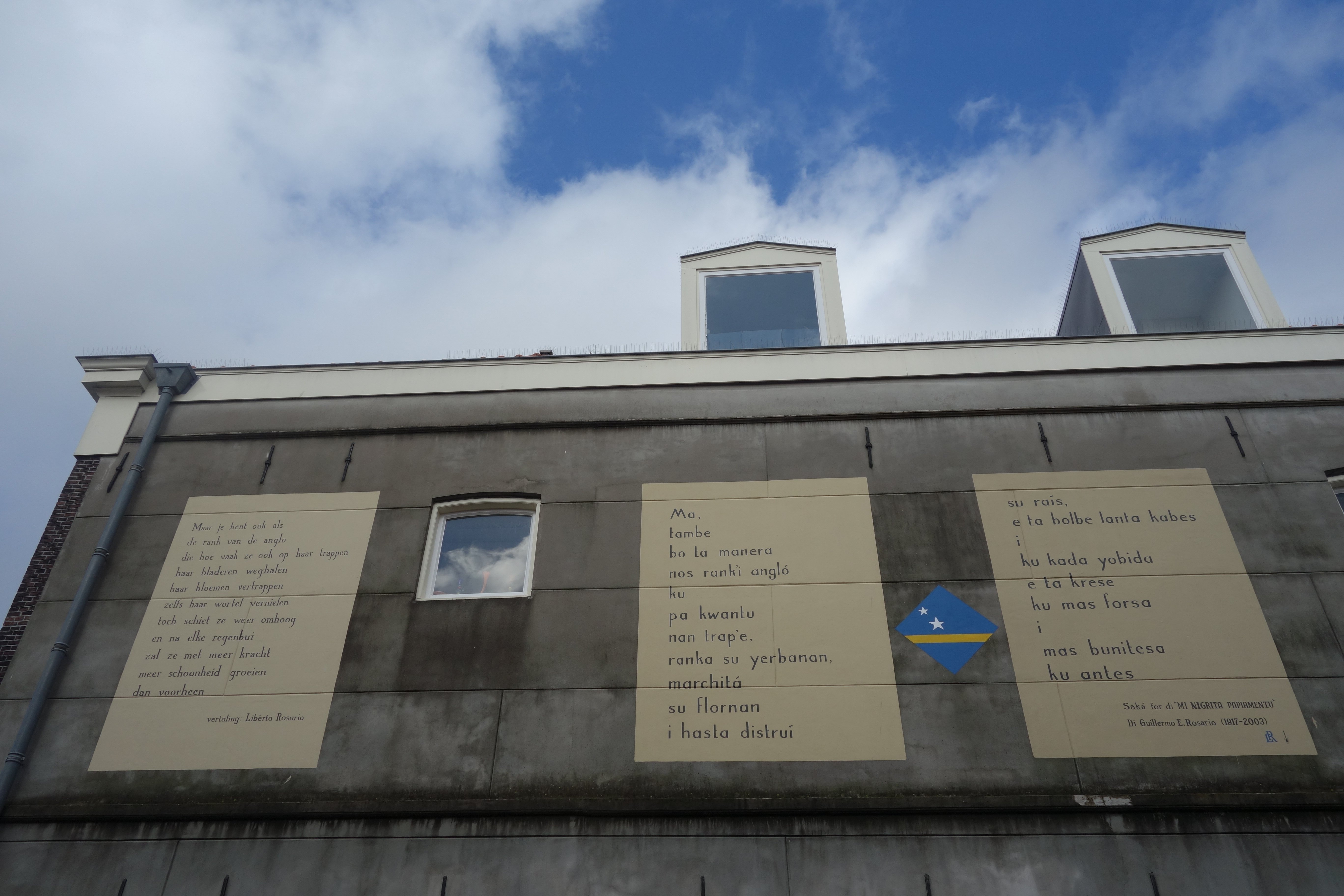
Vocabulary
Most of the vocabulary is derived from Portuguese and derived Portuguese-based creoles and (Early Modern) Spanish. Most of the remaining vocabulary derives from Dutch. The real origin is usually difficult to tell because the two Iberian languages are very similar, and adaptations were made in Papiamento. A list of 200 basic Papiamento words can be found in the standard Swadesh list, with etymological reference to the language of origin. There is a remarkable similarity between words in Papiamento, Cape Verdean Creole, and Guinea-Bissau Creole, which all belong to the same language family of the Upper Guinea Creoles. Most of the words can be connected with their Portuguese origin.
Linguistic studies have shown that roughly 80% of the words in Papiamento's present vocabulary are of Iberian origin, 20% are of Dutch origin, and some of Native American or African origin. A study by Van Buurt and Joubert inventoried the words of Taíno and Caquetío Arawak origin, mostly words for plants and animals. Arawak is an extinct language that was spoken by Indigenous people throughout the Caribbean. The Arawak words were re-introduced in Papiamento by borrowing from the Spanish dialect of Venezuela Some research indicates that some Papiamento vocabulary may derive from English and Caribbean English Creoles, such as Jamaican Patois. There is also an English influence on Papiamento grammar.
Many words are of Iberian origin, and it is impossible to label them as either Portuguese or Spanish:
- por fabor ("please") – Portuguese: por favor – Spanish: por favor
- señora ("madam") – Portuguese: senhora – Spanish: señora
- kua ("which") – Portuguese: qual – Spanish: cuál
- kuantu ("how much") – Portuguese: quanto – Spanish: cuánto
While the presence of word-final can easily be traced to Portuguese, the diphthongisation of some vowels is characteristic of Spanish. The use of , rather than , descends from its pronunciation in the dialects of northern Portugal as well as of Spanish. Also, a sound shift may have occurred in the direction of Spanish, whose influence on Papiamento came later than that of Portuguese: subrino ("nephew"): sobrinho in Portuguese, sobrino in Spanish. The pronunciation of o as is certainly Portuguese, but the use of n instead of nh () in the ending -no is from Spanish.
Few Portuguese words come directly from Portuguese, but most come via the Portuguese-based creole; in the examples below, the Cape Verdean Creole equivalents are borboléta, katchor, prétu and fórsa.
Portuguese-origin words:
- barbulètè ("butterfly") – Portuguese: borboleta
- kachó ("dog") – Portuguese: cachorro
- pretu ("black") – Portuguese: preto
- forsa ("power") – Portuguese: força
Spanish-origin words:
- siudat ("city") – Spanish: ciudad
- sombré ("hat") – Spanish: sombrero
- karson ("trousers") – Spanish: calzón
- hòmber ("man") – Spanish: hombre
Dutch-origin words:
- apel ("apple") – Dutch: appel
- buki ("book") – Dutch: boek
- lesa ("to read") – Dutch: lezen
- mart ("March") – Dutch: maart
English-origin words:
- bèk – English: back
- bòter – English: bottle
- beisbòl - English: baseball
- baiskel – English: bicycle
African-origin words:
- pinda ("peanut") – Kongo: mpinda
- makamba ("Dutch person") – Bantu: ma-kamba
- yongotá ("to kneel") – Wolof: djongotó
- maribomba ("wasp") – Bantu: ma-rimbondo
Native American-origin words:
- orkan ("hurricane") – Taíno: juracán
- maishi ("corn") – Taíno: mahíz
- kunuku ("farm") – Taíno: conuco
- mahos ("ugly") – Arawak: muhusu
Literature and culture
Aruba and Bonaire's national anthems are in Papiamento, "Aruba Dushi Tera" and "Tera di Solo y suave biento" respectively. The newspaper Diario is also in the language.
The 2013 films Abo So (Aruba) and Sensei Redenshon (Curaçao) were the first feature films in Papiamento; the comedy Bon Bini Holland (Curaçao and Netherlands) also contains some Papiamento.
Examples

Phrase and word samples
- Kon ta bai? (How are you?) – Portuguese: Como vai?
- Kon ta k'e bida? (How is life?) – Spanish: ¿Cómo te va la vida? – Portuguese: Como está a vida?
- Por fabor (please) – Spanish: Por favor – Portuguese: Por favor
- Danki (Thank you) – Dutch: Dank je
- Ainda no (Not yet) – Portuguese: Ainda não
- Bo mama ta mashá bunita (Your mother is very beautiful) – Portuguese: Vossa mãe é muito bonita
- Na epoka di mi añanan eskolar (During my school years) – Portuguese: Na época dos meus anos escolares
- Bati boka (Argue) – Portuguese: Bate boca
- Bringa (Fight) – Portuguese: Briga
- Bon (Good) – Portuguese: Bom
Expressions
- Hopi skuma, tiki chukulati (A lot of foam, little chocolate): Too good to be true.
- Einan e porko su rabo ta krul (That is where the pig's tail curls): That is where the problem lies.
- Sopi pura ta sali salo (Quick soup turns salty): Good things take time.
- E ke bula ku ala di manteka (He wants to fly with wings of butter): He wants to do more than he can handle.
- Ora dia ta serka di habri, nochi ta mas skur (Just before dawn, the night is darkest): When need is greatest, salvation is near.
Lord's Prayer
The Lord's Prayer in a register of Papiamento used liturgically by the Roman Catholic Church, compared with Spanish, Portuguese, and King James English:
| Papiamento | Spanish | Portuguese | English |
|---|
Comparison of vocabularies
This section provides a comparison of the vocabularies of Papiamento, Portuguese, and the Portuguese creoles of Guinea-Bissau and Cape Verde. Spanish is shown for the contrast.
| English | Curaçao and | |||||
|---|---|---|---|---|---|---|
| Bonaire | Aruba | Portuguese | Guinea-Bissau | Cape Verdean | Spanish | |
| Good morning | Bon dia | Bon dia | Bom dia | Bon dia | Bon dia | Buen día - Buenos días |
| Thank you | Danki | Danki | Obrigado | Obrigadu | Obrigadu | Gracias |
| How are you? | Kon ta bai? | Con ta bay? | Como estás? Como vais? - | Kumá ku bu na bai?¹ | Módi ki bu sta?² | ¿Cómo estás? - ¿Cómo vás? |
| Very good | Mashá bon | Masha bon | Muito bom | Mutu bon | Mutu bon | Muy bueno |
| I am fine | Mi ta bon | Mi ta bon | Estou bem | N sta diritu | N sta dretu | Estoy bien |
| I | Mi | Mi | Eu | N³ | N³ | Yo |
| I am | (A)Mi ta | (A)Mi ta | Eu sou | (A)Mi i | (A)Mi e | Yo soy |
| Have a nice day | Pasa un bon dia | Pasa un bon dia | Tem um bom dia | Pasa un bon dia | Pasa un bon dia | Pasa un buen día |
| See you later | Te aweró | Te aworo | Até logo | Te logu | Te lógu | Hasta luego |
| Food | Kuminda | Cuminda | Comida | Kumida | Kumida | Comida |
| Bread | Pan | Pan | Pão | Pon | Pon | Pan |
| Not yet | Ainda no | Ainda no | Ainda não | Inda nau | Inda nau² | Aún no |
| I like Curaçao | Mi gusta Kòrsou | Mi gusta Corsou | Eu gosto de Curaçau | N gosta di Curaçau | N gosta di Curaçau | Me gusta Curazao |
¹ Liter. “How are you going?”
² Santiago dialect
³ Unstressed (subject) form. The stressed (non-subject) form is “mi”.
Notes
References
Works cited
References
- "Invoeringswet openbare lichamen Bonaire, Sint Eustatius en Saba". wetten.nl.
- "Language and education in The Caribbean Netherlands".
- Quint, Nicolas. (September 8, 2011). "From West Africa to the Antilles, Dynamic Portuguese Creoles".
- Jacobs, Bart. (2009-11-09). "The Upper Guinea origins of Papiamentu: Linguistic and historical evidence". Diachronica.
- Romero, Simon. (5 July 2010). "Willemstad Journal: A Language Thrives in Its Caribbean Home". [[The New York Times]].
- Bouscholte, Jacoba Elisabeth. (1978). "Certain Aspects of the Dutch Influence on Papiamentu". University of British Columbia.
- "First Catechism Written in Papiamentu Language".
- Baptista, Marlyse. (2011). "On the development of verbal and nominal morphology in four lusophone creoles". The Canadian Journal of Linguistics.
- Todd Dandaré, Ramon. (2014). "Emancipation of the Papiamentu Language : from language of the slaves to language of the future".
- Paul Brenneker – Curacaoensia (Augustinus 1961)
- Ansano, Richenel. "Malungo, praise names and places: how dead can a language really be?".
- (13 March 2007). "Papiaments officieel erkend".
- "Tijdelijke wet officiële talen BES".
- Sanchez, Tara. (n.d.). "Papiamentu".
- (8 July 2013). "First Opera in Papiamentu: Katibu di Shon".
- Lobo, Jairo. (2013). "Katibu di Shon is an Unmistakable Enrichment of Our Cultural Heritage". Werkgroep Caraïbische letteren.
- Jones, Addam Amauri. (n.d.). "Identity via Papiamentu: From Marginalization to Language of Instruction".
- (2015). "The Discovery, Nature, and Implications of a Papiamentu Text Fragment from 1783". Journal of Pidgin and Creole Languages.
- Nicolaas, Quito. (2016). "Papiamento: de emancipatie van een creoolse taal".
- "". link
- "Status Actual".
- "Papiamentu".
- (2024-11-25). "Saint Martin". Central Intelligence Agency.
- (1990-01-20). "CONCLUSIE". Amigoe.
- Maurer, Philippe (1990). "Die Verschriftung des Papiamento". In "Zum Stand der Kodifizierung romanischer Kleinsprachen". Gunter Narr Verlag. {{ISBN. 3823341995
- {{in lang. es Asociación de Academias de la Lengua Española (2010). "Diccionario de Americanismos". Lima
- (1971). "The English Loanwords in Papiamentu". Nieuwe West-Indische Gids / New West Indian Guide.
- "Interacting Influences of Spanish and English on the creole Papiamentu".
- (2013). "films in focus: abo so and red, white and black: a sports odyssey".
- Ortega Fernández, José G.. (c. 2016). "Ritual di selebrashonnan liturgiko pa e aña di miserikordia". Komishon Liturgiko Diosesano di Obispado di Willemstad.
This article was imported from Wikipedia and is available under the Creative Commons Attribution-ShareAlike 4.0 License. Content has been adapted to SurfDoc format. Original contributors can be found on the article history page.
Ask Mako anything about Papiamento — get instant answers, deeper analysis, and related topics.
Research with MakoFree with your Surf account
Create a free account to save articles, ask Mako questions, and organize your research.
Sign up freeThis content may have been generated or modified by AI. CloudSurf Software LLC is not responsible for the accuracy, completeness, or reliability of AI-generated content. Always verify important information from primary sources.
Report