From Surf Wiki (app.surf) — the open knowledge base
Paper tiger
Chinese phrase for an ineffectual threat
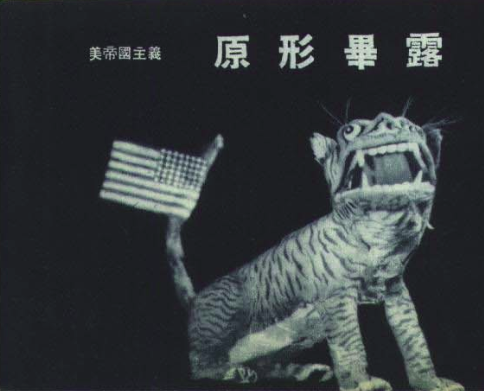
Chinese phrase for an ineffectual threat
"Paper tiger" is a calque of the Chinese phrase zhǐlǎohǔ (). The term refers to something or someone that claims or appears to be powerful or threatening but is actually ineffectual and unable to withstand challenge.
The expression became well known internationally as a slogan used by Mao Zedong, former chairman of the Chinese Communist Party and paramount leader of China, against his political opponents, particularly the United States. It has since been used in various capacities and variations to describe many other opponents and entities.
Origin
Zhilaohu dates from at least the nineteenth century. Robert Morrison, the British missionary and lexicographer, translated the phrase as "a paper tiger" in Vocabulary of the Canton Dialect in 1828. John Francis Davis translated the Chinese phrase as "paper tiger" in a book on Chinese history published in 1836.{{cite book|first=John Francis|last=Davis|author-link=John Francis Davis|year=1836|title=The Chinese: A General Description of the Empire of China and Its Inhabitants
Use
Mao Zedong first introduced his idea of paper tigers to Americans in an August 1946 interview with American journalist Anna Louise Strong:
All reactionaries are paper tigers. In appearance, the reactionaries are terrifying, but in reality they are not so powerful.}}
Mao Zedong's translator, who was skilled at English, initially translated "paper tiger" as "scarecrow" in an attempt to use a cultural reference point an American would understand. Mao realized something had been lost in translation, and asked if Strong knew what a paper tiger was; her reply was that it was an object used to scare birds in a field. Mao, switching to his heavily accented English, clarified that it was a "paper tiger". Anna Louise Strong identifies the translator as Lu Dingyi in her 1948 memoir Tomorrow's China, while some other sources instead identify as the translator.
In a 1956 interview with Strong, Mao used the phrase "paper tiger" to describe American imperialism again:
In 1957, Mao reminisced about the original interview with Strong:
In this view, "paper tigers" are superficially powerful but are prone to overextension that leads to sudden collapse. When Mao criticized Soviet appeasement of the United States during the Sino-Soviet split, Soviet Premier Nikita Khrushchev reportedly said, "the paper tiger has nuclear teeth".
The term was frequently used in Chinese Internet discourse regarding the trade war begun by United States President Donald Trump. Internet users referred to Trump as a paper tiger, frequently observing that the United States economy depends heavily on Chinese companies for a host of necessities, electronics, and raw components.
Other uses
In The Resistance to Theory (1982), Paul de Man used the phrase to reflect upon the threat of literary theory to traditional literary scholarship in American academia. He said, "If a cat is called a tiger it can easily be dismissed as a paper tiger; the question remains however why one was so scared of the cat in the first place".
The Little Red Schoolbook (1969) states, "all grown-ups are paper tigers". The book was controversial for instructing teenagers to challenge authority, and the quote was deemed its most famous.
Osama bin Laden described U.S. soldiers as "paper tigers". This statement may reflect the influence of Maoism on the formation of the Taliban.
The phrase was used in a 2006 speech by then-Senator Joe Biden to describe North Korea after a series of missile launches from the country that same year, defying the warnings of the international community while still incapable of directly harming the United States.
In 2025, Donald Trump used the phrase to dismiss Russia's conduct of Russo-Ukrainian war while delivering a speech at the United Nations.
China itself has been called a paper tiger. In 2021, Michael Beckley argued in his book Unrivaled: Why America Will Remain the World’s Sole Superpower that China would not be able to overtake the United States, and that the belief that China is stronger than it really is is detrimental to American perceptions and policy. According to Beckley, this is because "China’s economic, financial, technological, and military strength is hugely exaggerated by crude and inaccurate statistics": for example, Beckley states that high-scoring Chinese education statistics are actually cherry-picked, that the People's Liberation Army is not as strong as the United States Armed Forces due to their differing focuses, and that China's large GDP does not equate to their actual strength or power.
References
References
- Zimmer, Ben. (2017-02-23). "The Chinese Origins of 'Paper Tiger'". [[The Wall Street Journal]].
- Morrison, Robert. (1828). "Vocabulary of the Canton Dialect". East India Company's Press.
- "Memorandum of Conversation, Beijing, February 17–18, 1973, 11:30 p.m.–1:20 a.m.".
- Lary, Diana. (2015). "China's Civil War: A Social History, 1945–1949". [[Cambridge University Press]].
- Mao, Zedong. (August 1946). "[[Selected Works of Mao Tse-Tung]]". [[Foreign Languages Press]].
- Wu, Jingjian. (April 19, 2021). "When Diplomacy Is Lost in Translation".
- (March 29, 2021). "1946: Jiěfàng zhànzhēng qiú jiěfàng——zhōngguó gòngchǎndǎng xiānmíng tíchū “yīqiè fǎndòngpài dōu shì zhǐlǎohǔ”".
- Zhang, Qingmin. (2011). "Yǐnyù, wèntí biǎozhēng yǔ máozédōng de duìwài zhèngcè". China Academic Journal Electronic Publishing House.
- Mao, Zedong. (July 14, 1956). "Selected Works of Mao Tse-Tung". Foreign Languages Press.
- Mao, Zedong. (November 18, 1957). "Selected Works of Mao Tse-Tung". Foreign Languages Press.
- (12 July 1963). "The World: What They Are Fighting About".
- (2022). "Mao and markets the communist roots of Chinese enterprise". [[Yale University Press]].
- de Man, Paul. (1986). "The Resistance to Theory". [[University of Minnesota Press]].
- Moorhead, Joanna. (8 July 2014). "The Little Red Schoolbook - honest about sex and the need to challenge authority".
- (1998-08-23). "The World; Osama bin Laden, In His Own Words". [[The New York Times]].
- (2021-08-19). "Five myths about Osama bin Laden". [[The Washington Post]].
- (18 August 2021). "The Taliban's Mao-inspired return to power in Afghanistan shows the US is failing to heed the lessons of history". [[ABC News (Australia).
- "How Chinese influence in Taliban-ruled Afghanistan poses fresh threat to India". [[Times of India]].
- (10 June 2011). "By Understanding the Maoist Approach to Revolution and its Inherent Contradictions, Insights Will be Gained on Taliban Vulnerabilities".
- "Campaign 2008: Joseph R. Biden, Jr.".
- (5 July 2006). "Sen. Biden On N. Korea Test". [[CBS News]].
- Sarah Shamim. (24 September 2025). "Russia a ‘paper tiger’: How Trump changed his position on Ukraine, NATO". [[Al Jazeera English]].
- Beckley, Michael. (2018). "Unrivaled: Why America Will Remain the World's Sole Superpower".
- Frum, David. (2021-05-03). "China Is a Paper Dragon".
This article was imported from Wikipedia and is available under the Creative Commons Attribution-ShareAlike 4.0 License. Content has been adapted to SurfDoc format. Original contributors can be found on the article history page.
Ask Mako anything about Paper tiger — get instant answers, deeper analysis, and related topics.
Research with MakoFree with your Surf account
Create a free account to save articles, ask Mako questions, and organize your research.
Sign up freeThis content may have been generated or modified by AI. CloudSurf Software LLC is not responsible for the accuracy, completeness, or reliability of AI-generated content. Always verify important information from primary sources.
Report