From Surf Wiki (app.surf) — the open knowledge base
Paoay Church
Roman Catholic church in Ilocos Norte, Philippines
Roman Catholic church in Ilocos Norte, Philippines
| Field | Value | |
|---|---|---|
| name | Paoay Church | |
| fullname | Saint Augustine Parish Church | |
| native_name | es | |
| other name | San Agustin Church of Paoay | |
| image | File:Paoay Church and Bell Tower.jpg | |
| caption | Church façade and bell tower in 2023 | |
| pushpin map | Luzon mainland#Philippines | |
| map caption | Location in Luzon##Location in the Philippines | |
| coordinates | ||
| location | Paoay, Ilocos Norte | |
| country | Philippines | |
| denomination | Roman Catholic | |
| founded date | ||
| founder | Padre Antonio Estavillo | |
| dedication | Saint Augustine of Hippo | |
| status | Parish church | |
| functional status | Active | |
| heritage designation | National Cultural Treasure, World Heritage Site | |
| designated date | 1973, 1993 | |
| architect | Padre Antonio Estavillo | |
| architectural type | Church building | |
| style | Earthquake Baroque | |
| groundbreaking | ||
| completed date | ||
| length | 110 m | |
| width | 40 m | |
| spire quantity | 15 | |
| tower quantity | 1 | |
| materials | Coral stone and bricks | |
| province | Nueva Segovia | |
| diocese | Laoag | |
| bishop | ||
| embedded | {{Infobox UNESCO World Heritage Site | |
| child | yes | |
| official_name | Church of San Agustin (Paoay) | |
| part_of | Baroque Churches of the Philippines | |
| criteria | (ii)(iv) | |
| ID | 677bis-003 | |
| year | 1993 | |
| extension | 2013 | |
| {{designation list | embed | yes |
| designation2 | PNCT | |
| designation2_offname | Church of Paoay | |
| designation2_type | House of worship | |
| designation2_date | ||
| designation2_free1name | Legal basis | |
| designation2_free1value | PD No. 260, s. 1973 | |
| designation2_free2name | Region | |
| designation2_free2value | Ilocos Region | |
| designation2_free3name | Marker date | |
| designation2_free3value |
Saint Augustine Parish Church, commonly known as Paoay Church, is a Roman Catholic church in the municipality of Paoay, Ilocos Norte in the Philippines. It is under the ecclesiastical jurisdiction of the Diocese of Laoag. Completed in 1710, the church is famous for its distinctive architecture, a highlight of which are the enormous buttresses on the sides and the back of the building.
It is declared as a National Cultural Treasure by the Philippine government in 1973 and a UNESCO World Heritage Site under the collective group of Baroque Churches of the Philippines in 1993.
History
The earliest historical record of the area dates back to 1593, becoming an independent Augustinian parish by 1686. The construction of the present church was started in 1694 by Augustinian friar Father Antonio Estavillo and was completed in 1710. It was later on rededicated in 1896.
Some portions of the church were damaged in the 1865 and 1885 earthquakes but was later restored under the initiative of former First Lady, Imelda Marcos.
Restorations
Several projects for the restoration of the Paoay Church were sought by government and non-government organizations due to possible questions over its structural integrity. The Provincial Government of Ilocos Norte through resolution, in 2014, sought the retrofitting of the church and the reconstruction of the church's convent which were in ruins.
The restoration of the church's buttresses, walls, tower, and interior was announced in 2018. Conservation of the church's exteriors was begun by the National Historical Commission of the Philippines in the second quarter of 2019 and completed in June 2020. Work focused on the historic stone masonry walls and buttresses. Vegetation was removed from the exteriors to prevent stone erosion and lime grout loss. Major structural repair was done on the stairway of the bell tower. The entire roof system was also rehabilitated as part of the project.
The restored structure was turned over to the Laoag diocese in November 2020, and was reopened on November 15 of that year.
Architecture
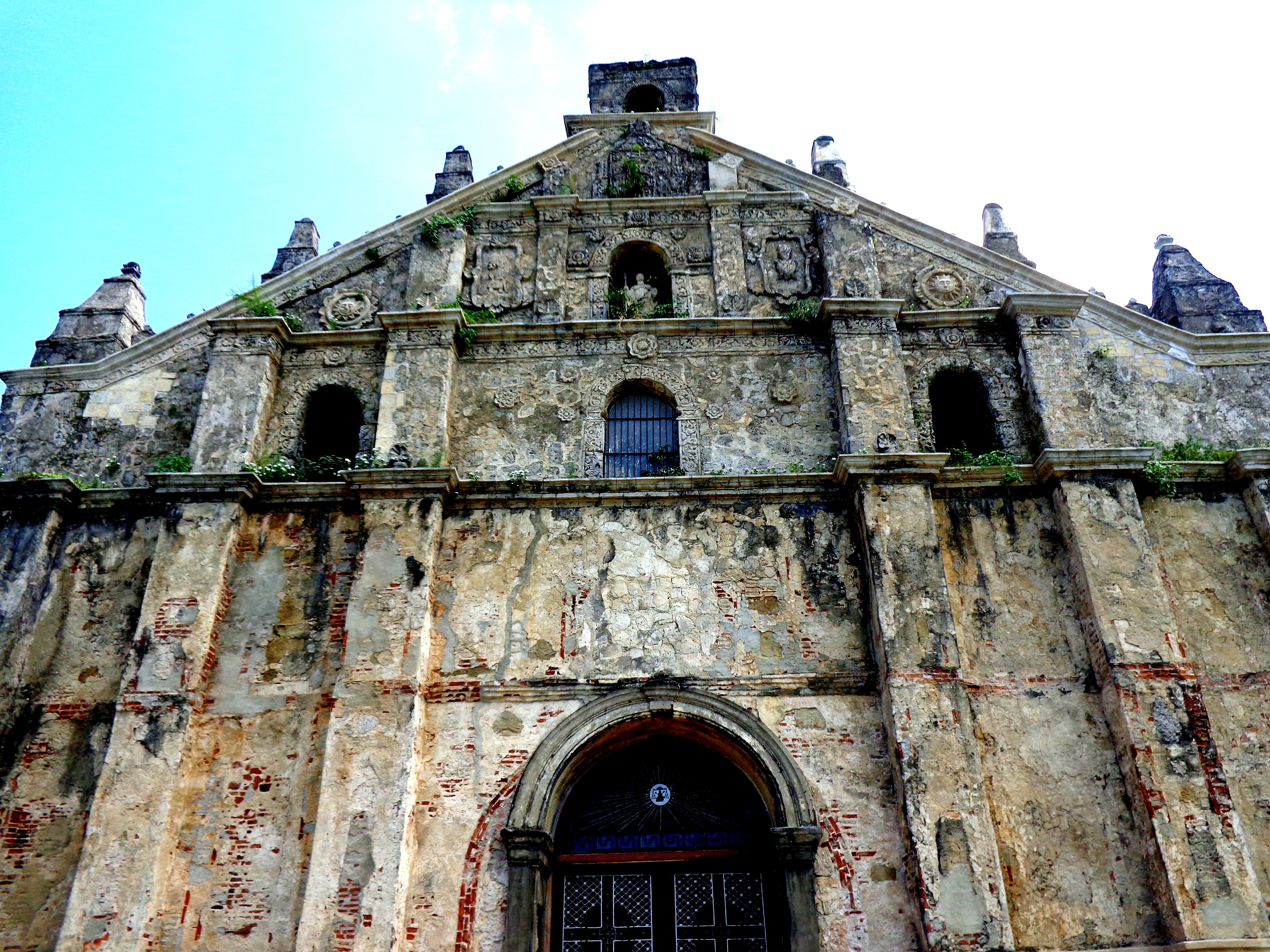
Paoay church is the Philippines' primary example of a Spanish colonial earthquake baroque architecture dubbed by Alicia Coseteng, an interpretation of the European Baroque adapted to the seismic condition of the country through the use of enormous buttresses on the sides and back of the building. The adaptive reuse of baroque style against earthquake is developed since many destructive earthquakes destroyed earlier churches in the country. Javanese architecture reminiscent of Borobudur of Java can also be seen on the church walls and façade.
Buttresses

The most striking feature of Paoay Church is the 24 huge buttresses of about 1.67 m thick at the sides and back of the church building. Extending from the exterior walls, it was conceived to a solution to possible destruction of the building due to earthquakes. Its stair-like buttresses (known as step buttresses) at the sides of the church is possibly for easy access of the roof.
Walls
Its walls are made of large coral stones on the lower part and bricks at the upper levels. The mortar used in the church includes sand and lime with sugarcane juice boiled with mango leaves, leather and rice straw. Its walls suggests Javanese architectural styles.
Façade
.jpg)
The stone façade appear as massive pediment rising from the ground and is built leaning towards the front. Square pilasters and stringed cornices divide the façade vertically and horizontally respectively. Its bottom part is plain. Gothic features are also present through the use of finials while the triangular pediment shows Chinese elements and Oriental strokes. Crenellations, niches, rosettes and the Augustinian coat of arms can also be seen. The façade is made of brick on the lower level and coral stones on the upper level.
Bell tower
.jpg)
Adjacent to the façade is a three-storey coral bell tower constructed separately from the church building on the right side resembling a pagoda. It was in 1793 when the cornerstone of the bell tower was laid. It stands at some distance from the church as a protection against earthquake. It served as observational post for Filipino revolutionaries against the Spaniards in 1898 and by Filipino guerrillas against Japanese soldiers during World War II. According to historians, the bell tower also served as a status symbol for the locals. It is said that the bell would ring more loudly and more times during the wedding of a prominent clan that it would during the wedding of the poor.
Gallery
File:Front doors of Paoay Church.jpg|Church main portal File:Retablo of Church of Paoay, Ilocos Norte.jpg|Church altar and retablo mayor File:Paoay Church interior with visible roof trusses.jpg|The interior in 2012, pre-restoration File:San Agustin Church Interior, Paoay, Ilocos Norte 5.jpg|The interior in 2021, post-restoration
Declarations

By virtue of Presidential Decree No. 260, Paoay Church was declared as a National Cultural Treasure by the Philippine government in 1973.
In popular culture
The church was featured in a scene in the 1993 romance film Saan Ka Man Naroroon, which was shot in Ilocos Norte and Ilocos Sur.
References
References
- (1973-08-01). "Declaring the Sta. Ana Site Museum in Manila, the Roman Catholic Churches of Paoay and Bacarra in Ilocos Norte, the San Agustin Church and Liturgical Objects Therein in Intramuros, Manila, Fort Pilar in Zamboanga City, the Petroglyphs of the Rock-shelter in Angono, Rizal, the Petroglyphs of Alab, Bontoc, the Stone Agricultural Calendars of Dap-ay Guiday in Besao, Bontoc, the Mummy Caves of Kabayan, Benguet and of Sagada and Alab, Bontoc, the Ifugao Rice Terraces of Banaue as National Cultural Treasures; and the Barasoain Church in Malolos, Bulacan, Tirad Pass in Cervantes, Ilocos Sur, the Miagao Church in Miagao, Iloilo, the Site of the Battle of Mactan on Mactan Island, Cebu, the San Sebastian Church in Quiapo, Manila, and the Church and Convent of Santo Niño in Cebu City as National Shrines, Monuments, and/ or Landmarks, Defining the Implementing Agencies and Providing Funds Therefor". [[Official Gazette (Philippines).
- (July 27, 2006). "Heritage Conservation Society. "Paoay Church"".
- Lazaro, Freddie. (June 28, 2014). "Retrofitting of Paoay church sought". [[Manila Bulletin]].
- Gaspar, Roger. (1996). "Earthquake Baroque: Paoay Church in the Ilocos".
- Bagaforo, Nelson. (April 20, 2011). "Historic churches of Ilocos Norte". Sun.Star.
- (June 23, 2014). "Restoration of Paoay church pushed". [[The Philippine Star]].
- Adriano, Leilanie. (December 11, 2018). "NHCP to restore historic Paoay Church, Bacarra Tower in Ilocos". [[Philippine News Agency]].
- Magcamit, Yann. (June 22, 2020). "This UNESCO heritage site just got restored, and now you can visit it via video".
- Tabios, Hanah. (November 19, 2020). "NHCP delivers restored heritage icons to Ilocos Norte". [[Manila Bulletin]].
- Aquino, Mike. (May 15, 2013). "Touring the oldest churches in the Philippines". Yahoo News Philippines.
- "The Paoay Church: Ilocos Norte, Philippines". digitaljournal.com.
- Villalon, Augusto. "16th to 19th Century Church Architecture in the Philippines". National Commission for Culture and the Arts.
- (March 16, 2011). "Paoay church in Ilocos to get facelift". Balita.ph.
- "St. Augustine Church in Paoay". vigattintourism.com.
- "Baroque Churches of the Philippines". UNESCO World Heritage Site.
This article was imported from Wikipedia and is available under the Creative Commons Attribution-ShareAlike 4.0 License. Content has been adapted to SurfDoc format. Original contributors can be found on the article history page.
Ask Mako anything about Paoay Church — get instant answers, deeper analysis, and related topics.
Research with MakoFree with your Surf account
Create a free account to save articles, ask Mako questions, and organize your research.
Sign up freeThis content may have been generated or modified by AI. CloudSurf Software LLC is not responsible for the accuracy, completeness, or reliability of AI-generated content. Always verify important information from primary sources.
Report