From Surf Wiki (app.surf) — the open knowledge base
Pangu Plaza
Building in Beijing, China
Building in Beijing, China
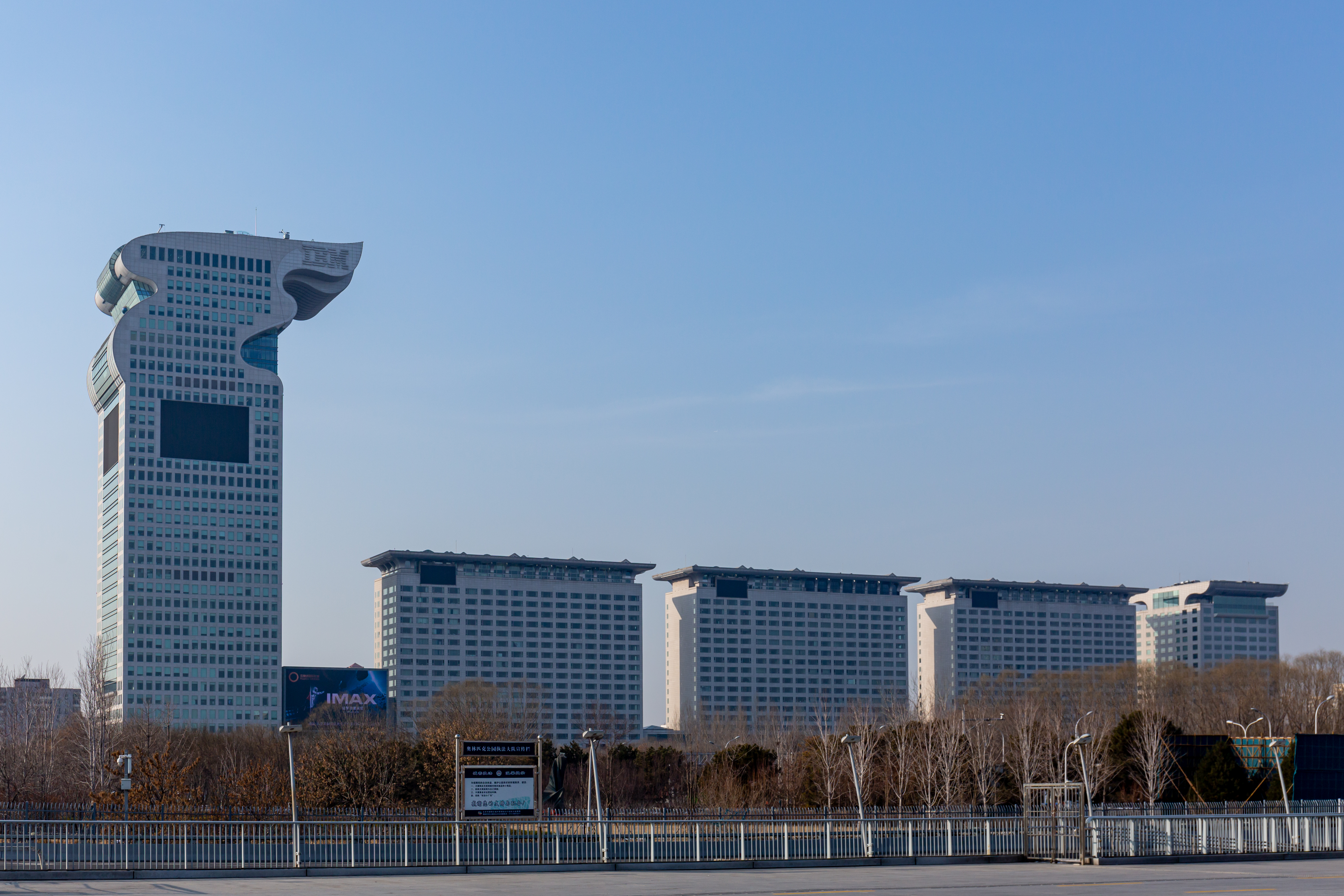
The Pangu Plaza () is a five building mixed use complex comprising an office building, three apartment buildings, clubs, retail shops and the Pangu 7 Star Hotel (Pangu Seven Star Hotel), located at 27, North 4th Ring Middle Road, Chaoyang, Beijing, China.
Shaped like a dragon, it is a neighbour of many of the 2008 Beijing Olympic venues, including the Beijing National Stadium (Bird Nest) and the Beijing National Aquatics Center (Water Cube). Also, it is close to the National Library, the fourth largest library in the world and the largest one in China.
The Pangu Plaza was designed by Chu-Yuan Lee of C.Y. Lee & Partners, the Taiwan-based architecture firm responsible for Taipei 101, for the world's first traditional Chinese “courtyard in the sky". The Pangu 7 Star Hotel occupies the first block of the "Pangu", and it contains two pavilions, a temple, a French restaurant, a Japanese restaurant, 234 guest rooms, with 140 suites and a 600 m corridor.
The Pangu Plaza was financed and built by Guo Wengui in 2008.

Rating and further information
The “tail” building of Pangu Plaza "Pangu 7 Star Hotel" is one of the world's only two 7-star hotels. The hotel is named "Pangu 7 Star Hotel Beijing" even though no traditional organisation or formal body awards or recognises any rating over "five-star deluxe", and despite that customarily a hotel does not award itself stars. Traditionally, hotel rating have a maximum of 5 stars. The Pangu 7 Star Hotel is considered to be the top luxury hotel in Beijing. Bill Gates, the founder of Microsoft Corp., stayed at the hotel during the Beijing Olympics.
Chinese authorities seized ownership of the tallest building of Pangu Plaza in 2016 and auctioned it for nearly 5.19 billion yuan. This building also houses the headquarters of IBM's China division.
Demolition of the Dragon Head
In 2022, the "dragon head" of the primary tower was demolished and replaced with a simpler rectangular crown.
Footnotes
References
- (August 2024). "Pangu Plaza {{!}} Buildings {{!}} EMPORIS".
- (3 February 2013). "Beijing China Tourist Website".
- Barboza, David. (20 August 2008). "In Beijing, No Making Heads or Tails of a New Building". The New York Times.
- "Creditors put fugitive Guo Wengui's dragon head-shaped Pangu Plaza on the auction block at a steep discount to recoup debt".
- (30 October 2011). "Enter The Dragon Building: Beijing China's Pangu Plaza".
- (3 February 2013). "Beijing Tourist Website".
- "Pangu 7 Star Hotel Beijing (北京盘古七星酒店)". [[Sinohotel.
- Holland, Oscar. (21 August 2019). "Seized Beijing skyscraper sells online for a 'bargain' $734M".
- Hood, Bryan. (22 August 2019). "This Beijing Skyscraper, Seized by Chinese Authorities, Just Sold for $734 Million Online".
- link
- link
- (2 December 2021). "曾為流亡富商郭文貴資產 北京盤古大觀「龍首」遭拆最新造型曝光".
This article was imported from Wikipedia and is available under the Creative Commons Attribution-ShareAlike 4.0 License. Content has been adapted to SurfDoc format. Original contributors can be found on the article history page.
Ask Mako anything about Pangu Plaza — get instant answers, deeper analysis, and related topics.
Research with MakoFree with your Surf account
Create a free account to save articles, ask Mako questions, and organize your research.
Sign up freeThis content may have been generated or modified by AI. CloudSurf Software LLC is not responsible for the accuracy, completeness, or reliability of AI-generated content. Always verify important information from primary sources.
Report