From Surf Wiki (app.surf) — the open knowledge base
Pangolin
Mammals of the order Pholidota

Mammals of the order Pholidota
|Afredentata Szalay & Schrenk, 1994 |Lepidota Lane, 1910 |Manides Gervais, 1854 |Maniformes Zagorodniuk, 2008 |Manitheria Haeckel, 1895 |Neomanida Haeckel, 1895 |Nomarthra Cope, 1889 |Pholidotheria Haeckel, 1895 |Pholidotiformes Kinman, 1994 |Pholidotina Pearse, 1936 |Repentia Newman, 1843 |Scutata Murray, 1866 |Squamata Huxley, 1872 |Squamigera Gill, 1910 |Squamosa Haeckel, 1895
Pangolins, also called scaly anteaters, are mammals of the order Pholidota (). The one extant family, the Manidae, has three genera: Manis, Phataginus, and Smutsia. Manis comprises four species found in Asia, while Phataginus and Smutsia include two species each, all found in sub-Saharan Africa. These species range in size from 30 to. Several extinct pangolin species are also known. In September 2023, nine species were reported.
Pangolins have large, protective keratin scales, covering their skin. Depending on the species, they live in hollow trees or burrows. Pangolins are nocturnal, and their diet consists of mainly ants and termites, which they capture using their long tongues. They tend to be solitary animals, meeting only to mate and produce a litter of one to three offspring, which they raise for about two years.
Pangolins are threatened by poaching (for their meat and scales, which are used in traditional medicine) and heavy deforestation of their natural habitats, and are also the most trafficked mammals in the world. , there are eight species of pangolin whose conservation status is listed in the threatened tier. Three (Manis culionensis, M. pentadactyla and M. javanica) are critically endangered, three (Phataginus tricuspis, Manis crassicaudata and Smutsia gigantea) are endangered and two (Phataginus tetradactyla and Smutsia temminckii) are vulnerable on the Red List of Threatened Species of the International Union for Conservation of Nature.
Etymology
The name of order Pholidota comes from Ancient Greek Φολιδωτός – "clad in scales" from φολίς pholís "scale".
The name "pangolin" comes from the Malay word pengguling meaning "one who rolls up" from guling or giling "to roll"; it was used for the Sunda pangolin (Manis javanica). However, the modern name is tenggiling. In Javanese, it is terenggiling; and in the Philippine languages, it is goling, tanggiling, or balintong (with the same meaning).
In ancient India, according to Aelian, it was known as the phattáges (φαττάγης).
Description
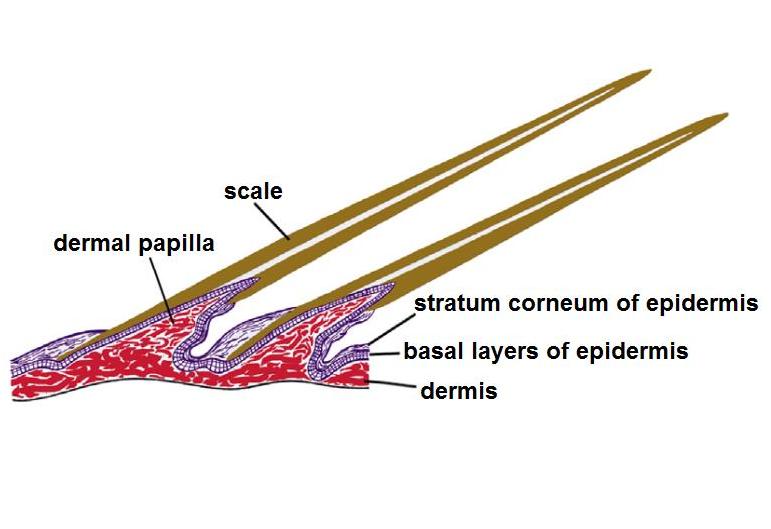
The physical appearance of a pangolin is marked by large, hardened, overlapping, plate-like scales, which are soft on newborn pangolins, but harden as the animal matures. They are made of keratin, the same material from which human fingernails and tetrapod claws are made, and are structurally and compositionally very different from the scales of reptiles. The pangolin's scaled body is comparable in appearance to a pine cone. It can curl up into a ball when threatened, with its overlapping scales acting as armor, while it protects its face by tucking it under its tail. The scales are sharp, providing extra defense from predators. Despite their appearance, they are not closely related to armadillos, having both evolved scales by convergent evolution.
Pangolins can emit a noxious-smelling chemical from glands near the anus, similar to the spray of a skunk. They have short legs, with sharp claws which they use for burrowing into ant and termite mounds and for climbing.
The tongues of pangolins are extremely long, and like those of the giant anteater and the tube-lipped nectar bat, the root of the tongue is not attached to the hyoid bone but is in the thorax between the sternum and the trachea. Large pangolins can extend their tongues as much as 40 cm, with a diameter of only about 0.5 cm.
Behaviour
.jpg)
.jpg)
Most pangolins are nocturnal animals which use their well-developed sense of smell to find insects. The long-tailed pangolin is also active by day, while other species of pangolins spend most of the daytime sleeping, curled up into a ball ("volvation").
Arboreal pangolins live in hollow trees, whereas the ground-dwelling species dig tunnels to a depth of 3.5 m.
Some pangolins walk with their front claws bent under the foot pad, although they use the entire foot pad on their rear limbs. Furthermore, some exhibit a bipedal stance for some behavior, and may walk a few steps bipedally. Pangolins are also good swimmers.
Diet
Pangolins are insectivorous. Most of their diet consists of various species of ants and termites and may be supplemented by other insects, especially larvae. They are somewhat particular and tend to consume only one or two species of insects, even when many species are available. A pangolin can consume 140 – of insects per day. Pangolins are an important regulator of termite populations in their natural habitats.
Pangolins have very poor vision. They also lack teeth. They rely heavily on smell and hearing, and they have other physical characteristics to help them eat ants and termites. Their skeletal structure is sturdy and they have strong front legs used for tearing into termite mounds. They use their powerful front claws to dig into trees, soil, and vegetation to find prey, then proceed to use their long tongues to probe inside the insect tunnels and to retrieve their prey.
The structure of their tongue and stomach is key to aiding pangolins in obtaining and digesting insects. Their saliva is sticky, causing ants and termites to stick to their long tongues when they are hunting through insect tunnels. However, without teeth, pangolins cannot chew; so while foraging, they ingest small stones (gastroliths), which accumulate in their stomachs to help to grind up ants. This part of their stomach is called the gizzard, and it is also covered in keratinous spines. These spines further aid in the grinding up and digestion of the pangolin's prey.
Some species, such as the tree pangolin, use their strong, prehensile tails to hang from tree branches and strip away bark from the trunk, exposing insect nests inside.
Reproduction

Pangolins are solitary and meet only to reproduce, with mating typically taking place at night after the male and female pangolin meet near a watering hole. Males are larger than females, weighing up to 40% more. While the mating season is not defined, they typically mate once each year, usually during the summer or autumn. Rather than the males seeking out the females, males mark their location with urine or feces and the females find them. If competition over a female occurs, the males use their tails as clubs to fight for the opportunity to mate with her.
Gestation periods differ by species, ranging from roughly 70 to 140 days. African pangolin females usually give birth to a single offspring at a time, but the Asiatic species may give birth to from one to three.
Classification and phylogeny
Taxonomy
| last1=McKenna | first1=M. C. | last2=Bell | first2=S. K. | title=Classification of Mammals: Above the Species Level | publisher=Columbia University Press | year=1997 | isbn=978-0-231-52853-5 | url=https://books.google.com/books?id=zS7FZkzIw-cC | access-date=2024-09-16 | page=631}} | Current classification: |
|---|
Summary of extant species
| Common name | Binomial name | Population | Status | Trend | Notes | Image | |||||||||||||
|---|---|---|---|---|---|---|---|---|---|---|---|---|---|---|---|---|---|---|---|
| Cryptic pangolin | Manis mysteria | unknown | Identified via genetic analyses in 2023. Species has not been assessed by IUCN. | [[File:Manis mysteria scales.jpg | 175px]] | ||||||||||||||
| Philippine pangolin | Manis culionensis | title=Manis culionensis | article-number=e.T136497A123586862 | last=Schoppe, S. | year=2019 | doi=10.2305/IUCN.UK.2019-3.RLTS.T136497A123586862.en | last2=Katsis, L. | last3=Lagrada, L.}} | [[File:Philippine Pangolin Curled-up by Gregg Yan.jpg | 175px]] | |||||||||
| Sunda pangolin | Manis javanica | title=Manis javanica | article-number=e.T12763A123584856 | last=Challender, D. | year=2019 | doi=10.2305/IUCN.UK.2019-3.RLTS.T12763A123584856.en | last2=Willcox, D.H.A. | last3=Panjang, E. | last4=Lim, N. | last5=Nash, H. | last6=Heinrich, S. | last7=Chong, J.}} | Population in Singapore is estimated to be 1,068 individuals. Thousands of this species are estimated to be illegally exported annually. | [[File:Trenggiling Sunda Sunda Pangolin Manis javanica.jpg | 175px]] | ||||
| Chinese pangolin | Manis pentadactyla | title=Manis pentadactyla | article-number=e.T12764A168392151 | last=Challender, D. | year=2020 | doi=10.2305/IUCN.UK.2019-3.RLTS.T12764A168392151.en | last2=Wu, S. | last3=Kaspal, P. | last4=Khatiwada, A. | last5=Ghose, A. | last6=Ching-Min Sun, N. | last7=Mohapatra, R.K. | last8=Laxmi Suwal, T.}} | Values given are a very rough estimate given various, disjointed national estimates. | [[File:Manis pentadactyla I.jpg | 175px]] | |||
| Indian pangolin | Manis crassicaudata | title=Manis crassicaudata | article-number=e.T12761A123583998 | last=Mahmood, T. | year=2019 | doi=10.2305/IUCN.UK.2019-3.RLTS.T12761A123583998.en | last2=Challender, D. | last3=Khatiwada, A. | last4=Andleeb, S. | last5=Perera, P. | last6=Trageser, S.J. | last7=Ghose, A. | last8=Mohapatra, R.K.}} | Species is heavily threatened by exportation for illegal wildlife trade. | [[File:Manis crassicaudata (29600051791).jpg | 175px]] | |||
| White-bellied pangolin | Phataginus tricuspis | title=Phataginus tricuspis | article-number=e.T12767A123586469 | last=Pietersen, D. | year=2019 | doi=10.2305/IUCN.UK.2019-3.RLTS.T12767A123586469.en | last2=Moumbolou, C. | last3=Ingram, D.J. | last4=Soewu, D. | last5=Jansen, R. | last6=Sodeinde, O. | last7=Keboy Mov Linkey Iflankoy, C. | last8=Challender, D. | last9=Shirley, M.H.}} | The scales of 400,000 individuals were seized from illegal wildlife trade between 2015-2019. | [[File:Phataginus tricuspis.jpg | 175px]] | ||
| Giant ground pangolin | Smutsia gigantea | title=Smutsia gigantea | article-number=e.T12762A123584478 | last=Nixon, S. | year=2019 | doi=10.2305/IUCN.UK.2019-3.RLTS.T12762A123584478.en | last2=Pietersen, D. | last3=Challender, D. | last4=Hoffmann, M. | last5=Godwill Ichu, I. | last6=Bruce, T. | last7=Ingram, D.J. | last8=Matthews, N. | last9=Shirley, M.H.}} | [[File:Em - Smutsia gigantea - 2.jpg | 175px]] | |||
| Black-bellied pangolin | Phataginus tetradactyla | title=Phataginus tetradactyla | article-number=e.T12766A123586126 | last=Ingram, D.J. | year=2019 | doi=10.2305/IUCN.UK.2019-3.RLTS.T12766A123586126.en | last2=Shirley, M.H. | last3=Pietersen, D. | last4=Godwill Ichu, I. | last5=Sodeinde, O. | last6=Moumbolou, C. | last7=Hoffmann, M. | last8=Gudehus, M. | last9=Challender, D.}} | [[File:Manis tetradactyla (29645778336).jpg | 175px]] | |||
| Temminck's ground pangolin | Smutsia temminckii | title=Smutsia temminckii | article-number=e.T12765A123585768 | last=Pietersen, D. | year=2019 | doi=10.2305/IUCN.UK.2019-3.RLTS.T12765A123585768.en | last2=Jansen, R. | last3=Connelly, E.}} | Population of this species over its South African range is estimated to be 16,329–24,102 mature individuals. | [[File:Pangolin monitoring at working with wildlife.jpg | 175px]] |
Phylogeny
Among placentals
The order Pholidota was long considered to be the sister taxon to Xenarthra (neotropical anteaters, sloths, and armadillos), but recent genetic evidence indicates their closest living relatives are the carnivorans, with which they form a clade, the Ferae. Palaeanodonts are even closer relatives to pangolins, being classified with pangolins in the clade Pholidotamorpha. The split between carnivorans and pangolins is estimated to have occurred 79.47 Ma (million years) ago.
Among Manidae
The first dichotomy in the phylogeny of extant Manidae separates Asian pangolins (Manis) from African pangolins (Smutsia and Phataginus). Within the former, Manis pentadactyla is the sister group to a clade comprising M. crassicaudata and M. javanica. Within the latter, a split separates the large terrestrial African pangolins of the genus Smutsia from the small arboreal African pangolins of the genus Phataginus.
Asian and African pangolins are thought to have diverged about 41.37 Ma ago. Moreover, the basal position of Manis within Pholidota suggests the group originated in Eurasia, consistent with their laurasiatherian phylogeny.
Threats
_(32575640450).jpg)
Pangolins are in high demand in southern China and Vietnam because their scales are believed to have medicinal properties in traditional Chinese and Vietnamese medicine. Their meat is also considered a delicacy. 100,000 are estimated to be trafficked a year to China and Vietnam, amounting to over one million over the past decade. This makes them the most trafficked animal in the world. This, coupled with deforestation, has led to a large decrease in the numbers of pangolins. Some species, such as Manis pentadactyla have become commercially extinct in certain ranges as a result of overhunting.
In November 2010, pangolins were added to the Zoological Society of London's list of evolutionarily distinct and endangered mammals. All eight species of pangolin are assessed as threatened by the IUCN, while three are classified as critically endangered. All pangolin species are currently listed under Appendix I of CITES which prohibits international trade, except when the product is intended for non-commercial purposes and a permit has been granted.
China had been the main destination country for pangolins until 2018, where it was surpassed by Vietnam. In 2019, Vietnam was reported to have seized the largest volumes of pangolin scales, surpassing Nigeria that year.
Pangolins are also hunted and eaten in Ghana and are one of the more popular types of bushmeat, while local healers use the pangolin as a source of traditional medicine. A 2025 study in Nature Ecology & Evolution found that opportunistic hunting for meat, rather than hunting for scales used in traditional medicine, is the primary driver of pangolin population declines in Nigeria.
Though pangolins are protected by an international ban on their trade, populations have suffered from illegal trafficking due to beliefs in East Asia that their ground-up scales can stimulate lactation or cure cancer or asthma. In the past decade, numerous seizures of illegally trafficked pangolin and pangolin meat have taken place in Asia. In one such incident in April 2013, 10000 kg of pangolin meat were seized from a Chinese vessel that ran aground in the Philippines. In another case in August 2016, an Indonesian man was arrested after police raided his home and found over 650 pangolins in freezers on his property. The same threat is reported in Nigeria, where the animal is on the verge of extinction due to overexploitation. The overexploitation comes from hunting pangolins for game meat and the reduction of their forest habitats due to deforestation caused by timber harvesting. The pangolin are hunted as game meat for both medicinal purposes and food consumption.
Virology
COVID-19 infection
The nucleic acid sequence of a specific receptor-binding domain of the spike protein belonging to coronaviruses taken from pangolins was found to be a 99% match with SARS coronavirus 2 (SARS-CoV-2), the virus which causes COVID-19 and is responsible for the COVID-19 pandemic. Researchers in Guangzhou, China, hypothesized that SARS-CoV-2 had originated in bats, and prior to infecting humans, was circulating among pangolins. The illicit Chinese trade of pangolins for use in traditional Chinese medicine was suggested as a vector for human transmission. However, whole-genome comparison found that the pangolin and human coronaviruses share only up to 92% of their RNA. Ecologists worried that the early speculation about pangolins being the source may have led to mass slaughters, endangering them further, which was similar to what happened to Asian palm civets during the SARS outbreak. It was later proved that the testing which suggested that pangolins were a potential host for the virus was flawed, when genetic analysis showed that the spike protein and its binding to receptors in pangolins had minimal effect from the virus, and therefore were not likely mechanisms for COVID-19 infections in humans.
''Pestivirus'' and ''Coltivirus''
In 2020, two novel RNA viruses distantly related to pestiviruses and coltiviruses have been detected in the genomes of dead Manis javanica and Manis pentadactyla. To refer to both sampling site and hosts, they were named Dongyang pangolin virus (DYPV) and Lishui pangolin virus (LSPV). The DYPV pestivirus was also identified in Amblyomma javanense nymph ticks from a diseased pangolin.
In addition to pestiviruses and coltiviruses, genomic surveys of healthy pangolins have revealed the presence of multiple potentially zoonotic viruses, including coronaviruses, flaviviruses, and circoviruses, indicating that pangolins naturally harbor diverse viral communities without showing disease symptoms.
Folk medicine

Pangolin scales and flesh are used as ingredients for various traditional Chinese medicine preparations. While no scientific evidence exists for the efficacy of those practices, and they have no logical mechanism of action, their popularity still drives the black market for animal body parts, despite concerns about toxicity, transmission of diseases from animals to humans, and species extermination. The ongoing demand for parts as ingredients continues to fuel pangolin poaching, hunting and trading.
The first record of pangolin scales occurs in Ben Cao Jinji Zhu ("Variorum of Shennong's Classic of Materia Medica", 500 CE), which recommends pangolin scales for protection against ant bites; burning the scales as a cure for people crying hysterically during the night. During the Tang dynasty, a recipe for expelling evil spirits with a formulation of scales, herbs, and minerals appeared in 682, and in 752 CE the idea that pangolin scales could also stimulate milk secretion in lactating women, one of the main uses today, was recommended in the Wai Tai Mi Yao ("Arcane Essentials from the Imperial Library"). In the Song dynasty, the notion of penetrating and clearing blockages was emphasized in the Taiping sheng hui fan ("Formulas from Benevolent Sages Compiled During the Era of Peace and Tranquility"), compiled by Wang Huaiyin in 992.
In the 21st century, the main uses of pangolin scales are quackery practices based on unproven claims the scales dissolve blood clots, promote blood circulation, or help lactating women secrete milk. The supposed health effects of pangolin meat and scales claimed by folk medicine practitioners are based on their consumption of ants, long tongues, and protective scales. The Pharmacopoeia of the People's Republic of China included Chinese pangolin scales as an ingredient in traditional Chinese medicine formulations. Although pangolin scales have been removed from the list of raw ingredients, the scales are still listed as a key ingredient in various medicines.
Pangolin parts are also used for medicinal purposes in other Asian countries such as India, Nepal and Pakistan. In some parts of India and Nepal, locals believe that wearing the scales of a pangolin can help prevent pneumonia. Pangolin scales have also been used for medicinal purposes in Malaysia, Indonesia and northern Myanmar. Indigenous people in southern Palawan, Philippines, have held the belief that elders could avoid prostate illnesses by wearing belts made with the scales.
Conservation

As a result of increasing threats to pangolins, mainly in the form of illegal, international trade in pangolin skin, scales, and meat, these species have received increasing conservation attention in recent years. , the IUCN considered all eight species of pangolin on its Red List of Threatened Species as threatened. The IUCN SSC Pangolin Specialist Group launched a global action plan to conserve pangolins, dubbed "Scaling up Pangolin Conservation", in July 2014. This action plan aims to improve all aspects of pangolin conservation with an added emphasis on combating poaching and trafficking of the animal while educating communities on its importance.
Another suggested approach to fighting pangolin (and general wildlife) trafficking consists in "following the money" rather than "the animal", which aims to disrupt smugglers' profits by interrupting money flows. Financial intelligence gathering could thus become a key tool in protecting these animals, although this opportunity is often overlooked. In 2018, a Chinese NGO launched the Counting Pangolins movement, calling for joint efforts to save the mammals from trafficking. Wildlife conservation group TRAFFIC has identified 159 smuggling routes used by pangolin traffickers and aims to shut these down.
.jpg)
Many attempts have been made to breed pangolins in captivity, but due to their reliance on wide-ranging habitats and very particular diets, these attempts are often unsuccessful. Pangolins have significantly decreased immune responses due to a genetic dysfunction, making them extremely fragile. They are susceptible to diseases such as pneumonia and the development of ulcers in captivity, complications that can lead to an early death. In addition, pangolins rescued from illegal trade often have a higher chance of being infected with parasites such as intestinal worms, further lessening their chance for rehabilitation and reintroduction to the wild.
The idea of farming pangolins to reduce the number being illegally trafficked is being explored with little success. The third Saturday in February is promoted as World Pangolin Day by the conservation NPO Annamiticus. World Pangolin Day has been noted for its effectiveness in generating awareness about pangolins.
In 2017, Jackie Chan made a public service announcement called WildAid: Jackie Chan & Pangolins (Kung Fu Pangolin).
In December 2020, a study found that it is "not too late" to establish conservation efforts for Philippine pangolins (Manis culionensis), a species that is only found on the island province of Palawan.
Taiwan
Taiwan is one of the few conservation grounds for pangolins in the world after the country enacted the 1989 Wildlife Conservation Act. The introduction of Wildlife Rehabilitation Centers in places like Luanshan (Yanping Township) in Taitung and Xiulin townships in Hualien became important communities for protecting pangolins and their habitats and has greatly improved the survival of pangolins. These centers work with local aboriginal tribes and forest police in the National Police Agency to prevent poaching, trafficking, and smuggling of pangolins, especially to black markets in China. These centers have also helped to reveal the causes of death and injury among Taiwan's pangolin population. Today, Taiwan has the highest population density of pangolins in the world.
References
References
- (1994). "Abstracts of Papers". Journal of Vertebrate Paleontology.
- Lane, Henry Higgins (1910) [https://archive.org/details/jstor-1636382 "A corrected classification of the edentates."] Science, new ser., vol. 31, pp. 913-914
- (2008). "Scientific names of mammal orders: from descriptive to uniform". Visnyk of Lviv University.
- Haeckel, Ernst. (1895). "Systematische Phylogenie: Wirbelthiere". G. Reimer.
- (1889). "The Edentata of North America". American Naturalist.
- Kenneth E. Kinman (1994) "The Kinman System: Toward a Stable Cladisto-Eclectic Classification of Organisms: Living and Extinct, 48 Phyla, 269 Classes, 1,719 Orders", Hays, Kan. (P. O. Box 1377, Hays 67601), 88 pages
- Pearse, Arthur Sperry. (1936). "Zoological names. A list of phyla, classes, and orders, prepared for section F, American Association for the Advancement of Science". Duke University Press.
- Edward Newman (1843) [https://www.biodiversitylibrary.org/item/123076#page/7/mode/1up "The Zoologist: a monthly journal of natural history. (Vol. 1)"], London, J. Van Voorst
- Murray, Andrew (1866) [https://www.biodiversitylibrary.org/item/53245#page/7/mode/1up "The geographic distribution of mammals"], London, Day and Son, Ltd., XVI + 420 pp., 101 maps
- Huxley, Thomas Henry (1872) [https://www.biodiversitylibrary.org/item/109100#page/7/mode/1up "A manual of the anatomy of vertebrated animals"], New York, d, Appleton and Co., 431 pp.
- (1910). "Classification of the Edentates". Science.
- {{Cite EB1911
- Schlitter, Duane A.. (2005). "Mammal Species of the World: A Taxonomic and Geographic Reference". Johns Hopkins University Press.
- Gaudin, Timothy. (28 August 2009). "The Phylogeny of Living and Extinct Pangolins (Mammalia, Pholidota) and Associated Taxa: A Morphology Based Analysis". [[Springer Science+Business Media]].
- Incorvala, Darren. (25 September 2023). "A Mystery Species Was Discovered in Traffic Pangolin Scales - Researchers believed there were eight species of the strange mammals. But a ninth was identified genetically, although no one knew it was a separate species in the wild.". [[The New York Times]].
- (2009). "The Encyclopedia of Mammals". Oxford University Press.
- (2020-11-05). "Snake oil and pangolin scales: insights into wild animal use at "Marché des Fétiches" traditional medicine market, Togo". [[Nature Conservation]].
- (1 January 1938). "Chinese Medicine and the Pangolin". Nature.
- Goode, Emilia. (31 March 2015). "A Struggle to Save the Scaly Pangolin". [[The New York Times]].
- "Manidae Family search". [[IUCN]].
- (1956). "The Composition of Scientific Words". Smithsonian Institution Press.
- (1940). "φολίς". Perseus Digital Library.
- (2002). "Concise Oxford English Dictionary". [[Oxford University Press]].
- Wilkinson, Richard James. (1932). "tĕnggiling". Salavopoulos & Kinderlis.
- "Interesting Philippine Animals". Island Publishing House, Inc..
- [[Claudius Aelianus. Aelian]], ''On Animals'', 16:6 [[Loeb Classical Library]], translated A. F. Scholfield 1959 vol. 3, pp. 266-268.
- (2020-09-03). "Combined proteomics and transcriptomics reveal the genetic basis underlying the differentiation of skin appendages and immunity in pangolin". Scientific Reports.
- Spearman, R.I.C.. (2008). "On the nature of the horny scales of the pangolin". [[Oxford University Press]].
- (2016). "Pangolin armor: Overlapping, structure, and mechanical properties of the keratinous scales". [[Elsevier]].
- (2015). "Meet the Pangolin!". Pangolins.org.
- (2011). "''Manis tricuspis'': tree pangolin". [[University of Michigan]].
- Chan, Lap-Ki. (1995). "Extrinsic Lingual Musculature of Two Pangolins (Pholidota: Manidae)". [[Oxford University Press]].
- (January 1994). "Husbandry of pangolins ''Manis'' spp". International Zoo Yearbook.
- (1988). "Great Book of the Animal Kingdom". Arch Cape Press.
- (2014). "Behavioural descriptions of Indian pangolins (Manis crassicaudata) in captivity.". [[Wiley-Blackwell]].
- Grosshuesch, Craig. (2012). "Rollin' With the Pangolin – Diet". [[University of Wisconsin–La Crosse]].
- (2017). "Transcriptomic analysis identifies genes and pathways related to myrmecophagy in the Malayan pangolin (Manis javanica)". [[O'Reilly Media]].
- (2010). "Xenarthra and Pholidota (Armadillos, Anteaters, Sloths and Pangolins)". John Wiley & Sons, Ltd.
- (December 1997). "Foraging behavior and ecology of the Cape pangolin (Manis temminckii) in north-western Zimbabwe". African Journal of Ecology.
- Gutteridge, Lee. (2008). "The South African Bushveld: A Field Guide from the Waterberg". 30° South Publishers.
- (2015). "Wildlife of the World". [[Dorling Kindersley]].
- (1 April 2009). "Loss of teeth and enamel in tetrapods: fossil record, genetic data and morphological adaptations". [[John Wiley & Sons]].
- Prothero, Donald R.. (2016). "The Princeton Field Guide to Prehistoric Mammals". [[Princeton University Press]].
- (10 June 2019). "All hope is not lost for vanishing Palawan pangolin". Rappler.
- Grosshuesch, Craig. (2012). "Rollin' With the Pangolin – Reproduction". University of Wisconsin–La Crosse.
- (8 June 2015). "Captive breeding of pangolins: current status, problems and future prospects". ZooKeys.
- Dickman, Christopher R.. (1984). "The Encyclopedia of Mammals". Facts on File.
- (1997). "Classification of Mammals: Above the Species Level". Columbia University Press.
- Gu, Tong-Tong. (2023). "Genomic analysis reveals a cryptic pangolin species". PNAS.
- Schoppe, S.. (2019). "''Manis culionensis''".
- Challender, D.. (2019). "''Manis javanica''".
- Challender, D.. (2020). "''Manis pentadactyla''".
- Wangmo, L.K.. (2025). "Indo-Burmese pangolin (''Manis indoburmanica''): a novel phylogenetic species of pangolin evolved in Asia". Mammalian Biology.
- Mahmood, T.. (2019). "''Manis crassicaudata''".
- Pietersen, D.. (2019). "''Phataginus tricuspis''".
- Nixon, S.. (2019). "''Smutsia gigantea''".
- Ingram, D.J.. (2019). "''Phataginus tetradactyla''".
- Pietersen, D.. (2019). "''Smutsia temminckii''".
- (14 December 2001). "Resolution of the Early Placental Mammal Radiation Using Bayesian Phylogenetics". Science.
- Amrine-Madsen, H.. (2003). "A new phylogenetic marker, apolipoprotein B, provides compelling evidence for eutherian relationships". Molecular Phylogenetics and Evolution.
- (2006). "A higher-level MRP supertree of placental mammals". [[BioMed Central]].
- (2014). "The complete mitochondrial genome of Temminck's ground pangolin (''Smutsia temminckii''; Smuts, 1832) and phylogenetic position of the Pholidota (Weber, 1904)". Gene.
- (2012). "A nearly complete skeleton of ''Ernanodon'' (Mammalia, Palaeanodonta) from Mongolia: morphofunctional analysis". [[Taylor & Francis]].
- (11 May 2018). "The Complete Phylogeny of Pangolins: Scaling Up Resources for the Molecular Tracing of the Most Trafficked Mammals on Earth". Journal of Heredity.
- Sean P. Heighton, Rémi Allio, Jérôme Murienne, Jordi Salmona, Hao Meng, Céline Scornavacca, Armanda D. S. Bastos, Flobert Njiokou, Darren W. Pietersen, Marie-Ka Tilak, Shu-Jin Luo, Frédéric Delsuc, Philippe Gaubert (2023.) [https://www.biorxiv.org/content/10.1101/2023.02.16.528682v1 "Pangolin genomes offer key insights and resources for the world's most trafficked wild mammals"]
- (2017). "Mitochondrial genomes of African pangolins and insights into evolutionary patterns and phylogeny of the family Manidae". BMC Genomics.
- Sutter, John D.. (April 2014). "Change the List: The Most Trafficked Mammal You've Never Heard Of". CNN.
- (2021-01-01). "The Use and Prescription of Pangolin in Traditional Vietnamese Medicine". Tropical Conservation Science.
- (2016). "The Illegal Wildlife Trade: Inside the World of Poachers, Smugglers and Traders (Studies of Organized Crime)". Springer.
- Hance, Jeremy. (29 July 2014). "Over a million pangolins slaughtered in the last decade". [[Mongabay]].
- (2019). "''Manis javanica''".
- Actman, Jani. (20 December 2015). "Crime Blotter: Pangolin Scales, Tiger Skins, and More".
- Cruise, Adam. (18 April 2015). "Tiger Eyes, Crocodile Penis: It's What's For Dinner in Malaysia".
- (10 October 2018). "What's the secret to saving this rare creature?". BBC News.
- (March 2018). "Assessing Africa-Wide Pangolin Exploitation by Scaling Local Data: Assessing African pangolin exploitation". Conservation Letters.
- Fletcher, Martin. (5 February 2015). "The world's most-trafficked mammal – and the scaliest". BBC News.
- (2019). "''Manis pentadactyla''".
- Agence France-Presse. (19 November 2010). "'Asian unicorn' and scaly anteater make endangered list". The Sydney Morning Herald.
- "The CITES Appendices". CITES.
- Sen. (February 18, 2020). "First ivory, now pangolin scales: Vietnam remains wildlife trafficking hotspot". [[VnExpress]].
- (20 January 2015). "Knowledge and uses of African pangolins as a source of traditional medicine in Ghana". PLOS ONE.
- (August 2025). "Pangolin hunting in southeast Nigeria is motivated more by local meat consumption than international demand for scales". Nature Ecology & Evolution.
- Wassener, Bettina. (12 March 2013). "No Species Is Safe From Burgeoning Wildlife Trade". [[The New York Times]].
- Sutter, John D.. (3 April 2014). "The Most Trafficked Mammal You've Never Heard Of". [[CNN]].
- (17 March 2008). "23 tonnes of pangolins seized in a week". Traffic.org.
- Watts, Jonathan. (25 May 2007). "'Noah's Ark' of 5,000 rare animals found floating off the coast of China". [[The Guardian]].
- (27 May 2012). "Asia in Pictures". [[The Wall Street Journal]].
- Carrington, Damian. (15 April 2013). "Chinese vessel on Philippine coral reef caught with illegal pangolin meat". [[Associated Press]].
- Molland, Judy. (16 April 2013). "Boat Filled With 22,000 Pounds Of Pangolin Hits Endangered Coral Reef". Care2.
- (26 August 2016). "Indonesian man arrested as 650 pangolins found dead in freezers". BBC News.
- The ''[[Media Trust. Daily Trust]]'' (Nigeria), Saturday 18 February 2017
- (24 April 2009). "Pangolins in south-west Nigeria – current status and prognosis". Oryx.
- Cyranoski, David. (7 February 2020). "Did pangolins spread the China coronavirus to people?". Nature.
- (2019). "Viral Metagenomics Revealed Sendai Virus and Coronavirus Infection of Malayan Pangolins (Manis javanica)". Viruses.
- (15 March 2020). "1st known case of coronavirus traced back to November in China". [[LiveScience]].
- (7 May 2020). "Isolation of SARS-CoV-2-related coronavirus from Malayan pangolins". Nature.
- (19 March 2020). "Probable Pangolin Origin of SARS-CoV-2 Associated with the COVID-19 Outbreak". Current Biology.
- (11 January 2004). "Civet Cat Slaughter To Fight SARS". CBSNews.
- Partin, Clyde. (2021). "Etymologia: ''Sunda pangolin''". Centers for Disease Control and Prevention.
- (1 January 2020). "Newly identified viral genomes in pangolins with fatal disease". Virus Evolution.
- Tian, Feng-Juan. (2022-11-18). "Virome in healthy pangolins reveals compatibility with multiple potentially zoonotic viruses". Zoological Research.
- (25 March 2018). "Quackery and superstition: species pay the cost". [[Agence France-Presse]].
- (1 January 1938). "Chinese Medicine and the Pangolin". Nature.
- Steven Novella. (25 January 2012). "What Is Traditional Chinese Medicine?". [[Science-Based Medicine]].
- Zhouying Jin. (2005). "Global Technological Change: From Hard Technology to Soft Technology". [[Intellect Books]].
- (2012). "Evaluation of Impact on Health-Related Quality of Life and Cost Effectiveness of Traditional Chinese Medicine: A Systematic Review of Randomized Clinical Trials". The Journal of Alternative and Complementary Medicine.
- Boyle, Louise. (30 June 2020). "'If we don't buy, they don't die': Tackling the global demand that's driving the illegal wildlife trade". The Independent.
- (2019). "Pangolins: Science, Society and Conservation". Academic Press.
- (9 June 2020). "Pangolins receive surprising lifeline with new protections in China".
- (2020). "Did China really ban the pangolin trade? Not quite, investigators say".
- "Pangolins: Science, Society and Conservation". [[Academic Press]].
- "Pangolins: Science, Society and Conservation". [[Academic Press]].
- Shibaike, Takumi. (2021). "Small NGOs and Agenda-Setting in Global Conservation Governance: The Case of Pangolin Conservation". Global Environmental Politics.
- "Action Plan".
- Xinhua News (21 November 2018) [https://web.archive.org/web/20181123065637/http://www.xinhuanet.com/english/2018-11/21/c_137620372.htm Spotlight: Pangolin conservationists call for ban on illegal trade of mammal products]
- China Plus (18 February 2017) [https://web.archive.org/web/20170222062715/http://english.cri.cn/12394/2017/02/18/3124s952140.htm World Pangolin Day: Conservationists demand greater protection to stop extinction]
- Xinhua News (8 June 2018) [http://www.xinhuanet.com/english/2018-06/08/c_137240161.htm How China is combating wildlife trafficking in Africa] {{Webarchive. link. (30 November 2020)
- "Pangolins – Species we work with at TRAFFIC".
- (September 2019). "Complications Associated with Pregnancy and Parturition in African White-bellied Pangolins (Phataginus Tricuspis)". Journal of Zoo and Wildlife Medicine.
- (2016). "Pangolin genomes and the evolution of mammalian scales and immunity". Genome Research.
- (1 October 2019). "Evaluating the feasibility of pangolin farming and its potential conservation impact". Global Ecology and Conservation.
- (26 October 2011). "World Pangolin Day – About". Pangolins.org/Annamiticus.
- (2021). "Species awareness days: Do people care or are we preaching to the choir?". Biological Conservation.
- (23 August 2017). "Jackie Chan fights for pangolins". [[China Daily]].
- (27 January 2021). "It's not too late – yet – to save the Philippine pangolin, study finds".
- (1 December 2020). "Scaling up local ecological knowledge to prioritise areas for protection: Determining Philippine pangolin distribution, status and threats". Global Ecology and Conservation.
- (23 June 2019). "Taiwan's Path to Pangolin Conservation: How a Mega Pangolin Leather Exporter Transformed into a Conservation Specialist". [[The Reporter (Taiwan)]].
- (6 February 2019). "Mortality and morbidity in wild Taiwanese pangolin (''Manis pentadactyla pentadactyla'')". PLOS ONE.
- (25 September 2019). "Taiwanese Researchers Collaborate With Locals In Pangolin Conservation". [[The News Lens]].
This article was imported from Wikipedia and is available under the Creative Commons Attribution-ShareAlike 4.0 License. Content has been adapted to SurfDoc format. Original contributors can be found on the article history page.
Ask Mako anything about Pangolin — get instant answers, deeper analysis, and related topics.
Research with MakoFree with your Surf account
Create a free account to save articles, ask Mako questions, and organize your research.
Sign up freeThis content may have been generated or modified by AI. CloudSurf Software LLC is not responsible for the accuracy, completeness, or reliability of AI-generated content. Always verify important information from primary sources.
Report