From Surf Wiki (app.surf) — the open knowledge base
Panchamukha
Iconography of five-faced deities in Hinduism
.jpg)
Iconography of five-faced deities in Hinduism
Iconography
Hanuman
.jpeg)
The deity Hanuman is sometimes featured with five-faces in his iconography, known as Panchamukhi Hanuman, or Panchamukha Anjaneya. Each head is that of a deity associated with Vishnu, and is depicted to be facing a cardinal direction: Hanuman faces the east, Narasimha faces the south, Varaha faces the north, Garuda faces the west, and Hayagriva faces the sky. This iconography is not regarded to exist in mainstream Hinduism, and has been primarily featured in the Tantra tradition only since the 15th century CE. The description of the appearance of Panchamukha Hanuman is found in a Tantric treatise called the Hanumat Rahashyam. The section of the text called the Panchamukhahanumat Kavacham contains a description of this form.

This form of the deity also appears in regional traditions of the Ramayana. In one version, Rama and Lakshmana are captured by Ahiravana, and are offered to a goddess as sacrifices in Patala, the netherworld. Hanuman rescues the brothers from their captivity, slaying the goddess, and defeats Ahiravana by extinguishing five lamps simultaneously by manifesting his five faces.
Shiva
Main article: Sadashiva
The deity Shiva is sometimes represented in his panchamukha aspect, each connoting one of his attributes:
- His upward face is called iśānam, and represents knowledge and nature. It is supposed to be depicted in a copper hue.
- His eastern face is called tatpuruṣam, and represents the organs of touch and action. It is supposed to be depicted in a yellow hue.
- His western face is called vāmadevam, and represents the ego and fire. It is supposed to be depicted in a red hue.
- His southern face is called aghoram, and represents intellect and righteousness. It is supposed to be depicted in a blue hue.
- His northern face is called sadyojātam, and represents the mind and the substance called soma. It is supposed to be depicted in a white hue.
Brahma
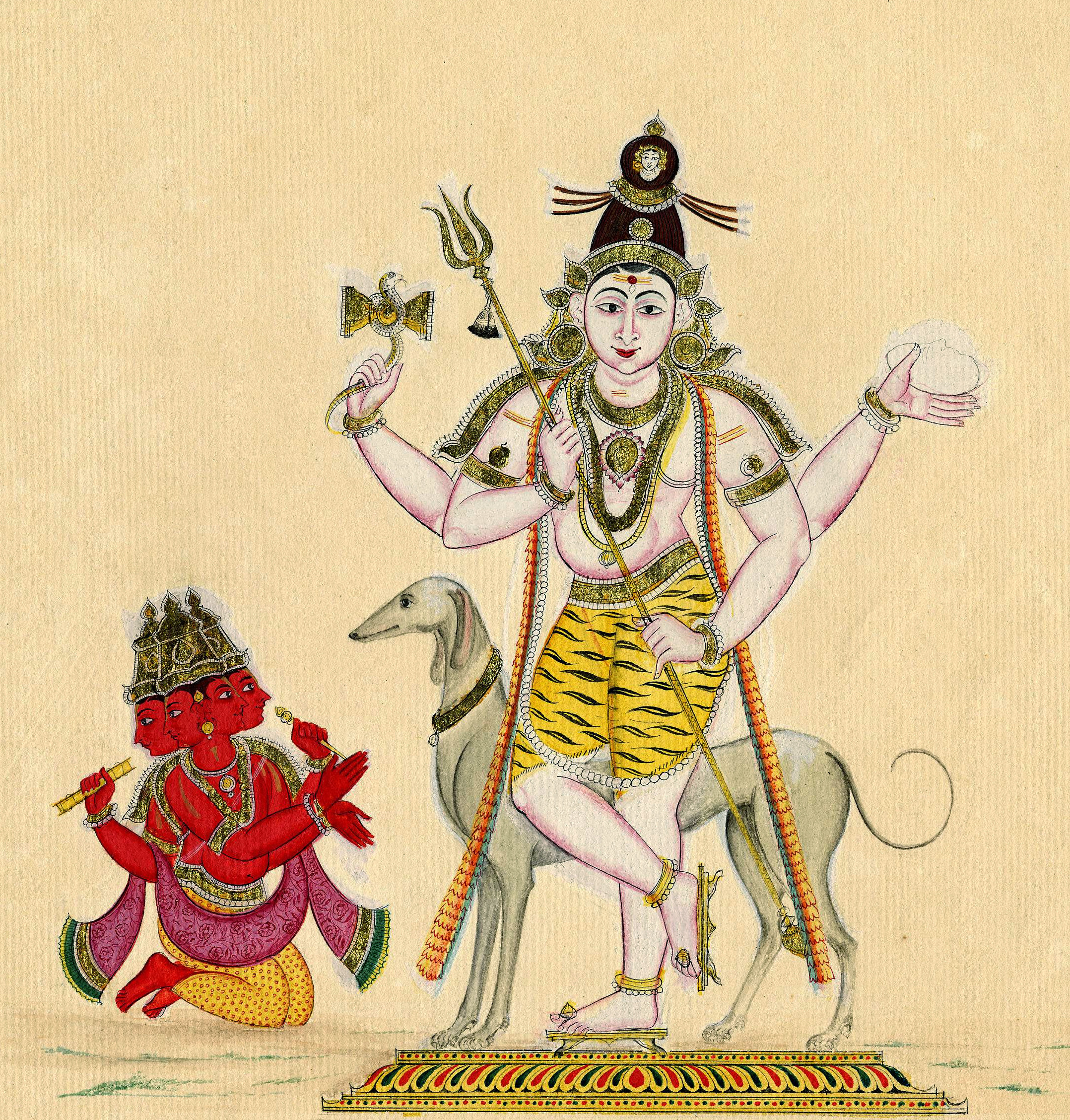
The deity Brahma, while most commonly depicted with four heads, is often stated to have once possessed five heads in Hindu literature. According to one legend, after Brahma created a goddess, named either Saraswati, Savitri, or Gayatri, he grew infatuated by her, despite the protests of sages that she was his spiritual daughter. The goddess is said to have offered her respects to her creator by circumambulating him. Unable to control himself, in desperation to maintain his sight of her, Brahma manifested three heads to his sides and also one atop his head. This exhausted him of all of his merit. in another legend, Brahma asserted his superiority over Shiva, his fifth head making a number of incendiary remarks against him. Shiva responded by manifesting his own panchamukha aspect, and sliced off Brahma's fifth head with his fingernail, or commanded his aspect of Bhairava to perform the deed.
Ganesha
Main article: Heramba
.jpg)
The deity Ganesha is sometimes represented with five faces in his iconography, called Heramba or Panchamukha Ganesha. Each head of the deity is said to represent the five koshas, the sheaths of annamaya, pranamaya, manomaya, vijñānamaya, and anandamaya.
Gayatri

Temples
Panchmukhi Hanuman temple, Basatiyawala
The Panchmukhi Hanuman temple of Basatiyawala is situated in the Yamunanagar district of Haryana near Bilaspur.[[File:Punchamukhi Hanuman Temple 1.jpg|thumb|[[Panchmukhi Hanuman Temple|Shri Panchmukhi Hanuman Temple]]]]
Panchmukhi Hanuman Temple, Karachi
A Panchmukhi Hanuman temple is located in Karachi in the Sindh Province of Pakistan. It is claimed to be a 1,500 year old temple.
References
References
- Lingham, Durgadas (Rodney). (2013-11-03). "Exploring Mantric Ayurveda: Secrets and Insights of Mantra-Yoga and Healing". Lulu.com.
- www.wisdomlib.org. (2017-07-05). "Pancamukha, Pañcamukha, Panca-mukha, Pancan-mukha, Pamcamukha: 11 definitions".
- (1992). "Itihas". Director of State Archives, Government of Andhra Pradesh..
- (2022-08-18). "World Archaeoprimatology: Interconnections of Humans and Nonhuman Primates in the Past". Cambridge University Press.
- Five Heads and no tail: Hanuman and the popularization of Tantra by Philip Lutgendorf, 2001, International Journal of Hindu Studies, Vol. 5, No. 3, Page 269-296
- Hanumat Rahashyam with Hindi Commentary by Shivadutta Mishra Shastri, pp-130-133. link
- Five Heads and no tail: Hanuman and the popularization of Tantra by Philip Lutgendorf, 2001, International Journal of Hindu Studies, Vol. 5, No. 3, Page 269-296
- Dalal, Roshen. (2014-04-18). "Hinduism: An Alphabetical Guide". Penguin UK.
- Tripathy, Dr Preeti. (2010). "Indian Religions: Tradition, History and Culture". Axis Publications.
- Murty, Sudha. (2018-09-25). "The Upside-Down King: Unusual Tales about Rama and Krishna". Penguin Random House India Private Limited.
- (2000). "Gods And Goddesses Of India". Diamond Pocket Books (P) Ltd..
- www.wisdomlib.org. (2015-05-25). "Pancabrahma, Pañcabrahma, Panca-brahma: 5 definitions".
- Bonnefoy, Yves. (1993-05-15). "Asian Mythologies". University of Chicago Press.
- Iyer, V. K.. (2013-12-30). "7 Steps to the Art of Tanjore Painting". Partridge Publishing.
- Chandra, Suresh. (1998). "Encyclopaedia of Hindu Gods and Goddesses". Sarup & Sons.
- [https://www.tribuneindia.com/news/haryana/kalesar-kalka-stretch-to-be-promoted-for-tourism/715488.html Kalesar-Kalka stretch to be promoted for tourism] {{Webarchive. link. (2019-04-17 , The Tribune, 18 jan 2019.)
- (27 December 2019). "Diwali celebrations begin in Karachi Prayer services, ceremonies organised at temples across the city". Dawn.
- Rabia Ali. (19 February 2012). "Recycling history: And all of Hanuman's men put this temple together again". Express Tribune.
This article was imported from Wikipedia and is available under the Creative Commons Attribution-ShareAlike 4.0 License. Content has been adapted to SurfDoc format. Original contributors can be found on the article history page.
Ask Mako anything about Panchamukha — get instant answers, deeper analysis, and related topics.
Research with MakoFree with your Surf account
Create a free account to save articles, ask Mako questions, and organize your research.
Sign up freeThis content may have been generated or modified by AI. CloudSurf Software LLC is not responsible for the accuracy, completeness, or reliability of AI-generated content. Always verify important information from primary sources.
Report