From Surf Wiki (app.surf) — the open knowledge base
Panamax
Size limits for ships that can transit the Panama Canal
Size limits for ships that can transit the Panama Canal
| Field | Value |
|---|---|
| section1 | {{Infobox ship/characteristics |
| header_caption | Panamax |
| tonnage | |
| length | 950 ft |
| beam | 106 ft |
| height | 190 ft |
| draft | 39.5 ft |
| capacity | |
| notes | Opened 1914 |
the size criteria for ships traveling through the Panama Canal

Panamax and New Panamax (or Neopanamax) are terms for the size limits for ships traveling through the Panama Canal. The limits and requirements are published by the Panama Canal Authority (ACP) in a publication titled "Vessel Requirements". These requirements also describe topics like exceptional dry seasonal limits, propulsion, communications, and detailed ship design.
The allowable size is limited by the width and length of the available lock chambers, by the depth of water in the canal, and by the height of the Bridge of the Americas since that bridge's construction, along with the clearance under the Atlantic and Centennial Bridges since their constructions in 2019 and 2004 respectively. These dimensions give clear parameters for ships destined to traverse the Panama Canal and have influenced the design of cargo ships, naval vessels, and passenger ships.
Panamax specifications have been in effect since the opening of the canal in 1914. In 2009, the ACP published the "New Panamax" specification, which came into effect when the canal's third set of locks, larger than the original two, opened on 26 June 2016. Ships that do not fall within the Panamax-sizes may be called post-Panamax, super-Panamax, or Capesize.
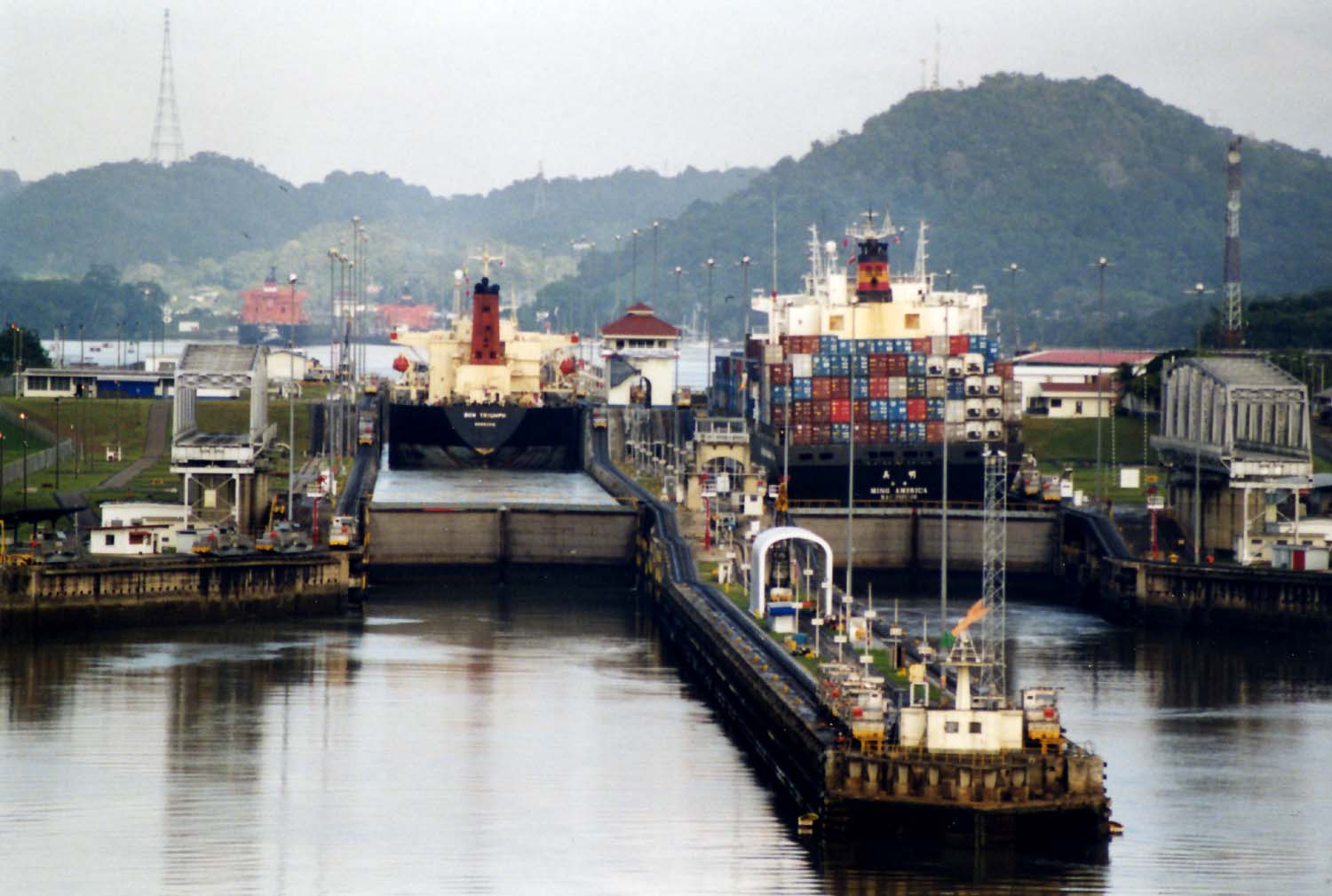
The increasing prevalence of vessels of the maximum size is a problem for the canal, as a Panamax ship is a tight fit that requires precise control of the vessel in the locks, possibly resulting in longer lock time, and requiring that these ships transit in daylight. Because the largest ships traveling in opposite directions cannot pass safely within the Culebra Cut, the canal effectively operates an alternating one-way system for these ships.
Ship dimensions
Main article: Cargo ship#Size categories


Panamax is determined principally by the dimensions of the canal's original lock chambers, each of which is 110 ft wide, 1050 ft long, and 41.2 ft deep. The usable length of each lock chamber is 1000 ft. The available water depth in the lock chambers varies, but the shallowest depth is at the south sill of the Pedro Miguel Locks and is 41.2 ft at a Miraflores Lake level of 54 ft. The clearances under the Bridge of the Americas at Balboa, the Centennial Bridge near the Culebra Cut, and the Atlantic Bridge in Colon, are the three limiting factors on a vessel's overall height for both Panamax and Neopanamax ships; the exact figure depends on the water level.
The maximum dimensions allowed for a ship transiting the canal using the original locks and the new locks (New Panamax) are:
Length
Overall (including protrusions): 950 ft. Exceptions:
- Container ship and passenger ship: 965 ft
- Tug-barge combination, rigidly connected: 900 ft overall
- Other nonself-propelled vessels-tug combination: 850 ft overall;
New Panamax increases the allowable length to 366 m.
Width (beam)
Width over outer surface of the shell plating: 106 ft. General exception: 107 ft, when draft is less than 37 ft in tropical fresh water.
New Panamax originally allowed a width of 49 m. This was expanded to 51.25 m during June 2018.
Draft
The maximum allowable draft is 39.5 ft in tropical freshwater (TFW). The name and definition of TFW is created by ACP using the freshwater Lake Gatún as a reference. The salinity and temperature of water affect its density, and hence how deep a ship will float in the water. The lake's water has a density of 995.4 kg/m3, at 29.1 C. The physical limit is set by the lower (seaside) entrance of the Pedro Miguel locks. When the water level in Lake Gatún is low during an exceptionally dry season, the maximum permitted draft may be reduced. Such a restriction is published three weeks in advance, so ship loading plans can take appropriate measures.
New Panamax increases allowable draft to 15.2 m; however, due to low rainfall, the Canal Authority limited draft to 43 ft when the new locks opened in June 2016, increasing it to 44 ft in August, "based on the current level of Gatun Lake and the weather forecast for the following weeks."
Height
Vessel height is limited to 190 ft measured from the waterline to the vessel's highest point; the limit also pertains to New Panamax in order to pass under the Bridge of the Americas at Balboa harbor. Exception: 205 ft when passage at low water (MLWS) at Balboa is possible.
Cargo capacity
A Panamax cargo ship would typically have a DWT of 65,000–80,000 tonnes, but its maximum cargo would be about 52,500 tonnes during a transit due to draft limitations in the canal. New Panamax ships can carry 120,000 DWT. Panamax container ships can carry , with for New Panamax vessels.
Records
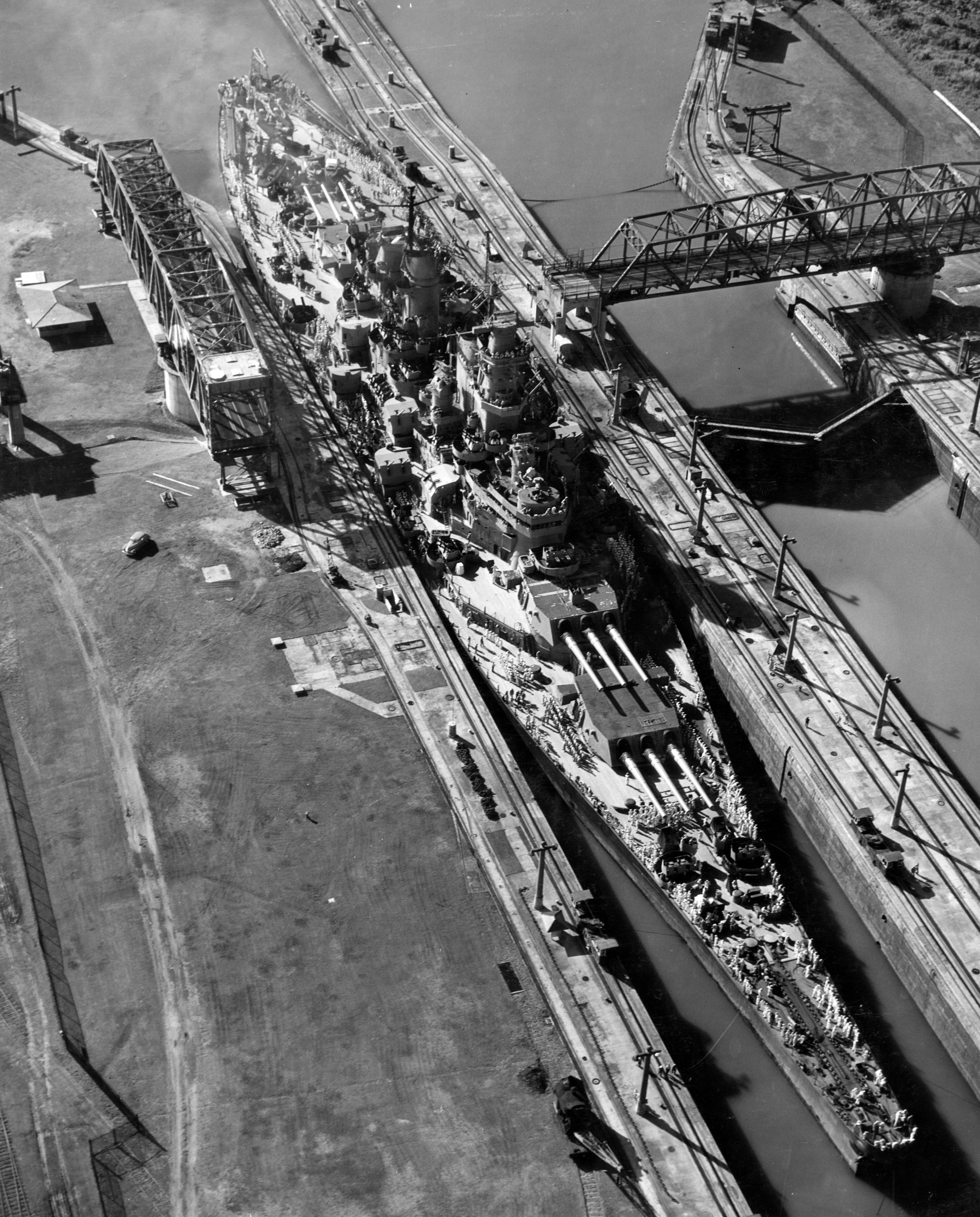
The longest ship ever to transit the original locks was San Juan Prospector, now Marcona Prospector, an ore-bulk-oil carrier that is 973 ft long, with a beam of 106 ft. The widest ships to transit are the and battleships, which have a maximum beam of 108 ft, leaving less than 6 in margin of error between the ships and the walls of the locks.
Routes
Major Panamax bulk trade routes include Brazil to China, Australia to China, U.S. to China, China to China, and Australia to India.
Expansion
Main article: Panama Canal expansion project
As early as the 1930s, new locks were proposed for the Panama Canal to ease congestion and to allow larger ships to pass. The project was abandoned in 1942.
On October 22, 2006, the Panama Canal Authority (with the support of the Electoral Tribunal) held a referendum for Panamanian citizens to vote on the Panama Canal expansion project. The expansion was approved by a wide margin, with support from about 78% of voters. Construction began in 2007, and after several delays, the new locks opened for commercial traffic on 26 June 2016.
New Panamax
Neopanamax
Construction of another set of larger locks led to the creation of the "Neopanamax" or "New Panamax" ship classification, based on the new locks' dimensions of 427 m in length, 55 m in beam, and 18.3 m in depth. Naval architects and civil engineers began taking into account these dimensions for container ships. With the new locks, the Panama Canal is able to handle vessels with overall length of 366 m, 49 m beam (increased by the Canal Authority effective 1 June 2018 to 51.25 m, to accommodate ships with 20 rows of containers) and 15.2 m draft, and cargo capacity up to ; previously, it could only handle vessels up to about . The Neopanamax standard accommodates ships up to 120,000 DWT.
Impact on world ports
United States

.jpg)
Several ports, including the ports of New York and New Jersey, Norfolk, and Baltimore, all on the East Coast of the United States, have already increased their depth to at least 50 ft to accommodate New Panamax ships; in 2015 the Port of Miami achieved the same in a project known as the "Deep Dredge" and is the closest deepwater port to the Panama Canal in the US. In 2017, the Port Authority of New York and New Jersey raised the clearance of the Bayonne Bridge to 215 ft, at a cost of $1.7 billion, to allow New Panamax ships to reach container port facilities at Port Newark–Elizabeth Marine Terminal. Previously, only GCT Bayonne, Global Container, could handle the New Panamax ships.
As of April 2012, a controversy between Savannah, Georgia, and Charleston, South Carolina, over limited federal funding for dredging/deepening projects—including both state and federal lawsuits filed by environmental groups in both states opposing the techniques planned to be used in dredging the Savannah River—also revolves around attracting the business of carriers whose fleets include New Panamax vessels. Jacksonville, Florida, is pursuing its "Mile Point" project with the prospect of deepening the St. John's River in anticipation of Post-Panamax traffic; Mobile, Alabama, has completed the deepening of its harbor to 45 ft for the same reason; and other ports seem likely to follow suit.
The American conservative think tanks The Heritage Foundation and Cato Institute have cited the Foreign Dredge Act of 1906 as a factor in constraining American dredging capacity for expanding ports to accommodate post-Panamax ships.
United Kingdom and Canada
Liverpool built a new container terminal, Liverpool2, where ships berth in the tidal river rather than in the enclosed docks, coinciding with the opening of the widened Panama Canal locks. In Halifax, Canada, a major expansion of the South End Container Terminal was completed in 2012, extending the pier and increasing the berth depth from 14.5 to 16 m.
Mexico
The port of Salina Cruz, in the state of Oaxaca, Mexico, has been expanded to obtain the capacity to receive Post Panamax ships. This expansion forms part of the Interoceanic Corridor of the Isthmus of Tehuantepec (CIIT) project which the Mexican government has been executing since 2019. This expansion, which began in January 2022, consists of the creation of a new port with an access depth of 24 m, a 1600 m long breakwater and a 300 m wide mouth. This new port is planned to be inaugurated on February 26, 2024. Between January 2020 and June 30, 2023, the government spent over 3.8 billion Mexican pesos to this expansion. The project's goal is to create a land-based route alternative to the Panama Canal, which has faced complications in recent years due to intense droughts. However, the port of Coatzacoalcos, Veracruz, is still 12 m deep, but it has nonetheless been subjected to expansion and modernization to efficiently transport cargo.
Impact on existing ships
.jpg)
Due to the expansion, demand for Old Panamax ships has plummeted, resulting in ships being traded at scrap value. Some ships only seven years old have been sold for scrap, and others have been widened.
Comparison of sizes
| Original locks | Panamax | Third locks | New-Panamax | Length | Width | tropical freshwater]] (TF) | TEUs | 5,000 | style="border-left: 3px solid grey;" | 13,000 | Tonnage | style="border-left: 3px solid grey;" | ||||||||||||||
|---|---|---|---|---|---|---|---|---|---|---|---|---|---|---|---|---|---|---|---|---|---|---|---|---|---|---|
| 1050 ft | 965 ft | 427 m | 366 m | |||||||||||||||||||||||
| 110 ft | 106 ft | 55 m | 51.25 m | |||||||||||||||||||||||
| 41.2 ft | 39.5 ft | 18.3 m | 15.2 m |

Post-Panamax and Post-Neopanamax ships
Post-Panamax or over-Panamax denote ships larger than Panamax that do not fit in the original canal locks, such as supertankers and the largest modern container and passenger ships. The first post-Panamax ship was the RMS Queen Mary, launched in 1934, built with a 118 ft beam as she was intended solely for North Atlantic passenger runs. When she was moved to Long Beach, California, as a tourist attraction in 1967, a lengthy voyage around Cape Horn was necessary.
References
References
- "Vessel Requirements". [[Panama Canal Authority]].
- Manuel E. Benítez, ACP. (2009-01-19). "Dimensions for Future Lock Chambers and "New Panamax" Vessels". ACP.
- (16 May 2019). "Watch: Largest Vessel In Dimension To Pass Through Expanded Panama Canal". Marine Insight.
- (1999-06-03). "Regulation on navigation in Panama Canal Waters". The Panama Canal Authority.
- [http://www.joc.com/port-news/panama-canal-news/canal-adds-foot-maximum-draft-neo-panamax-locks_20160808.html Canal adds foot to maximum draft of neo-Panamax locks], Joseph Bonney, joc.com, Aug 08, 2016, Accessed December 11, 2016
- [http://www.pancanal.com/eng/maritime/notices/2010/N01-2010-r1.pdf OP NOTICE TO SHIPPING No. N-1-2010, Rev. 1 To: Steamship Agents, Owners and Operators Subject: Vessel Requirements] {{Webarchive. link. (2021-12-04 page 4. 16 April 2010 ''www.pancanal.com'', accessed 10 April 2021)
- "Modern ship size definitions". Lloyd's register.
- "Background of the Panama Canal". Montclair State University.
- "BB-61 Iowa-class".
- (7 February 2017). "Top Five Panamax Bulk Trades".
- (2016-06-26). "Panama Canal Opens $5B Locks, Bullish Despite Shipping Woes". [[The New York Times]].
- {{citation. link. "Propulsion Trends in Container Vessels". MAN B&W Two-stroke Engines
- "Panama canal expansion, reordering maritime trade". CMA CGA.
- "Fleet". Rickmers Maritime.
- (12 September 2012). "The New Panamax; 13,200-TEU Containership, 120,000 dwt Bulk Carrier".
- "Bill Johnson, Director of the Port of Miami, presented on the Port of Miami's Deep Dredge Project to the Miami Beach Chamber of Commerce's…".
- "Navigational Clearance Project - Bayonne Bridge - The Port Authority of NY & NJ".
- "This 113-Year-Old Law Is Hurting American Ports". The Heritage Foundation.
- (2022-04-29). "To New Critics of the Foreign Dredge Act: Welcome Aboard!". Cato Institute.
- Tosi, Gregory. (2021-03-19). "How to Make US Ports Competitive Again {{!}} RealClearPolicy".
- (13 February 2012). "$35m port terminal project nearing completion". Halifax Chronicle-Herald.
- Sabanero, Axel. (13 February 2024). "Tren del Istmo: estos son los buques masivos que llegarán al puerto de Salina Cruz". [[Radio Fórmula]].
- Silva Alanis, Pedro. (2 September 2023). "Tren interoceánico, al 90%; muelle de Salina Cruz, al 30%". El Imparcial de Oaxaca.
- Pamplona, Fabian. (October 17, 2023). "Corredor Interoceánico: Semar informa sobre avances en los puertos de Coatzacoalcos, Salina Cruz, Chiapas y Dos Bocas". Diario del Istmo.
- Ríos, Jose. (February 13, 2024). "Corredor Interoceánico: ¿cómo son los buques que llegarán a Salina Cruz?". Diario del Istmo.
- Robertson, Jamie. (1 March 2017). "Why a ship worth $60m was sold as scrap". BBC News.
- (19 December 2016). "Maersk scrapping eight Panamax ships".
- Lutz Müller, Olaf Doerk: ''Verbreiterung von Panamax-Containerschiffen''. In: ''Schiff & Hafen'', Vol. 8/2017, pp. 12–17
- [http://www.pancanal.com/common/maritime/advisories/2018/a-11-2018.pdf Increase in Maximum Beam for Vessels in the Neopanamax Locks (ADVISORY TO SHIPPING No. A-11-2018)] {{Webarchive. link. (2018-04-27 14 April 2018 ''www.pancanal.com'', accessed 10 April 2021)
- "Yamato Class Battleship – Japan (Pacific 1940)".
- Friedman, Norman. (1985). "U.S. Battleships: An Illustrated Design History". Naval Institute Press.
- "70 years of schemes to improve and enlarge the Panama Canal", p. 1 (''Essex''-class aircraft carriers were the "last fleet carriers capable of passing through the canal’s original locks"). The paper is linked from Dr. Roger's website, [http://web.mst.edu/~rogersda/Panama-Canal-2012/ Panama Canal], ''web.mst.edu'', accessed 10 April 2021
This article was imported from Wikipedia and is available under the Creative Commons Attribution-ShareAlike 4.0 License. Content has been adapted to SurfDoc format. Original contributors can be found on the article history page.
Ask Mako anything about Panamax — get instant answers, deeper analysis, and related topics.
Research with MakoFree with your Surf account
Create a free account to save articles, ask Mako questions, and organize your research.
Sign up freeThis content may have been generated or modified by AI. CloudSurf Software LLC is not responsible for the accuracy, completeness, or reliability of AI-generated content. Always verify important information from primary sources.
Report