From Surf Wiki (app.surf) — the open knowledge base
Pan-Turkism
Political movement advocating the unity of Turkic peoples
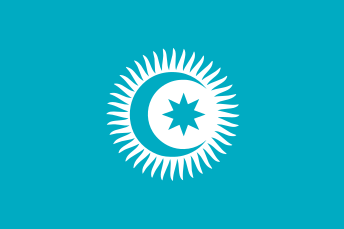
Political movement advocating the unity of Turkic peoples

]]
Pan-Turkism () or Turkism () is a political movement that emerged during the 1880s among Turkic intellectuals who lived in the Russian region of Kazan (Tatarstan), South Caucasus (modern-day Azerbaijan) and the Ottoman Empire (modern-day Turkey), with its aim being the cultural and political unification of all Turkic peoples. Turanism is a closely related movement but it is a more general term, because Turkism only applies to Turkic peoples. However, researchers and politicians who are steeped in the pan-Turkic ideology have used these terms interchangeably in many sources and works of literature.
Although many of the Turkic peoples share historical, cultural and linguistic roots, the rise of a pan-Turkic political movement is a phenomenon of the 19th and 20th centuries. Ottoman poet Ziya Gökalp defined pan-Turkism as a cultural, academic, and philosophical{{Cite book
Name
In research literature, "pan-Turkism" is used to describe the political, cultural and ethnic unity of all Turkic people. "Turkism" began to be used with the prefix "pan-" (from the Greek πᾶν, pan = all).
Proponents use the latter as a point of comparison, since "Turkic" is a linguistic, ethnic and cultural distinction rather than a citizenship description. This differentiates it from "Turkish", which is the term which is officially used in reference to citizens of Turkey. Pan-Turkic ideas and reunification movements have become popular since the collapse of the Soviet Union in Central Asian and other Turkic countries.
History
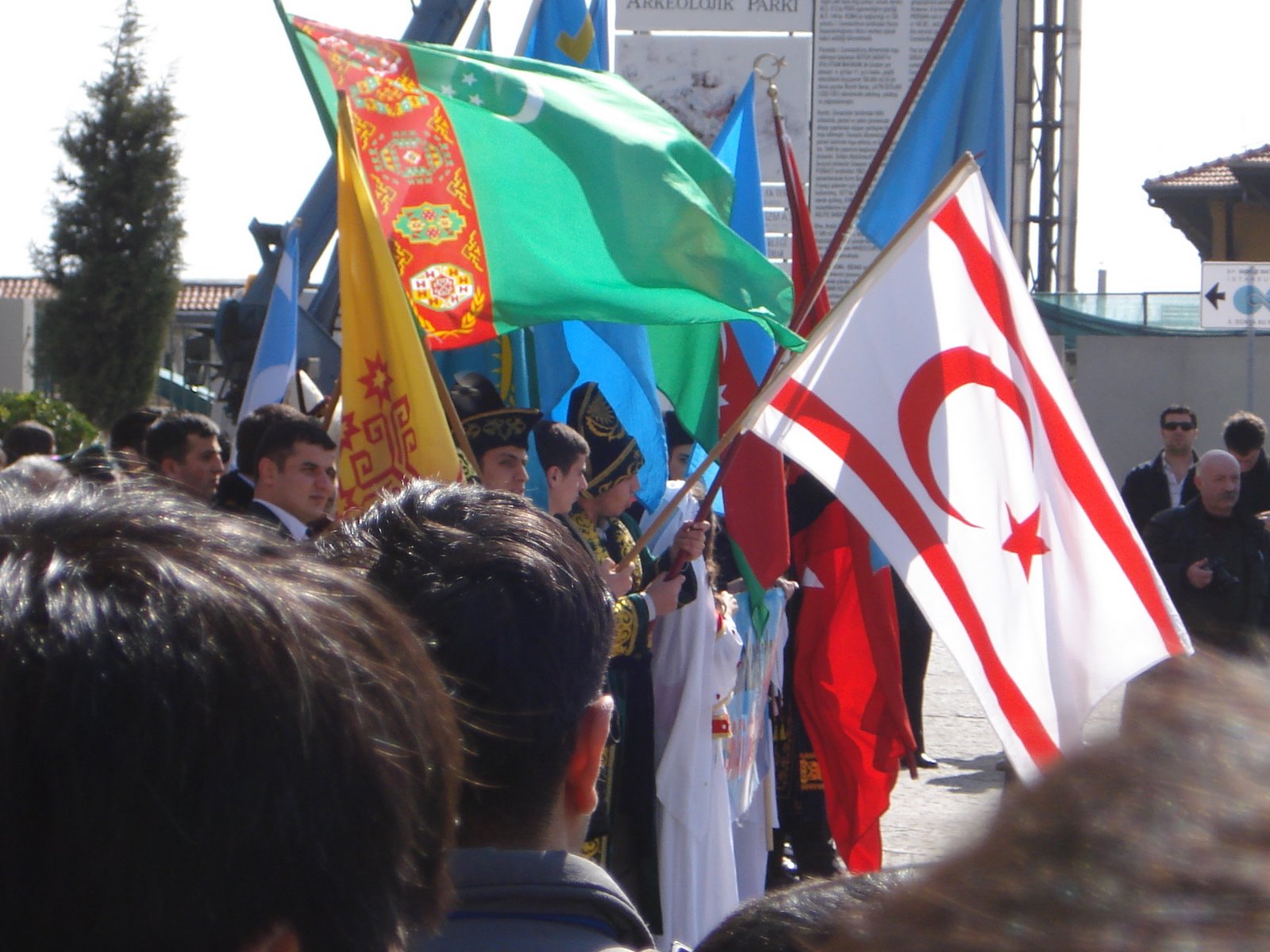
Development and spread
In 1804, the Tatar theologian Ghabdennasir Qursawi wrote a treatise calling for the modernization of Islam. Qursawi was a Jadid (from the Arabic word jadid, "new"). The Jadids encouraged critical thinking, supported education and advocated the equality of the sexes, advocated tolerance of other faiths, advocated Turkic cultural unity, and advocated openness to Europe’s cultural legacy. The Jadid movement was founded in 1843 in Kazan. Its aim was the implementation of a semi-secular modernization program and the implementation of an educational reform program, both programs would emphasize the national (rather than the religious) identity of the Turks. Before they founded their movement in 1843, the Jadids considered themselves Muslim subjects of the Russian Empire, a belief which they held until the Jadid movement disbanded.
After they joined the Wäisi movement, the Jadids advocated national liberation. After 1907, many supporters of Turkic unity immigrated to the Ottoman Empire.
The newspaper Türk in Cairo was published by exiles from the Ottoman Empire after the suspension of the Ottoman constitution of 1876 and the persecution of liberal intellectuals. It was the first publication to use the ethnic designation as its title. Yusuf Akçura published "Three Types of Policy" (Üç tarz-ı siyaset) anonymously in 1904, the earliest manifesto of a pan-Turkic nationalism. Akçura argued that the supra-ethnic union espoused by the Ottomans was unrealistic. The Pan-Islamic model had advantages, but Muslim populations were under colonial rule which would oppose unification. He concluded that an ethnic Turkish nation would require the cultivation of a national identity; a pan-Turkish empire would abandon the Balkans and Eastern Europe in favor of Central Asia. The first publication of "Three Types of Policy" had a negative reaction, but it became more influential by its third publication in 1911 in Istanbul. The Ottoman Empire had lost its African territory to the Kingdom of Italy and it would soon lose the Balkans. Pan-Turkish nationalism consequently became a more feasible (and popular) political strategy.
In 1908, the Committee of Union and Progress came to power in Ottoman Turkey, and the empire adopted a nationalistic ideology. This contrasted with its largely Muslim ideology which dated back to the 16th century, when the sultan was the caliph of his Muslim lands. Leaders who espoused Pan-Turkism fled from Russia and moved to Istanbul, where a strong pan-Turkic movement arose; the Turkish pan-Turkic movement grew and transformed itself into a nationalistic, ethnically oriented movement which sought to replace the caliphate with a state. After the fall of the Ottoman Empire, some of them tried to replace the multi-cultural and multi-ethnic empire with a Turkish commonwealth, the advocates of this idea were influenced by the nationalism of the Young Turks. Leaders like Mustafa Kemal Atatürk acknowledged that such a goal was impossible, replacing pan-Turkic idealism with a form of nationalism which aimed to preserve the existence of an Anatolian nucleus.
The Türk Yurdu Dergisi (Journal of the Turkish Homeland) was founded in 1911 by Akçura. This was the most important Turkist publication of the time, "in which, along with other Turkic exiles from Russia, [Akçura] attempted to instill a consciousness about the cultural unity of all Turkic peoples of the world."
In 1923, Ziya Gökalp, famous poet and theorician of Turkism ideology, wrote his book The Principles of Turkism and idealized the unity of Turkic peoples by calling Turan as a goal of Turkism.
A significant early exponent of pan-Turkism was Enver Pasha (1881–1922), the Ottoman Minister of War and acting commander-in-chief during World War I. He later became a leader of the Basmachi movement (1916–1934) against Russian and Soviet rule in Central Asia. During World War II, the Nazis founded a Turkestan Legion which was primarily composed of soldiers who hoped to establish an independent Central Asian state after the war. The German intrigue bore no fruit.
When the Turkish Republic was established under the leadership of Mustafa Kemal Atatürk in 1923, interest in Pan-Turkism declined, because Atatürk promoted Turkish nationalism within Turkey. The Pan-Turkist movements gained some momentum in the 1940s, due to the support which it received from Nazi Germany, which sought to use Pan-Turkism as leverage in order to undermine Russian influence in an effort to acquire the resources of Central Asia during the course of World War II. The development of pan-Turkist and anti-Soviet ideology, in some circles, was influenced by Nazi propaganda during this period. Some sources claim that Nihal Atsız advocated Nazi doctrines and adopted a Hitler-style haircut. Alparslan Türkeş, a leading pan-Turkist, took a pro-Hitler position during the war and developed close connections with Nazi leaders in Germany. Several pan-Turkic groups in Europe apparently had ties to Nazi Germany (or its supporters) at the start of the war, if not earlier. The Turco-Tatars in Romania cooperated with the Iron Guard, a Romanian fascist organisation. Although the Turkish government's archives which date back to the World War II years have not been declassified, the level of contact can be ascertained from German archives. A ten-year Turco-German treaty of friendship was signed in Ankara on 18 January 1941. Official and semi-official meetings between German ambassador Franz von Papen and other German officials and Turkish officials, including General H. E. Erkilet (of Tatar origin and a frequent contributor to pan-Turkic journals) took place in the second half of 1941 and the early months of 1942. The Turkish officials included General Ali Fuad Erdem and Nuri Pasha (Killigil), brother of Enver Pasha.
Pan-Turkists were not supported by the Turkish government during this time and on 19 May 1944, İsmet İnönü made a speech in which he condemned Pan-Turkism as "a dangerous and sick demonstration of the latest times" going on to say that the Turkish Republic was "facing efforts hostile to the existence of the Republic" and those who advocate these ideas "will only bring trouble and disaster". Nihal Atsız and other prominent pan-Turkist leaders were tried and sentenced to imprisonment for conspiring against the government. Zeki Velidi Togan was sentenced to ten years imprisonment and four years in internal exile, Reha Oğuz Türkkan was sentenced to five years and ten months in prison and two years in exile, Nihal Atsız was sentenced to six years, six months and 15 days in prison and 3 years in exile. Others were sentenced to prison terms which only ranged from a few months to four years in length. But the defendants appealed the convictions and in October 1945, the sentences of all the convicted were abolished by the Military Court of Cassation.
While Erkilet discussed military contingencies, Nuri Pasha told the Germans about his plan to establish independent states which would be allies (not satellites) of Turkey. These states would be formed by the Turkic-speaking populations which lived in Crimea, Azerbaijan, Central Asia, northwestern Iran, and northern Iraq. Nuri Pasha offered to assist Nazi Germany's propaganda efforts on behalf of this cause. However, Turkey's government also feared for the survival of the Turkic minorities in the USSR and it told von Papen that it could not join Germany until the USSR was crushed. The Turkish government may have been apprehensive about Soviet might, which kept the country out of the war. On a less-official level, Turkic emigrants from the Soviet Union played a crucial role in negotiations and contacts between Turkey and Germany; among them were prominent pan-Turkic activists like Zeki Velidi Togan, Mammed Amin Rasulzade, Mirza Bala, Ahmet Caferoĝlu, Sayid Shamil and Ayaz İshaki. Several Tatar military units which consisted of Turkic speakers from the Turco-Tatar and Caucasian regions of the USSR who had previously been prisoners of war of the Germans joined them and fought against the Soviets, the members of these Tatar military units generally fought as guerrillas in the hope that they would be able to secure the independence of their homelands and establish a pan-Turkic union. The units, which were reinforced, numbered several hundred thousand. Turkey took a cautious approach at the government level, but pan-Turkists were angered by the Turkish government's inaction because they believed that it was wasting a golden opportunity to achieve the goals of pan-Turkism.
Criticism
Pan-Turkism is often perceived as being a new form of Turkish imperial ambition. Some view the young Turk leaders who believed that they could reclaim the prestige of the Ottoman Empire by espousing the pan-Turkist ideology as racist and chauvinistic.Jacob M. Landau. Pan-Turkism: From Irredentism to Cooperation. India University Press, 1995. 2nd Edition. pg 45: "Pan-Turkism's historic chance arrived both shortly before and during the First World War, when it was adopted as a guiding principle of state policy by an influential group among the Young Turks"
{{anchor|Viewpoint on Armenian history}}Pan-Turkist views on Armenian history
Clive Foss, professor of ancient history at the University of Massachusetts Boston, critically notes that in 1982: The Armenian File in the Light of History, Cemal Anadol writes that the Iranian Scythians and Parthians are Turks. According to Anadol, the Armenians welcomed the Turks into the region; their language is a mixture with no roots and their alphabet is mixed, with 11 characters which were borrowed from the ancient Turkic alphabet. Foss calls this view historical revisionism: "Turkish writings have been tendentious: history has been viewed as performing a useful service, proving or supporting a point of view, and so it is treated as something flexible which can be manipulated at will". He concludes, "The notion, which seems well established in Turkey, that the Armenians were a wandering tribe without a home, who never had a state of their own, is of course entirely without any foundation in fact. The logical consequence of the commonly expressed view of the Armenians is that they have no place in Turkey, and they never did. The result would be the same if the viewpoint were expressed first, and the history were written to order. In a sense, something like this seems to have happened, for most Turks who grew up under the Republic were educated to believe in the ultimate priority of Turks in all parts of history, and ignore the Armenians all together; they had been clearly consigned to oblivion."
{{anchor|Viewpoint on Armenian history}}Zangezur corridor
Main article: Zangezur corridor

The Zangezur corridor is a concept for a transport corridor that emerged after the 2020 Nagorno-Karabakh War, promoted primarily by Azerbaijan and Turkey as a direct land link between mainland Azerbaijan and its Nakhchivan exclave through Armenia’s southern Syunik province. This proposed route, is envisioned without Armenian checkpoints and is framed by its supporters as a way to connect the broader Turkic world. Armenia has steadily objected to it, asserting that "corridor logic" deviates from the ceasefire terms, and that it is a form of propaganda that threatens Armenian sovereignty.
Certain critics regard the concept as a pan-Turkic expansionist project. Azerbaijan has threatened to force the corridor’s creation using if Armenia does not agree. Turkey has long sought to establish a direct land corridor to mainland Azerbaijan. Multiple sources state that this ambition was a driving factor behind the Armenian Genocide, as the Armenian population represented a geographical obstacle between Turkic entities. Genocide Watch characterizes the corridor as a pan-Turkic project which "will cost thousands of Armenian lives." The Lemkin Institute for Genocide Prevention has stated that the seizure of Armenia's Syunik region would "realize the pan-Turkic dream that fueled the Armenian Genocide of 1915-1923," adding that Azerbaijan's "actions extend far beyond mere territorial disputes, touching upon the very existence of Armenia and Armenians in what is left of their ancestral homeland."
Ahmad Kazemi, academic and researcher on Eurasian issues, wrote that "Azerbaijan is seeking to establish the so-called pan-Turkic illusionary Zangezur corridor in south of Armenia under the pretext of creating connectivity in the region," arguing that "this corridor is not compatible with any of the present geopolitical and historical realities of the region."
Since the end of the Second Nagorno-Karabakh War, Azerbaijan has increasingly promoted expansionist claims to Armenian territory which it describes as "Western Azerbaijan."{{bulleted list| | | | |
{{anchor|Pan-Turkist views in Azerbaijan}}Pan-Turkist views in Azerbaijan

Kâzım Karabekir said
Western Azerbaijan is a term used in the Republic of Azerbaijan to refer to Armenia. According to the Whole Azerbaijan theory, modern Armenia and Nagorno-Karabakh were once inhabited by the Azerbaijanis. Its claims are based on the belief that current Armenia was ruled by Turkic tribes and states from the Late Middle Ages to the Treaty of Turkmenchay which was signed after the 1826–1828 Russo-Persian War. The concept has been sanctioned by the government of Azerbaijan and its current president, Ilham Aliyev, who has said that Armenia is part of ancient Turkic, Azerbaijani land. Turkish and Azerbaijani historians have said that Armenians are alien, not indigenous, in the Caucasus and Anatolia.{{bulleted list| | Tofig Kocharli, "Armenian Deception" | Ohannes Geukjian, "Ethnicity, Nationalism and Conflict in the South Caucasus: Nagorno-Karabakh and the Legacy of Soviet Nationalities Policy" | | |
During the existence of the Azerbaijan SSR of the Soviet Union, pan-Turkist political elites of Baku who were loyal to the Communist cause, in tandem with Soviet-era historical revisionism and myth-building, invented a national history based on the existence of an Azerbaijani nation-state that dominated the areas to the north and south of the Aras river, which was supposedly torn apart by an Iranian-Russian conspiracy in the Treaty of Turkmenchay of 1828. This "imagined community" was cherished, promoted and institutionalized in formal history books of the educational system of the Azerbaijan SSR and the post-Soviet Azerbaijan Republic. As the Soviet Union was a closed society, and its people were unaware of the actual realities regarding Iran and its citizens of Azerbaijani descent, the elites in Soviet Azerbaijan kept cherishing and promoting the idea of a "united Azerbaijan" in their activities. This romantic thought led to the founding of nostalgic literary works, known as the "literature of longing"; examples amongst this genre are, for instance, Foggy Tabriz by Mammed Said Ordubadi, and The Coming Day by Mirza Ibrahimov. As a rule, works belonging to the "literature of longing" genre were characterized by depicting the life of Iranian Azerbaijanis as a misery due to suppression by the "Fars" (Persians), and by narrating stories about Iranian Azerbaijanis waiting for the day when their "brothers" from the "north" would come and liberate them. Works that belonged to this genre, as the historian and political scientist Zaur Gasimov explains, "were examples of blatant Azerbaijani nationalism stigmatizing the “division” of the nation along the river Araxes, as well as denunciations of economic and cultural exploitation of Iranian Azerbaijanis, etc." Gasimov adds: "an important by-product of this literary genre was strongly articulated anti-Iranian rhetoric. Tolerance and even support of this anti-Iranian rhetoric by the communist authorities were obvious."
Nationalist political elites in post-Soviet Azerbaijan, being the inheritors of this mentality created during the Soviet rule, forwarded this "mission" for achieving a "united Azerbaijan" as a political goal of utmost importance. Azerbaijani president Abulfaz Elchibey (1992–93) devoted his life to carrying out this mission, and he, in tandem with other pan-Turkist elites, went on a campaign for the ethnic awakening of Iranian Azerbaijanis. It may be due to these ideas that Elchibey was elected president in the new country's first presidential election in 1992. He and his government has been widely described as pursuing Pan-Turkic and anti-Iranian policies.{{bulleted list | | | |
Ahmad Kazemi, the author of the book Security in South Caucasus, told Iran's Strategic Council on Foreign Relations in a 2021 interview that "Azerbaijan is seeking to establish the so-called pan-Turkish illusionary Zangezur corridor in south of Armenia under the pretext of creating connectivity in the region", arguing that "this corridor is not compatible with any of the present geopolitical and historical realities of the region".
{{anchor|Tsarist Russia and Soviet viewpoint on pan-Turkism}}Russian views on pan-Turkism
In Tsarist Russian circles, pan-Turkism was considered a political, irredentist and aggressive idea. Turkic peoples in Russia were threatened by Turkish expansion, and I. Gasprinsky and his followers were accused of being Turkish spies. After the October Revolution, the Bolsheviks’ attitude to Turkism differed significantly from the Russian Empire’s. At the 10th Congress of Bolshevik Communist Party in 1921, the party "condemned pan-Turkism as a slope to bourgeois-democratic nationalism", however unofficially pan-Turkism was supported and promoted. The emergence of a pan-Turkism scare in Soviet propaganda made it one of the “most frightening” political labels in the USSR. The most widespread accusation used in the repression of educated Tatars and other Turkic peoples during the 1930s was that of pan-Turkism.
In the United States and the rest of the New World
Pan-Turkists like Reha Oğuz Türkkan have openly claimed that pre-Columbian civilizations were Turkic civilizations and they have also claimed that modern-day Native Americans are Turkic peoples, and activities which Turkish lobbying groups have conducted in order to draw Native Americans into the service of the wider Turkic world agenda have drawn criticism and triggered accusations that the Turkish government is falsifying the history of Native Americans in the service of Turkish imperialist ambitions.{{bulleted list| | | | |
The idea has also been discussed in the francophone world, noting that as victors in the First World War, England and France "dismembered the Arab portion" of the Ottoman Empire and shared it amongst themselves, further alienating Turkey. The loss of the Arabian oil fields limited Turkey becoming a petroleum power on the world stage; called "le panturquisme" in French, authors argue that it arose as a way of reclaiming some of the lost glory after the Ottoman defeat in the war and the loss of prestige in the region.
Pseudoscientific theories
Pan-Turkism has been characterized by pseudoscientific theories known as Pseudo-Turkology. Though dismissed in serious scholarship, scholars promoting such theories, often known as Pseudo-Turkologists, have in recent times emerged among every Turkic nationality. A leading light among them is Murad Adzhi, who insists that two hundred thousand years ago, "an advanced people of Turkic blood" were living in the Altai Mountains. These tall and blond Turks are supposed to have founded the world's first state, Idel-Ural, 35,000 years ago, and to have migrated as far as the Americas. According to theories like the Turkish History Thesis, promoted by pseudo-scholars, the Turkic peoples are supposed to have migrated from Central Asia to the Middle East in the Neolithic. The Hittites, Sumerians, Babylonians, and ancient Egyptians are here classified as being of Turkic origin. The Kurgan cultures of the early Bronze Age up to more recent times are also typically ascribed to Turkic peoples by pan-Turkic pseudoscholars, such as Ismail Miziev. Non-Turkic peoples typically classified as Turkic, Turkish, Proto-Turkish or Turanian include Scythians, Sakas, Cimmerians, Medes, Parthians, Caucasian Albanians, and various ethnic minorities in Turkic countries, such as Kurds. Adzhi also considers Alans, Goths, Burgundians, Saxons, Alemanni, Angles, Lombards, and many Russians as Turks. Only a few prominent peoples in history, such as Jews, Chinese people, Armenians, Greeks, Persians, and Scandinavians are considered non-Turkic by Adzhi. Philologist Mirfatyh Zakiev, former chairman of the Supreme Soviet of the Tatar ASSR, has published hundreds of "scientific" works on the subject, suggesting Turkic origins of the Sumerian, Greek, Icelandic, Etruscan and Minoan languages. Zakiev contends that "proto-Turkish is the starting point of the Indo-European languages". Not only peoples and cultures, but also prominent individuals, such as Saint George, Peter the Great, Mikhail Kutuzov and Fyodor Dostoevsky, are proclaimed to have been "of Turkic origin". As such the Turkic peoples are supposed to have once been the "benevolent conquerors" of the peoples of most of Eurasia, who thus owe them "a huge cultural debt". The pseudoscientific Sun Language Theory states that all human languages are descendants of a proto-Turkic language and was developed by the Turkish president Mustafa Kemal Atatürk during the 1930s. Kairat Zakiryanov considers the Japanese and Kazakh gene pools to be identical. Several Turkish academics (Şevket Koçsoy, Özkan İzgi, Emel Esin) claim that Zhou dynasty were of Turkic origins.{{bulleted list| | Esin, Emel (1986). "The Culture of the Turks: The Initial Inner Asian Phase" Publisher, Atatürk Culture Centre. p. 435, 439. | Koçsoy, Şevket (2002). "Türk Tarihi Kronojojisi", Türkler, C. I., Yeni Türkiye, Ankara, p. 73. | İzgi, Özkan (2002). "Orta Asya'nın En Eski Kültürleri ve Çin Medeniyeti ile İlişkileri", Türkler, C. I., Yeni Türkiye, Ankara, pp. 685-687. | Esin, Emel (2002). "İç Asya'da Milattan Önceki Bin Yılda Türklerin Atalarına Atfedilen Kültürler", Türkler, C. I., Yeni Türkiye, Ankara, p. 733-734.
Philip L. Kohl notes that the above-mentioned theories are nothing more than "incredible myths". Nevertheless, the promotion of these theories have "taken on large-scale proportions" in countries such as Turkey and Azerbaijan. Often associated with Greek, Assyrian and Armenian genocide denial, pan-Turkic pseudoscience has received extensive state and state-backed non-governmental support, and is taught all the way from elementary school to the highest level of universities in such countries. Turkish and Azerbaijani students are imbued with textbooks which make "absurdly inflated" claims which state that all Eurasian nomads, including the Scythians, and all civilizations on the territory of the Ottoman Empire, such as Sumer, ancient Egypt, ancient Greece, and the Byzantine Empire, were of Turkic origin. Konstantin Sheiko and Stephen Brown explain the reemergence of such pseudo-history as a form of national therapy, helping its proponents cope with the failures of the past.
Notable pan-Turkists
- Abulfaz Elchibey
- Ali bey Huseynzade
- Ahmet Ağaoğlu
- Omar Faig Nemanzadeh
- Alimardan Topchubashov
- Alparslan Türkeş
- Ali Suavi
- Askar Akayev
- Djemal Pasha
- Enver Pasha
- Fuat Köprülü
- Fuat Köseraif
- Isa Alptekin
- Ismail Gaspirali
- Mammad Amin Rasulzade
- Mehmet Emin Yurdakul
- Mirsaid Sultan-Galiev
- Mustafa Shokay
- Munis Tekinalp
- Nejdet Sançar
- Nihal Atsız
- Nuri Killigil
- Ömer Seyfettin
- Rıza Nur
- Sadri Maksudi Arsal
- Talaat Pasha
- Reha Oğuz Türkkan
- Yusuf Akçura
- Zeki Velidi Togan
- Ziya Gökalp
Pan-Turkist organizations
Azerbaijan
-
Azerbaijan National Democrat Party
-
Southern Azerbaijan National Awakening Movement (SANAM)
-
Azerbaijan National Resistance Organization (ANRO) Kazakhstan
-
National Patriotic Party Turkey
-
Turkish Hearths
-
National Party
-
Nationalist Movement Party (MHP)
- Grey Wolves
-
Atsız Youth
-
Victory Party
-
İYİ Party
-
Republican Villagers Nation Party
-
Republican Nation Party
-
Turkish Villagers' Party Turkish Republic of Northern Cyprus (TRNC)
-
Nationalist Democracy Party Uzbekistan
-
Birlik
Notes
References
References
- ''Zhoushu'' [https://zh.wikisource.org/wiki/%E5%91%A8%E6%9B%B8/%E5%8D%B750 vol. 50]. quote: "旗纛之上,施金狼頭。…… 蓋本狼生,志不忘舊。"
- ''Suishu'' [https://zh.wikisource.org/wiki/%E9%9A%8B%E6%9B%B8/%E5%8D%B784 Vol. 84] text: "故牙門建'''狼頭纛''',示不忘本也。"
- ''Beishi'' [https://zh.wikisource.org/wiki/%E5%8C%97%E5%8F%B2/%E5%8D%B7099#%E7%AA%81%E5%8E%A5 vol. 99: section Tujue] text: "故牙門建'''狼頭纛''',示不忘本也。"
- Clauson, Gerard (1972). An Etymological Dictionary of Pre-13th Century Turkish. Oxford University Press. p. 464
- Fishman, Joshua. (2011). "Handbook of Language and Ethnic Identity: The Success-Failure Continuum in Language and Ethnic Identity Efforts". Oxford University Press.
- (2009). "Pan-Turkism". Encyclopædia Britannica.
- Landau, Jacob. (1995). "Pan-Turkism: From Irredentism To Cooperation". Indiana University Press.
- Jacob M. Landau, "Radical Politics in Modern Turkey", BRILL, 1974.
- [[Robert F. Melson]], "The Armenian Genocide" in Kevin Reilly (Editor), Stephen Kaufman (Editor), Angela Bodino (Editor) "Racism: A Global Reader (Sources and Studies in World History)", M.E. Sharpe (January 2003). pg 278:"Concluding that their liberal experiment had been a failure, CUP leaders turned to Pan-Turkism, a [[Xenophobia. xenophobic]] and [[Chauvinism. chauvinistic]] brand of [[nationalism]] that sought to create a new empire which would have been based on [[Islam]] and Turkish ethnicity."
- Iskander Gilyazov, "[http://beznen-yul.narod.ru/by-kyzyk/panturk.htm Пантюрκизм, Пантуранизм и Германия] {{webarchive. link. (2006-10-04 ", magazine "Татарстан" No 5-6, 1995. {{in lang). ru
- "Pan-Turkism".
- Doğan, Attila. (2006). "Osmanlı Aydınları ve Sosyal Darwinizm". Bilgi Üniversitesi Yayınları.
- Hovannisian, Richard G.. (2011). "The Armenian Genocide: Cultural and Ethical Legacies". [[Transaction Publishers]].
- (2020). "Epistemic Injustice from Afar : Rethinking the Denial of Armenian Genocide". Social Epistemology.
- ru
- Rafael Khakimov, "[http://eng.globalaffairs.ru/region-ecology/numbers/5/504.html Taklid and Ijtihad] {{webarchive. link. (2007-02-10 ", ''[[Russia in Global Affairs]]'', Dec. 2003.)
- N.N., "[http://www.panorama.ru/gazeta/p35_turk.html Полтора Века Пантюрκизма в Турции]", magazine "Панорама". {{in lang. ru
- (January 2010). "Modernism: The Creation of Nation States". Central European University Press.
- Türkçülüğün Esasları pg.25 (Gökalp, Ziya)
- [https://www.britannica.com/topic/Pan-Turkism Pan Turkism], Encyclopedia Britannica.
- Eligur, Banu. (2010). "The Mobilization of Political Islam in Turkey". Cambridge University Press.
- Jacob M. Landau, "Radical Politics in Modern Turkey", BRILL, 1974. pg 194: "In the course of the [[World War II. Second World War]], various circles in Turkey absorbed [[Propaganda in Nazi Germany. Nazi propaganda]]; these were pro-German and admired [[Nazism]], which they grasped as a doctrine of warlike dynamism and a source of national inspiration, on which they could base their pan-Turkic and anti-Soviet ideology."
- John M. VanderLippe, "The politics of Turkish democracy", SUNY Press, 2005. "A third group was led by Nihal Atsiz, who favored a Hitler style haircut and mustache, and advocated [[Nazi racial theories. racist Nazi doctrines]]"
- John M. VanderLippe, ''The Politics of Turkish Democracy: Ismet Inonu and the Formation of the Multi-Party System, 1938-1950'', (State University of New York Press, 2005), 108;"A third group was led by Nihal Atsiz, who favored a Hitler style haircut and moustache, and advocated Nazi racist doctrines."
- Peter Davies, Derek Lynch, "The Routledge Companion to Fascism and the Far Right", Routledge, 2002. pg 244: "Alparslan Türkeş: Leader of a Turkish neo-fascist movement, Nationalist Action Party(MHP). During the war, he adopted a pro-Hitler position and was imprisoned after a 1960 coup attempt against his country's ruler.
- Berch Berberoglu, " Turkey in crisis: from state capitalism to neocolonialism", Zed, 1982. 2nd edition. pg 125: "Turkes established close ties with Nazi leaders in Germany in 1945 "
- Jacob M. Landau. Pan-Turkism: From Irredentism to Cooperation. India University Press, 1995. 2nd Edition. pp 112–114.
- VanderLippe, John M.. (2012-02-01). "Politics of Turkish Democracy, The: Ismet Inonu and the Formation of the Multi-Party System, 1938-1950". SUNY Press.
- (2018). "Atsız, Türkçülüğün Mistik Önderi". Panama Yayincilik.
- (1995). "Pan-Turkism: From Irredentism to Cooperation". Indiana University Press.
- Robert F. Melson, "The Armenian Genocide" in Kevin Reilly (Editor), Stephen Kaufman (Editor), Angela Bodino (Editor) "Racism: A Global Reader (Sources and Studies in World History)", M.E. Sharpe (January 2003). pg 278: "Concluding that their liberal experiment had been a failure, CUP leaders turned to Pan-Turkism, a xenophobic and chauvinistic brand of nationalism that sought to create a new empire based on Islam and Turkish ethnicity ... It was in this context of revolutionary and ideological transformation and war that the fateful decision to destroy the Armenians was taken."
- Clive Foss, “The Turkish View of Armenian History: A Vanishing Nation,” in ''The Armenian Genocide: History, Politics, Ethics'', ed. by Richard G. Hovannisian (New York: St. Martins Press, 1992), pp. 261–268.
- Clive Foss, “The Turkish View of Armenian History: A Vanishing Nation,” in ''The Armenian Genocide: History, Politics, Ethics'', ed. by Richard G. Hovannisian (New York: St. Martins Press, 1992), p. 276.
- (27 October 2021). ""Օր կգա, երբ մենք Զանգեզուրից կկարողանանք հասնել մինչև Ստամբուլ". Էրդողան". «Ազատ Եվրոպա/Ազատություն» Ռադիոկայան.
- (12 November 2021). "Ilham Aliyev: Zangezur Corridor will unite the entire Turkic world".
- Ismayilova, Vafa. (31 May 2021). "President Aliyev: Zangazur corridor to boost connectivity with Turkey". AzerNews.
- (20 May 2021). "Azerbaijani President: when Zangazur corridor opens, it will open new opportunities for all the countries of the region". Azeri Press Agency.
- Bayramova, Aynur. (3 February 2021). "Azerbaijani, Turkish officials to discuss Nakhchivan corridor". Report Information Agency.
- (28 May 2021). "Armenia 2nd President Kocharyan on "Meghri corridor" plan: Not beneficial to us now to discuss it as "corridor"". [[News.am]].
- Yakish, Yashar. (24 January 2021). "Moscow summit on Karabakh". Azerbaijan In Focus.
- (21 April 2021). ""The November 9 statement makes no mention of Zangezur, Syunik corridor" - PM holds consultation in Syunik Marz administration". [[Prime Minister of Armenia]].
- Hovsepyan, Gayane. (20 May 2021). "Pashinyan says Baku seeking to influence June parliamentary election". [[Hetq Online]].
- "Azerbaijan Embarks on Construction of Nakhchivan Railway (Part Two)".
- (17 May 2021). "The 'Zangezur Corridor' is a geo-economic revolution".
- (22 March 2021). "The Meghri Corridor: A Viable Transport Link or Geopolitical Noose?".
- (23 May 2021). "Южные ворота Карабаха. Что происходит в Гадруте после войны".
- (16 June 2021). "In Karabakh, Turkish and Azerbaijani leaders cement alliance".
- (19 November 2021). "Fikir ayrılığı: 'Dəhliz' ilə 'nəqliyyat əlaqəsi'nin fərqi".
- de Waal, Thomas. "In the South Caucasus, Can New Trade Routes Help Overcome a History of Conflict?".
- (2021-05-17). "Armenian-Azerbaijani border crisis: latest developments". Caucasus Watch.
- (21 April 2021). "What will become of the Zangezur corridor? Comments from Azerbaijan and Armenia - JAMnews".
- Marsoobian, Armen T.. (2023-08-01). "Genocide by Other Means: Heritage Destruction, National Narratives, and the Azeri Assault on the Indigenous Armenians of Karabakh". Genocide Studies International.
- (9 October 2021). "Iran-Azerbaijan: What is behind the recent tensions?".
- Seleck, Jude E.. (9 March 2024). "1001 Masks of Turkish Ittihadism in a Century: From Armenian Genocide to Neo-Ittihadism". Unknown.
- Zenkovsky, Serge A. 1907–1990. (1960). "Pan-Turkism and Islam in Russia". Harvard Univ. Pr..
- (2021). "Collective and state violence in Turkey: the construction of a national identity from empire to nation-state". Berghahn.
- Dadrian, Vahakn N.. (1989). "Genocide as a Problem of National and International Law: The World War I Armenian Case and Its Contemporary Legal Ramifications". Yale Journal of International Law.
- (2024-04-24). "Genocide Warning: Azerbaijan is invading Armenia".
- "Red Flag Alert for Genocide - Azerbaijan in Armenia".
- (November 24, 2022). "Statement on Self-Determination of Armenians in Artsakh (South Caucasus): There is No Peace or Prosperity through Genocide". Lemkin Institute for Genocide Prevention.
- [https://www.lemkininstitute.com/statements-new-page/a-peace-to-end-all-peace%3F--statement-on-the-international-actors-sponsoring-so-called-peace-negotiations-between-armenia-and-azerbaijan- "A Peace to End All Peace? Statement on the International Actors Sponsoring So-Called Peace Negotiations Between Armenia and Azerbaijan."] Lemkin Institute, 3 May. 2024, "It is imperative that the great powers negotiating this peace view their work within the context of an on-going genocidal threat to Armenian life that has existed in the region since the 19th century and particularly since the Armenian Genocide of 1915-1923.”
- "Red Flag Alert - Azerbaijan in the Republic of Armenia - Update 2".
- (23 May 2005). "Strategic dimensions of the recent tension in relations between Armenia and Azerbaijan".
- "The rise and fall of Azerbaijan's "Goycha-Zangazur Republic" {{!}} Eurasianet".
- [[Kâzım Karabekir. Karabekir]], Istiklâl Harbimiz/n.2/, p. 631
- (October 16, 2010). "Present-day Armenia located in ancient Azerbaijani lands – Ilham Aliyev".
- (2017). "The Great Game in West Asia: Iran, Turkey and the South Caucasus". [[Oxford University Press]].
- (2017). "The Great Game in West Asia: Iran, Turkey and the South Caucasus". [[Oxford University Press]].
- (2022). "Observing Iran from Baku: Iranian Studies in Soviet and Post-Soviet Azerbaijan". Iranian Studies.
- (2017). "The Great Game in West Asia: Iran, Turkey and the South Caucasus". Oxford University Press.
- (2017). "The Great Game in West Asia: Iran, Turkey and the South Caucasus". [[Oxford University Press]].
- (27 August 2021). "Strategic dimensions of the recent tension in relations between Armenia and Azerbaijan".
- Geraci, Robert P.. (2001). "Window on the East: National and Imperial Identities in Late Tsarist Russia". Cornell University Press.
- Mansur Hasanov, Academician of Academy of Sciences of Tatarstan republic, in "People's Political Newspaper" № 96–97 (24393-24394) 17 May 2001 http://www.rt-online.ru/numbers/public/?ID=25970
- (2007). "International: Le Corridor Des Turcs L'aire Des Turcs Ou l'ère Des Turcs". La Revue Administrative.
- (2013). "The Kurdish Question in Turkey: New Perspectives on Violence, Representation and Reconciliation". [[Routledge]].
- (2010). "Nationalism in the Troubled Triangle: Cyprus, Greece and Turkey". [[Springer Science+Business Media.
- Frankle, Elanor. (1948). "Word formation in the Turkic languages". [[Columbia University Press]].
- (2014). "History as Therapy: Alternative History and Nationalist Imaginings in Russia". ibidem Press.
- (1996). "Post-Soviet Eurasia: Anthropological Perspectives on a World in Transition". Department of Anthropology, [[University of Michigan]].
- (2004). "Islam in Russia: The Politics of Identity and Security". [[M.E. Sharpe]].
- (1995). "Nationalism, Politics and the Practice of Archaeology". [[Cambridge University Press]].
- Simonian, Hovann. (2007). "The Hemshin: History, Society and Identity in the Highlands of Northeast Turkey". [[Routledge]].
- (2012). "On The Modern Politization of the Persian Poet Nezami Ganjavi". CCIS.
- [[Lynn Meskell]], ''Archaeology Under Fire: Nationalism, Politics and Heritage in the Eastern Mediterranean and Middle East'', Routledge, 1998.
- "Мустафа (Кемаль) Ататюрк Мустафа Ататюрк".
- [http://zonakz.net/articles/25509?mode=default К.Закирьянов. Я вполне допускаю мысль, что в жилах Обамы течет тюркская кровь] (Russian)
- (2017). "Historical Mechanisms: An Experimental Approach to Applying Scientific Theories to the Study of History". [[Taylor & Francis]].
- (2014). "Religion, Nation and Democracy in the South Caucasus". Routledge.
- (2009). "Turkey's Entente with Israel and Azerbaijan: State Identity and Security in the Middle East and Caucasus". Routledge.
- (2000). "Turkish Foreign Policy, 1774-2000". Psychology Press.
- (2003). "Turkish Foreign Policy in an Age of Uncertainty". Rand Corporation.
This article was imported from Wikipedia and is available under the Creative Commons Attribution-ShareAlike 4.0 License. Content has been adapted to SurfDoc format. Original contributors can be found on the article history page.
Ask Mako anything about Pan-Turkism — get instant answers, deeper analysis, and related topics.
Research with MakoFree with your Surf account
Create a free account to save articles, ask Mako questions, and organize your research.
Sign up freeThis content may have been generated or modified by AI. CloudSurf Software LLC is not responsible for the accuracy, completeness, or reliability of AI-generated content. Always verify important information from primary sources.
Report