From Surf Wiki (app.surf) — the open knowledge base
Pamlico Sound
Largest lagoon along the North American East Coast
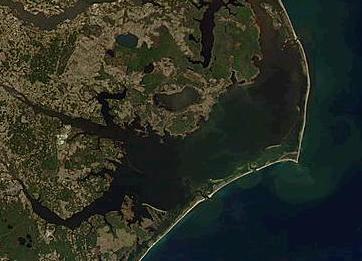
Largest lagoon along the North American East Coast
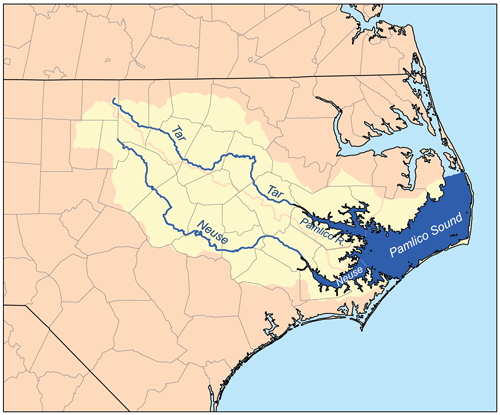
Pamlico Sound ( ) is a large estuarine lagoon in North Carolina. The largest lagoon along the North American East Coast, it extends 80 mi long and 15 to wide. It is part of a large, interconnected network of similar lagoons that includes Albemarle Sound, Currituck Sound, Croatan Sound, Roanoke Sound, Pamlico Sound, Bogue Sound, Back Sound, and Core Sound known collectively as the Albemarle-Pamlico sound system. With over 3,000 sq. mi. (7,800 km2) of open water the combined estuary is second only in size to 4479 sqmi Chesapeake Bay in the United States.
The Pamlico Sound is separated from the Atlantic Ocean by the Outer Banks, a row of low, sandy barrier islands that include Cape Hatteras National Seashore, Cape Lookout National Seashore, and Pea Island National Wildlife Refuge. The Albemarle-Pamlico Sound is one of nineteen great waters recognized by the America's Great Waters Coalition.
Hydrology
Pamlico Sound is connected to the north with Albemarle Sound through passages provided by the Roanoke Sound and Croatan Sound. Core Sound is located at the Pamlico's narrow southern end. It is fed by the Neuse and Pamlico rivers (the latter of which is the estuary of the Tar River) from the west, and from the east by Oregon Inlet, Hatteras Inlet, and Ocracoke Inlet, which also provide passage to the Atlantic Ocean. The salinity of the sound averages 20 ppt, compared to an average coastal salinity of 35 ppt in the Atlantic and 3 ppt in the Currituck Sound, which is located north of the Albemarle Sound.
The sound and its ocean inlets are noted for wide expanses of shallow water and occasional shoaling, making the area hazardous for larger vessels. While the deepest hole of the estuary (26 ft) can be found in the Pamlico Sound, depths generally range from 5 to. In addition, the shallow waters are susceptible to wind and barometric pressure-driven tidal fluctuations. This effect is amplified on the tributary rivers, where water levels can change by as much as two feet in three hours when winds are aligned with the rivers' axes and are blowing strongly.
History and current use
In March 1524, Italian Explorer Giovanni da Verrazzano mistook the sound for the Pacific Ocean because of its wide expanse and separation from the Atlantic Ocean by the Outer Banks barrier islands. The sound was named for the Pamlico that lived along the sound's mainland banks and who were referred to as the Pamouik by the Raleigh expeditions (circa 1584).
Three locations of Pamlico Sound in the Outer Banks between Cape Hatteras and Cape Fear were once under serious consideration by the United States Atomic Energy Commission as an atomic bomb test site during the late 1940s and early 1950s. Portions of Pamlico Sound are used as a bombing and training range for Camp Lejeune.
In 1987, Congress declared the Albemarle-Pamlico Sound an "estuary of national significance." For vacationers to the Outer Banks, the Pamlico Sound is a "watersports playground" providing opportunities for fishing and crabbing, boating, kayaking, sailing, windsurfing, kiteboarding, parasailing, paddleboarding, and more. In 2012, the economic impact of tourism to the Albemarle-Pamlico Sound area exceeded $1.3 billion.
The sound also supports local commercial fishing, crabbing, shrimping, clamming, and oystering. 90% of North Carolina's commercial fishing catches are attributed to the Pamlico Sound, generating almost $100 million per year.
Wildlife
Along the coastal areas are numerous waterfowl nesting sites, including Pea Island National Wildlife Refuge on the Outer Banks, and Swanquarter National Wildlife Refuge on the mainland. Dolphins and sea turtlesEpperly P.S.. Braun J.. Veishlow A.. 1995. Sea Turtles in Noerh Carolina Waters . the Conservation Biology Vol. 9, No. 2 (Apr., 1995), pp. 384-394. Retrieved on December 10. 2014 are abundant, with occasional visits by seals such as harp seal in early January and February. Many other cetaceans including rare species such as fin whales, Cuvier's beaked whales, and orcas are present off Outer Banks and Cape Hatteras. Whales such as Atlantic gray (now extirpated), North Atlantic right (critically endangered), and North Atlantic humpback were historically common. Endangered species such as leatherback turtles, whale sharks, and basking sharks are also known to visit the sound as well.
The sound also sports a variety of fish populations including red drum, speckled trout, flounder, striped bass (known as rockfish by local populations), croaker, spot, pompano, kingfish, and bluefish. In addition, shellfish populations including blue crab, shrimp, oysters, and clams are healthy.
Gallery
File:Pamlico Sound from Buxton sunset.jpg|A sunset on Pamlico Sound as seen from The Inn on Pamlico Sound in Buxton, North Carolina. File:PamlicoSoundSouthOfSalvo.JPG|Sunset over the Sound just south of Salvo, North Carolina.
References
References
- "NCDEQ - Fast Facts".
- National Wildlife Federation. (August 18, 2010). "America's Great Waters Coalition".
- "Albemarle-Pamlico Sound". University of Rhode Island.
- "Pamlico Sound". Outer Banks.
- "The Albemarle-Pamlico Estuary {{!}} Outer Banks Catch".
- "Pamlico Sound - OuterBanks.com".
- "Pamlico Sound - OuterBanks.com".
- "Pamlico Indians {{!}} NCpedia".
- [http://www.villagecraftsmen.com/news042112.htm Project Nutmeg] {{Webarchive. link. (2016-05-05 Ocracoke Newsletter; (April 21, 2012); ''Village Craftsman''; retrieved: December 12, 2016.)
- [http://www.ieer.org/latest/i131quot.html Excerpts from documents and books regarding the decision to locate the test site in Nevada]; Retrieved December 10, 2016.
- [http://www.wcti12.com/news/military-releases-information-on-continued-exercises-going-on-in-area/16037805 Military releases information on continued exercises going on in area]; Retrieved: December 10, 2016.
- "North Carolina's blue crab dilemma - Commercial Fishing Data".
- link. (2014-12-14 . VELADOR - the Sea Turtle Conservancy Newspaper. Issue 2 (2007). The [[Sea Turtle Conservancy]]. Retrieved on December 10. 2014)
- [http://www.fmap.ca/ramweb/media/biodiversity_loss/downloads/RegionalExtinctionExamples.pdf Regional Species Extinctions - Examples of regional species extinctions over the last 1000 years and more.] {{webarchive. link. (2011-04-25 . Retrieved on December 10. 2014)
- Young N..2006. [http://dukespace.lib.duke.edu/dspace/bitstream/handle/10161/106/Young%20MP%202006.pdf?sequence=1. GUIDELINES FOR DEVELOPING APOTENTIAL BIOLOGICAL REMOVAL (PBR)FRAMEWORK FOR MANAGING SEA TURTLEBYCATCH IN THE PAMLICO SOUNDFLOUNDER GILLNET FISHERY]. Master of Environmental Management degree in the Nicholas School of the Environment and Earth Sciences of [[Duke University]]. Retrieved on December 10. 2014
- Schwartz J.F.. 2010. [http://dc.lib.unc.edu/cgi-bin/showfile.exe?CISOROOT=/jncas&CISOPTR=3965. BASKING AND WHALE SHARKS OF NORTH CAROLINA]. Journal of the North Carolina Academy of Science, 126(3), 2010, pp. 84–87. Retrieved on December 10. 2014
This article was imported from Wikipedia and is available under the Creative Commons Attribution-ShareAlike 4.0 License. Content has been adapted to SurfDoc format. Original contributors can be found on the article history page.
Ask Mako anything about Pamlico Sound — get instant answers, deeper analysis, and related topics.
Research with MakoFree with your Surf account
Create a free account to save articles, ask Mako questions, and organize your research.
Sign up freeThis content may have been generated or modified by AI. CloudSurf Software LLC is not responsible for the accuracy, completeness, or reliability of AI-generated content. Always verify important information from primary sources.
Report