From Surf Wiki (app.surf) — the open knowledge base
Pak Hon-yong
Korean independence activist (1900–1955)

Korean independence activist (1900–1955)
| Field | Value |
|---|---|
| name | Pak Hon-yong |
| native_name | 박헌영 |
| native_name_lang | ko |
| office | Vice Chairman of the Workers' Party of Korea Central Committee |
| term_start | 24 June 1949 |
| term_end | 6 August 1953 |
| 1blankname | Chairman |
| 1namedata | Kim Il Sung |
| alongside | Ho Ka-i |
| convocation | 2nd Central Committee |
| office1 | Vice Premier of the Cabinet |
| term_start1 | 9 September 1948 |
| term_end1 | 3 March 1953 |
| premier1 | Kim Il Sung |
| alongside1 | Hong Myong-hui, Kim Chaek, Ho Ka-i, Choe Chang-ik and Choe Yong-gon |
| convocation1 | 1st Cabinet of North Korea |
| office2 | Minister of Foreign Affairs |
| convocation2 | 1st Cabinet of North Korea |
| term_start2 | 9 September 1948 |
| term_end2 | 3 March 1953 |
| predecessor2 | Post established |
| successor2 | Nam Il |
| premier2 | Kim Il Sung |
| office3 | Vice Chairman of the Workers' Party of South Korea Central Committee |
| term_start3 | 24 November 1946 |
| term_end3 | 30 June 1949 |
| 1blankname3 | Chairman |
| 1namedata3 | Ho Hon |
| alongside3 | Yi Ki-sok |
| office4 | Chairman of the Communist Party of Korea Central Committee |
| term_start4 | 14 September 1945 |
| term_end4 | 24 November 1946 |
| predecessor4 | Post established |
| successor4 | Ho Hon |
| image | Pak Hon-yong 02.jpg |
| caption | Pak in 1948 |
| birth_date | |
| birth_place | Yesan, South Chungcheong Province, Korean Empire |
| death_date | (aged 55) |
| death_place | Pyongyang, North Korea |
| nationality | Korean |
| citizenship | North Korean |
| education | Kyŏngsŏng Ordinary High School(1919) |
| alma_mater | KyungKi High School |
| International Lenin School | |
| spouse | Joo Se-juk, Jung Sunnyen, Yi Sunkeum, Yun Lena |
| children | Daughter: Vivian Park, Nathesa Park |
| Son: Park Byungsam | |
| parents | Lee Hakkyu (Mother) |
| Park Hyin-ju (Father) | |
| module | {{Infobox Korean name/auto |
| hangul | %박헌영 |
| hanja | 朴憲永 |
| hangulho | %_이정%, %_이춘 |
| hanjaho | 而丁/而靜, 而春 |
| hangulja | %_덕영 |
| hanjaja | 德永 |
| child | yes |
International Lenin School Son: Park Byungsam Park Hyin-ju (Father) Pak Hon-yong (; 28 May 1900 – 18 December 1955), courtesy name Togyong (덕영), was a Korean independence activist, politician, philosopher, communist activist and one of the main leaders of the Korean communist movement during Japan's colonial rule (1910–1945).
During the Japanese occupation of Korea, he tried to organize the Korean Communist Party. When the Japanese authorities cracked down on the party, he went into hiding. After Korea's liberation, August 1945, he set up the Communist Party of Korea in the South, but under pressure from American authorities he moved to North Korea (then People's Committee of North Korea) in April 1948. He attended a meeting with Kim Ku and Kim Kyu-sik on the subject of Korean reunification.
On record, he collaborated with Kim Il Sung in the Korean War. In 1955, on account of the defeat in the Korean War, he was sentenced to forfeiture of all property and death. Although the Soviet Union and China tried to dissuade Kim Il Sung from executing Pak, Pak was eventually executed for the fabricated accusation of being an American spy.
Biography
Early life
Pak was born to a yangban family of the Yeonghae Park lineage in Sinyang-myeon, Yesan County, South Chungcheong Province. However, he was the illegitimate son of a concubine.
In 1919, he graduated from Kyŏngsŏng Ordinary High School, now Kyunggi High School. In March 1919, he was involved in the March First Movement and later independence movements.
Political activities
In 1921, he joined the Shanghai branch of the Communist Party of Korea, Irkutsk faction. At this time, he was secretary of the Korean Communist Youth League. In January 1922, he participated in the Comintern Far East People's Representative Council in Moscow.
Pak Hon-yong was arrested in Korea in April 1922 and was charged with being a Communist Party organizer. He was released in 1924 and became active as a reporter for the newspapers The Dong-A Ilbo and The Chosun Ilbo under the names Ijong (이정) and Ichun (이춘).
Underground
On 18 April 1925, Pak Hon-yong became one of the founders of the Communist Party of Korea. From this point until the end of World War II, his activities were clandestine.
In 1926, Pak appeared in court. During the trial, he feigned insanity and ate feces, with the result that he was acquitted in November of that year. Afterwards, he was confined to his home due to his supposed ill-health, but in December he escaped by way of Manchuria to reach the Soviet Union. It was only then that the Japanese realized that he was feigning madness.
In the Soviet Union, he was educated in the International Lenin School, returning home in 1940. Back in Korea, he was active in the resistance to Japanese rule.
After World War II

Late in August 1945, the Communist Party of Korea () was re-established, having been officially disbanded in 1928, and Pak became its secretary. Pak was the most prominent Communist in Korea at the time. On 5 January 1946, as its representative, he announced at a foreign and domestic press conference that, supporting the decision of the Moscow conference of great powers (UK, US, Soviet Union), Korea was now in the process of a "democratic revolution". After the December 1945 Moscow Conference, the Communist Party of Korea was oppressed by United States Army Military Government.
In September 1946, he was instrumental in organizing a general strike, which at its peak involved more than a quarter of a million workers.
In December 1946, he organized the Workers Party of South Korea known as (), and became one of two vice chairmen.
North–South negotiations and life in North Korea

In April 1948, Pak visited North Korea for negotiations, along with Kim Ku and Kim Kyu-sik. In May 1948, the negotiations ended, and he remained in the North.
In September 1948, while keeping his role as secretary of the Workers' Party of South Korea, he became Deputy Prime Minister and Foreign Minister of the newly established North Korean state.
Pak became secretary of the Workers' Party of Korea when the North and South parties united in April 1950. Pak was the vice chairman of the Politburo of the DPRK from 1949 to 1953, and Foreign Minister of the DPRK until he was ousted and arrested in 1953.
Korean War
According to secret documents of the former Soviet Union released in succession until 2002, Kim Il Sung and Pak always acted together until the detailed plans of the war were finally decided. They were also on hand during their visit to Moscow from 30 March to 25 April 1950, meeting Stalin and receiving written instructions of detailed war plans.
Arrest and death
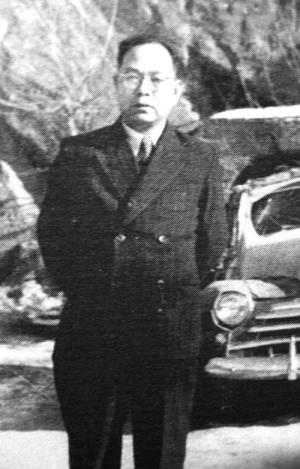
Pak was arrested on 3 August 1953 in a purge of the former members of the Workers' Party of South Korea orchestrated by Kim Il Sung. On 15 December 1955, he was sentenced to death for espionage. The date of Pak's death is uncertain, though sources suggest that he was executed that same month.
Works
- Our Duties in Modern Society
- Historical Views of the Christian Inner
References
References
- link. (6 June 2010). [[The Chosun Ilbo]]
- Ivanov, Vasily Ivanovich, [https://digitalarchive.wilsoncenter.org/document/111639 Memorandum of Conversation with Kim Il Sung : April 19, 1956] Wilson Center Digital Archive
- Lankov, Andrei. (2013). "[[The Real North Korea]]". Oxford University Press.
- link. Bakssi Jokbo website. (October 2010)
- Robinson, Michael E.. (2007-04-30). "Korea's Twentieth-Century Odyssey: A Short History". University of Hawaii Press.
- (24 June 2010). "2010, 인물로 다시 보는 6·25". [[The Chosun Ilbo]].
- (1988). "Kim Il Sung: The North Korean Leader". Columbia University Press.
- (1963). "The Post-War Politics of Communist Korea". The China Quarterly.
- (1996). "Review of The Origins of the Korean War by Bruce Cumings". Science & Society.
This article was imported from Wikipedia and is available under the Creative Commons Attribution-ShareAlike 4.0 License. Content has been adapted to SurfDoc format. Original contributors can be found on the article history page.
Ask Mako anything about Pak Hon-yong — get instant answers, deeper analysis, and related topics.
Research with MakoFree with your Surf account
Create a free account to save articles, ask Mako questions, and organize your research.
Sign up freeThis content may have been generated or modified by AI. CloudSurf Software LLC is not responsible for the accuracy, completeness, or reliability of AI-generated content. Always verify important information from primary sources.
Report