From Surf Wiki (app.surf) — the open knowledge base
Paisley (UK Parliament constituency)
Parliamentary constituency in the United Kingdom, 1832–1983

Parliamentary constituency in the United Kingdom, 1832–1983
| Field | Value |
|---|---|
| name | Paisley |
| parliament | uk |
| image | |
| caption | Paisley within Scotland, showing boundaries used from 1918 to 1950. |
| year | 1832 |
| abolished | 1983 |
| type | Burgh |
| elects_howmany | One |
| previous | Renfrewshire |
| next | Paisley North |
| Paisley South | |
| region | Scotland |
| towns | Paisley |
Paisley South
Paisley was a parliamentary constituency represented in the House of Commons of the Parliament of the United Kingdom from 1832 until 1983, when it was divided into Paisley North and Paisley South. These two constituencies were in turn amalgamated into Paisley and Renfrewshire South and Paisley and Renfrewshire North in 2005.
Boundaries
The constituency covered the burgh of Paisley.
The boundaries of the constituency, as set out in the Representation of the People (Scotland) Act 1832, were-
:"From the Summit of Byres Hill, on the North-east of the Town, in a straight Line to the Point near Knock Hill at which the Renfrew Road is joined by a Road from Glasgow; thence in a straight Line to the Summit of Knock Hill; thence in a straight Line to the Northern Gable of the Moss Toll House on the Greenock Road; thence in a straight Line in the Direction of the Chimney of Linwood Cotton Mill to the Point at which such straight Line cuts the Candren Burn; thence up the Candren Burn to the Point at which the same is joined by the Braidiland Burn at the Bridge over the same on the Johnstone Road; thence up the Braidiland Burn to a Point which is distant Five hundred Yards (measured along the Braidiland Burn) above the said Bridge; thence in a straight Line to Meikleridge Bridge over the Candren Burn; thence in a straight Line to the Point at which the old Neilston Road leaves the new Neilston Road; thence in a straight Line to the Summit of Dykebar Hill; thence in a straight Line to a Point which is One hundred Yards due North-east of the Summit of Bathgo Hill; thence in a straight Line to the Point first described."
Members of Parliament
| Election | Member | Party | |
|---|---|---|---|
| Whigs (British political party)}}" | 1832 | Sir John Maxwell | |
| Whigs (British political party)}}" | 1834 by-election | Sir Daniel Sandford | |
| Whigs (British political party)}}" | 1835 | Alexander Speirs | |
| Radicals (UK)}}" | 1836 by-election | Archibald Hastie | |
| Whigs (British political party)}}" | 1857 by-election | Humphrey Crum-Ewing | |
| Liberal Party (UK)}}" | 1859 | Liberal | |
| Liberal Party (UK)}}" | 1874 | William Holms | |
| Liberal Party (UK)}}" | 1884 by-election | Stewart Clark | |
| Liberal Party (UK)}}" | 1885 | William Barbour | |
| Liberal Party (UK)}}" | 1891 by-election | Sir William Dunn | |
| Liberal Party (UK)}}" | 1906 | Sir John McCallum | |
| Liberal Party (UK)}}" | 1920 by-election | H. H. Asquith | |
| Labour Party (UK)}}" | 1924 | Edward Mitchell | |
| Labour Party (UK)}}" | 1929 | James Welsh | |
| Liberal Party (UK)}}" | 1931 | Joseph Maclay | |
| Labour Party (UK)}}" | 1945 | Oliver Baldwin | |
| Labour Party (UK)}}" | 1948 by-election | Douglas Johnston | |
| Labour Party (UK)}}" | 1961 by-election | John Robertson | |
| Scottish Labour Party (1976)}}" | 1976 | Scottish Labour Party (1976) | |
| Labour Party (UK)}}" | 1979 | Allen Adams | |
| 1983 | constituency abolished |
Election results
Elections in the 1830s
|reg. electors = 1,242
Maxwell resigned, causing a by-election.
|reg. electors = 1,261
- Gordon retired in favour of Sandford
|reg. electors = 1,510
Speirs resigned, causing a by-election.
|reg. electors = 1,465
|reg. electors = 1,610
Elections in the 1840s
|reg. electors = 1,324
|reg. electors = 1,060
Elections in the 1850s
|reg. electors = 1,342
|reg. electors = 1,305
Hastie's death caused a by-election.
|reg. electors = 1,349
|reg. electors = 1,370
Elections in the 1860s
|reg. electors = 1,361
|reg. electors = 3,264
Elections in the 1870s
|reg. electors = 5,083
Elections in the 1880s
|reg. electors = 4,979
Holms' resignation caused a by-election.
|reg. electors = 5,688 |reg. electors = 6,794 |reg. electors = 6,794
Elections in the 1890s
|reg. electors = 8,107 |reg. electors = 8,223 |reg. electors = 9,105
Elections in the 1900s

|reg. electors = 10,758
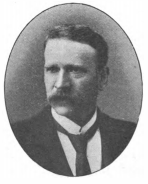
|reg. electors = 12,179
Elections in the 1910s

|reg. electors = 12,331 |reg. electors = 12,541 General Election 1914–15: Another General Election was required to take place before the end of 1915. The political parties had been making preparations for an election to take place and by July 1914, the following candidates had been selected;
- Liberal: John McCallum
- Unionist: |reg. electors = 38,508
Elections in the 1920s
|reg. electors = 39,235
|reg. electors = 38,093 |reg. electors = 37,792 Cormack was the nominee of the local branch of the Labour party, which did not accept Biggar as the official candidate.

|reg. electors = 37,901 |reg. electors = 51,385
Elections in the 1930s
General Election 1939–40: Another General Election was required to take place before the end of 1940. The political parties had been making preparations for an election to take place and by the Autumn of 1939, the following candidates had been selected;
- Liberal National: Joseph Maclay
- Labour: Oliver Baldwin
Election in the 1940s
Elections in the 1950s
|reg. electors = 61,874 |reg. electors = 63,281 |reg. electors = 62,376 |reg. electors = 63,097
Election in the 1960s
|reg. electors = 62,336 |reg. electors = 61,363
Elections in the 1970s
References
References
- "Renfrewshire".
- Representation of the People (Scotland) Act 1832, Schedule (M).
- (1842). "The Register of Parliamentary Contested Elections". Simpkin, Marshall & Company.
- (2005). "Anglo-Scottish Relations from 1603 to 1900". Oxford University Press.
- (2016). "The Spirit of the Union". Routledge.
- (26 March 1836). "Lancaster Gazette".
- (16 December 1857). "Scotland". Aberdeen Press and Journal.
- (2 March 1834). "Page 9". The Examiner.
- (10 July 1841). "Election News". Northern Star and Leeds General Advertiser.
- (12 July 1852). "Paisley". Evening Mail.
- "Charles Favell Forth Wordsworth".
- (12 December 1857). "Scotland". Greenock Telegraph and Clyde Shipping Gazette.
- Debrett's House of Commons, 1870
- "Archibald Campbell Campbell (Douglas)".
- (1977). "British Parliamentary Election Results 1832–1885". Macmillan Press.
- British parliamentary election results, 1885–1918 (Craig)
- (4 May 2014). "Lord Sands ~ Politician, Lawyer, Church Advisor, and Educationalist".
- British Parliamentary Election Results 1918–1949, FWS Craig
- Whitaker's Almanack, 1934
- Whitaker's Almanack, 1939
- Report of the Annual Conference of the Labour Party, 1939
- "1948 By Election Results".
- F W S Craig, British Parliamentary Election Results 1950–1973; Political Reference Publications, Glasgow 1973
- "UK General Election results 1964".
- "UK General Election results 1970".
- "'Paisley', Feb 1974 – May 1983". Cognitive Computing Limited.
- "UK General Election results February 1974".
- "UK General Election results October 1974".
- "UK General Election results 1979".
This article was imported from Wikipedia and is available under the Creative Commons Attribution-ShareAlike 4.0 License. Content has been adapted to SurfDoc format. Original contributors can be found on the article history page.
Ask Mako anything about Paisley (UK Parliament constituency) — get instant answers, deeper analysis, and related topics.
Research with MakoFree with your Surf account
Create a free account to save articles, ask Mako questions, and organize your research.
Sign up freeThis content may have been generated or modified by AI. CloudSurf Software LLC is not responsible for the accuracy, completeness, or reliability of AI-generated content. Always verify important information from primary sources.
Report