From Surf Wiki (app.surf) — the open knowledge base
Pair-rule gene
Gene involved in the development of segmented embryos of insects
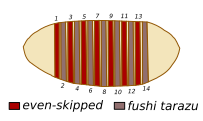
Gene involved in the development of segmented embryos of insects
A pair-rule gene is a type of gene involved in the development of the segmented embryos of insects. Pair-rule genes are expressed as a result of differing concentrations of gap gene proteins, which encode transcription factors controlling pair-rule gene expression. Pair-rule genes are defined by the effect of a mutation in that gene, which causes the loss of the normal developmental pattern in alternating segments.
Pair-rule genes were first described by Christiane Nüsslein-Volhard and Eric Wieschaus in 1980. They used a genetic screen to identify genes required for embryonic development in the fruit fly Drosophila melanogaster. In normal unmutated Drosophila, each segment produces bristles called denticles in a band arranged on the side of the segment closer to the head (the anterior). They found five genes – even-skipped, hairy, odd-skipped, paired and runt – where mutations caused the deletion of a particular region of every alternate segment. For example, in even-skipped, the denticle bands of alternate segments are missing, which results in an embryo having half the number of denticle bands. Later work identified more pair-rule genes in the Drosophila early embryo – fushi tarazu, odd-paired and sloppy paired.
Once the pair-rule genes had been identified at the molecular level it was found that each gene is expressed in alternate parasegments – regions in the embryo that are closely related to segments, but are slightly out of register. Each parasegment includes the posterior part of one (future) segment, and an anterior part of the next (more posterior) segment. The bands of expression of the pair-rule genes correspond to the regions missing in the mutant. The expression of the pair-rule genes in bands is dependent both upon direct regulation by the gap genes and on regulatory interactions between the pair-rule genes themselves.
References
References
- (2000). "Developmental Biology". Sinauer Associates.
- "Segmentation Genes in Drosophila Development: Pair Rule, Segment Polarity & Gap Genes".
- (October 1980). "Mutations affecting segment number and polarity in Drosophila". Nature.
- (January 1981). "Analysis of larval segmentation in lethal genotypes associated with the antennapedia gene complex in Drosophila melanogaster". Dev. Biol..
- (July 1984). "Spatial distribution of transcripts from the segmentation gene fushi tarazu during Drosophila embryonic development". Cell.
- Ingham, P. W.. (1985). "Transcription pattern of the Drosophila segmentation gene hairy". Nature.
- (December 1986). "Isolation, structure, and expression of even-skipped: a second pair-rule gene of Drosophila containing a homeo box". Cell.
- (1987). "Borders of parasegments in Drosophila embryos are delimited by the fushi tarazu and even-skipped genes". Nature.
- Ingham, P. W.. (1986). "Correlative changes in homoeotic and segmentation gene expression in Krüppel mutant embryos of Drosophila". The EMBO Journal.
- Howard K .. (1986). "Regulatory interactions between the segmentation genes fushi tarazu, hairy, and engrailed in the Drosophila blastoderm". Cell.
This article was imported from Wikipedia and is available under the Creative Commons Attribution-ShareAlike 4.0 License. Content has been adapted to SurfDoc format. Original contributors can be found on the article history page.
Ask Mako anything about Pair-rule gene — get instant answers, deeper analysis, and related topics.
Research with MakoFree with your Surf account
Create a free account to save articles, ask Mako questions, and organize your research.
Sign up freeThis content may have been generated or modified by AI. CloudSurf Software LLC is not responsible for the accuracy, completeness, or reliability of AI-generated content. Always verify important information from primary sources.
Report