From Surf Wiki (app.surf) — the open knowledge base
Pahalgam
Town in Jammu and Kashmir, India
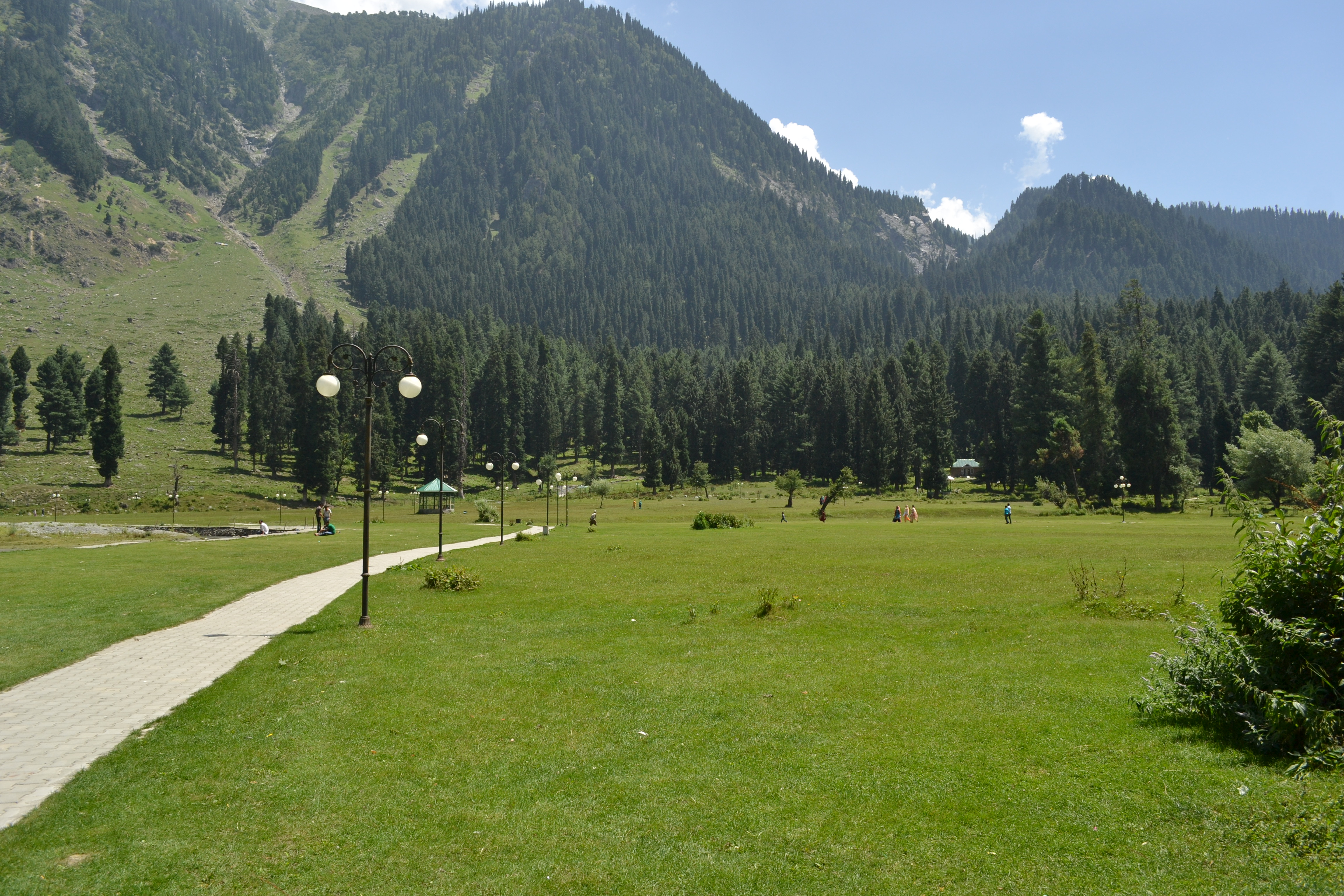
Town in Jammu and Kashmir, India
| Field | Value |
|---|---|
| name | Pahalgam |
| native_name | Pahalgom |
| native_name_lang | ks |
| settlement_type | Town |
| image_skyline | {{multiple image |
| perrow | 2/2/2 |
| border | infobox |
| total_width | 300 |
| image1 | LiddarRiverJhelum.jpeg |
| caption1 | Lidder River |
| image2 | Pahalgam views 33.JPG |
| caption2 | Baisaran Valley |
| image3 | Lavender Park 4.jpg |
| caption3 | Lavender Park |
| image4 | Pahalgham(the valley of shepherds).jpg |
| caption4 | View of the town |
| image5 | Pine trees in the snow in Pahalgam.jpg |
| caption5 | Trees above the valley in winter |
| image6 | A view of Pahalgam valley.jpg |
| caption6 | View of the valley |
| pushpin_map | India Jammu and Kashmir#India |
| pushpin_label_position | right |
| pushpin_map_caption | Location in Jammu and Kashmir, India |
| coordinates | |
| subdivision_type | Country |
| subdivision_name | India |
| subdivision_type1 | Union Territory |
| subdivision_name1 | Jammu and Kashmir |
| subdivision_type2 | District |
| subdivision_name2 | Anantnag |
| governing_body | Pahalgam Municipal Committee |
| unit_pref | Metric |
| area_footnotes | |
| area_total_km2 | 18.02 |
| elevation_m | 2200 |
| population_total | 9264 |
| population_as_of | 2011 |
| population_density_km2 | auto |
| population_footnotes | |
| demographics_type1 | Languages |
| demographics1_title1 | Official |
| demographics1_info1 | Kashmiri, Urdu, Hindi, Dogri, English |
| timezone1 | IST |
| utc_offset1 | +5:30 |
| postal_code_type | PIN |
| postal_code | 192126 |
| area_code | +91-01936 |
| area_code_type | STD Code |
| registration_plate | JK-03 |
| website |
Pahalgam () or Pahalgom () is a town in Anantnag district of the Indian union territory of Jammu and Kashmir. It is located on the banks of Lidder River at an altitude of 2200 m in the Vale of Kashmir. Pahalgam is the headquarters of the Pahalgam tehsil, one of the eleven tehsils in Anantnag district.
Located about 45 km from Anantnag, the town is a popular tourist destination and hill station. The town is the starting point of the annual pilgrimage to the Amarnath Temple, which takes place in July–August.
Etymology
Pahalgam literally means "village of the shepherds" in Kashmiri, with "Pạhạlʸ" meaning shepherds and "Gōm" meaning village. In Hindu literature, the region is mentioned as "Bailgaon", meaning "village of the bull", to indicate where the Hindu god Shiva left his bull on the way to Amarnath.
Geography
Pahalgam is located in Anantnag district of the Indian union territory of Jammu and Kashmir. It is located at an altitude of 2200 m in the Lidder Valley, which extends east of Jhelum River in the Vale of Kashmir. The two streams of Lidder River—East and West Lidder—join near Pahalgam before proceeding through the narrow valley. At Pahalgam, the valley divides into two, one heading towards Amarnath in the northeast and another leading to Aru in the northwest. The region is made up of volcanic and limestone rocks interspersed with asymmetrical roche rocks. The vegetation in the region is dominated by evergreen fir and coniferous trees such as pine and spruce.
Climate
Pahalgam has a temperate climate, with mild summers and cold winters. The temperature variation across the day in minimal in the winter months of December to February. Cold winds can result in a steep decrease in nighttime temperatures in winter to below zero. Winter can result in heavy snowfall of up to 4 m thick. Summer extends from June to October, when the temperatures are at a maximum. Pahalgam receives most of the precipitation from late winter after November to May before the onset of summer.
| Jan record high C = 13.8 | Feb record high C = 17.6 | Mar record high C = 23.9 | Apr record high C = 27.4 | May record high C = 30.8 | Jun record high C = 32.0 | Jul record high C = 31.5 | Aug record high C = 32.2 | Sep record high C = 30.0 | Oct record high C = 27.7 | Nov record high C = 23.0 | Dec record high C = 15.6 | year record high C = 32.2 | Jan record low C = -18.6 | Feb record low C = -17.3 | Mar record low C = -13.0 | Apr record low C = -4.0 | May record low C = -1.0 | Jun record low C = 1.5 | Jul record low C = 2.0 | Aug record low C = 4.0 | Sep record low C = 0.6 | Oct record low C = -5.1 | Nov record low C = -10.8 | Dec record low C = -15.7 | year record low C = | access-date = April 8, 2024 | archive-date = 10 November 2024 | archive-url = https://web.archive.org/web/20241110020508/https://imdpune.gov.in/library/public/Climatological%20Tables%201991-2020.pdf | url-status = live | archive-url = https://web.archive.org/web/20200205040301/http://imdpune.gov.in/library/public/1981-2010%20CLIM%20NORMALS%20%28STATWISE%29.pdf | archive-date = 5 February 2020 | access-date = 15 March 2020}} | archive-url = https://web.archive.org/web/20200205042509/http://imdpune.gov.in/library/public/EXTREMES%20OF%20TEMPERATURE%20and%20RAINFALL%20upto%202012.pdf | archive-date = 5 February 2020 | access-date = 15 March 2020}}
Demographics
, Pahalgam had a population of 9,264 people. Males constitute 59.8% of the population and females 40.2%. The town had an average literacy rate of 64.9% amongst the population of seven years and above. About 48% of the eligible age group were employed full-time, and 10% had casual employment. Scheduled Castes and Scheduled Tribes made up about two percent of the population. Islam was the major religion, with 80% adherents, with Hindus forming the second largest group (17.6%).
Administration
Pahalgam is administered by the Pahalgam Municipal Committee. The municipal committee is responsible for providing basic civic amenities such as water supply, sanitation and waste management, and other government services. The town is divided into 13 wards which elect their own local body representative to the municipal council.
Transportation
Pahalgam is well-connected with other regions of Jammu and Kashmir by roads. The NH 501 connects Pahalgam with Anantnag. State-run bus services and private buses connect the town with Anantnag, Jammu, and Srinagar. The nearest major rail heads are located at Udhampur and Jammu, about 217 km and 285 km away respectively. The nearest airport is the Srinagar International Airport, about 95 km from Pahalgam.
Tourism
Pahalgam's location in the Lidder valley and its climate has led to the town becoming a popular tourist destination and hill station. In 2015, the town had about 7,020 beds for tourists.
The Amarnath Temple is a Hindu pilgrimage site situated above the Pahalgam valley. The town forms the base camp for the yatra to the temple that takes place every year in the months of July–August, and results in a seasonal influx of pilgrims. As per Hindu mythology, Shiva is believed to have left his mount Nandi in Pahalgam, the moon he carries on his head in Chandanwari, the snakes around his neck at Sheshnag Lake, and the five natural elements at Panchtarni before entering the Amarnath cave. The yatra begins from Chandanwari, situated about 16 km from Pahalgam, and proceeds towards Amarnath via Sheshnag Lake and Panchtarni.
Kolahoi Glacier is a hanging glacier situated up the Lidder Valley, just below Kolahoi Peak. It is accessible via a 35 km trail from Pahalgam via Aru. Baisaran and Betaab valleys are verdant meadows flanked by mountains and evergreen trees, located close to Pahalgam. Pahalgam Golf Course, also known as Lidder Valley Golf Course, is an 18-hole golf course inaugurated in 2011.
The high influx of seasonal tourists results in the production of large quantities of solid wastes, which overwhelms the waste management system, and leads to dumping of wastes throughout the town. With an estimated 74% of the total municipal wastes coming from tourism, the dumping had increased the probability of waterborne diseases downstream of the Lidder River and other health issues.
2025 Pahalgam attack
Main article: 2025 Pahalgam attack
On 22 April 2025, militants affiliated with The Resistance Front opened fire on a group of tourists at Baisaran valley near Pahalgam, killing at least 28 people and injuring more than 20 others.
References
Bibliography
References
- "Pahalgam". citypopulation.de.
- "Basic Population Figures of India, States, Districts, Sub-District and Village, 2011". Census Commission of India.
- (27 September 2020). "The Jammu and Kashmir Official Languages Act, 2020". The Gazette of India.
- (23 September 2020). "Parliament passes JK Official Languages Bill, 2020". Rising Kashmir.
- "Pincodes and STD codes". [[Government of Jammu and Kashmir]].
- "Rain Genomics – Pahalgam". Galling Rain.
- "Population by religious community, Jammu and Kashmir - 2011". Census Commission of India.
- "Pahalgam MC". Census 2011.
- (July 2025). "Cooperatives in Anantnag district". [[Government of Jammu and Kashmir]].
- "Services and amenities". [[Government of Jammu and Kashmir]].
- "New highways notification dated September, 2012". [[Ministry of Road Transport and Highways]].
- "Pahalgam". [[Government of Jammu and Kashmir]].
- (24 June 2010). "Pahalgam: Valley of paradise". Bangalore Mirror.
- (January 2016). "Tourism Induced Challenges in Municipal Solid Waste Management in Hill Towns: Case of Pahalgam". Procedia Environmental Sciences.
- (15 July 2024). "Amarnath Yatra: Fresh batch of pilgrims leaves under heightened security". [[Business Standard]].
- Sunita Pant Bansal. (15 November 2012). "Hindu pilgrimage;a journey through the holy places of Hindus all over India". V & S Publishers.
- "Traditional route, Amarnath Yatra". Amarnath Yatra board.
- N. Ahmed and N. H. Hashimi. (1974). "Glacial History of Kolahoi Glacier, Kashmir, India". Journal of Glaciology.
- (11 July 2011). "Bollywood returns to Kashmir, its original home". [[NDTV]].
- (23 April 2025). "All About Pahalgam's Baisaran: From India's 'Mini Switzerland' To The Valley Of Horror". [[News18]].
- (12 November 2024). "Pahalgam's Lidder Valley Golf Course struggles with maintenance, 'mismanagement'". Greater Kashmir.
- (23 April 2025). "LeT Affiliate "Resistance Front" Claims Pahalgam Attack: All About It". [[NDTV]].
This article was imported from Wikipedia and is available under the Creative Commons Attribution-ShareAlike 4.0 License. Content has been adapted to SurfDoc format. Original contributors can be found on the article history page.
Ask Mako anything about Pahalgam — get instant answers, deeper analysis, and related topics.
Research with MakoFree with your Surf account
Create a free account to save articles, ask Mako questions, and organize your research.
Sign up freeThis content may have been generated or modified by AI. CloudSurf Software LLC is not responsible for the accuracy, completeness, or reliability of AI-generated content. Always verify important information from primary sources.
Report