From Surf Wiki (app.surf) — the open knowledge base
Oxyrhynchus Papyri
Manuscript fragments from 32BC–640AD found in an Egyptian rubbish dump

Manuscript fragments from 32BC–640AD found in an Egyptian rubbish dump


The Oxyrhynchus Papyri are a group of manuscripts discovered during the late nineteenth and early twentieth centuries by papyrologists Bernard Pyne Grenfell and Arthur Surridge Hunt at an ancient rubbish dump near Oxyrhynchus in Egypt (, modern el-Bahnasa).
The manuscripts date from the time of the Ptolemaic (3rd century BC) and Roman periods of Egyptian history (from 32 BC to the Muslim conquest of Egypt in 640 AD).
Only an estimated 10% are literary in nature. Most of the papyri found seem to consist mainly of public and private documents: codes, edicts, registers, official correspondence, census-returns, tax-assessments, petitions, court-records, sales, leases, wills, bills, accounts, inventories, horoscopes, and private letters.
Although most of the papyri were written in Greek, some texts written in Egyptian (Egyptian hieroglyphics, Hieratic, Demotic, mostly Coptic), Latin and Arabic were also found. Texts in Hebrew, Aramaic, Syriac and Pahlavi have so far represented only a small percentage of the total.
Since 1898, academics have collated and transcribed over 5,000 documents from what were originally hundreds of boxes of papyrus fragments the size of large cornflakes. This is thought to represent only 1 to 2% of what is estimated to be at least half a million papyri still remaining to be conserved, transcribed, deciphered and catalogued. The most recent published volume was Vol. LXXXVIII, .
Oxyrhynchus Papyri are currently housed in institutions all over the world. A substantial number are housed in the Bodleian Art Library at Oxford University. There is an online table of contents briefly listing the type of contents of each papyrus or fragment.
Administrative texts
Administrative documents assembled and transcribed from the Oxyrhynchus excavation encompass a wide variety of legal matters, such as marriages, employment contracts, and censuses. Some of the more notable papyri transcribed so far include:
- The contract of a wrestler agreeing to throw his next match for a fee.
- Various and sundry ancient recipes for treating haemorrhoids, hangovers and cataracts.
- Details of a grain dole mirroring a similar program in the Roman capital.
- Tryphon and Saraeus:
- Tryphon, son of Dionysus, and Saraeus, daughter of Apion, a married couple are mentioned in several administrative papyri, detailing their various brushes with legal authorities in Oxyrhynchus.
- However, before Tryphon married Saraeus, he had a wife called Demetrous, daughter of Heraclides. After their divorce, Tryphon complains to the strategus, Alexander, that she has stolen several of his belongings. The papyrus is too damaged, however, to correctly ascertain what these are.
- In 37 CE, the couple appears in a marriage contract, almost entirely concerned with Saraeus' dowry. Most surviving marriage contracts keep similar detail on dowries and other assets, in case of divorce.
- However Tryphon's first wife, it seems, had not forgiven him. The same year as his second marriage, he petitions the strategus again, this time alleging that Demetrous and her mother have attacked Saraeus. The response from the strategus, Sotas, is unknown.
- In 49 CE, Saraeus was summoned before the strategus as part of a case between her and an employer. She has been contracted as a wet-nurse for a foundling, who had died during her employment. Pesouris, her employer, accused her of kidnapping the child to pose as her own. Paison, the strategus, ruled that the living child was Saraeus', and that in return she must pay back her wages.
- However, several months, later, Tryphon is petitioning Capito, the praefectus, complaining that Saraeus' former employer is refusing to co-operate with Paison's ruling, and 'hinders [Tryphon] in [his] trade'.
- In 51 CE, Tryphon files another complaint, presumably to the strategus, that he and Saraeus were attacked by unnamed women in the street.
In addition to detailing the cases themselves, these legal documents provide interesting insight into everyday life under Graeco-Roman occupied Egypt, and are often overlooked beside its pharaonic predecessor. For example, Saraeus' hearing with strategus Paison reveal that courts used the Roman names for year, marked by the reign of the emperor, but maintained the Egyptian months, called Pharmouthi.
Secular texts
Although most of the texts uncovered at Oxyrhynchus were non-literary in nature, the archaeologists succeeded in recovering a large corpus of literary works that had previously been thought to have been lost. Many of these texts had previously been unknown to modern scholars.
Greek
Several fragments can be traced to the work of Plato, for instance the Republic, Phaedo, or the dialogue Gorgias, dated around 200–300 CE.
Historiography
The discovery of a historical work known as the Hellenica Oxyrhynchia also revealed new information about classical antiquity. The identity of the author of the work is unknown; many early scholars proposed that it may have been written by Ephorus or Theopompus, but many modern scholars are now convinced that it was written by Cratippus. The work has won praise for its style and accuracy and has even been compared favorably with the works of Thucydides.
Mathematics

The findings at Oxyrhynchus also turned up the oldest and most complete diagrams from Euclid's Elements.
Drama

The classical author who has most benefited from the finds at Oxyrhynchus is the Athenian playwright Menander (342–291 BC), whose comedies were very popular in Hellenistic times and whose works are frequently found in papyrus fragments. Menander's plays found in fragments at Oxyrhynchus include Misoumenos, Dis Exapaton, Epitrepontes, Karchedonios, Dyskolos and Kolax. The works found at Oxyrhynchus have greatly raised Menander's status among classicists and scholars of Greek theatre.
Another notable text uncovered at Oxyrhynchus was Ichneutae, a previously unknown play written by Sophocles. The discovery of Ichneutae was especially significant since Ichneutae is a satyr play, making it only one of two extant satyr plays, with the other one being Euripides's Cyclops.
Extensive remains of the Hypsipyle of Euripides and a life of Euripides by Satyrus the Peripatetic were also found at Oxyrhynchus.
Poetry
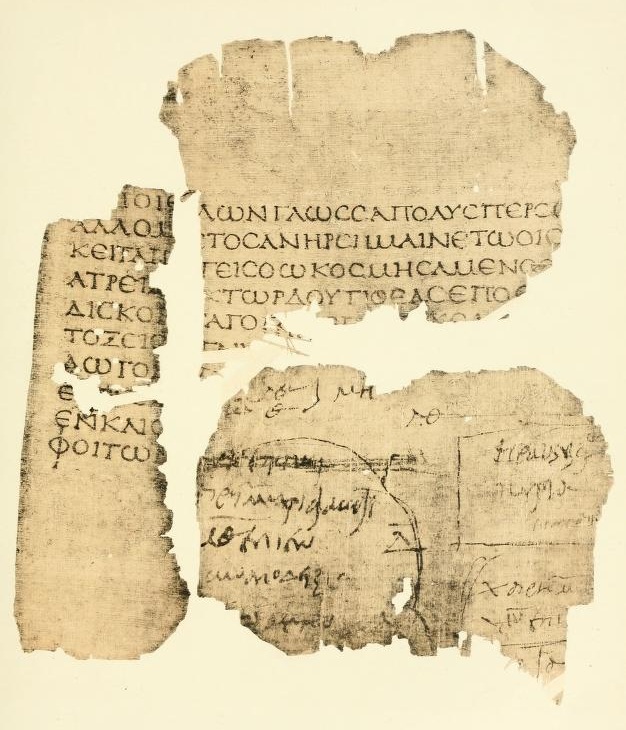

- Poems of Pindar. Pindar was the first known Greek poet to reflect on the nature of poetry and on the poet's role.
- Fragments of Sappho, Greek poet from the island of Lesbos famous for her poems about love.
- Fragments of Alcaeus, an older contemporary and an alleged lover of Sappho, with whom he may have exchanged poems.
- Larger pieces of Alcman, Ibycus, and Corinna.
- Passages from Homer's Iliad. See Papyrus Oxyrhynchus 20 – Iliad II.730-828 and Papyrus Oxyrhynchus 21 – Iliad II.745-764
- Passages and coloured line drawings of the killing of the Nemean Lion from Labours of Heracles (Pap. Oxyrhynchus 2331)
Latin
An epitome of seven of the 107 lost books of Livy was the most important literary find in Latin.
Christian texts
Among the Christian texts found at Oxyrhynchus, were fragments of early non-canonical Gospels, Oxyrhynchus 840 (3rd century AD) and Oxyrhynchus 1224 (4th century AD). Other Oxyrhynchus texts preserve parts of Matthew 1 (3rd century: P2 and P401), 11–12 and 19 (3rd to 4th century: P2384, 2385); Mark 10–11 (5th to 6th century: P3); John 1 and 20 (3rd century: P208); Romans 1 (4th century: P209); the First Epistle of John (4th-5th century: P402); the Apocalypse of Baruch (chapters 12–14; 4th or 5th century: P403); the Gospel of Thomas (3rd century AD: P655); The Shepherd of Hermas (3rd or 4th century: P404), and a work of Irenaeus, (3rd century: P405). There are many parts of other canonical books as well as many early Christian hymns, prayers, and letters also found among them.
All manuscripts classified as "theological" in the Oxyrhynchus Papyri are listed below. A few manuscripts that belong to multiple genres, or genres that are inconsistently treated in the volumes of the Oxyrhynchus Papyri, are also included. For example, the quotation from Psalm 90 (P. Oxy. XVI 1928) associated with an amulet, is classified according to its primary genre as a magic text in the Oxyrhynchus Papyri; however, it is included here among witnesses to the Old Testament text. In each volume that contains theological manuscripts, they are listed first, according to an English tradition of academic precedence (see also Doctor of Divinity).
Old Testament
Main article: Old Testament
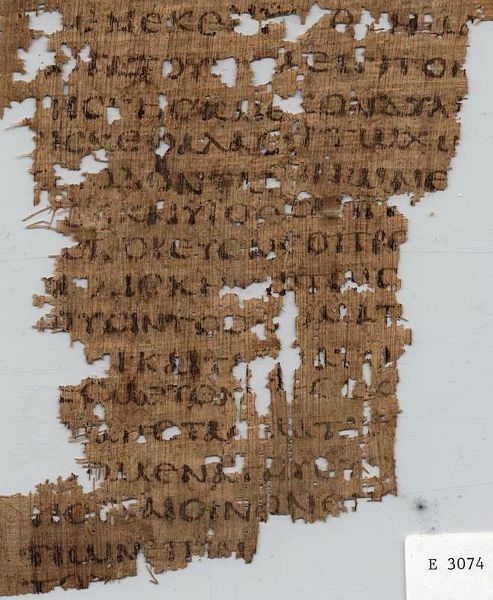
The original Hebrew Bible (Tanakh) was translated into Greek between the 3rd and 1st centuries BC. This translation is called the Septuagint (or LXX, both 70 in Latin), because there is a tradition that seventy Jewish scribes compiled it in Alexandria. It was quoted in the New Testament and is found bound together with the New Testament in the 4th and 5th century Greek uncial codices Sinaiticus, Alexandrinus and Vaticanus. The Septuagint included books, called the Apocrypha or Deuterocanonical by some Christians, which were later not accepted into the Jewish canon of sacred writings (see next section). Portions of Old Testament books of undisputed authority found among the Oxyrhynchus Papyri are listed in this section.
- The first number (Vol) is the volume of the Oxyrhynchus Papyri in which the manuscript is published.
- The second number (Oxy) is the overall publication sequence number in Oxyrhynchus Papyri.
- Standard abbreviated citation of the Oxyrhynchus Papyri is:
- Context will always make clear whether volume 70 of the Oxyrhynchus Papyri or the Septuagint is intended.
- P. Oxy. VIII 1073 is an Old Latin version of Genesis, other manuscripts are probably copies of the Septuagint.
- Dates are estimated to the nearest 50 year increment.
- Content is given to the nearest verse where known.
| Vol | Oxy | Date | Content | Institution | City, State | Country |
|---|---|---|---|---|---|---|
| IV | 656 | 150 | Gen 14:21–23; 15:5–9; 19:32–20:11; | |||
| 24:28–47; 27:32–33, 40–41 | Bodleian Library; MS.Gr.bib.d.5(P) | Oxford | UK | |||
| VI | 845 | 400 | Psalms 68; 70 | Egyptian Museum; JE 41083 | Cairo | Egypt |
| VI | 846 | 550 | Amos 2 | University of Pennsylvania; E 3074 | Philadelphia | |
| Pennsylvania | U.S. | |||||
| VII | 1007 | 400 | Genesis 2–3 | British Museum; Inv. 2047 | London | UK |
| VIII | 1073 | 350 | Gen 5–6 Old Latin | British Museum; Inv. 2052 | London | UK |
| VIII | 1074 | 250 | Exodus 31–32 | University of Illinois; GP 1074 | Urbana, Illinois | U.S. |
| VIII | 1075 | 250 | Exodus 11:26–32 | British Library; Inv. 2053 (recto) | London | UK |
| IX | 1166 | 250 | Genesis 16:8–12 | British Library; Inv. 2066 | London | UK |
| IX | 1167 | 350 | Genesis 31 | Princeton Theological Seminary | ||
| Pap. 9 | Princeton | |||||
| New Jersey | U.S. | |||||
| IX | 1168 | 350 | Joshua 4-5 vellum | Princeton Theological Seminary | ||
| Pap. 10 | Princeton | |||||
| New Jersey | U.S. | |||||
| X | 1225 | 350 | Leviticus 16 | Princeton Theological Seminary | ||
| Pap. 12 | Princeton | |||||
| New Jersey | U.S. | |||||
| X | 1226 | 300 | Psalms 7–8 | Liverpool University | ||
| Class. Gr. Libr. 4241227 | Liverpool | UK | ||||
| XI | 1351 | 350 | Lev 27 vellum | Ambrose Swasey Library; 886.4 | ||
| Rochester | ||||||
| New York | U.S. | |||||
| XI | 1352 | 325 | Pss 82–83 vellum | Egyptian Museum; JE 47472 | Cairo | Egypt |
| XV | 1779 | 350 | Psalm 1 | United Theological Seminary | Dayton, Ohio | U.S. |
| XVI | 1928 | 500 | Ps 90 amulet | Ashmolean Museum | Oxford | UK |
| XVII | 2065 | 500 | Psalm 90 | Ashmolean Museum | Oxford | UK |
| XVII | 2066 | 500 | Ecclesiastes 6–7 | Ashmolean Museum | Oxford | UK |
| XXIV | 2386 | 500 | Psalms 83–84 | Ashmolean Museum | Oxford | UK |
| L | 3522 | 50 | Job 42.11–12 | Ashmolean Museum | Oxford | UK |
| LX | 4011 | 550 | Ps 75 interlinear | Ashmolean Museum | Oxford | UK |
| LXV | 4442 | 225 | Ex 20:10–17, 18–22 | Ashmolean Museum | Oxford | UK |
| LXV | 4443 | 100 | Esther 8:16-9:3 | Ashmolean Museum | Oxford | UK |
Old Testament Deuterocanon (or, Apocrypha)
This name designates several, unique writings (e.g., the Book of Tobit) or different versions of pre-existing writings (e.g., the Book of Daniel) found in the canon of the Jewish scriptures (most notably, in the Septuagint translation of the Hebrew Tanakh). Although those writings were no longer viewed as having a canonical status amongst Jews by the beginning of the second century A.D., they retained that status for much of the Christian Church. They were and are accepted as part of the Old Testament canon by the Catholic Church and Eastern Orthodox churches. Protestant Christians, however, follow the example of the Jews and do not accept these writings as part of the Old Testament canon.
- PP. Oxy. XIII 1594 and LXV 4444 are vellum ("vellum" noted in table).
- Both copies of Tobit are different editions to the known Septuagint text ("not LXX" noted in table).
| Vol | Oxy | Date | Content | Institution | City, State | Country |
|---|---|---|---|---|---|---|
| III | 403 | 400 | 2 Baruch 12:1–13:2, 13:11–14:3 | Property of | ||
| The General Theological Seminary | Alexandria, VA | U.S. | ||||
| VII | 1010 | 350 | 2 Esdras 16:57–59 | Bodleian Library | ||
| MS.Gr.bib.g.3(P) | Oxford | UK | ||||
| VIII | 1076 | 550 | Tobit 2 | |||
| not LXX | John Rylands University Library | |||||
| 448 | Manchester | UK | ||||
| XIII | 1594 | 275 | Tobit 12 | |||
| vellum, not LXX | Cambridge University Library | |||||
| Add.MS. 6363 | Cambridge | UK | ||||
| XIII | 1595 | 550 | Ecclesiasticus 1 | |||
| Palestine Institute Museum | ||||||
| Pacific School of Religion | Berkeley | |||||
| California | U.S. | |||||
| XVII | 2069 | 400 | 1 Enoch 85.10–86.2, 87.1–3 | Ashmolean Museum | Oxford | UK |
| XVII | 2074 | 450 | Apostrophe to Wisdom [?] | Ashmolean Museum | Oxford | UK |
| LXV | 4444 | 350 | Wisdom 4:17–5:1 | |||
| vellum | Ashmolean Museum | Oxford | UK |
Other related papyri
| Vol | Oxy | Date | Content | Institution | City, State | Country |
|---|---|---|---|---|---|---|
| IX | 1173 | 250 | Philo | Bodleian Library | Oxford | UK |
| XI | 1356 | 250 | Philo | Bodleian Library | Oxford | UK |
| XVIII | 2158 | 250 | Philo | Ashmolean Museum | Oxford | UK |
| XXXVI | 2745 | 400 | onomasticon of Hebrew names | Ashmolean Museum | Oxford | UK |
New Testament

Main article: New Testament
The Oxyrhynchus Papyri have provided the most numerous sub-group of the earliest copies of the New Testament. These are surviving portions of codices (books) written in Greek uncial (capital) letters on papyrus. The first of these were excavated by Bernard Pyne Grenfell and Arthur Surridge Hunt in Oxyrhynchus, at the turn of the 20th century. Of the 127 registered New Testament papyri, 52 (41%) are from Oxyrhynchus. The earliest of the papyri are dated to the middle of the 2nd century, so were copied within about a century of the writing of the original New Testament documents.
Grenfell and Hunt discovered the first New Testament papyrus (), on only the second day of excavation, in the winter of 1896–7. This, together with the other early discoveries, was published in 1898, in the first volume of the now 86-volume work, The Oxyrhynchus Papyri.
- The third column (CRG) refers to the now standard sequences of Caspar René Gregory.
- 𝔓 indicates a papyrus manuscript, a number beginning with zero indicates vellum.
- The CRG number is an adequate abbreviated citation for New Testament manuscripts.
- Content is given to the nearest chapter; verses are sometimes listed.
| Vol | Oxy | CRG | Date | Content | Institution | City, State | Country |
|---|---|---|---|---|---|---|---|
| I | 2 | 250 | Matthew 1 | University of Pennsylvania | Philadelphia | ||
| Pennsylvania | U.S. | ||||||
| I | 3 | 069 | 500 | Mark 10:50.51; 11:11.12 | Frederick Haskell Oriental Institute | ||
| University of Chicago; 2057 | Chicago | ||||||
| Illinois | U.S. | ||||||
| II | 208=1781 | 250 | John 1, 16, 20 | British Library | London | UK | |
| II | 209 | 350 | Romans 1 | Houghton Library, Harvard | Cambridge | ||
| Massachusetts | U.S. | ||||||
| III | 401 | 071 | 500 | Matthew 10-11 † | Harvard Semitic Museum; 3735 | Cambridge | |
| Massachusetts | U.S. | ||||||
| III | 402 | 250 | 1 John 4 | Houghton Library, Harvard | Cambridge | ||
| Massachusetts | U.S. | ||||||
| IV | 657 | 250 | Hebrews 2–5, 10–12 | British Library | London | UK | |
| VI | 847 | 0162 | 300 | John 2 | Metropolitan Museum of Art | New York | U.S. |
| VI | 848 | 0163 | 450 | Revelation 16 | Metropolitan Museum of Art | New York | U.S. |
| VII | 1008 | 250 | 1 Corinthians 7–8 | Egyptian Museum | Cairo | Egypt | |
| VII | 1009 | 300 | Philippians 3–4 | Egyptian Museum | Cairo | Egypt | |
| VIII | 1078 | 350 | Hebrews 9 | Cambridge University Library, Cambridge | Cambridge | UK | |
| VIII | 1079 | 300 | Revelation 1 | British Library | London | UK | |
| VIII | 1080 | 0169 | 350 | Revelation 3–4 | Robert Elliott Speer Library | ||
| Princeton Theological Seminary | Princeton | U.S. | |||||
| IX | 1169 | 0170 | 500 | Matthew 6 | Robert Elliott Speer Library | ||
| Princeton Theological Seminary | Princeton | U.S. | |||||
| IX | 1170 | 400 | Matthew 10–11 | Bodleian Library | Oxford | UK | |
| IX | 1171 | 250 | James 2–3 | Harvey S. Firestone Memorial Library, Princeton | Princeton | ||
| New Jersey | U.S. | ||||||
| X | 1227 | 400 | Matthew 12 | Muhlenberg College | Allentown | ||
| Pennsylvania | U.S. | ||||||
| X | 1228 | 250 | John 15–16 | Glasgow University Library | Glasgow | UK | |
| X | 1229 | 250 | James 1 | University of Illinois | Urbana, Illinois | U.S. | |
| X | 1230 | 350 | Revelation 5–6 | Franklin Trask Library | |||
| Andover Newton Theological School | Newton | ||||||
| Massachusetts | U.S. | ||||||
| XI | 1353 | 0206 | 350 | 1 Peter 5 | United Theological Seminary | Dayton, Ohio | U.S. |
| XI | 1354 | 600 | Romans 1 | Joseph S. Bridwell Library | |||
| Southern Methodist University | Dallas, Texas | U.S. | |||||
| XI | 1355 | 250 | Romans 8–9 | Cambridge University Library | Cambridge | UK | |
| XIII | 1596 | 250 | John 6 | Palestine Institute Museum | |||
| Pacific School of Religion | Berkeley | ||||||
| California | U.S. | ||||||
| XIII | 1597 | 250 | Acts 26 | Bodleian Library | Oxford | UK | |
| XIII | 1598 | 250 | 1 Ths 4–5; 2 Ths 1 | Ghent University Library | Ghent | Belgium | |
| XV | 1780 | 250 | John 8 | Museum of the Bible | Washington, D.C. | U.S. | |
| XV | 1781=208 | 250 | John 1, 16, 20 | British Library | London | UK | |
| XVIII | 2157 | 400 | Galatians 1 | Ashmolean Museum | Oxford | UK | |
| XXIV | 2383 | 250 | Luke 22 | Ashmolean Museum | Oxford | UK | |
| XXIV | 2384 | 250 | Matthew 2–3, 11–12, 24 | Ashmolean Museum | Oxford | UK | |
| XXIV | 2385 | 350 | Matthew 19 | Ashmolean Museum | Oxford | UK | |
| XXXIV/LXIV | 2683/4405 | 200 | Matthew 23 | Ashmolean Museum | Oxford | UK | |
| XXXIV | 2684 | 300 | Jude | Ashmolean Museum | Oxford | UK | |
| L | 3523 | 150 | John 18–19 | Ashmolean Museum | Oxford | UK | |
| LXV | 4449 | 300 | James 3–5 | Sackler Library | |||
| Papyrology Rooms | Oxford | UK | |||||
| LXIV | 4401 | 250 | Matthew 3–4 | Ashmolean Museum | Oxford | UK | |
| LXIV | 4402 | 300 | Matthew 4 | Ashmolean Museum | Oxford | UK | |
| LXIV | 4403 | 200 | Matthew 13–14 | Ashmolean Museum | Oxford | UK | |
| LXIV | 4404 | 150 | Matthew 21? | Ashmolean Museum | Oxford | UK | |
| LXIV | 4406 | 500 | Matthew 27–28 | Ashmolean Museum | Oxford | UK | |
| LXV | 4445 | 250 | John 1 | Ashmolean Museum | Oxford | UK | |
| LXV | 4446 | 250 | John 17 | Ashmolean Museum | Oxford | UK | |
| LXV | 4447 | 250 | John 17/18 | Ashmolean Museum | Oxford | UK | |
| LXV | 4448 | 250 | John 21 | Ashmolean Museum | Oxford | UK | |
| LXVI | 4494 | 350 | Matthew 10 | Sackler Library | |||
| Papyrology Rooms | Oxford | UK | |||||
| LXVI | 4495 | 250 | Luke 17 | Ashmolean Museum | Oxford | UK | |
| LXVI | 4496 | 450 | Acts 26–27 | Ashmolean Museum | Oxford | UK | |
| LXVI | 4497 | 250 | Romans 2 | Ashmolean Museum | Oxford | UK | |
| LXVI | 4498 | 250 | Hebrews 1 | Ashmolean Museum | Oxford | UK | |
| LXVI | 4499 | 300 | Revelation 2–3, 5–6, 8–15 | Ashmolean Museum | Oxford | UK | |
| LXVI | 4500 | 0308 | 350 | Revelation 11:15–18 | Ashmolean Museum | Oxford | UK |
| LXXI | 4803 | 250 | John 1:21–28, 38–44 | Ashmolean Museum | Oxford | UK | |
| LXXI | 4804 | 350 | John 1:25–28, 33–38, 42–44 | Ashmolean Museum | Oxford | UK | |
| LXXI | 4805 | 250 | John 19:17–18, 25–26 | Ashmolean Museum | Oxford | UK | |
| LXXI | 4806 | 4th/5th century | John 21:11–14, 22–24 | Ashmolean Museum | Oxford | UK | |
| LXXII | 4844 | 4th/5th century | 1 Corinthians 14:31–34; 15:3–6 | Ashmolean Museum | Oxford | UK | |
| LXXII | 4845 | 4th/5th century | 2 Corinthians 11:1-4. 6–9 | Ashmolean Museum | Oxford | UK | |
| LXXIII | 4934 | 3rd/4th century | 1 Peter 1:23-2:5.7-12 | Ashmolean Museum | Oxford | UK | |
| LXXIV | 4968 | 5th century | Acts 10–17 | Ashmolean Museum | Oxford | UK | |
| LXXXI | 5258 | 3rd/4th century | Ephesians 3:21–4:2, 14–16 | Unknown | Unknown | Unknown | |
| LXXXI | 5259 | 3rd century | 1 Timothy 3:13–4:8 | Ashmolean Museum | Oxford | UK | |
| LXXXVII | 5575 | late 2nd century | Syncretistic: portions of Matt 6, Luke 12, Thomas 27 |
New Testament apocrypha
The Oxyrhynchus Papyri collection contains around twenty manuscripts of New Testament apocrypha, works from the early Christian period that presented themselves as biblical books, but were not eventually received as such by the orthodoxy. These works found at Oxyrhynchus include the gospels of Thomas, Mary, Peter, James, The Shepherd of Hermas, and the Didache. (All of these are known from other sources as well.) Among this collection are also a few manuscripts of unknown gospels. The three manuscripts of Thomas represent the only known Greek manuscripts of this work; the only other surviving manuscript of Thomas is a nearly complete Coptic manuscript from the Nag Hammadi find. P. Oxy. 4706, a manuscript of The Shepherd of Hermas, is notable because two sections believed by scholars to have been often circulated independently, Visions and Commandments, were found on the same roll.
- P. Oxy. V 840 and P. Oxy. XV 1782 are vellum
- 2949?, 3525, 3529? 4705, and 4706 are rolls, the rest codices.
| Vol | Oxy | Date | Content | Institution | City, State | Country |
|---|---|---|---|---|---|---|
| Early Writings | ||||||
| LXIX | 4705 | 250 | Shepherd, Visions 1:1, 8–9 | Ashmolean Museum | Oxford | UK |
| LXIX | 4706 | 200 | Shepherd | |||
| Visions 3–4; Commandments 2; 4–9 | Ashmolean Museum | Oxford | UK | |||
| L | 3526 | 350 | Shepherd, Commandments 5–6 | |||
| Ashmolean Museum | Oxford | UK | ||||
| XV | 1783 | 325 | Shepherd, Commandments 9 | |||
| IX | 1172 | 350 | Shepherd, Parables 2:4–10 | |||
| British Library; Inv. 224 | London | UK | ||||
| LXIX | 4707 | 250 | Shepherd, Parables 6:3–7:2 | Ashmolean Museum | Oxford | UK |
| XIII | 1599 | 350 | Shepherd, Parables 8 | |||
| L | 3527 | 200 | Shepherd, Parables 8:4–5 | Ashmolean Museum | Oxford | UK |
| L | 3528 | 200 | Shepherd, Parables 9:20–22 | Ashmolean Museum | Oxford | UK |
| III | 404 | 300 | Shepherd | |||
| XV | 1782 | 350 | Didache 1–3 | Ashmolean Museum | Oxford | UK |
| Pseudepigrapha | ||||||
| I | 1 | 200 | Gospel of Thomas | Bodleian Library | ||
| Ms. Gr. Th. e 7 (P) | Oxford | UK | ||||
| IV | 654 | 200 | Gospel of Thomas | British Library; Inv. 1531 | London | UK |
| IV | 655 | 200 | Gospel of Thomas | Houghton Library, Harvard | ||
| SM Inv. 4367 | Cambridge | |||||
| Massachusetts | US | |||||
| XLI | 2949 | 200 | Gospel of Peter? | Ashmolean Museum | Oxford | UK |
| L | 3524 | 550 | Gospel of James 25:1 | Ashmolean Museum | Oxford | UK |
| L | 3525 | 250 | Gospel of Mary | Ashmolean Museum | Oxford | UK |
| LX | 4009 | 150 | Gospel of Peter? | Ashmolean Museum | Oxford | UK |
| I | 6 | 450 | Acts of Paul and Thecla | |||
| VI | 849 | 325 | Acts of Peter | |||
| VI | 850 | 350 | Acts of John | |||
| VI | 851 | 500 | Apocryphal Acts | |||
| VIII | 1081 | Gnostic Gospel | ||||
| II | 210 | 250 | Unknown gospel | Cambridge University Library | ||
| Add. Ms. 4048 | Cambridge | UK | ||||
| V | 840 | 200 | Unknown gospel | Bodleian Library | ||
| Ms. Gr. Th. g 11 | Oxford | UK | ||||
| X | 1224 | 300 | Unknown gospel | Bodleian Library | ||
| Ms. Gr. Th. e 8 (P) | Oxford | UK |
Other related texts
- Four exact dates are marked in bold type:
| Vol | Oxy | Date | Content | Institution | City, State | Country |
|---|---|---|---|---|---|---|
| Biblical quotes | ||||||
| VIII | 1077 | 550 | Amulet: magic text | |||
| quotes Matthew 4:23–24 | Trexler Library; Pap. Theol. 2 | |||||
| Muhlenberg College | Allentown | |||||
| Pennsylvania | U.S. | |||||
| LX | 4010 | 350 | "Our Father" (Matthew 6:9ff) | |||
| with introductory prayer | Papyrology Room | |||||
| Ashmolean Museum | Oxford | UK | ||||
| Creeds | ||||||
| XVII | 2067 | 450 | Nicene Creed (325) | Papyrology Room | ||
| Ashmolean Museum | Oxford | UK | ||||
| XV | 1784 | 450 | Constantinopolitan Creed (4th-century) | Ambrose Swasey Library | ||
| Colgate Rochester Crozer Divinity School | Rochester | |||||
| New York | U.S. | |||||
| Church Fathers | ||||||
| III | 405 | 250 | Irenaeus, Against Heresies | Cambridge University Library | ||
| Add. Ms. 4413 | Cambridge | UK | ||||
| XXXI | 2531 | 550 | Theophilus I of Alexandria | |||
| Peri Katanuxeos [?] | Papyrology Rooms | |||||
| Sackler Library | Oxford | UK | ||||
| Unknown theological works | ||||||
| XIII | 1600 | 450 | treatise on The Passion | Bodleian Library | ||
| Ms. Gr. Th. d 4 (P) | Oxford | UK | ||||
| I | 4 | 300 | theological fragment | Cambridge University Library | Cambridge | UK |
| III | 406 | 250 | theological fragment | Library; BH 88470.1 | ||
| McCormick Theological Seminary | Chicago | |||||
| Illinois | U.S. | |||||
| Dialogues (theological discussions) | ||||||
| XVII | 2070 | 275 | anti-Jewish dialogue | Papyrology Rooms | ||
| Sackler Library | Oxford | UK | ||||
| XVII | 2071 | 550 | fragment of a dialogue | Papyrology Rooms | ||
| Sackler Library | Oxford | UK | ||||
| Apologies (arguments in defence of Christianity) | ||||||
| XVII | 2072 | 250 | fragment of an apology | Papyrology Rooms | ||
| Sackler Library | Oxford | UK | ||||
| Homilies (short sermons) | ||||||
| XIII | 1601 | 400 | homily about spiritual warfare | Ambrose Swasey Library | ||
| Colgate Rochester Crozer Divinity School | Rochester | |||||
| New York | U.S. | |||||
| XIII | 1602 | 400 | homily to monks (vellum) | University Library | ||
| State University of Ghent | Ghent | Belgium | ||||
| XIII | 1603 | 500 | homily about women | John Rylands University Library | ||
| Inv R. 55247 | Manchester | UK | ||||
| XV | 1785 | 450 | collection of homilies [?] | Papyrology Room | ||
| Ashmolean Museum | Oxford | UK | ||||
| XVII | 2073 | 375 | fragment of a homily | |||
| and other text | Papyrology Rooms | |||||
| Sackler Library | Oxford | UK | ||||
| Liturgical texts (protocols for Christian meetings) | ||||||
| XVII | 2068 | 350 | liturgical [?] fragments | Papyrology Rooms | ||
| Sackler Library | Oxford | UK | ||||
| III | 407 | 300 | Christian prayer | Department of Manuscripts | ||
| British Library | London | UK | ||||
| XV | 1786 | 275 | Christian hymn | |||
| with musical notation | Papyrology Rooms | |||||
| Sackler Library | Oxford | UK | ||||
| Hagiographies (biographies of saints) | ||||||
| L | 3529 | 350 | martyrdom of Dioscorus | Papyrology Room | ||
| Ashmolean Museum | Oxford | UK | ||||
| *Libelli* (certificates of pagan sacrifice) | ||||||
| LVIII | 3929 | 250 | libellus from between | |||
| 25 June and 24 July 250 | Papyrology Room | |||||
| Ashmolean Museum | Oxford | UK | ||||
| IV | 658 | 250 | libellus from the year 250 | Beinecke Library | ||
| Yale University | New Haven | |||||
| Connecticut | U.S. | |||||
| XII | 1464 | 250 | libellus 27 June 250 | Department of Manuscripts | ||
| British Library | London | UK | ||||
| XLI | 2990 | 250 | libellus from the 3rd century | Papyrology Rooms | ||
| Sackler Library | Oxford | UK | ||||
| Other documentary texts | ||||||
| XLII | 3035 | 256 | warrant to arrest a Christian | |||
| 28 February 256 | Papyrology Room | |||||
| Ashmolean Museum | Oxford | UK | ||||
| Other fragments | ||||||
| I | 5 | 300 | early Christian fragment | Bodleian Library | ||
| Ms. Gr. Th. f 9 (P) | Oxford | UK |
Bibliography
The Oxyrhynchus papyri series has been published since 1898.
-
v. 1. Texts (I-CCVII) – Indexes. 1898
-
v. 2. Texts (CCVIII-CCCC) – Indexes. 1899
-
v. 3. Texts (401-653) – Indexes. 1903
-
v. 4. Texts (654-839) – Indexes. 1904
-
v. 5. Texts (840-844) – Indexes. 1908
-
v. 6. Texts (845-1006) – Indexes. 1908
-
v. 7. Texts (1007-1072) – Indexes. 1910
-
v. 8. Texts (1073-1165) – Indexes / edited with translations and notes by Arthur S. Hunt. 1911
-
v. 9. Texts (1166-1223) – Indexes / edited with translations and notes by Arthur S. Hunt. 1912
-
v. 10. Texts (1224-1350) – Indexes. 1914
-
v. 11. Texts (1351-1404) – Indexes. 1915
-
v. 13. Texts (1594-1625) – Indexes. 1919
-
v. 14. Texts (1626-1777) – Indexes. 1920
-
v. 15. Texts (1778-1828) – Indexes. 1922
-
v. 16. Texts (1829-2063) – Indexes. 1924
-
v. 17. Texts (2065-2156) – Indexes / edited with translations and notes by Arthur S. Hunt. 1927
-
v. 18. Texts (2157-2207) – Indexes / edited with translations and notes by E. Lobel. 1941
-
v. 19. Texts (2208-2244) – Indexes / edited with translations and notes by E. Lobel [and others]. 1948
-
v. 20. Texts (2245-2287) – Indexes / edited with translations and notes by E. Lobel [and others]. 1952
-
v. 21. Texts (2288-2308) – Indexes / edited with notes by E. Lobel. 1951
-
v. 22. Texts (2309-2353) – Indexes / edited with translations and notes by E. Lobel and C.H. Roberts. 1954
-
v. 23. Texts (2354-2382) – Indexes / edited with notes by E. Lobel. 1956
-
v. 24. Texts (2383-2425) – Indexes / edited with translations and notes by E. Lobel [and others]. 1957 (repr. 1964)
-
v. 25. Texts (2426-2437) – Indexes / edited with translations and notes by E. Lobel and E.G. Turner. 1959
-
v. 26. Texts (2438-2451) – Indexes / edited with notes by E. Lobel. 1961
-
v. 27. Texts (2452-2480) – Indexes / edited with translations and notes by E.G. Turner [and others]. 1962
-
v. 28. Texts (2481-2505) – Indexes / edited with notes by E. Lobel. 1962
-
v. 29. Text (2506) – Indexes / edited with a commentary by Denys Page. 1963
-
v. 30. Texts (2507-2530) – Indexes / edited with notes by E. Lobel. 1964
-
v. 31. Texts (2531-2616) – Indexes / edited with translations and notes by J.W.B. Barns [and others]. 1966
-
v. 32. Texts (2617-2653) – Indexes / edited with notes by E. Lobel. 1967
-
v. 33. Texts (2654-2682) – Indexes / edited with translations and notes by Peter Parsons [and others]. 1968
-
v. 34. Texts (2683-2732) – Indexes / edited with translations and notes by L. Ingrams [and others]. 1968
-
v. 35. Texts (2733-2744) – Indexes / edited with notes by E. Lobel. 1968
-
v. 36. Texts (2745-2800) – Indexes / edited with translations and notes by R.A. Coles [and others]. 1970
-
v. 37. Texts (2801-2823) – Indexes / edited with notes by E. Lobel. 1971
-
v. 38. Texts (2824-2877) – Indexes / edited with translations and notes by Gerald M. Browne. 1971
-
v. 39. Texts (2878-2891) – Indexes / edited with notes by E. Lobel. 1972
-
v. 40. Texts (2892-2942) – Indexes / edited with translations and notes by J.R. Rea. 1972
-
v. 41. Texts (2943-2998) – Indexes / edited with translations and notes by G.M. Browne. 1972
-
v. 42. Texts (2999-3087) – Indexes / edited with translations and notes by p.J. Parsons. 1974
-
v. 43. Texts (3088-3150) – Indexes / edited with translations and notes by J.R. Rea. 1975
-
v. 44. Texts (3151-3208) – Indexes / edited with translations and notes by A.K. Bowman [and others]. 1976
-
v. 45. Texts (3209-3266) – Indexes / edited with translations and notes by A.K. Bowman [and others]. 1977
-
v. 46. Texts (3267-3315) – Indexes / edited with translations and notes by J.R. Rea. 1978
-
v. 47. Texts (3316-3367) – Indexes / edited with translations and notes by R.A. Coles, M.W. Haslam. 1980
-
v. 48. Texts (3368-3430) – Indexes / edited with translations and notes by M. Chambers [and others]. 1981
-
v. 49. Texts (3431-3521) – Indexes / edited with translations and notes by A. Bülow-Jacobsen, J.E.G. Whitehorne. 1982
-
v. 50. Texts (3522-3600) – Indexes / edited with translations and notes by A.K. Bowman [and others]. 1983
-
v. 51. Texts (3601-3646) – Indexes / edited with translations and notes by J.R. Rea. 1984
-
v. 52. Texts (3647-3694) – Indexes / edited with translations and notes by Helen M. Cockle. 1984
-
v. 53. Texts (3695-3721) – Indexes / edited with translations and notes by M.W. Haslam. 1986
-
v. 54. Texts (3722-3776) – Indexes / edited with translations and notes by R.A. Coles, H. Maehler, p.J. Parsons. 1987
-
v. 55. Texts (3777-3821) – Indexes / edited with translations and notes by J.R. Rea. 1988
-
v. 56. Texts (3822-3875) – Indexes / edited with translations and notes by M.G. Sirivianou. 1989
-
v. 57. Texts (3876-3914) – Indexes / edited with translations and notes by M.W. Haslam, H. el-Maghrabi, J.D. Thomas. 1990
-
v. 58. Documents of the Roman and Byzantine periods (3915-3962) – Indexes / edited with translations and notes by J.R. Rea. 1991
-
v. 59. Texts (3963-4008) – Indexes / edited with translations and notes by E.W. Handley [and others]. 1992
-
v. 60. Texts (4009-4092) – Indexes / edited with translations and notes by R.A. Coles, M.W. Haslam, p.J. Parsons. 1994
-
v. 61. Texts (4093-4300) – Indexes / edited with translations and notes by T. Gagos. 1995
-
v. 62. Texts (4301-4351) – Indexes / edited with translations and notes by J.C Shelton, J.E.G. Whitehorne. 1995
-
v. 63. Documents of the Byzantine period (4352-4400) – Indexes / edited with translations and notes by J.R. Rea. 1996
-
v. 64. New Testament (4401-4406) – Comedy (4407-4412) – Hellenistic poets (4413-4432) – Documents of the Roman and Byzantine periods (4433-4441) – Indexes. 1998
-
v. 65. Theological texts (4442-4449) – Literary texts (4450-4460) – Texts with musical notation (4461-4467) – Magic, religion and astrology (4468-4477) – Documentary texts (4478-4493) – Indexes. 1998
-
v. 66. New Testament (4494-4500) – Epigram and elegy (4501-4507) – Comedy (4508-4523) – Documentary texts (4524-4544) – Indexes. 1999
-
v. 67. Euripides (4545-4568) – Demosthenes (4569-4580) – Oracular texts (4581) – Documentary texts (4582-4623) – Private letters (4624-4629) – Scholia Minora to Homer, Iliad II (4630-4638) – Indexes. 2001
-
v. 68. New literary texts (4639-4652) – Known literary texts (4653-4668) – Subliterary texts (4669-4674) – Documentary texts (4675-4704) – Indexes. 2003
-
v. 69. Theological texts (4705-4707) – New literary texts (4708-4714) – Known literary texts (4715-4738) – Documentary texts (4739-4757) – Appendix – Indexes. 2005
-
v. 70. Theological text (4759) – New literary texts (4760-4762) – Known literary texts (4763-4771) – Documentary texts (4772-4802) – Appendix – Indexes. 2006
-
v. 71. Theological texts (4803-4806) – New literary texts (4807-4812) – Homer and Homerica (4813-4821) – Documentary texts (4822-4837) – Drawings (4838-4843) – Indexes. 2007
-
v. 72. New Testament (4844-4845) – Hexameter poetry (4846-4853) – Rhetorical texts (4854-4855) – Documents of the Roman period (4856-4892) – Documents of the Byzantine period (4893-4930) – Indexes. 2008
-
v. 73. Theological texts (4931-4934) – Comedy (4935-4937) – New literary texts (4938-4945) – Known literary texts (4946-4949) – Subliterary texts (4950-4952) – Documentary texts (4953-4967) – Indexes. 2009
-
v. 74. New Testament (4968) – Medical and related texts (4969-4979) – Documentary texts (4980-5019) – Indexes. 2009
-
v. 75. Theological texts (5020-5024) – New literary texts (5025-5026) – Known literary texts (5027-5048) – Documentary texts (5049-5071)
-
v. 76. Theological texts (5072-5074) – New literary texts (5075-5077) – Known literary texts (5078-5092) – Documentary texts (5096-5100) – Indexes. Edited with translations and notes by D. Colomo and J. Chapa. 2011
-
v. 77. Septuagint (5101) – Hexameters (5102-5106) – Documentary texts (5107-5126) – Indexes. Edited with translations and notes by A. Benaissa. 2011
-
v. 78. Theological texts (5127-5129) – New literary texts (5130-5131) – Known literary texts (5132-5158) – Subliterary texts (5159-5163) – Documentary texts (5164-5182). Edited with translations and notes by R.-L. Chang, W.B. Henry, P.J. Parsons, and A. Benaissa. 2012
-
v. 79. New literary texts (5183-5194) – Known literary texts (5195-5200) – Subliterary texts (5201-5205) – Documentary texts (5206-5218) / edited with translations and notes by W.B. Henry, P.J. Parsons, and [18 others]. And an appendix: Games, competitors, and performers in Roman Egypt / by S. Remijsen. Indexes. 2014
-
v. 80. Extant medical texts (5219-5229) – New medical texts (5230-5253) – Doctors' reports (5254-5257) – Indexes. Edited with translations and notes by M. Hirt, D. Leith and W.B. Henry ; with contributions by D. Colomo, N. Gonis, L. Tagliapietra. 2014
-
v. 81. Theological texts (5258-5260) – New literary texts (5261-5264) – Known literary texts (5265-5280) – Subliterary texts (5281-5285) – Documentary texts (5286-5289) / edited with translations and notes by J.H. Brusuelas and C. Meccariello. 2016
-
v. 82. Theological texts (5290-91) – New classical text (5292) – Extant classical texts (5293-5301) – Glossary (5302) – Magic and medicine (5303-15) – Documentary texts (5316-42) – Drawing (5343) / edited with translations and notes by N. Gonis, F. Maltomini, W.B. Henry and S. Slattery. 2016
-
v. 83. Theological texts (5344-5348) – New literary & subliterary texts (5349-5359) – Documentary texts (5360-5400) – Painting & drawings (5401-5403) / edited with translations and notes by P.J. Parsons, N. Gonis. 2018
-
v. 84. Septuagint (5404-8) – New literary & subliterary texts (5409-14) – Apollonius Rhodius (5415-31) – Documentary texts (5432-75) – Painting (5476) / edited with translations and notes by A. Benaissa and N. Gonis, W.B. Henry, M. Langelotti. 2019
-
v. 85. Theological texts (5477-80) – New literary texts (5481-3) – Known literary texts (5484-94) – Law (5495) – Documentary texts (5496-5531) – Indexes / edited with translations and notes by N. Gonis, P. J. Parsons, and W. B. Henry. 2020
-
v. 86 Theological texts (5532-5534) – New literary and subliterary texts (5535-5548) – Documentary texts (5549-5572) / edited with translations and notes by A. Benaissa, M. Zellmann-Rohrer
References
References
- Professor Nickolaos Gonis from University College London, in [https://www.youtube.com/watch?v=dEJ0hqbu904 a film] from the British Arts and Humanities Research Council on Oxyrhynchus Papyri Project.
- World Archaeology [https://www.world-archaeology.com/features/oxyrnchus.htm Issue 36], 7 July 2009
- (2009-06-02 }}; {{cite web). "Oxyrhynchus Online Image Database". Imaging Papyri Project.
- Jarus, Owen. [http://www.livescience.com/44867-ancient-wrestling-match-was-fixed.html Live Science]. 16 April 2014.
- Sharpe, Emily. [http://theartnewspaper.com/news/armchair-archaeologists-reveal-details-of-life-in-ancient-egypt/ Armchair archaeologists reveal details of life in ancient Egypt]. The Art Newspaper. 29 February 2016.
- Rathbone, Dominic. [https://www.youtube.com/watch?v=nS_FSkFwpIM&t=1118s Documentary] of an event organised by the Hellenic Society in association with the Roman Society and the Egypt Exploration Society. 28 April 2012.
- Brewster, Ethel H.. (1927). "A Weaver of Oxyrhynchus: Sketch of a Humble Life in Roman Egypt". Transactions and Proceedings of the American Philological Association.
- (1906). "Papyrus Cattaoui.". Archiv für Papyrusforschung und verwandte Gebiete.
- Bernard P. Grenhell and Arthur S. Hunt. (1899). "The Oxyrhynchus Papyri part 2".
- (1898). "The Oxyrhynchus papyri". Egypt Exploration Fund.
- Bernard P. Grenhell and Arthur S. Hunt. (1899). "The Oxyrhynchus Papyri part 2".
- (1898). "The Oxyrhynchus papyri". Egypt Exploration Fund.
- (1898). "The Oxyrhynchus papyri".
- Goligher, W. A.. (1908). "The New Greek Historical Fragment Attributed to Theopompus or Cratippus". Oxford University Press.
- Harding, Philipp. (1987). "The Authorship of the Hellenika Oxyrhynchia". The Ancient History Bulletin.
- Meister, Klaus. (2003). "Oxford Classical Dictionary". Oxford University Press.
- Westlake, H. D.. (1960). "Review of ''Hellenica Oxyrhynchia'' by Vittorio Bartoletti". [[Cambridge University Press]].
- Bill Casselman. "One of the Oldest Extant Diagrams from Euclid". University of British Columbia.
- Thomas Little Heath. (1921). "A history of Greek mathematics". Oxford, The Clarendon Press.
- (1994). "Ancient Greek Music". Clarendon Press at the Oxford University Press.
- Sophocles' ''Ichneutae'' was adapted, in 1988, into a play entitled ''[[The Trackers of Oxyrhynchus]]'', by British poet and author [[Tony Harrison]], featuring Grenfell and Hunt as main characters.
- [[Eberhard Nestle]], [[Erwin Nestle]], Barbara Aland and [[Kurt Aland]] (eds), ''[[Novum Testamentum Graece]]'', 27th edition, (Stuttgart: [[Deutsche Bibelgesellschaft]], 2001).
- Philip W Comfort and David P Barrett. ''The Text of the Earliest New Testament Greek Manuscripts''. Wheaton, Illinois: [[Tyndale House. Tyndale House Publishers Incorporated]], 2001.
- "4494".
- (4 September 2023). ""Sayings of Jesus" papyrus (P.Oxy. 5575) now published".
- Kirby, Peter. [http://www.earlychristianwritings.com/thomas.html "The Gospel of Thomas"], ''Early Christian Writings''. Retrieved June 30, 2007.
- Barbantani, Silvia. "Review: Gonis (N.), Obbink (D.) [et al.] (edd., trans.) ''The Oxyrhynchus Papyri. Volume LXIX. (Graeco-Roman Memoirs 89.)''" (2007) ''The Classical Review,'' 57:1 p.66 [[Cambridge University Press]] {{doi. 10.1017/S0009840X06003209
- [http://www.csad.ox.ac.uk/POxy/papyri/vol60/pages/4010.htm 4010]
- "2067".
- "2531".
- "2070".
- "2071".
- [http://163.1.169.40/cgi-bin/library?e=q-000-00---0POxy--00-0-0--0prompt-10---4----ded--0-1l--1-en-50---20-about-2072--00031-001-1-0utfZz-8-00&a=d&c=POxy&cl=search&d=HASHd16fb142cd577b17627fdf 2072]
- [http://163.1.169.40/cgi-bin/library?e=q-000-00---0POxy--00-0-0--0prompt-10---4----ded--0-1l--1-en-50---20-about-2073--00031-001-1-0utfZz-8-00&a=d&c=POxy&cl=search&d=HASH01297239834d638b976ac071 2073]
- "2068".
- [http://www.csad.ox.ac.uk/POxy/papyri/vol50/pages/3529.htm 3529]
This article was imported from Wikipedia and is available under the Creative Commons Attribution-ShareAlike 4.0 License. Content has been adapted to SurfDoc format. Original contributors can be found on the article history page.
Ask Mako anything about Oxyrhynchus Papyri — get instant answers, deeper analysis, and related topics.
Research with MakoFree with your Surf account
Create a free account to save articles, ask Mako questions, and organize your research.
Sign up freeThis content may have been generated or modified by AI. CloudSurf Software LLC is not responsible for the accuracy, completeness, or reliability of AI-generated content. Always verify important information from primary sources.
Report