From Surf Wiki (app.surf) — the open knowledge base
Oxford Circus tube station
London Underground station

London Underground station
| Field | Value | |
|---|---|---|
| symbol | underground | |
| name | Oxford Circus | |
| image_name | Oxford Circus Underground Station (Central, Bakerloo and Victoria Lines) (54457725249).jpg | |
| caption | Bakerloo line surface building | |
| manager | London Underground | |
| owner | Transport for London | |
| fare_zone | 1 | |
| locale | Oxford Circus | |
| borough | City of Westminster | |
| years1 | 30 July 1900 | |
| years2 | 10 March 1906 | |
| years3 | 7 March 1969 | |
| events1 | CLR opened | |
| events2 | BS&WR opened | |
| events3 | Victoria line opened | |
| platforms | 6 | |
| <!-- | tubeexits06 | 68.44 |
| tubeexits07 | 72.046 | |
| tubeexits08 | 72.91 | |
| tubeexits09 | 73.97-- | |
| listing_grade | II | |
| listing_start | ||
| listing_detail | Original CLR and BS&WR buildings. | |
| listing_entry | ||
| listing_reference | ||
| map_type | Central London | |
| coordinates | ||
| interchange | Bond Street |
Oxford Circus is a London Underground station in Central London. It serves Oxford Circus and is located at the junction of Regent Street and Oxford Street, with entrances on all four corners of the intersection. The station is served by three lines: Bakerloo, Central and Victoria. As of , it was the fourth-busiest station on the London Underground; and as such access to the station is frequently restricted at peak times. On the Bakerloo line the station is between Regent's Park and Piccadilly Circus stations, on the Central line it is between Bond Street and Tottenham Court Road stations, and on the Victoria line it is between Green Park and Warren Street stations. It is in London fare zone 1.
The Central line station opened on 30 July 1900, and the Bakerloo line station on 10 March 1906. Both are Grade II listed. The station was rebuilt in 1912 to relieve congestion. Further congestion led to another reconstruction in 1923. Numerous improvements were made as part of the New Works Programme and as a flood protection measure. To accommodate additional passengers on the Victoria line, a new ticket hall was built. The Victoria line platforms opened on 7 March 1969, including cross-platform interchange with the Bakerloo line.
History
Central line
In the 1890s, the Central London Railway (CLR) published a notice of a private bill that would be presented to Parliament for the 1890 parliamentary session. The bill planned an underground route between Shepherd's Bush and Cornhill (now Bank station).{{#tag:ref|The proposals faced strong objections from the Metropolitan and District Railways (MR and DR) whose routes on the Inner Circle, (now the Circle line, a sub-surface loop line operated jointly by the MR and the DR){{cite web |last=Feather |first=Clive |title=Circle line |work=Clive's Underground Line Guides |access-date=17 July 2015 |archive-date=12 July 2015
The CLR employed the engineers James Henry Greathead, Sir John Fowler, and Sir Benjamin Baker to design the railway. Tunnelling was completed by the end of 1898 and the official opening of the CLR (now the Central line) by the Prince of Wales took place on 27 June 1900; it was opened to the public on 30 July. Oxford Circus station opened as part of the first section of the line, between Shepherd's Bush and Bank. As part of the 1935—40 New Works Programme, the misaligned tunnels of the central section on the Central line that slowed running speeds were corrected and the platforms lengthened to accommodate longer trains.
Bakerloo line

In November 1891, notice was given of a private bill that would be presented to Parliament for the construction of the Baker Street and Waterloo Railway (BS&WR, now the Bakerloo line). The railway was planned to run entirely underground from Marylebone to Elephant & Castle via Baker Street and Waterloo. The route was approved in 1900. Construction commenced in August 1898 under the direction of Sir Benjamin Baker, W.R. Galbraith and R.F. Church. The works were carried out by Perry & Company of Tregedar Works, Bow. Oxford Circus was altered below ground following a Board of Trade inspection; at the end of 1905, the first test trains began running. The official opening of the BS&WR by Sir Edwin Cornwall took place on 10 March 1906. The first section of the BS&WR was between Baker Street and Lambeth North, then known as Kennington Road.
Victoria line
A proposal for a new underground railway running from Victoria to Walthamstow was first proposed by a Working Party set up by the British Transport Commission in 1948, though that largely followed a 1946 plan for an East Croydon to Finsbury Park line.{{refn|These plans include "Route 8 – South to North link from East Croydon to Finsbury Park", a main-line service running between Norbury and Hornsey in tunnel, a tube line running into north-east London between Coulsdon North or Sanderstead and Walthamstow (Hoe Street) or Waltham Cross. Several feasibility studies were carried out to form a combined route, "Route C" running between Walthamstow and Victoria via Oxford Circus. The Victoria line platforms opened on 7 March 1969. The station opened as part of a second extension from Warren Street to Victoria. Cross-platform interchange between the Bakerloo and Victoria lines was provided by constructing the Victoria line platforms parallel to the Bakerloo ones.
Incidents and accidents
- On 13 February 1976, a 20 - bomb left in a case at the station by the Provisional IRA was discovered and safely defused. The station, at the height of the afternoon rush hour, was evacuated.
- On 23 November 1984, during renovation works, the station suffered a severe fire which burned out the northbound Victoria line platform.
- On 3 March 1997, a train derailment caused the northbound Bakerloo line service between Piccadilly Circus and Oxford Circus to be suspended for 12 days.
- On 11 August 2017, a fire occurred on a Bakerloo Line train, which was evacuated at Oxford Circus. Services were suspended between Elephant and Castle and Paddington. A number of people were treated for smoke inhalation after the fire broke out.
- On 24 November 2017, a fight between passengers on the westbound Central line platform caused a mass panic and stampede that led to 16 injuries.
Renaming
In 2011, Australian winemaker Oxford Landing was in talks to 'rename' the station after its product, by changing the name on all signage; the deal eventually broke down due to intellectual property concerns over the London Underground logo, although TfL claimed the talks were only ever "informal".
Station building
Bakerloo and Central lines
The CLR and BSWR had separate surface buildings and lift shafts. The station buildings, which remain today as exits from the station, were built on very confined plots on either side of Argyll Street on the south side of Oxford Street, just east of the circus itself. The stations as originally built were entirely separate, but connecting passages were soon provided at platform level.

Almost from the outset, overcrowding has been a constant problem, and there have been numerous improvements to the facilities and below-ground arrangements to deal with this. After much discussion between the then two separate operators, a major reconstruction began in 1912. This entailed a new ticket hall, serving both lines, being built in the basement of the Bakerloo station, with the Bakerloo lifts removed and new deep-level escalators opened down to the Bakerloo line level. Access to the CLR was by way of existing deep-level subways. The new works came into use on 9 May 1914 with the CLR lifts still available for passengers. By 1923 even this rearrangement was unable to cope, so a second rebuilding began. This involved a second set of escalators being built directly down to the Central line and the CLR station building becoming exit-only. On 2 October 1928, a third escalator leading to the Bakerloo platforms was opened. Unusually, lifts came back into prominence at an Underground station when, in 1942, a set of high-speed lifts came into use, largely used as an exit route from the Central line platforms directly to the Argyll Street exit building.
The station was closed between 31 August and 20 November 1939 to facilitate flood protection works for the preparation of The Second World War. Although street access was closed, trains still called, and interchange between the Bakerloo and Central lines was still possible within the station.
Victoria line
Station reconstruction to accommodate the Victoria line was described as the most time-consuming for the Victoria line project. To handle the additional Victoria line passenger loads, a new ticket hall was constructed directly under the road junction. Separate banks of escalators to each line were to be built, the existing structure to be used as exits and the lifts to be removed. A new one-way interchange subways system was to be built between the Bakerloo/Victoria lines and the Central line. To excavate the new ticket hall below the roadway, traffic was diverted for five and a half years (August 1963 to Easter 1968) onto a temporary bridge-like structure known as the "umbrella" covering the Regent Street/Oxford Street intersection. It consisted of 245 pieces of separate prefabricated steel work. The deck plates were placed on top of a system of steel girders which in turn rested on 25 cylindrical 3 ft diameter concrete foundations, sunk from 43 to deep at night. The cylindrical piles had to clear the sites of the main and secondary roof beams of the new ticket hall and various low-level obstructions. The piles had to be built with wide footings to avoid them from collapsing. Service tunnels were constructed to carry water mains and telecom cables past the new ticket hall. The umbrella deck was extended eastwards along Oxford Street to facilitate the construction of a connecting passageway between the old and new ticket halls during the weekend of the August Bank Holiday in 1966. Construction of the Victoria line station tunnels with their platforms, the new escalator shafts and the linking passages to the Central line platforms was carried out from access shafts sunk from nearby Cavendish Square, Upper Regent Street and Argyll Street. For the construction of the southbound Victoria line platform tunnel, a special design of tunnel segment, fabricated with mild steel was adopted as there was limited space available for the construction of the platform tunnel. A pre-stressed concrete raft was constructed below the Peter Robinson's third basement level as an extra precaution against settlement before driving the platform tunnel. The interchange passageway between the Central line and the Bakerloo line in the area of the former junction with the Bakerloo line lift landing was replaced by the southbound Victoria line platform tunnel. From there, a pilot tunnel Ventilation systems were rearranged with a new ventilation plant installed in the former Bakerloo line lift shaft. A new substation for the Bakerloo line was built at the bottom of the shaft. With the additional escalators in place, the one-way circulation scheme was introduced and the remaining lifts were removed.
The station today
In 2007 the station underwent a major modernisation, removing the murals installed on the Central and Bakerloo line platforms in the 1980s and replacing them with plain white tiles, The Central line platform works were substantially complete and a new Station Operations Room at top level opened.
Oxford Circus station has 14 escalators. Major escalator refurbishment took place in 2010–11. Platform humps were also installed at the station to provide level access from the platforms onto the trains.{{#tag:ref|This project was in accordance with the Rail Vehicle Accessibility (Non Interoperable Rail System) Regulations 2010 and the Disability Discrimination Act 1995.
Station architecture
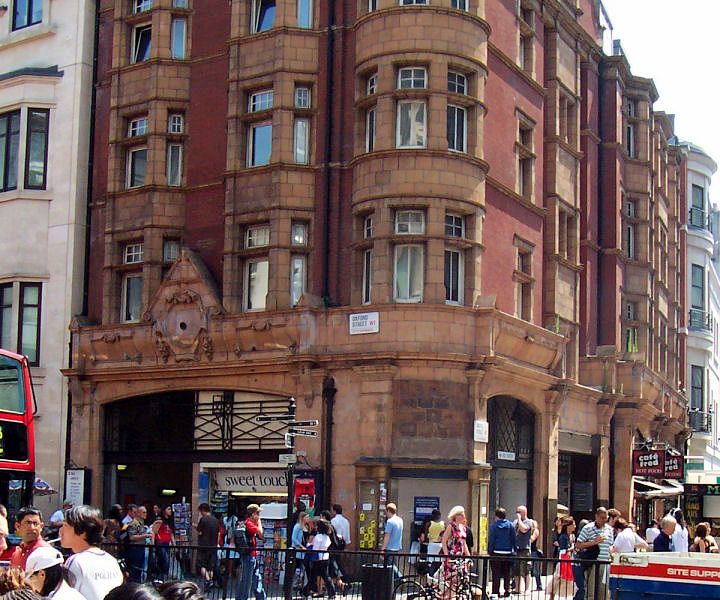
On 20 July 2011, the separate station buildings were given Grade II status by the Tourism and Heritage Minister on the advice of English Heritage. Part of the reason was the consistency of the design shown by architect Leslie Green on several stations.
The station building on the northeast corner of Argyll Street and Oxford Street was designed by Harry Bell Measures. The upper storey offices designed by Delissa Joseph were later added in 1908. The building as a whole was described as a "vigorous and well-detailed composition" and the best preserved. This design of the station resembles the traditional design of a Central London Railway (CLR) station. The materials used are of pinkish-buff terracotta and red brick with slate roof. The detailed description of the facade is quoted below:
"Wholly terracotta-clad with Mannerist detailing: pilasters flanking the entrances have capitals broken by masks and scroll brackets, supporting a cornice and frieze with moulded swags and cornucopias. Short elevation to Oxford Street contains main entrance (now exit), a broad segmental archway, originally glazed with timber mullions and now containing an openwork transom panel with diamond bracing. Large cartouche above rising into a gable, its cherub finial now lost. Long elevation to Argyll Street has two smaller segment-headed entrances, that to left cut down from an original window, and between them two similar openings containing shops. In centre, narrower doorway with glazed overlight gives access to upper floors. Curved corner section contains a metal-framed kiosk with bowed side sections bearing monograms, added before 1927 and now blocked."
Opposite the Measures's building, the original two-storey Bakerloo line entrance was designed by Leslie Green which resembles the original architecture of the Baker Street and Waterloo Railway (BS&WR) stations. It is the only station to have the original tiled signage and a cartouche bearing the Underground Electric Railways (UERL) company insignia retained. Like other original BS&WR station designs, it features ox-blood red terracotta and a brick-clad steel frame. The terracotta was manufactured by Leeds Fireclay Co. Ltd. Unlike the other building, the offices above are not Grade II listed. The station name is carved with raised gilded lettering on the lower frieze to Argyll Street and Oxford Street.
Services and connections
Services

Bakerloo line
On the Bakerloo line, Oxford Circus station is between Regent’s Park to the north and Piccadilly Circus to the south. The typical off-peak service in trains per hour (tph) operating during off-peak hours weekdays and all day Sunday is as follows:
- 8tph northbound to Queen's Park
- 4tph northbound to Stonebridge Park (via Queen's Park)
- 4tph northbound to Harrow & Wealdstone (via Queen's Park and Stonebridge Park)
- 16tph southbound to Elephant & Castle
Central line
On the Central line, Oxford Circus station is between Bond Street to the west and Tottenham Court Road to the east. Trains generally run between West Ruislip and Epping, and between Ealing Broadway and Hainault (via Newbury Park), with some trains on the latter route continuing to Woodford via Grange Hill. The general frequency between trains is 3–10 minutes.
Night Tube services on Friday and Saturday nights generally operate 6tph in each direction. The typical night tube service as of 2018 is:
- 3tph eastbound to Hainault via Newbury Park
- 3tph eastbound to Loughton
- 3tph westbound to Ealing Broadway
- 3tph westbound to White City
Victoria line
On the Victoria line, Oxford Circus station is between Green Park to the south and Warren Street to the north. The typical off-peak service in trains per hour (tph) is 27 trains per hour in each direction to Brixton and Walthamstow Central, with reduced frequencies of six trains per hour during Night Tube operations.
Connections
A large number of London Buses serve the station and the local area, day and night.
Nearby attractions
- All Souls Church, Langham Place
- BBC Broadcasting House
- Carnaby Street
- Langham Hotel
- London College of Fashion, John Princes Street
- London Palladium, Argyll Street
- Oxford Street
- Regent Street
- Hamleys
- St George's, Hanover Square
References
Notes
Citations
Bibliography
References
- {{National Heritage List for England |num=1400976 |desc=Oxford Circus Underground Station at the north-east corner of Argyll Street and Oxford Street, including offices above |access-date=3 April 2015}}
- {{National Heritage List for England
- (2022-10-20). "New OSI (Bond Street) and Same Station Exit Changes".
- {{Citation LU usage 2024
- "Oxford Circus Tube station 'closes every three days' because of overcrowding".
- {{London Gazette. (26 November 1889)
- {{London Gazette. (25 November 1890)
- {{London Gazette. (7 August 1891)
- Feather, Clive. "Central line". Clive's Underground Line Guides.
- {{London Gazette. (20 November 1891)
- {{London Gazette. (11 August 1896)
- {{London Gazette. (7 August 1900)
- Lee, Charles E.. (March 1956). "Jubilee of the Bakerloo Railway – 1". The Railway Magazine.
- Feather, Clive. "Bakerloo line". Clive's Underground Line Guides.
- {{harvnb. Railway (London Plan) Committee. 1946
- Feather, Clive. "Victoria line". Clive's Underground Line Guides.
- (October 1968). "London's new tube starts work". Ian Allan.
- (31 October 2016). "London: Bombed Blitzed and Blown Up: The British Capital Under Attack Since 1867". Pen & Sword Books.
- (14 February 1976). "20 lb bomb defused in rush hour at London Tube station". [[The Times]].
- (23 November 1984). "1984: London tube fire traps hundreds". BBC News.
- Hartley-Parkinson, Richard. (11 August 2017). "'Tube fire' at Oxford Circus sparks evacuation in central London". Metro.
- (11 August 2017). "Two taken to hospital after fire on rush-hour tube train in London".
- (25 November 2017). "Oxford Circus: Platform 'altercation' caused tube panic". BBC.
- (24 June 2011). "The grape escape for Oxford Circus: Tube station nearly renamed in winemaker's sponsor deal".
- Horne, Mike. "The Story of a Station – Oxford Circus".
- (July 2007). "Station Refurbishment Summary".
- "Oxford Circus Station". [[Historic England]].
- "Tube Stations with the most escalators". Geofftech.
- {{citation Avoiding stairs Tube guide
- (15 April 2010). "Exit and interchange only at Oxford Circus on weekday mornings". Transport for London.
- "Victoria Line Platform Humps and RVAR". Livis.
- "Victoria Line Platform Humps and RVAR". Livis.
- "Creating Step Free Access for All". Marshalls.
- {{cite map/Standard Tube Map
- (16 May 2021). "Bakerloo Line Working Timetable 47". Transport for London.
- (13 May 2021). "As Govt restrictions ease further, TfL is ready to welcome back those returning to London". Transport for London.
- (7 August 2016). "Central line Working Timetable 69". [[Transport for London]].
- "The Night Tube". [[Transport for London]].
- (21 May 2017). "Victoria Line Working Timetable (WTT 41)". [[Transport for London]].
- {{cite map/Standard Night Tube Map
- (24 October 2022). "Buses from Oxford Circus".
- (24 October 2022). "Night buses from Oxford Circus".
This article was imported from Wikipedia and is available under the Creative Commons Attribution-ShareAlike 4.0 License. Content has been adapted to SurfDoc format. Original contributors can be found on the article history page.
Ask Mako anything about Oxford Circus tube station — get instant answers, deeper analysis, and related topics.
Research with MakoFree with your Surf account
Create a free account to save articles, ask Mako questions, and organize your research.
Sign up freeThis content may have been generated or modified by AI. CloudSurf Software LLC is not responsible for the accuracy, completeness, or reliability of AI-generated content. Always verify important information from primary sources.
Report