From Surf Wiki (app.surf) — the open knowledge base
Overview effect
Cognitive shift after seeing Earth from space

Cognitive shift after seeing Earth from space
Characteristics

Broadly, Yaden et al. (2016) state that the most prominent common aspects of the astronauts' experience were appreciation and perception of beauty, unexpected and even overwhelming emotion, and an increased sense of connection to other people and the Earth as a whole. Yaden et al. proposed that the overview effect can be understood in terms of awe and self-transcendence, which they describe as "among the deepest and most powerful aspects of the human experience". More specifically, they write that the effect might best be understood as "a state of awe with self-transcendent qualities, precipitated by a particularly striking visual stimulus". Yaden posited that the overview effect triggers awe through both perceptual vastness (like seeing the Grand Canyon) and conceptual vastness (like contemplating big ideas like infinity).
Yaden et al. (2016) write that some astronauts viewing Earth from space "report overwhelming emotion and feelings of identification with humankind and the planet as a whole". The effect can cause changes in the observer's self concept and value system, and is sometimes transformative. Voski (2020) demonstrated a marked influence on astronauts' environmental attitudes and behaviors, and a new level of environmental awareness and consciousness. Though astronaut Leland Melvin said the effect seems to take hold of astronauts regardless of culture or nation of origin, Yaden et al. observed that cultural differences, including differences in religious and social identity, affect the ways in which the effect is experienced and interpreted. Expressions range from the religious, to the "vaguely spiritual", to the naturalistic, to calls to social duty.
Author Frank White, who in the 1980s coined the term overview effect after interviewing many astronauts, said that the overview effect is "beyond words", requiring experience to understand, even likening it in this regard to Zen Buddhism. He said that astronauts' very first views of the planet were generally very significant, adding that some experience the effect "in a moment" while in others it grows over time; and generally that the effect "does accumulate".
Not all astronauts experience the overview effect. Further, White distinguished experiences in low Earth orbit where the planet takes up most of an astronaut's view, from experiences on the Moon in which one sees the whole Earth "against a backdrop of the entire cosmos". He described a "big difference" between professional astronauts, who are focused on their missions—versus people who have recently been going into space "with an intention to have an experience" and who may already be aware of the overview effect.
{{anchor|Bimm|JordanBimm|Overlord effect|overlord effect}}Alternative characterizations
Beginning in the 2010s, science historian Jordan Bimm argued against White's interpretation that the overview effect is, in Bimm's words, "a reliably produced mental effect—a naturally occurring phenomenon between the environment and the human mind". Instead, Bimm asserts that the effect is "both a natural and cultural object" that is variable over particular individuals, divergent cultures, and different time periods. Preliminarily, Bimm noted that studies of early test pilots' negative-experience break-off phenomenon ended in 1973 (displaced by White's "positive conversion narrative"), that astronauts in a "lie to fly" culture feel career pressure to avoid reporting negative psychological reactions, and that individuals already aware of the overview effect may make it a self-fulfilling prophecy. He posited that it was Cold War and mastery-of-Earth mentalities of Western technological supremacy that contributed to the rise of borderless-world concepts such as the Gaia hypothesis, spaceship Earth, and the Blue Marble.
Bimm expressed concern over White's perception that the effect embodies a natural imperative for humans to pursue space travel and colonization, Bimm saying the attitude resembles the 18th-century American colonialist, expansionist concept of manifest destiny. Bimm warned of hubris underlying a perception of having achieved a new level of enlightenment that he called the "overlord effect".
History
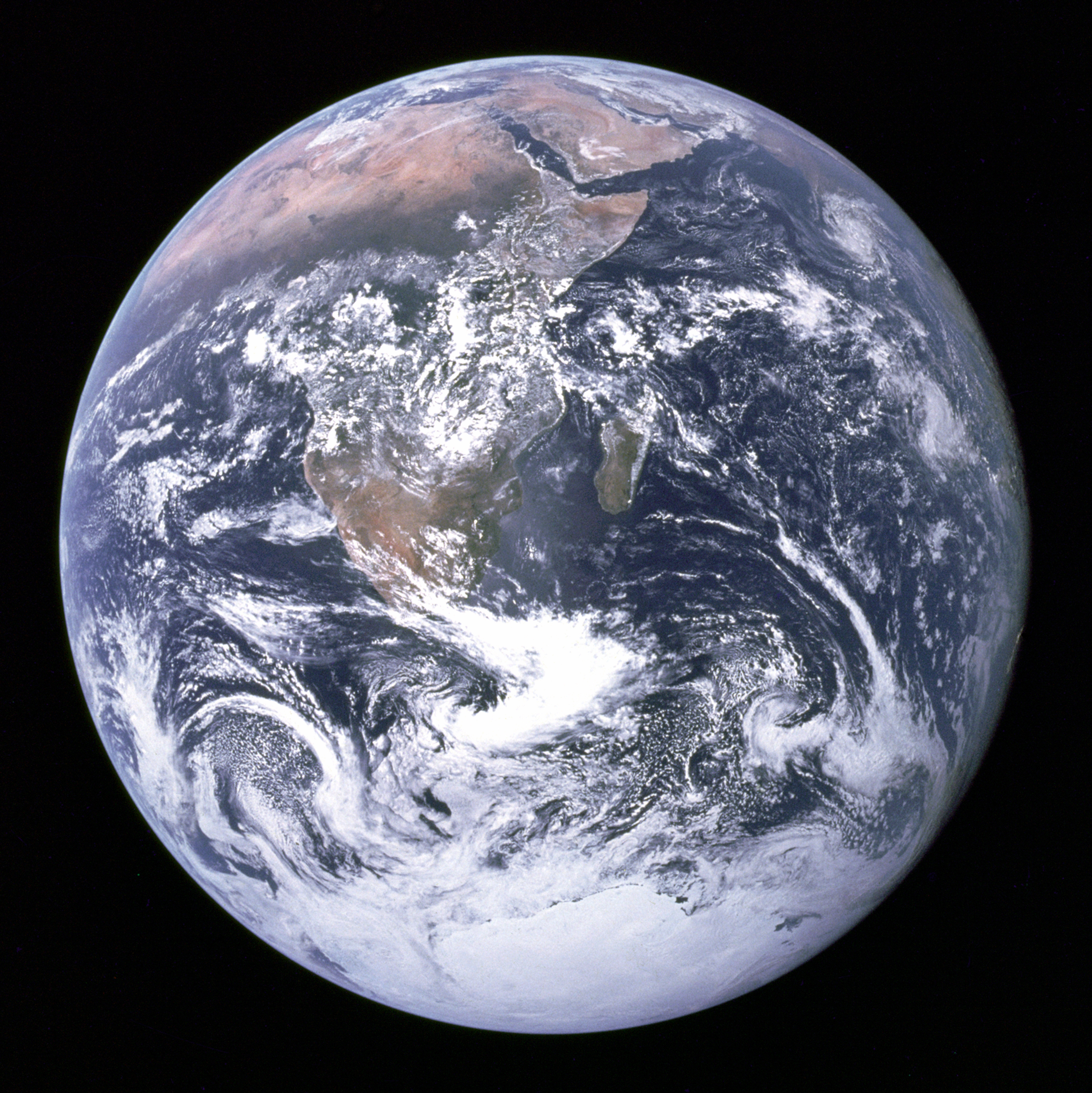
English astronomer Fred Hoyle wrote in 1948 that, "once a photograph of the Earth, taken from the outside, is available, a new idea as powerful as any in history will be let loose". After Apollo 8 astronaut William Anders' December 1968 Earthrise photograph of the Earth from lunar orbit, the Apollo missions were credited with inspiring the environmental movement, the first Earth Day being held in April 1970. Hoyle said that people suddenly seemed to care about protecting Earth's natural environment, though others attribute that awareness to Rachel Carson's 1962 book Silent Spring and reactions to several environmental disasters in the 1960s.
The term overview effect was coined by author and researcher Frank White, who said he thought he first had "a mild experience" of the effect while flying across the country and looking out the aircraft's window. That experience led him to imagine living in an O'Neill cylinder (habitat in space), which inspired him to become involved with the Space Studies Institute and begin speaking with astronauts.
White's astronaut interviews confirmed the importance of the difference between intellectual knowledge versus experience, of perceiving the "striking thinness of the atmosphere", of thinking of ourselves interconnected and part of the Earth as an organic system, and that we as different people "are all in this together". The first public use of the term was in a poster at a Space Studies Institute meeting in 1985. Eventually, White wrote about the effect in his book The Overview Effect — Space Exploration and Human Evolution (1987), which has a fourth edition (2021). White's work did not attain broad influence until the 2010s—a period of increased societal divisions and a new prospect of private space travel.
Accounts
ThinBlueLine[[File:Thin Line of Earth's Atmosphere and the Setting Sun.jpg|thumb| The Thin Blue Line photograph was taken from the [[International Space Station]] in 2009. Author Frank White's description of interviews with astronauts emphasized their perception of the "striking thinness of the atmosphere".]] Michael Collins, Yuri Gagarin, Ron Garan, Chris Hadfield, James Irwin, Mae Jemison, Scott Kelly, André Kuipers, Jerry Linenger, Mike Massimino, Anne McClain, Leland Melvin, Edgar Mitchell, Sian Proctor, Rusty Schweickart, William Shatner, Nicole Stott and Ed Dwight are among those reported to have experienced the effect.
Yuri Gagarin (Vostok 1; 1961) wrote, "Circling the Earth in a spaceship, I marveled at the beauty of our planet. People of the world, let us safeguard and enhance this beauty, and not destroy it!"
Michael Collins (Apollo 11; 1969) said that "the thing that really surprised me was that it [Earth] projected an air of fragility. And why, I don't know. I don't know to this day. I had a feeling it's tiny, it's shiny, it's beautiful, it's home, and it's fragile".
Edgar Mitchell (Apollo 14; 1971) described it as an "explosion of awareness" and an "overwhelming sense of oneness and connectedness... accompanied by an ecstasy... an epiphany".
William Shatner (Blue Origin NS-18, 2021) said immediately after landing that, "Everybody in the world needs to do this. [...] The covering of blue was... the sheet, this blanket, this comforter of blue that we have around us, we think, "Oh, that’s blue sky." And then [...] you shoot through it all of a sudden, as though you whip off a sheet off you when you're asleep, and you're looking into blackness, into black ugliness, and you look down. There's the blue down there, and the black up there and it's... There is mother, and Earth, and comfort. And there is — is there death? I don't know. [...] It was so moving to me. This experience, it’s something unbelievable."
Ed Dwight (Blue Origin NS-25, 2024) reflected after his suborbital spaceflight, "Out the window, I could see the Earth. Everything looked ordered and neat and wonderful and beautiful. There was no separation between countries or states. And you ask yourself: As wonderful as it all is, why can’t the people who live on it get along? Why don’t they want to take care of such a beautiful place?"
Lasting impact
Researchers have recognized that awe-based experiences—such as interaction with nature, religious or spiritual or mystical experiences, meditation, and peak and flow experiences during high task performance—can change a person and promote the feeling of unity or interconnectedness. Gallagher et al. (2015) defined a set of consensus categories for awe that included being captured by the view or drawn to the phenomenon, experiences of elation, desiring more of the experience, feeling overwhelmed, and scale effects – feelings of the vastness of the universe or of one's own smallness when faced with that vastness. Besides being an enjoyable experience, such phenomena can have short and long-term positive outcomes such as increased well-being, pro-social and pro-environmental attitudes, and improved physical health. The self-transcendent experience can cause long-term changes in personal outlook, and can influence peoples' very sense of self by affecting their self-schema ("the particular framework through which (people) imagine themselves in relation to the world").
_-_DPLA_-_0e4d63ab3ecd3df1d963ed55c4a3fe85.jpg)
Specifically, Frank White noted that upon return, some astronauts became involved in humanitarian activities, or became artists, with astronaut Edgar Mitchell founding the Institute of Noetic Sciences. Though Yaden et al. (2016) noted that the experience can be transformative, White said in 2019 that generally there was no "dramatic transformation" or "marching in peace parades"; that the lasting effect was more subtle.
A 2018 questionnaire survey of 39 astronauts and cosmonauts found that humanistic changes predominated over spiritual changes. In particular, the survey found a moderate degree of change in the Perceptions of Earth subscale (Earth as "a beautiful, fragile object to be treasured"), which significantly correlated with subsequent involvement in environmental causes. In contrast, the survey found "no to very small change" in the Spiritual Change subscale, which the researchers said likely reflected established pre-launch values.
Immediately after his October 2021 Blue Origin flight, William Shatner told founder Jeff Bezos, "What you have given me is the most profound experience. I hope I never recover from this. I hope that I can maintain what I feel now." However, in October 2022 he recounted that it took hours for him to realize why he wept after stepping out of the spacecraft: "I realized I was in grief for the Earth." He later said that "I saw more clearly than I have... (the) slow death of Earth and we on it." His biography Boldly Go recounted that "it was among the strongest feelings of grief I have ever encountered. The contrast between the vicious coldness of space and the warm nurturing of Earth below filled me with overwhelming sadness. Every day, we are confronted with the knowledge of further destruction of Earth at our hands... It filled me with dread. My trip to space was supposed to be a celebration; instead, it felt like a funeral."
At one point the Skylab 4 (1970s) crew refused to work, asserting, in the flight director's words, "their needs to reflect, to observe, to find their place amid these baffling, fascinating, unprecedented experiences". This event, plus research indicating that actively photographing the Earth has positive psychological effects, caused Yaden et al. to posit that studying the overview effect might improve understanding of psychological well-being in isolated, confined, extreme (ICE) environments such as space flight.
Early photos of Earth taken from space have inspired a mild version of the overview effect in earthbound viewers. The images became prominent symbols of environmental concern and have been credited for raising the public's consciousness about the fragility of Earth and expanding concern for long-term survival on a finite planet.
The accumulating experience of astronauts and space tourists inspires in many of them a strong desire to protect the Earth by actively communicating their broadened perspective, for example by speaking at international climate summits. Virgin Galactic officials specifically cite the overview effect as a motivation for carrying people to the edge of space, to fundamentally change the way people think about their home world. Critics note, however, that the space travel needed to personally experience the full overview effect, itself involves significant environmental pollution. A less polluting approach is to simulate the effect on Earth, with virtual reality technology.
Simulating the effect
Researchers have found that virtual reality (VR) technology elicits components of awe-based experiences and can induce minor cognitive shifts in participants' world views similar to those of the overview effect. Perceived safety, personal background and familiarity with the environment, and induction of a small visceral fear reaction, were found to be key contributors to the immersive experience. VR studies through 2019 had not observed a transformative experience on a scale similar to the overview effect itself, but VR experience can trigger profound emotional responses such as awe.

A 2019 study found that a virtual experience invoked "minor transformative experiences in some participants", including appreciation of beauty and vastness, realization of interconnectedness, and a potential intent to change one's behavior. Recognizing the relatively early state of VR technology, the researchers urged using knowledge of profound transformative experiences to motivate the design of VR installations, and thereafter study the VR experience itself as its own phenomenon.
On December 24, 2018—the fiftieth anniversary of the first day on which humans saw an earthrise with their own eyes—the Spacebuzz project was unveiled in Hilversum, Netherlands. Within a mobile, rocket-shaped vehicle more than 15 m in length, Spacebuzz's nine moving seats and virtual reality (VR) headsets simulate spaceflight in an experience designed especially for children.
Researchers at the University of Missouri tried to reproduce the experience with a water-filled flotation tank, half a tonne of Epsom salts, and a waterproof VR headset.
"The Infinite" provides an hour-long simulation of being on the International Space Station using 360-degree, 3D, astronaut-recorded footage from the VR film Space Explorers: The ISS Experience. Visitors share a 12,500 square foot (1150 square meter) area allowing them to physically explore the ISS and look outside.
A three-dimensional model of the Earth 7 m in diameter, created from detailed NASA imagery and appearing to float in the air, toured the U.K. in 2022, the installation "aim(ing) to create a sense of the Overview Effect".
Other names
The overview effect has been referred to as the big picture effect (Edgar Mitchell), orbital perspective (Ronald J. Garan Jr.), and the astronaut's secret (Albert Sacco).
Referring to how profound Mitchell's experience on the Moon was—distinguished from experiences in low Earth orbit—author Frank White called Mitchell's experience universal insight as it had a more universal perspective.
Explanatory notes
References
References
- (24 September 2021). "Inspiration4 Reveal They Felt the 'Overview Effect' in Space — What to Know About the Phenomenon". Dotdash Meredith.
- (6 January 2009). "Celebrate With the World for One Night: Yuri's Night". National Aeronautics and Space Administration (NASA) / Langley Research Center.
- (Oct 13, 2021). "Watch William Shatner's first remarks back on Earth". CNET Highlights (via [[YouTube]]).
- Shaw, Debra Benita. (2023-02-15). "The Way Home: Space Migration and Disorientation". Lawrence & Wishart.
- (January 2020). "Spirituality, humanism, and the Overview Effect during manned space missions". Acta Astronautica.
- (October 13, 2021). "William Shatner, TV's Capt. Kirk, blasts into space".
- (November 3, 2021). "The awesome power of awe: How this neglected emotion can change lives".
- (February 1, 2014). "Rethinking the Overview Effect". Quest: The History of Spaceflight.
- Feloni, Richard. (March 19, 2018). "NASA astronaut Scott Kelly explains how seeing planet Earth from space changed his perspective on life".
- (April 11, 2022). "'The Infinite' VR Is the Closest You'll Feel to Space Without Floating".
- (October 10, 2022). "William Shatner on traveling to space: 'All I saw was death'". CNN.
- (October 13, 2021). "'Whoa, That's Death!' Here's Everything William Shatner Said To Jeff Bezos After Returning From Space (transcript)".
- (May 22, 2019). "Understanding AWE: Can a Virtual Journey, Inspired by the Overview Effect, Lead to an Increased Sense of Interconnectedness?". Frontiers Media.
- (March 12, 2021). "The Overview Effect and Creative Performance in Extreme Human Environments". Frontiers Media.
- (February 9, 2022). "The Overview Effect / How the view from space might be key to saving the planet".
- (December 26, 2019). "Scientists attempt to recreate 'Overview effect' from Earth". The Guardian.
- (August 23, 2022). "Gaia – a large glowing earth will float inside Southwark Cathedral".
- (June 9, 2019). "The Overview Effect: Seeing Earth from Above Can Inspire Change".
- (March 27, 2018). "Six NASA Astronauts Describe the Moment in Space when 'Everything Changed'".
- Voski, Anaïs. (2020-08-01). "The ecological significance of the overview effect: Environmental attitudes and behaviours in astronauts". Journal of Environmental Psychology.
- (August 30, 2019). "The Overview Effect".
- (November 25, 2009). "Image of the Day Gallery / Thin Blue Line".
- (February 3, 2015). "Orbital Perspective: Astronaut Ron Garan Explains How to Save the Planet". NBC News.
- (October 23, 2022). "William Shatner experienced profound grief in space. It was the 'overview effect'".
- Chang, Kenneth. (July 16, 2019). "For Apollo 11 He Wasn't on the Moon. But His Coffee Was Warm". The New York Times.
- (January 28, 2021). "Can Astronaut Thinking Heal America At Last?".
- (2016). "The overview effect: Awe and self-transcendent experience in space flight". Psychology of Consciousness: Theory, Research, and Practice.
- Gallagher, S., Janz, B., Reinerman, L., Trempler, J., and Bockelman, P. (2015). ''A Neurophenomenology of Awe and Wonder: Towards a Non-reductionist Cognitive Science.'' London: Springer.
- (August 13, 2020). "The Overview Effect and the Ultraview Effect: How Extreme Experiences in/of Outer Space Influence Religious Beliefs in Astronauts". Religions.
- (August 5, 2006). "Space Tourism: Face Time with Earth".
- (February 11, 2019). "The View from Space Could Change the World, Virgin Galactic Says".
- (August 2, 2022). "Space philosopher Frank White on 'The Overview Effect' and humanity's connection with Earth".
- (April 1957). "The Break-off Phenomenon / A Feeling of Separation from the Earth Experienced by Pilots at High Altitude". [[Aerospace Medicine and Human Performance.
- (August 2, 2021). "'The Infinite' Virtual Reality Exhibit Offers a Taste of Life in Outer Space".
- (May 22, 2008). "The Human Brain in Space: Euphoria and the "Overview Effect" Experienced by Astronauts".
- (October 6, 2022). "William Shatner: My Trip to Space Filled Me With 'Overwhelming Sadness'".
- (February 11, 2016). "The Metaphysical Astronauts".
- (October 12, 2016). "Seeing Earth from Space Is the Key to Saving Our Species from Itself".
- (February 7, 2025). "The Ride of His Life".
This article was imported from Wikipedia and is available under the Creative Commons Attribution-ShareAlike 4.0 License. Content has been adapted to SurfDoc format. Original contributors can be found on the article history page.
Ask Mako anything about Overview effect — get instant answers, deeper analysis, and related topics.
Research with MakoFree with your Surf account
Create a free account to save articles, ask Mako questions, and organize your research.
Sign up freeThis content may have been generated or modified by AI. CloudSurf Software LLC is not responsible for the accuracy, completeness, or reliability of AI-generated content. Always verify important information from primary sources.
Report