From Surf Wiki (app.surf) — the open knowledge base
Overhead microphone
Microphone placement technique
Microphone placement technique
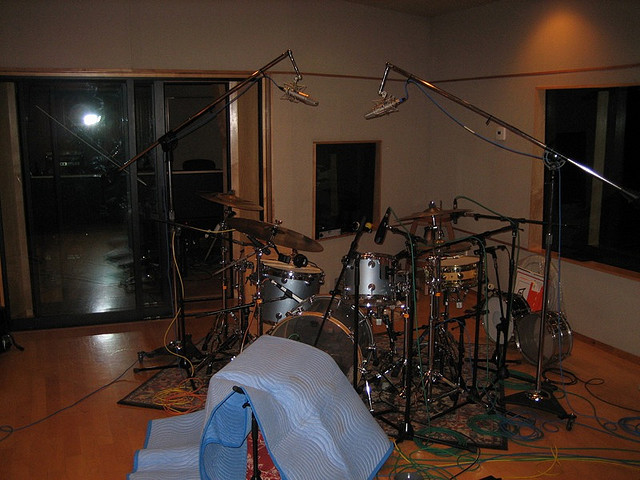
Overhead microphones are those used in sound recording and live sound reproduction to pick up ambient sounds, transients and the overall blend of instruments. They are used in drum recording to achieve a stereo image of the full drum kit, as well as orchestral recording to create a balanced stereo recording of full orchestras.
Overhead positioning
There are multiple arrangements for drum overheads, which are often based on personal preference of the musician, engineer, or producer. These include "A-B" spaced pairs (where two directional microphones are suspended above the left and right clusters of cymbals), "X-Y" coincident pairs, where the two directional microphones are centred on the drum kit with their capsule are very close without touching, and angled across each other at 90°. Coincident placement give a wider stereo image than spaced pairs, and some engineers prefer it for this reason.
Other drum overhead positions include the Recorderman Technique (where the distance between both microphones and the snare drum is equal, as is the distance between both microphones and the bass drum) and the Glyn Johns method (where one "overhead" is placed to the drummer's right, aiming across the floor tom to the centre of the kit).
In orchestral recordings, particularly those for film score recordings, the Decca tree is often used.
Footnotes
Sources
References
- {{harvtxt. Huber. 2005
- {{harvtxt. Huber. 2005
- {{harvtxt. Bartlett. 2006
- {{harvtxt. Eargle. 2004
- {{harvtxt. McKinney. 2007
- {{harvtxt. Griffiths. 2007
- {{harvtxt. Streicher. 2003
This article was imported from Wikipedia and is available under the Creative Commons Attribution-ShareAlike 4.0 License. Content has been adapted to SurfDoc format. Original contributors can be found on the article history page.
Ask Mako anything about Overhead microphone — get instant answers, deeper analysis, and related topics.
Research with MakoFree with your Surf account
Create a free account to save articles, ask Mako questions, and organize your research.
Sign up freeThis content may have been generated or modified by AI. CloudSurf Software LLC is not responsible for the accuracy, completeness, or reliability of AI-generated content. Always verify important information from primary sources.
Report