From Surf Wiki (app.surf) — the open knowledge base
Our Lady of Lourdes Catholic Church (Minneapolis, Minnesota)
Historic church in Minnesota, United States
Historic church in Minnesota, United States
| Field | Value |
|---|---|
| denomination | Roman Catholic |
| name | Our Lady of Lourdes Catholic Church |
| image | 2008-0705-OurLadyofLourdesMPLS.jpg |
| alt | front of the church today (contemporary photo) |
| pushpin map | Minnesota |
| pushpin label position | left |
| coordinates | |
| country | United States |
| location | One Lourdes Place |
| Minneapolis, Minnesota | |
| previous denomination | Universalist |
| website | |
| former name | First Universalist Church |
| founded date | |
| status | Parish church |
| functional status | Active |
| heritage designation | NRHP |
| years built | 1854–1857 |
| length | |
| width | |
| width nave | |
| height | |
| spire height | |
| bell weight | |
| pastor | Fr John M. Bauer |
| architect | Carl F. Struck (parsonage) |
| architectural type | Greek Revival; French Provincial; Gothic Revival |
| embed | yes |
| name | Our Lady of Lourdes Catholic Church |
| nrhp_type | cp |
| nocat | yes |
| added | March 11, 1971 |
| partof | St. Anthony Falls Historic District |
| partof_refnum | 71000438 |
Minneapolis, Minnesota
Our Lady of Lourdes Catholic Church is a Roman Catholic parish church of the Archdiocese of Saint Paul and Minneapolis located in Minneapolis, Minnesota in the United States. It was built on the east bank of the Mississippi River in today's Nicollet Island/East Bank neighborhood; it is the oldest continuously used church building in the city and is part of the St. Anthony Falls Historic District.
History
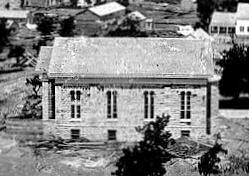
The oldest church building in Minneapolis, Our Lady of Lourdes has been in continuous use since the mid-19th century. The First Universalist Society of St. Anthony erected the building in Greek Revival style as a meeting hall between 1854 and 1857 as the First Universalist Church where they worshipped until 1877. A congregation of Catholic French Canadians acquired the church in 1877 and named it in honor of the Blessed Virgin Mary who had recently appeared to Bernadette Soubirous in France as Our Lady of Lourdes. One of many churches throughout the world named for the appearances in Lourdes, Our Lady of Lourdes in Minneapolis was the first in the U.S. with this name. The Catholic parish made significant additions to the building between 1880 and 1883, adding a transept, apse and front bell tower with three steeples; a front vestibule was added in 1914.
Near the birthplace of Minneapolis, the church stands near the Pillsbury "A" Mill and the only natural waterfall on the Mississippi River. The building is not listed as a National Historic Landmark but it is the subject of Historic American Buildings Survey (HABS) drawings and photographs created in 1934.
The parish school spoke French until about 1917 when the congregation dwindled and by 1945 the priests gave sermons only in English. The church survived extinction when the Minneapolis City Council persuaded bishops of the diocese to stop plans to close and board it up in 1968. Our Lady of Lourdes is now one of 85 contributing properties of the St. Anthony Falls Historic District which is on the National Register of Historic Places.
Architecture
The architecture is an unusual combination of architectural styles. The Universalists constructed the original building of limestone quarried at nearby Nicollet Island in Greek Revival style based on a Greek temple (shown below at left). Their design was 3000 sqft and built at a cost of $15,000. In the 1880s, the Catholic congregation added a V-frame beam truss, the steeple, the transept, bell tower, sacristy and vestibule in French Provincial and Gothic Revival style. The design for the circular nave comes from the Chapel Royale at Versailles.
Today
The church teaches Catholic beliefs, the morality and model for conduct taught by Jesus, the sacraments and prayer. Members believe in caring for the ill and those who are physically unable to attend services. The parish offers classes called faith formation for all ages.
To support the continuing restoration of their church, the congregation produces and sells French Canadian tourtières, a savory meat pie. Parishioners have protected the stained glass, building exterior, and the Blessed Virgin's grotto above the front entrance, and have restored the interior, renovated the rectory and added carillon bells. Guided tours are offered by appointment. The address was at one time Prince Street and is now called Lourdes Place.
Gallery
MinneapolisLourdesRC.jpg|The inside of the church in 2015 Our Lady of Lourdes Church-capture.png|Drawing made for the 1934 HABS
Notes
References
- [https://lourdesmpls.org/contact-us]
- {{NRISref
- The Archdiocese of Saint Paul and Minneapolis. "Parishes".
- Millett, Larry. (2007). "AIA Guide to the Twin Cities: The Essential Source on the Architecture of Minneapolis and St. Paul". [[Minnesota Historical Society.
- Our Lady of Lourdes Catholic Church. (n.d.). "History".
- Historic American Buildings Survey. (1934). "Survey number HABS MN-29-10".
- Minnesota Historical Society. (2001). "First Universalist Church/Our Lady of Lourdes Catholic Church".
- Emporis. (2007). "Our Lady of Lourdes Catholic Church".
- (2007). "Our Lady of Lourdes Catholic Church". Yahoo! Travel.
- Our Lady of Lourdes Catholic Church. (2007-04-16 }}, and {{cite web). "Pastoral Ministry".
- Our Lady of Lourdes Catholic Church. (2007-04-19 }}, and {{cite web). "Pastoral Ministry".
This article was imported from Wikipedia and is available under the Creative Commons Attribution-ShareAlike 4.0 License. Content has been adapted to SurfDoc format. Original contributors can be found on the article history page.
Ask Mako anything about Our Lady of Lourdes Catholic Church (Minneapolis, Minnesota) — get instant answers, deeper analysis, and related topics.
Research with MakoFree with your Surf account
Create a free account to save articles, ask Mako questions, and organize your research.
Sign up freeThis content may have been generated or modified by AI. CloudSurf Software LLC is not responsible for the accuracy, completeness, or reliability of AI-generated content. Always verify important information from primary sources.
Report