From Surf Wiki (app.surf) — the open knowledge base
Ouderkerk aan de Amstel
| Field | Value |
|---|---|
| name | Ouderkerk aan de Amstel |
| settlement_type | Town |
| native_name_lang | nl |
| image_skyline | Ouderkerk aan de Amstel overwiew.jpg |
| image_caption | Ouderkerk aan de Amstel seen from the Amstel |
| image_map | LocatieOuder-Amstel.png |
| image_map1 | Map NL - Ouder-Amstel - Ouderkerk aan de Amstel.svg |
| map_caption1 | The town centre (dark green) and the municipal boundaries (light green) of Ouderkerk aan de Amstel in the municipality of Ouder-Amstel |
| coordinates | |
| pushpin_map | Netherlands#Netherlands North Holland |
| pushpin_label_position | top |
| pushpin_mapsize | 250 |
| pushpin_map_caption | Location in the Netherlands##Location in the province of North Holland in the Netherlands |
| subdivision_type | Country |
| subdivision_name | Netherlands |
| subdivision_type1 | Province |
| subdivision_name1 | North Holland |
| subdivision_type2 | Municipality |
| subdivision_name2 | Ouder-Amstel |
| Amstelveen | |
| elevation_footnotes | |
| elevation_m | -0.9 |
| area_footnotes | |
| area_total_km2 | 2.21 |
| population_footnotes | |
| population_total | 8,185 |
| population_as_of | 2021 |
| population_density_km2 | auto |
| timezone | CET |
| utc_offset | +1 |
| timezone_DST | CEST |
| utc_offset_DST | +2 |
| postal_code_type | Postal code |
| postal_code | 1191 |
| area_code_type | Dialing code |
| area_code | 020 |
-- Amstelveen Ouderkerk aan de Amstel () is a town in the province of North Holland, Netherlands. It is largely a part of the municipality of Ouder-Amstel; it lies about 9 km south of Amsterdam. A small part of the town lies in the municipality of Amstelveen. It is connected to Amsterdam by the river Amstel. There is another village called Ouderkerk in South Holland, Ouderkerk aan den IJssel.
History
The village was first mentioned in 1308 as Ouderkerken, and means "old church". Old was probably added to distinguish from another village, however it is not clear which village. A candidate is Nieuwerkerk which disappeared in the Haarlemmermeer, but it can also refer to Amstelveen. It most likely refers to Amstelveen since Amstelveen used to be called Nieuwer-Amstel.
Ouderkerk developed at the confluence of the Bullewijk into the Amstel river. The castle of the van Amstel family was probably located on across the present church, however it was destroyed in 1204. From the 17th century onwards, estates were built in Ouderkerk aan de Amstel by the Amsterdam merchants.
Main sights
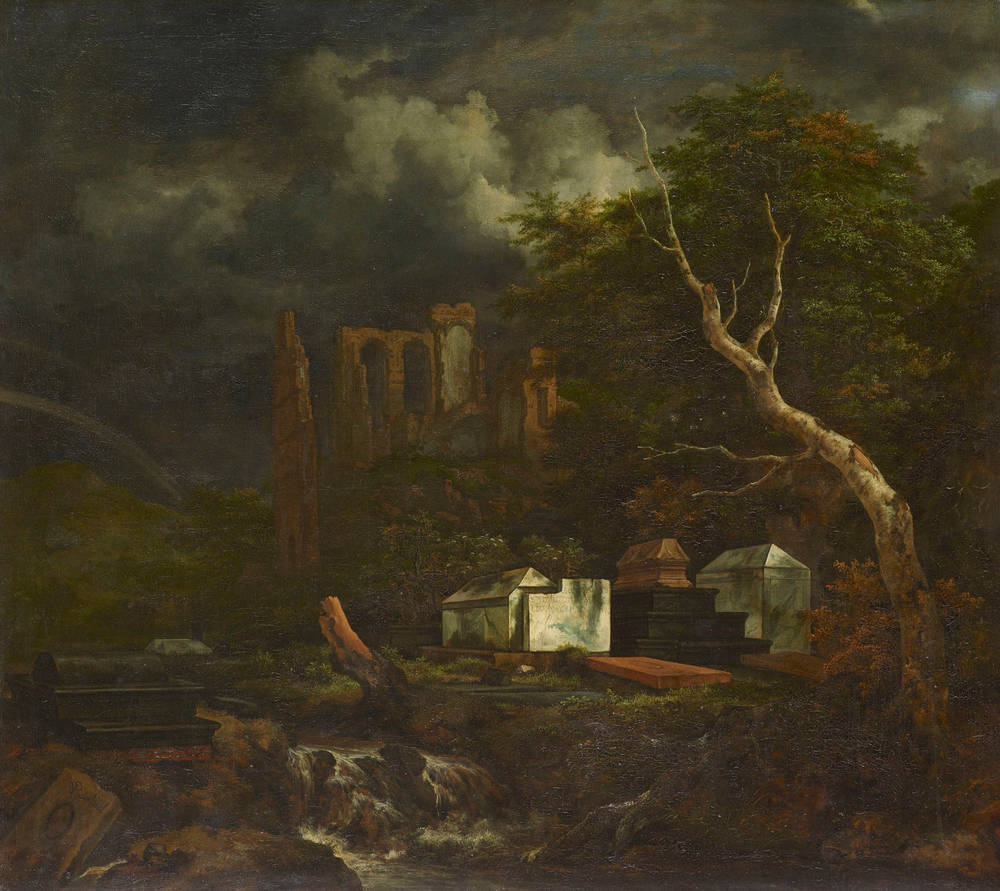
The town is the site of the Beth Haim of Ouderkerk aan de Amstel, the oldest Jewish cemetery in the Netherlands, as well as a neogothic Roman Catholic church that was designed by Pierre Cuypers in 1865. The Dutch landscape painter Jacob van Ruisdael created at least two renderings of the cemetery and a church, after his imagination
Gallery
File:Ouderkerk ad Amstel, de Kerkbrug RM31977 foto6 2015-08-28 13.10.jpg|Drawing bridge: de Kerkbrug File:De Zwaan Molen in Oudekerk ad Amstel.jpg|De Zwaan ("The Swan") windmill File:Ouderkerk ad Amstel, zicht op de Ronde Hoep foto2 2015-08-28 13.26.jpg|View to de Ronde Hoep File:Ouderkerk.jpg|Entering the town of Ouderkerk aan de Amstel File:Gemeentehuis van Ouder-Amstel.jpg|Ouder-Amstel Town Hall in Ouderkerk aan de Amstel
.jpg)
References
References
- (24 July 2019). "Postcodetool for 1191AA". Het Waterschapshuis.
- "Kerncijfers wijken en buurten 2021".
- "Ouderkerk aan de Amstel - (geografische naam)".
- Ronald Stenvert & Saskia van Ginkel-Meester. (2006). "Ouderkerk aan de Amstel". Waanders.
- Alvarez Vega, L.. (1974). "Het Beth Haim van Ouderkerk: beelden van een Portugees-Joodse begraafplaats". Van Gorcum.
- http://www.kerkenouderkerk.nl/web/node/65 (Dutch)
- Walford, E. John. (1991). "Jacob van Ruisdael and the Perception of Landscape". Yale University Press.
This article was imported from Wikipedia and is available under the Creative Commons Attribution-ShareAlike 4.0 License. Content has been adapted to SurfDoc format. Original contributors can be found on the article history page.
Ask Mako anything about Ouderkerk aan de Amstel — get instant answers, deeper analysis, and related topics.
Research with MakoFree with your Surf account
Create a free account to save articles, ask Mako questions, and organize your research.
Sign up freeThis content may have been generated or modified by AI. CloudSurf Software LLC is not responsible for the accuracy, completeness, or reliability of AI-generated content. Always verify important information from primary sources.
Report