From Surf Wiki (app.surf) — the open knowledge base
Ossetians
Ethnic group of the Caucasus
Ethnic group of the Caucasus
| Field | Value | ||
|---|---|---|---|
| group | Ossetians | ||
| native_name | Ирæттæ, Дигорæнттæ / Irættæ, Digorænttæ | ||
| native_name_lang | os | ||
| image | Caucasian dancer Alexander Dzusov.jpg | ||
| image_caption | Ossetian folk dancer in North Ossetia (Russia), 2010 | ||
| flag | |||
| <!-- | flag_caption | Flag of Ossetia -- | total = 700,000 |
| region1 | Russia | ||
| pop1 | 558,515 | ||
| ref1 | |||
| region2 | (North Ossetia–Alania) | ||
| pop2 | 480,310 | ||
| ref2 | |||
| region3 | South Ossetia | ||
| pop3 | 51,000 | ||
| ref3 | |||
| region4 | Georgia | ||
| (excluding South Ossetia P.A.) | |||
| pop4 | 14,385 | ||
| ref4 | |||
| region5 | Turkey | ||
| pop5 | 20,000–50,000 | ||
| ref5 | |||
| region6 | Tajikistan | ||
| pop6 | 7,861 | ||
| ref6 | |||
| region7 | Uzbekistan | ||
| pop7 | 5,823 | ||
| ref7 | |||
| region8 | Ukraine | ||
| pop8 | 4,830 | ||
| ref8 | |||
| region9 | Kazakhstan | ||
| pop9 | 4,308 | ||
| ref9 | |||
| region10 | Turkmenistan | ||
| pop10 | 2,066 | ||
| ref10 | |||
| region11 | Azerbaijan | ||
| pop11 | 1,170 | ||
| ref11 | |||
| region12 | Kyrgyzstan | ||
| pop12 | 758 | ||
| ref12 | |||
| region13 | Syria | ||
| pop13 | 700 | ||
| ref13 | |||
| region15 | Belarus | ||
| pop15 | 554 | ||
| ref15 | |||
| region16 | Moldova | ||
| pop16 | 403 | ||
| ref16 | |||
| region17 | Armenia | ||
| pop17 | 331 | ||
| ref17 | |||
| region18 | Latvia | ||
| pop18 | 285 | ||
| ref18 | |||
| region19 | Lithuania | ||
| pop19 | 119 | ||
| ref19 | |||
| region20 | Estonia | ||
| pop20 | 116 | ||
| ref20 | |||
| langs | Ossetian | ||
| rels | |||
| related | Jasz, Asud, other Iranian peoples, Caucasian peoples | ||
| footnotes | a. The total figure is merely an estimation; sum of all the referenced populations. |
(excluding South Ossetia P.A.) The Ossetians also known as Ossetes, Ossets and Alans, are an Iranian ethnic group who are indigenous to Ossetia, a region situated across the northern and southern sides of the Caucasus Mountains. They natively speak Ossetian, an Eastern Iranian language of the Indo-European language family, with most also being fluent in Russian as a second language.
Currently, the Ossetian homeland of Ossetia is politically divided between North Ossetia–Alania in Russia, and the de facto country of South Ossetia (recognized by the United Nations as Russian-occupied territory that is de jure part of Georgia). Their closest historical and linguistic relatives, the Jász people, live in the Jászság region within the northwestern part of the Jász-Nagykun-Szolnok County in Hungary. A third group descended from the medieval Alans are the Asud of Mongolia. Both the Jász and the Asud have long been assimilated; only the Ossetians have preserved a form of the Alanic language and Alanian identity.
The majority of Ossetians are Eastern Orthodox Christians, with sizable minorities professing the Ossetian ethnic religion of Uatsdin as well as Islam.
Name and etymology
Origin
The name Ossetians and Ossetia come from Russian Osetin, which in turn borrowed the Georgian term Oseti (ოსეთი), a toponymic formation meaning 'the land of the Osi'.
In Georgian, Osi (ოსი, pl. Osebi ოსები) has been used since the Middle Ages to refer to the Iranian-speaking population of the central Caucasus, ancestors of the modern Ossetians. The term ultimately derives from the Sarmatian ethnonym As (also attested as Ās in classical and medieval sources), the self-designation of an eastern Iranian tribe belonging to the Alanic branch of the Sarmatians.
The root os/as- is thought to descend from an earlier form *ows/aws-. This is supported by several parallels: the archaic Georgian root ovs- (as in Ovsi, Ovseti), recorded in the Georgian Chronicles; the gemination of s and/or lengthening of the preceding vowel in related forms (Ās, Āṣ in Middle Persian; Aas, Assi in Latin sources); and the Armenian ethnic name Ōsur- (reconstructed as **Awsowrk''' ), which appears to be connected to the Jassic term **Jaszok'', reflecting descendants of an Alanic branch of the Sarmatians attested near the Caucasus by the 7th century AD.
The ethnonym Iasi (pronounced 'Yazi'), cognate with Hungarian Jász (designating the Jasz people), stems from the Latin Iazyges, itself a rendering of the Sarmatian tribal name *Yazig, used among among western groups related to the Alans. The name is generally traced to the Proto-Iranian root *yaz- ('to worship' or 'to sacrifice'), perhaps originally signifying 'those who perform sacrifices'. In contrast, the broader Sarmatian confederation is thought to have called themselves Arii-tai ('Aryans'), a term preserved in modern Ossetian as Irættæ ('the Aryans', also the ethnonym underlying Iron, the main Ossetian subgroup).
Modern use
Since Ossetian speakers lacked any single inclusive name for themselves in their native language beyond the traditional Iron–Digoron subdivision, these terms came to be accepted by the Ossetians as an endonym even before their integration into the Russian Empire.
This practice was put into question by the new Ossetian nationalism in the early 1990s, when the dispute between the Ossetian subgroups of Digoron and Iron over the status of the Digor dialect made Ossetian intellectuals search for a new inclusive ethnic name. This, combined with the effects of the Georgian–Ossetian conflict, led to the popularization of Alania, the name of the medieval Sarmatian confederation, to which the Ossetians traced their origin and to the inclusion of this name into the official republican title of North Ossetia in 1994.
Subgroups
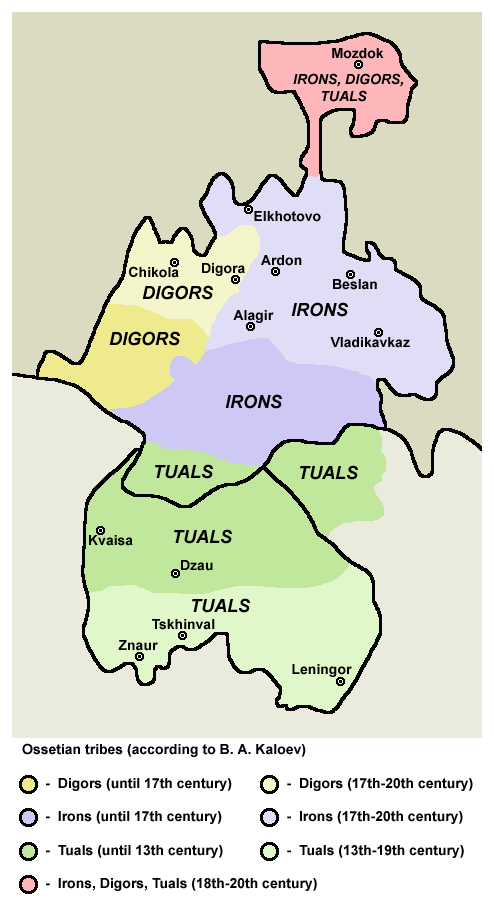
- Iron in the east and south form a larger group of Ossetians. They speak Iron dialect, which in turn is divided into several subgroups: Alagirs, Kurtats, Tagaurs, Kudar, Tual, Urstual and Chsan.
- Kudar are the southern group of Ossetians.
- Tual are in the central part of Ossetia.
- Ksan are in the east of South Ossetia.
- Digor people in the west. Digors live in Digora district, Iraf district and some settlements in Kabardino-Balkaria and Mozdok district. They speak Digor dialect.
- Iasi, who settled in the Jászság region in Hungary during the 13th century. They spoke the extinct Jassic dialect.
- Asud, a nomadic clan from Mongolia of Alanic-Ossetian origin. They, like the Iasi, thoroughly assimilated, and it is unclear what type of Ossetian dialect they used to speak before adopting the Mongolian language.
Culture
Mythology
Main article: Ossetian mythology
The native beliefs of the Ossetian people are rooted in their Sarmatian origin, which have been syncretized with a local variant of Folk Orthodoxy, in which some pagan gods have been converted into Christian saints. The Narts, the Daredzant, and the Tsartsiat, serve as the basic literature of folk mythology in the region.
Music
Main article: Ossetian music
Genres
Ossetian folk songs are divided into 10 unique genres:
- Historic songs
- War songs
- Heroic songs
- Work songs
- Wedding songs
- Drinking songs
- Humorous songs
- Dance songs
- Romantic songs
- Lyrical songs
Instruments
Ossetians use the following Instruments in their music:
- String Instruments:
- Plucked strings:
- Dyuuadæstænon – a twelve-stringed Harp
- Fændyr – a Harp with two or three plucked strings
- Bowed strings
- Hysyn – two or three string Fiddle
- Hyyrnæg – is a double-bridged instrument, a kind of Cello
- Plucked strings:
- Wind instruments
- Uadyndz – Flute
- Khyozyn – Reed Flute
- Lalym – Bagpipes
- Udaevdz – Double-reeds
- Fidiuæg – some kind of instrument made from a bull's horn
- Percussion instruments
- Kartsgænæg – Rattles
- Gymsæg – Drum
- Dala – Tambourine
History

Pre-history (Early ''Alans'')
Main article: Alans
The Ossetians descend from the Iazyges tribe of the Sarmatians, an Alanic sub-tribe, which in turn split off from the broader Scythians itself. The Sarmatians were the only branch of the Alans to keep their culture in the face of a Gothic invasion (c. 200 AD) and those who remained built a great kingdom between the Don and Volga Rivers, according to Coon, The Races of Europe. Between 350 and 374 AD, the Huns destroyed the Alan kingdom in the Battle of the Tanais River and the Alan people were split in half. A few fled to the west, where they participated in the Barbarian Invasions of Rome, established short-lived kingdoms in Spain and North Africa, and settled in many other places such as Orléans, France, Iași, Romania, Alenquer, Portugal and Jászberény, Hungary. The other Alans fled to the south and settled in the Caucasus, where they established their medieval kingdom of Alania.
Middle Ages
Main article: Alania

In the 7th century, in the well-known chronicle, Ashkharhatsuyts, the Alans were mentioned under the ethnonym Alanac, As-Digor
In the 8th century, a consolidated Alan kingdom, referred to in sources of the period as Alania, emerged in the northern Caucasus Mountains, roughly in the location of the latter-day Circassia and the modern North Ossetia–Alania. At its height, Alania was a centralized monarchy with a strong military force and had a strong economy that benefited from the Silk Road.

Alania reached its peak in the 11th century under the Alanian ruler Durgulel, who established relations with the Byzantine Empire.
Before the Mongol invasion, the Alans lived in the territory from the Laba (river) to the Argun River. In 1220, Genghis Khan sent his commanders Subutai and Jebe on a campaign, ordering them to reach "eleven countries and peoples", among whom were the "Kibchaut" (Kipchaks), "Orusut" (Rus'), "Machjarat" (inhabitants of the city Majar), "Asut" (Alania), "Sessut" (Durdzuks), "Serkessut" (Circassians) and others The Mongols, led by the generals Jebe and Subutai, met the Alans for the first time in 1222 after passing through Shirvan and Dagestan. They were confronted by a Kipchak-Alan alliance, which they defeated by scheming with the Kipchaks.
As a result of the second campaign of 1238-1239, a significant part of the Alania plain was captured by the Mongol Empire, and Alania itself ceased to exist as a political entity.
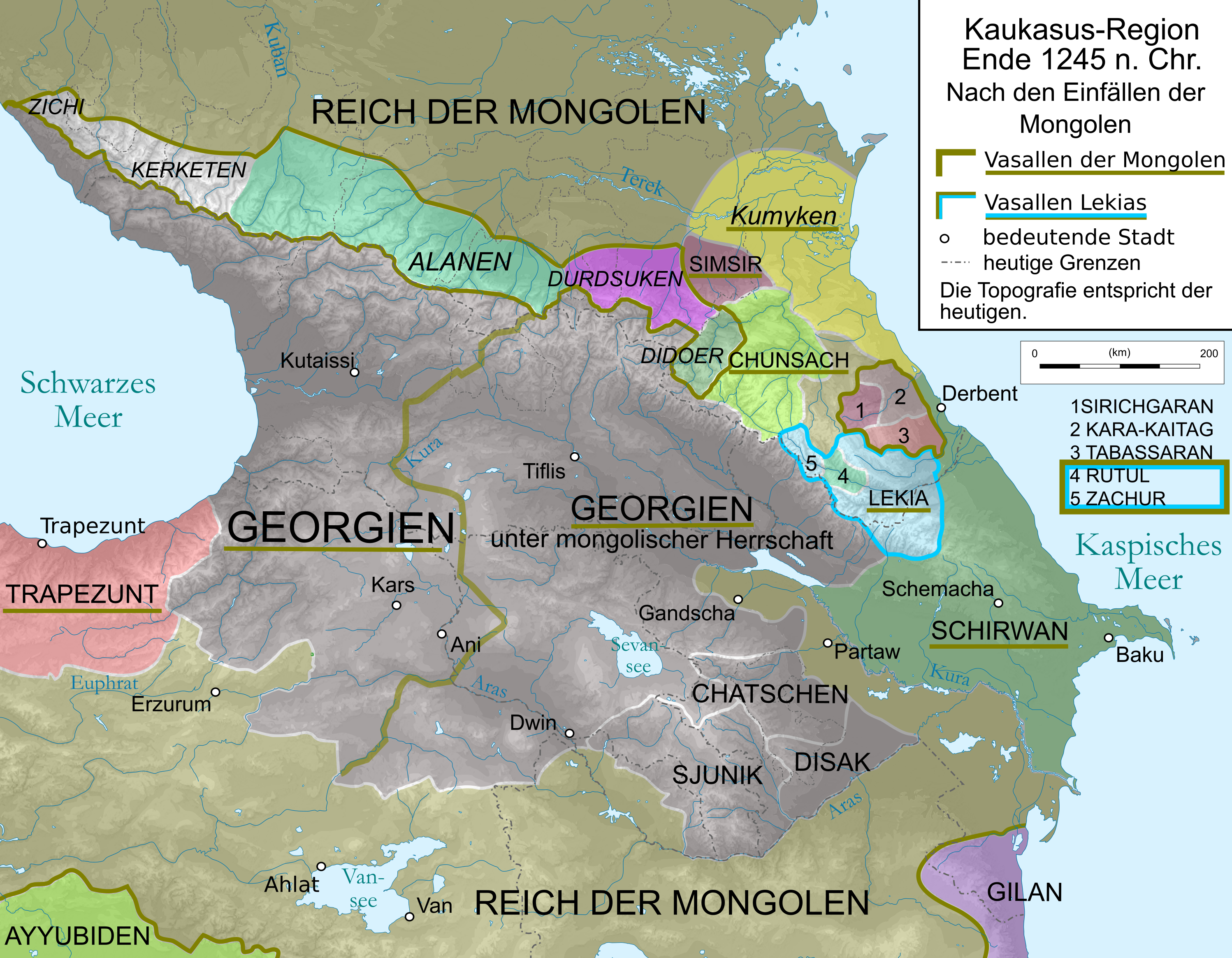
After the Mongol invasions of the 1200s, the Alans migrated further into Caucasus Mountains, where they would form three ethnographical groups; the Iron, the Digoron and the Kudar. The Jassic people are believed to be a potentially fourth group that migrated in the 13th century to Hungary.
In 1292, the Alanian king Os-Bagatar attacked the territory of Georgia and captured the territory of Gori, and a significant part of Shida Kartli. He tried to restore the statehood of Alania. But in 1306, Os-Bagatar died, and in 1326, George V of Georgia, after several attempts, was able to take Gori and drive the Alans out of the South Caucasus and Dvaletia.
Modern history

In more-recent history, the Ossetians were involved in the Ossetian–Ingush conflict (1991–1992) and Georgian–Ossetian conflicts (1918–1920, early 1990s) and in the 2008 South Ossetia war between Georgia and Russia.
Key events:
- 1774 — Expansion of the Russian Empire on Ossetian territory.
- 1801 — After Russian annexation of the east Georgian kingdom of Kartli-Kakheti, the modern-day territory of South Ossetia becomes part of the Russian Empire.
- in 1830, the Russian general Paul Andreas von Rennenkampff organized South Ossetian Expedition of 1830. 1,500 Russian troops besieged Ossetian towers in the village of Koshelta, where 30 Ossetian rebels were located.
- 1922 — Creation of the South Ossetian autonomous oblast. North Ossetia remains a part of the Russian SFSR, while South Ossetia remains a part of the Georgian SSR.
- 20 September 1990 – The independent Republic of South Ossetia is formed. Though it remained unrecognized, it detached itself from Georgia de facto. In the last years of the Soviet Union, ethnic tensions between Ossetians and Georgians in Georgia's former Autonomous Oblast of South Ossetia (abolished in 1990) and between Ossetians and Ingush in North Ossetia evolved into violent clashes that left several hundred dead and wounded and created a large tide of refugees on both sides of the border.
Ever since de facto independence, there have been proposals in South Ossetia of joining Russia and uniting with North Ossetia.
Language
Main article: Ossetian language

The Ossetian language belongs to the Eastern Iranian (Alanic) branch of the Indo-European language family.
Ossetian is divided into two main dialect groups: Ironian (os. – Ирон) in North and South Ossetia and Digorian (os. – Дыгурон) in Western North Ossetia. In these two groups are some subdialects, such as Tualian, Alagirian and Ksanian. The Ironian dialect is the most widely spoken.
Ossetian is among the remnants of the Scytho-Sarmatian dialect group, which was once spoken across the Pontic–Caspian Steppe. The Ossetian language is not mutually intelligible with any other Iranian language.
Religion
Prior to the 10th century, Ossetians were strictly pagan, though they were partially Christianized by Byzantine missionaries in the beginning of the 10th century. By the 13th century, most of the urban population of Ossetia gradually became Eastern Orthodox Christian as a result of Georgian missionary work.
Islam was introduced shortly after, during the 1500s and 1600s, when the members of the Digor first encountered Circassians of the Kabarday tribe in Western Ossetia, who themselves had been introduced to the religion by Tatars during the 1400s.
According to a 2013 estimate, up to 15% of North Ossetia’s population practice Islam.
In 1774, Ossetia became part of the Russian Empire, which only went on to strengthen Orthodox Christianity considerably, by having sent Russian Orthodox missionaries there. However, most of the missionaries chosen were churchmen from Eastern Orthodox communities living in Georgia, including Armenians and Greeks, as well as ethnic Georgians. Russian missionaries themselves were not sent, as this would have been regarded by the Ossetians as too intrusive.
Today, the majority of Ossetians from both North and South Ossetia follow Eastern Orthodoxy.
Assianism (Uatsdin or Aesdin in Ossetian), the Ossetian folk religion, is also widespread among Ossetians, with ritual traditions like animal sacrifices, holy shrines, annual festivities, etc. There are temples, known as kuvandon, in most villages. According to the research service Sreda, North Ossetia is the primary center of Ossetian folk religion and 29% of the population reported practicing the folk religion in a 2012 survey. Assianism has been steadily rising in popularity since the 1980s.
Demographics
The first data on the number of Ossetians dates back to 1742. According to the Georgian Archbishop Joseph, the number of Ossetians was approximately 200 thousand.
Outside of South Ossetia, there are also a significant number of Ossetians living in Trialeti, in north-central Georgia. A large Ossetian diaspora lives in Turkey and Syria. About 5,000–10,000 Ossetians emigrated to the Ottoman Empire, with their migration reaching peaks in 1860–61 and 1865. In Turkey, Ossetians settled in central Anatolia and set up clusters of villages around Sarıkamış and near Lake Van in eastern Anatolia. Ossetians have also settled in Belgium, France, Sweden, the United States (primarily New York City, Florida and California), Canada (Toronto), Australia (Sydney) and other countries all around the world.
Russian Census of 2002
The vast majority of Ossetians live in Russia (according to the Russian Census (2002)):
- North Ossetia-Alania North Ossetia–Alania — 445,300
- Moscow Moscow — 10,500
- Kabardino-Balkaria Kabardino-Balkaria — 9,800
- [[File:Flag of Stavropol Krai.svg|22x20px|border]] Stavropol Krai — 7,700
- [[File:Flag of Krasnodar kray (1995).png|22x20px|border]] Krasnodar Krai — 4,100
- Karachay-Cherkessia Karachay–Cherkessia — 3,200
- [[File:Flag of Saint Petersburg Russia.svg|22x20px|border]] Saint Petersburg — 2,800
- [[File:Flag of Rostov Oblast.svg|22x20px|border]] Rostov Oblast — 2,600
- [[File:Flag of Moscow oblast.svg|22x20px|border]] Moscow Oblast — 2,400
Genetics
The Ossetians are a unique ethnic group of the Caucasus, speaking an Indo-Iranian language surrounded mostly by Vainakh-Dagestani and Abkhazo-Circassian ethnolinguistic groups, as well as Turkic tribes such as the Karachays and the Balkars.
Like many other ethnolinguistic groups in the Caucasus, the genetic heritage of the Ossetians is both diverse yet distinctive. While Ossetians share genetic traits with neighboring populations, they have retained a distinct identity. With 70% of Ossetian males belonging to the Y-chromosomal haplogroup G2, specifically the G2a1a1a1a1a1b-FGC719 subclade. Among Iron people, this percentage rises to 72.6%, compared to 55.9% among Digor people.{{cite journal |last = Сабитов |first = Жаксылык Муратович |date = 2011 |title = Происхождение гаплогруппы G2a1a у осетин |url = https://www.academia.edu/13607514 |trans-title = The origin of haplogroup G2a1a among the Ossetians |journal = Russian Journal of Genetic Genealogy (Русская версия) |language = Russian |volume = 3 |issue = 1 |pages = 61-69 |issn = 1920-2997}}
This haplogroup has been identified in Alan burials associated with the Saltovo-Mayaki culture. In a 2014 study by V. V. Ilyinsky on bone fragments from ten Alanic burials along the Don River, DNA analysis was successfully performed on seven samples. Four of these belonged to Y-DNA Haplogroup G2, while six exhibited mitochondrial DNA (mtDNA) haplogroup I. The shared Y-DNA and mtDNA among these individuals suggest they may have belonged to the same tribe or were close relatives. These findings strongly support the hypothesis of direct Alan ancestry for Ossetians. This evidence challenges alternative theories, such as Ossetians being Caucasian speakers assimilated by the Alans, reinforcing that Haplogroup G2 is central to their genetic lineage.
Gallery
File:Osetino komXXjc.jpg|Ossetian woman in traditional clothes, early years of the 20th century File:Osetia woman working.jpg|Ossetian women working (19th century) File:Ramonov vano ossetin northern caucasia dress 18 century.jpg|Ossetian traditional dress of the 18th century, Ramonov Vano (19th century) File:Three ossetian teachers.jpg|Three Ossetian teachers (19th century) File:Ossetian girl 1883.jpg|Ossetian girl in 1883 File:Gazdanov-192?.jpg|Gaito Gazdanov, writer File:Barry (capitaine). F. 17. Ossèthe (Ossète), Koban. Mission scientifique de Mr Ernest Chantre. 1881.jpg|Ossetian man in 1881
References
Bibliography
Notes
References
- "Russian Census 2010: Population by ethnicity".
- "Всероссийская перепись населения 2002 года".
- {{South Ossetia-note
- (2007). "PCGN Report "Georgia: a toponymic note concerning South Ossetia"".
- "Ethnic Composition of Georgia".
- "Lib.ru/Современная литература: Емельянова Надежда Михайловна. Мусульмане Осетии: На перекрестке цивилизаций. Часть 2. Ислам в Осетии. Историческая ретроспектива".
- "Официальный сайт Постоянного представительства Республики Северная Осетия-Алания при Президенте РФ. Осетины в Москве".
- Refugees, United Nations High Commissioner for. "Refworld – The North Caucasian Diaspora In Turkey".
- (17 August 2008). "Göç edeli 100 yıl oldu ama Asetinceyi unutmadılar".
- link. Statistics of Tajikistan
- "Всесоюзная перепись населения 1989 года. Национальный состав населения по республикам СССР".
- (August 2018). "2001 Ukrainian census".
- "Всесоюзная перепись населения 1989 года. Национальный состав населения по республикам СССР".
- "Итоги всеобщей переписи населения Туркменистана по национальному составу в 1995 году.".
- "Всесоюзная перепись населения 1989 года. Национальный состав населения по республикам СССР".
- "Всесоюзная перепись населения 1989 года. Национальный состав населения по республикам СССР".
- "Осетины в Сирии". Администрация Президента Республики Южная Осетия.
- link. Национальный статистический комитет Республики Беларусь
- "Всесоюзная перепись населения 1989 года. Национальный состав населения по республикам СССР".
- "Всесоюзная перепись населения 1989 года. Национальный состав населения по республикам СССР".
- "Latvijas iedzīvotāju sadalījums pēc nacionālā sastāva un valstiskās piederības (Datums=01.07.2017)".
- "Lietuvos Respublikos 2011 metų visuotinio gyventojų ir būstų surašymo rezultatai".
- "2000 Estonian census".
- (19 June 2015). "Ossetians". Minority Rights Group.
- {{Cite OED. Ossetian
- Merriam-Webster (2021), s.v. [https://www.merriam-webster.com/dictionary/ossetian "Ossete"].
- (2016). "Islamic Peoples of the Soviet Union". Routledge.
- (2016). "Mythologization of History and the Invention of Tradition in Kazakhstan". Oriente Moderno.
- (2012). "Edge of Empires: A History of Georgia". Reaktion Books.
- (2015). "Historical Dictionary of Russian and Soviet Foreign Policy". Rowman & Littlefield.
- Bell, Imogen. (2003). "Eastern Europe, Russia and Central Asia". Taylor & Francis.
- Mirsky, Georgiy I.. (1997). "On Ruins of Empire: Ethnicity and Nationalism in the Former Soviet Union".
- Mastyugina, Tatiana. "An Ethnic History of Russia: Pre-revolutionary Times to the Present".
- Foltz, Richard. (2022). "The Ossetes: Modern-Day Scythians of the Caucasus.". Bloomsbury.
- Lebedynsky, Iaroslav (2014). ''Les Sarmates amazones et lanciers cuirassés entre Oural et Danube (VIIe siècle av. J.-C. – VIe siècle apr. J.-C.)''. Éd. Errance.
- Alemany, Agustí. (2000). "Sources on the Alans: A Critical Compilation". Brill.
- Alemany, Agustí. (2000). "Sources on the Alans: A Critical Compilation". Brill.
- (2006). "The Politics of a Name: Between Consolidation and Separation in the Northern Caucasus". Acta Slavica Iaponica.
- "Map image".
- "Map image".
- Foltz, Richard. (2022). "The Ossetes: Modern-Day Scythians of the Caucasus.". Bloomsbury.
- Lora Arys-Djanaïéva ''"Parlons ossète"'' (Harmattan, 2004)
- (2008). "Ossetians". Microsoft Corporation.
- Hewsen, Robert H.. "The Geography of Ananias of Širak: Ašxarhacʻoycʻ, the Long and the Short Recensions".
- "Тайны Аланского царства".
- "Atlas Of The Ethno Political History Of The Caucasus : Arthur Tsutsiev : Free Download, Borrow, and Streaming : Internet Archive".
- Amin Anguni: Государственность Народа Нохчий page 13
- "ГИБЕЛЬ АЛАНИИ".
- "Город Гори".
- (2006-03-01). "Ф.Х. ГУТНОВ. Северная Осетия в XIV-XV вв - Дарьял".
- "ЧУДИНОВ В. ОКОНЧАТЕЛЬНОЕ ПОКОРЕНИЕ ОСЕТИН. Часть 1. DrevLit.Ru - библиотека древних рукописей".
- "Getting Back Home? Towards Sustainable Return of Ingush Forced Migrants and Lasting Peace in Prigorodny District of North Ossetia".
- "Ca-c.org".
- "Завоевание Южной Осетии".
- (21 April 2016). "South Ossetia profile". BBC News.
- [http://www.gcsp.ch/e/publications/Issues_Institutions/Int_Organisations/Academic_Articles/Ghebali-Helsinki-3-04.pdf] {{dead link. (August 2017)
- "obiv.org.tr".
- [http://sreda.org/en/arena "Arena: Atlas of Religions and Nationalities in Russia"]. Sreda, 2012.
- [http://c2.kommersant.ru/ISSUES.PHOTO/OGONIOK/2012/034/ogcyhjk2.jpg 2012 Arena Atlas Religion Maps]. "Ogonek", № 34 (5243), 27 August 2012. Retrieved 21 April 2017. [https://web.archive.org/web/20170421154615/http://c2.kommersant.ru/ISSUES.PHOTO/OGONIOK/2012/034/ogcyhjk2.jpg Archived].
- Kuznetsov, Vladimir Alexandrovitch. "Alania and Byzantine". The History of Alania.
- James Stuart Olson, Nicholas Charles Pappas. An Ethnohistorical dictionary of the Russian and Soviet empires. Greenwood Publishing Group, 1994. p 522.
- Ronald Wixman. The peoples of the USSR: an ethnographic handbook. M.E. Sharpe, 1984. p 151
- (1986). "Muslims of the Soviet Union". Indiana University Press.
- "Ossetians in Georgia, with their backs to the mountains".
- (30 May 2012). "South Ossetia profile". [[BBC]].
- "Михаил Рощин : Религиозная жизнь Южной Осетии: в поисках национально-культурной идентификации.".
- [http://sreda.org/arena Arena – Atlas of Religions and Nationalities in Russia]. Sreda.org
- "DataLife Engine > Версия для печати > Местная религиозная организация традиционных верований осетин "Ǽцǽг Дин" г. Владикавказ".
- "Neue Seite 5".
- (2011). "Parallel evolution of genes and languages in the Caucasus region". Molecular Biology and Evolution.
- "Burial locations,дДНК Сарматы, Аланы".
- "Anthropological and genetic specificity of the Don Alans // E.I. Krupnov and the development of archeology of the North Caucasus. M. 2014. pp. 312-315.". Irina Reshetova, Gennady Afanasiev.


This article was imported from Wikipedia and is available under the Creative Commons Attribution-ShareAlike 4.0 License. Content has been adapted to SurfDoc format. Original contributors can be found on the article history page.
Ask Mako anything about Ossetians — get instant answers, deeper analysis, and related topics.
Research with MakoFree with your Surf account
Create a free account to save articles, ask Mako questions, and organize your research.
Sign up freeThis content may have been generated or modified by AI. CloudSurf Software LLC is not responsible for the accuracy, completeness, or reliability of AI-generated content. Always verify important information from primary sources.
Report