From Surf Wiki (app.surf) — the open knowledge base
Osroene
Ancient kingdom in Upper Mesopotamia (132 BC–214 AD)

Ancient kingdom in Upper Mesopotamia (132 BC–214 AD)
| Field | Value |
|---|---|
| native_name | |
| conventional_long_name | Osroene |
| common_name | Osroene |
| era | Hellenistic Age |
| status | Kingdom, vassal state, province |
| government_type | Monarchy |
| year_start | 132 BC |
| year_end | AD 638 |
| p1 | Seleucid Empire |
| s1 | Osroene (Roman province) |
| image_map | Map of the Armenian Empire of Tigranes (English).svg |
| image_map_caption | The map above includes Osroene as a tributary kingdom of the Armenian Empire under Tigranes the Great. |
| capital | Edessa |
| (modern-day Şanlıurfa, Turkey) | |
| common_languages | Aramaic (official) |
| Koine Greek | |
| Arabic | |
| Persian | |
| Parthian | |
| Armenian | |
| religion | Christianity c. 200 AD (State religion) (contested) |
| demonym | Osroenian |
| title_leader | King |
(modern-day Şanlıurfa, Turkey) Koine Greek Arabic Persian Parthian Armenian Osroene or Osrhoene (; ) was an ancient kingdom and region in Upper Mesopotamia. The Kingdom of Osroene, also known as the "Kingdom of Edessa" ( / "Kingdom of Urhay"), according to the name of its capital city (now Şanlıurfa, Turkey), existed from the 2nd century BC, up to the 3rd century AD, and was ruled by the Nabataean Arab Abgarid dynasty. They were generally allied with the Parthians.
History
The Kingdom of Osroene enjoyed semi-autonomy to complete independence from the years of 132 BC to AD 214. The kingdom's population was of mixed culture, being Aramaic and then Syriac-speaking from the earliest times. The city's cultural setting was fundamentally Semitic (Syrian-Aramaic and Arab), alongside Greek and Parthian influences.
The ruling Abgarid dynasty was deposed by the Romans during the reign of Roman Emperor Caracalla (211–217), probably in 214 or 216, and Osroene was incorporated as a province, but it was briefly reestablished during the reign of Roman emperor Gordianus III (238–244). Christianity came early to Osroene. From 318, Osroene was a part of the Diocese of the East. By the 5th century, Edessa had become a main center of Syriac literature and learning. In 608, the Sasanian emperor, Khosrow II (590–628), took Osroene. It was briefly reconquered by the Byzantines, but in 638 it fell to the Muslims as part of the Muslim conquests.
Background and context


Osroene, or Edessa, was one of several states that acquired independence from the collapsing Seleucid Empire through a dynasty of the nomadic Nabataean tribe from Southern Canaan and North Arabia, the Osrhoeni, from 136 BC. Osroene's name either derives from the name of this tribe, or from Orhay (Urhay), the original Aramaic name of Edessa. Arab influence had been strong in the region.
Osroene endured for four centuries, with twenty-eight rulers occasionally named "king" on their coins. Most of the kings of Osroene were called Abgar or Manu and settled in urban centers.
Osroene was generally allied with the Parthian Empire. After a period under the rule of the Parthian Empire, it was absorbed into the Roman Empire in 114 as a semiautonomous vassal state, and incorporated as a simple Roman province in 214.
Christianity in Edessa
Edessa was celebrated as the first kingdom to adopt Christianity as its official religion. There were two main Christianizing movements at Edessa, one that came from Nisibis in the east in the first century and the second that came from Antioch in the west in the end of the second century. There is a mention of a Christian synod in Osroene in 197 CE but scholars have doubted its authenticity. At the end of the second century a bishop of Edessa was consecrated in Rome but had to go to Antioch to be confirmed. The connection between Antioch and Edessa became close by the end of the second century and the see of Edessa became subject to Antioch in the early third century.
Edessa was regularly described as the 'capital of Mesopotamia' in early Syriac manuscripts. The earliest dated Christian literary manuscript in any language was written in November 411 CE, a fragment of Isaiah is dated 459-60 CE, a manuscript containing Genesis and Exodus is dated 463-4 CE, and the earliest dated Gospels in any language were completed in October 510 CE, although there are undated Gospel manuscripts which probably are from the fifth century.
"First Christian kingdom" claim contested with Armenia
There is an apocryphal legend, the Doctrine of Addai (late 4th or early 5th century), and an anonymous history, the Chronicle of Edessa (mid-6th century), claiming that Osroene was the first state to have accepted Christianity as state religion, but some scholars believe there is not enough evidence to support that claim.
By the end of the second century Christianity was well established in Edessa in various forms, some texts belong to the early third century and provide unambiguous evidence for Christianity at Edessa, such as the account of the flood at Edessa in 201 CE which is preserved in the Chronicle of Edessa, fragments of Bardaisan's works preserved by later writers and the Book of the Laws of the Countries written in the School of Bardaisan. By the end of the third century Christianity had spread to surrounding villages.
By c. AD 200, the Church in Edessa must have been of some size to judge from the expansion of Christianity in the early third century in Osroene and neighboring Adiabene, as according to the Chronicle of Arbela there were more than twenty bishoprics in the region bordering the Tigris in AD 224. Edessa was known as a Christian city at a very early date, but the countryside was only Christianized during the 4-5th centuries by Syrian monks and ascetics.
General opinion is that the official adoption of Christianity happened during the reign of Abgar VIII the Great (177 – 212), who was either Christian himself or not at all hostile to Christians, as the Christian writer Sextus Julius Africanus (c. 160 – c. 240) stayed at Abgar the Great's court in 195, and a Christian inscription was produced in Edessa, which is from the same period or few decades later than the Inscription of Abercius from 216. It is estimated that Christianity was preached in Edessa since 160 – 170, and a flood in 201 destroyed "the temple of the church of the Christians", indicating a community large enough to have had a building of notable importance to the city at the time. The earliest known Syriac writer, Bardaisan (154-222), was active, and contemporary coins dated 179-192 clearly show Abgar VIII the Great wearing a tiara with a cross. The dates and circumstances of the Christianization of the kings and the Kingdom of Osroene are still debated and the claim of becoming the first Christian kingdom is contested by Armenia.
In the Church of the Virgin in Dayr al-Suryān in Egypt, built in the middle seventh century and monumental paintings applied in later centuries, a number of narrative scenes of conversion as the central theme were painted. There are remains of a painting of King Abgar of Edessa with the mandylion, while on the same wall there is a painting of Constantine the Great on horseback holding the sign of the cross in his first battle as a Christian. The paintings are making a clear statement: Constantine was the first Christian Roman emperor but Edessa had a Christian king almost three centuries before. On an opposite wall fragments are preserved of Gregory the Illuminator's conversion of the Armenians. The unique conversion scenes were probably painted as a carefully planned addition after the eight century, covering scenes of the Pentecost, and it is possible that the church building had a geographical symbolism as Ethiopia is equaled with the south, Armenia with the north, and Byzantium and Edessa with the east. The first Armenian Christian king Tiridates the Great is absent from the depiction.
Population and culture
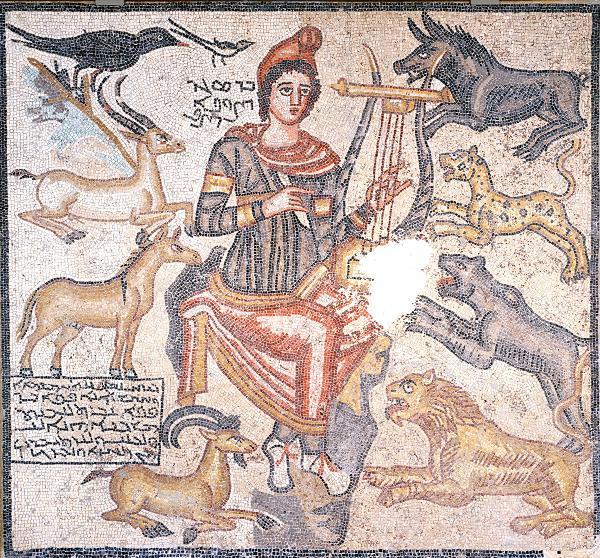
Most of Osroene's rulers were sedentarized Arabs from the Nabataean Abgarid dynasty, and the kingdom's population was primarily of mixed Semitic origins, being Aramaic-speaking from the earliest times. Before emerging as an early and important center for Syriac Christianity, Edessa was a major centre for cult worship in the Near East, with devotees of Atargatis and Sabians mixing with those of Mesopotamian/Palmyrene Bel and Nabataean Dushara worshippers, among other pre-Islamic Arabian cults (such as the twins Monimos and Azizos).. Its overall cultural setting was hybridized and syncretic, incorporating Babylonian, Aramaean, Arab, Jewish, Iranian, Indian and Hellenistic influences. A centre of local reaction against Hellenism, its Arab dynasts became increasingly influenced by Syriac Christianity, presaging Rome's later embrace of monotheism.
In his writings, Pliny the Elder refers to the natives of Osroene and Commagene as Arabs and the region as Arabia. Abgar II is called "an Arab phylarch" by Plutarch, while Abgar V is described as "king of the Arabs" by Tacitus.
The Edessene onomastic contains many Arabic names. The most common one in the ruling dynasty of Edessa being Abgar, a well-attested name among Arabic groups of antiquity. Some members of the dynasty bore Iranian names, while others had Arabic names. Judah Segal notes that the names ending in "-u" are "undoubtedly Nabatean". The Abgarid dynasts spoke "a form of Aramaic".
It was in the region in which the legend of Abgar V originated.
In Roman sources
The area of the kingdom was perhaps roughly coterminous with that of the Roman province of Osrhoene. The great loop of the Euphrates was a natural frontier to the north and west. In the south Batnae was capital of the semi-autonomous principality of Anthemusias until its annexation by Rome, in AD 115. The eastern boundary is uncertain; it may have extended to Nisibis or even to Adiabene in the first century AD. Ḥarrān, however, only 40 km south of Edessa, always maintained its independent status as a Roman colonia.
Edessa, the capital of the ancient kingdom, was a fortress of considerable strength and a staging post both large and nearest to the Euphrates. It was an important road junction; an ancient highway, along which caravans carried merchandise from China and India to the West, meeting there a north–south road connecting the Armenian Highlands with Antioch. Inevitably, Edessa figured prominently on the international stage.
In 64 BC, as Pompey waged war on the Parthian Empire, Abgar II of Osrhoene had sided with the Romans when Lucius Afranius occupied Upper Mesopotamia. The king was initially an ally of the Roman general Marcus Licinius Crassus in his campaign against the Parthians in 53 BC, but Roman historians allege that he betrayed Crassus by leading him to deviate from his safe route along the river and instead into an open desert, where the troops suffered from the barrenness and thus were vulnerable to cavalry attack. Abgar is said to have met with Surenas, the Parthian general, and informed him of the Roman movements. The enormous and infamous Battle of Carrhae followed and destroyed the entire Roman army. Just prior to the battle, Abgar made a pretext to ride away. However, modern historians have questioned whether Abgar intended to betray the Romans and instead may have simply been leading them along an old Arab trade route. According to a Syriac source, Abgar died later that year.
In the early 2nd century AD, King Abgar VII joined the Emperor Trajan's campaign into Mesopotamia and entertained him at court. The king later rebelled against the Romans, however, which led to the Roman general Lucius Quietus sacking Edessa and putting an end to Osrhoene's independence in 116. In 123, during the reign of Hadrian, the Abgarid dynasty was restored with the installation of Ma'nu VII, and Osroene was established as a client kingdom of the Empire. After the Roman–Parthian War of 161–166 under Marcus Aurelius, forts were built and a Roman garrison was stationed in Nisibis. In 195, following a civil war in which the kingdom had supported his rival Pescennius Niger, Septimius Severus mounted an invasion and annexed the territory as a new province, making Nisibis the capital. However, the emperor did allow the king, Abgar XI, to retain the city of Edessa and a small territory surrounding it. In 213, the reigning king was deposed by Caracalla, and the remaining territory was incorporated into the Roman province of Osroene.
According to legends (without historical justification), by 201 AD or earlier, under King Abgar the Great, Osroene became the first Christian state. It is believed that the Gospel of Thomas emanated from Edessa around 140. Prominent early Christian figures have lived in and emerged from the region such as Tatian the Assyrian, who came to Edessa from Hadiab (Adiabene). He made a trip to Rome and returned to Edessa around 172–173. Tatian was the editor of the Diatessaron, which was the primary sacred text of Syriac-speaking Christianity until in the 5th century the bishops Rabbula and Theodoret suppressed it and substituted a revision of the Old Syriac Canonical Gospels (as in the Syriac Sinaiticus and Curetonian Gospels).
Then, Edessa was again brought under Roman control by Decius and it was made a center of Roman operations against the Sasanian Empire. Amru, possibly a descendant of Abgar, is mentioned as king in the Paikuli inscription, recording the victory of Narseh in the Sassanid civil war of 293. Historians identify that Amru as Amru ibn Adi, the fourth king of the Lakhmids, which was then still based in Harran, not yet moved to al-Hirah in southern Mesopotamia.
Many centuries later, Dagalaiphus and Secundinus duke of Osrhoene, accompanied Julian in his war against the Sasanian emperor, Shapur II, in the 4th century.
Roman province

Main article: Osroene (Roman province)
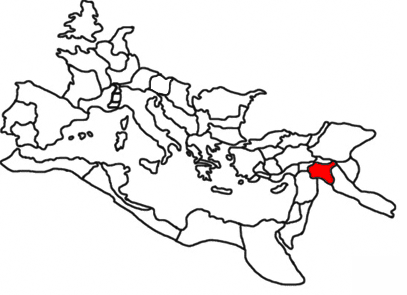
The independence of the state ended probably in ; during Caracalla's reign the monarchy was abolished by the Roman Empire and Osroene was incorporated it as a province (colonia). It was a frontier province, lying close to the Persian empires with which the Romans were repeatedly at war, and was taken and retaken several times. As it was on the frontier it had a Roman legion stationed there. Legio III Parthica and its Castrum (homebase) may have been Rhesaina, but that is uncertain.
Following Emperor Diocletian's tetrarchy reform during his reign (284-305), it was part of the diocese of the East, in the praetorian prefecture of the same name.
According to the late-4th-century Notitia Dignitatum, it was headed by a governor of the rank of praeses, and it was also the seat of the dux Mesopotamiae, who ranked as vir illustris and commanded (c. 400) the following army units:
- Equites Dalmatae Illyriciani, garrisoned at Ganaba.
- Equites Promoti Illyriciani, Callinicum.
- Equites Mauri Illyriciani, Dabana.
- Equites Promoti indigenae, Banasam
- Equites Promoti indigenae, Sina Iudaeorum.
- Equites Sagittarii indigenae, Oraba.
- Equites Sagittarii indigenae, Thillazamana.
- Equites Sagittarii indigenae Medianenses, Mediana.
- Equites Primi Osrhoeni, Rasin.
- Praefectus legionis quartae Parthicae, Circesium.
- (an illegible command, possibly Legio III Parthica), Apatna. as well as, 'on the minor roll', apparently auxiliaries:
- Ala Septima Valeria Praelectorum, Thillacama.
- Ala Prima Victoriae, Tovia -contra Bintha.
- Ala Secunda Paflagonum, Thillafica.
- Ala Prima Parthorum, Resaia.
- Ala Prima nova Diocletiana, inter Thannurin et Horobam.
- Cohors Prima Gaetulorum, Thillaamana.
- Cohors Prima Eufratensis, Maratha.
- Ala Prima Salutaria, Duodecimo constituta.
According to Sozomen's Ecclesiastical History, "there were some very learned men who formerly flourished in Osroene, as for instance Bardaisan, who devised a heresy designated by his name, and his son Harmonius. It is related that this latter was deeply versed in Grecian erudition, and was the first to subdue his native tongue to meters and musical laws; these verses he delivered to the choirs" and that Arianism, a more successful heresy, met with opposition there.
Rulers


Main article: Abgarid dynasty
| King | Reign | Comments | |
|---|---|---|---|
| Aryu | 132–127 BC | ||
| Abdu, son of Maz'ur | 127–120 BC | ||
| Fradasht, son of Gebar'u | 120–115 BC | ||
| Bakru I, son of Fradasht | 115–112 BC | ||
| Bakru II, son of Bakru | 112–94 BC | Ruled alone | |
| Bakru II and Ma'nu I | 94 BC | Ruled together | |
| Bakru II and Abgar I Piqa | 94–92 BC | Ruled together | |
| Abgar I | 92–68 BC | Ruled alone | |
| Abgar II, son of Abgar I | 68–53 BC | ||
| Interregnum | 53–52 BC | ||
| Ma'nu II | 52–34 BC | ||
| Paqor | 34–29 BC | ||
| Abgar III | 29–26 BC | ||
| Abgar IV Sumaqa | 26–23 BC | ||
| Ma'nu III Saflul | 23–4 BC | ||
| Abgar V Ukkama, son of Ma'nu | 4 BC–7 AD | 1st tenure | |
| Ma'nu IV, son of Ma'nu | 7–13 AD | ||
| Abgar V Ukkama | 13–50 AD | 2nd tenure | |
| Ma'nu V, son of Abgar | 50–57 AD | ||
| Ma'nu VI, son of Abgar | 57–71 AD | ||
| Abgar VI, son of Ma'nu | 71–91 AD | ||
| Interregnum | 91–109 AD | ||
| Abgar VII, son of Ezad | 109–116 AD | ||
| Interregnum | 116–118 AD | ||
| Yalur (Yalud) and Parthamaspates | 118–122 AD | Ruled together | |
| Parthamaspates | 122–123 AD | Ruled alone | |
| Ma'nu VII, son of Ezad | 123–139 AD | ||
| Ma'nu VIII, son of Ma'nu | 139–163 AD | First tenure | |
| Wa'el, son of Sahru | 163–165 AD | Installed by the Parthians | |
| Ma'nu VIII, son of Ma'nu | 165–177 AD | Second tenure | |
| Abgar VIII the Great, son of Ma'nu | 177–212 AD | ||
| Abgar IX Severus, son of Abgar | 212–214 AD | Deposed by the Romans; Osroene incorporated as a Roman province (colonia) | |
| Ma'nu IX, son of Ma'nu | 214–240 AD | Ruled only in name | |
| Abgar X Frahad, son of Ma'nu | 240–242 AD | Ruled only in name |
Notes
References
Sources
- Sommer, Michael (2018). Roms orientalische Steppengrenze. Palmyra – Edessa – Dura Europos – Hatra. Eine Kulturgeschichte von Pompeius bis Diocletian [Rome's oriental steppe frontier. Palmyra – Edessa – Dura Europos – Hatra. A cultural history from Pompey to Diocletian]. 2nd edition. Stuttgart: Franz Steiner, , esp. pp. 227–271.
References
- Ball, W. (2001). "Rome in the East: the transformation of an empire". Routledge.
- Frankfurter, David. (1998). "Pilgrimage and Holy Space in Late Antique Egypt". BRILL.
- (2005). "The Cambridge Ancient History: Volume 12, The Crisis of Empire, AD 193-337". Cambridge University Press.
- "Osroëne | ancient kingdom, Mesopotamia, Asia | Britannica".
- (2007). "Encyclopaedia Judaica". Macmillan Reference USA.
- (2013). "The History of the World". Oxford University Press.
- (1996). "History of Humanity: From the seventh century B.C. to the seventh century A.D.". UNESCO.
- Fortescue, Adrian. (1923). "The uniate Eastern churches: the Byzantine rite in Italy, Sicily, Syria and Egypt". Burns, Oates & Washbourne, ltd..
- Segal, J. B.. (1980). "Middle East studies and libraries: a felicitation volume for Prof. J.D. Pearson". Mansell.
- Brock, Sebastian P.. (2006). "The Bible in the Syriac tradition". Gorgias press.
- Brock, Sebastian Paul. (2013). "Orientalia Christiana: Festschrift für Hubert Kaufhold zum 70. Geburtstag". Harrassowitz.
- (2014). "Catalogue of the Syriac manuscripts and fragments in the library of Deir Al-Surian, Wadi Al-Natrun (Egypt)". Uitgeverij Peeters.
- Shahîd, Irfan. (1984). "Rome and the Arabs: a prolegomenon to the study of Byzantium and the Arabs/Irfan Shahîd". Dumberton Oaks research library and collection.
- Shahîd, Irfan. (1998). "Pilgrimage and Holy Space in Late Antique Egypt". BRILL.
- {{iranica. abgar-dynasty-of-edessa-2nd-century-bc-to-3rd-century-ad{{blockquote. The fame of Edessa in history rests, however, mainly on its claim to have been the first kingdom to adopt Christianity as its official religion. According to the legend current for centuries throughout the civilized world, Abgar Ukkama wrote to Jesus, inviting him to visit him at Edessa to heal him from sickness. In return he received the blessing of Jesus and subsequently was converted by the evangelist Addai. There is, however, no factual evidence for Christianity at Edessa before the reign of Abgar the Great, 150 years later. Scholars are generally agreed that the legend has confused the two Abgars. It cannot be proved that Abgar the Great adopted Christianity; but his friend Bardaiṣan was a heterodox Christian, and there was a church at Edessa in 201. It is testimony to the personality of Abgar the Great that he is credited by tradition with a leading role in the evangelization of Edessa.
- Ball, Warwick. (2000). "Rome in the East: The Transformation of an Empire". Psychology Press.
- Brock, Sebastian. (1992). "Eusebius, Christianity and Judaism". Wayne State Univ. Press.
- Barnard, L. W.. (1968). "The Origins and Emergence of the Church in Edessa during the First Two Centuries A.D.". Vigiliae Christianae.
- Drijvers, Han J. W.. (1999). "East of Antioch: studies in Early Syriac Christianity". Variorum.
- Ramelli, Ilaria. (2009). "Bardaisan of Edessa: a reassessment of the evidence and a new interpretation". Gorgias Press.
- Guscin, Mark. (2016). "The tradition of the image of Edessa". Cambridge Scholars Publishing.
- Ashbrook Harvey, Susan. (2006). "The Cambridge history of Christianity". Cambridge University Press.
- (1999). "The old Syriac inscriptions of Edessa and Osrhoene: texts, translations, and commentary". Brill.
- Healey, John F.. (2009). "Aramaic Inscriptions and Documents of the Roman Period: Aramaic Inscriptions and Documents of the Roman Period". OUP Oxford.
- Brock, Sebastian. (2004). "The Cambridge History of Early Christian Literature". Cambridge University Press}}{{blockquote.
- Ramelli, Ilaria L. E.. (2006). "Possible Historical Traces in the Doctrina Addai". Hugoye: Journal of Syriac Studies.
- Ramelli, Ilaria L. E.. (2013). "The Possible Origin of the Abgar-Addai Legend: Abgar the Black and Emperor Tiberius". Hugoye: Journal of Syriac Studies.
- (2024). "Strangers in the land: traveling texts, imagined others, and captured souls in Jewish, Christian, and Muslim traditions in late antique and mediaeval times". Brill.
- Atiya, Aziz Suryal. (1980). "A history of eastern Christianity". Kraus Reprint.
- Thomson, Robert W.. (2002). "Die Christianisierung des Kaukasus: Referate des Internationalen Symposions, Wien, 9.-12. Dezember 1999". Verlag der Österreichischen Akademie der Wissenschaften.
- Ball, Warwick. (2009). "Out of Arabia: Phoenicians, Arabs, and the discovery of Europe". East & West Publ..
- (2024). "Worlds of Byzantium: Religion, Culture, and Empire in the Medieval near East". Cambridge University Press.
- H. I. MacAdam, N. J. Munday, "Cicero's Reference to Bostra (AD Q. FRAT. 2. 11. 3)", ''Classical Philology'', pp.131-136, 1983.
- "History of Syriac texts and Syrian Christianity - Table 1".
- Guscin, Mark (2016). The Tradition of the Image of Edessa. Cambridge Scholars Publishing. p. 13.
- Retso, Jan (2013). The Arabs in Antiquity: Their History from the Assyrians to the Umayyads. Routledge. p. 419."Abgar, is a well-known name among Arabic-speaking groups in antiquity, the Nabataeans included."
- Sheldon, Mary Rose, "Intelligence Activities in Ancient Rome: Trust in the Gods But Verify", pg. 92
- Ball, W (2001). Rome in the East: the transformation of an empire. Routledge. p. 90.
- Southern, Pat, "The Empress Zenobia: Palmyra's Rebel Queen", 2009: pg. 36
- Birley, Anthony, "Septimius Severus: The African Emperor", 1999: pg. 115
- Sinclair, T.A., "Eastern Turkey: An Architectural & Archaeological Survey, Volume IV: pg. 196
- Cheetham, Samuel (1905). A History of the Christian Church During the First Six Centuries. Macmillan and Co. p. 58.
- Lockyer, Herbert (1988). All the Apostles of the Bible. Zondervan. p. 260. {{ISBN. 0-310-28011-7.
- L.W. Barnard, ''The Origins and Emergence of the Church in Edessa during the First Two Centuries A.D.'', Vigiliae Christianae, pp.161-175, 1968 (see pp. 162,165,167,169).
- A. T. Olmstead, "The Mid-Third Century of the Christian Era. II", ''Classical Philology'' (1942): 398-420 (see p. 399)
- E. Gibbon, ''The Decline And Fall Of The Roman Empire'', Vol. I, Chapter XXIV [http://www.ccel.org/ccel/gibbon/decline/volume1/chap24.htm] {{Webarchive. link. (2007-02-04.)
This article was imported from Wikipedia and is available under the Creative Commons Attribution-ShareAlike 4.0 License. Content has been adapted to SurfDoc format. Original contributors can be found on the article history page.
Ask Mako anything about Osroene — get instant answers, deeper analysis, and related topics.
Research with MakoFree with your Surf account
Create a free account to save articles, ask Mako questions, and organize your research.
Sign up freeThis content may have been generated or modified by AI. CloudSurf Software LLC is not responsible for the accuracy, completeness, or reliability of AI-generated content. Always verify important information from primary sources.
Report