From Surf Wiki (app.surf) — the open knowledge base
Oscar Straus (composer)
Viennese composer (1870-1954)

Viennese composer (1870-1954)
Oscar Nathan Straus (6 March 1870 – 11 January 1954) was a Viennese composer of operettas, film scores, and songs. He also wrote about 500 cabaret songs, chamber music, and orchestral and choral works. His original name was actually Strauss,{{cite web |access-date = 12 February 2022
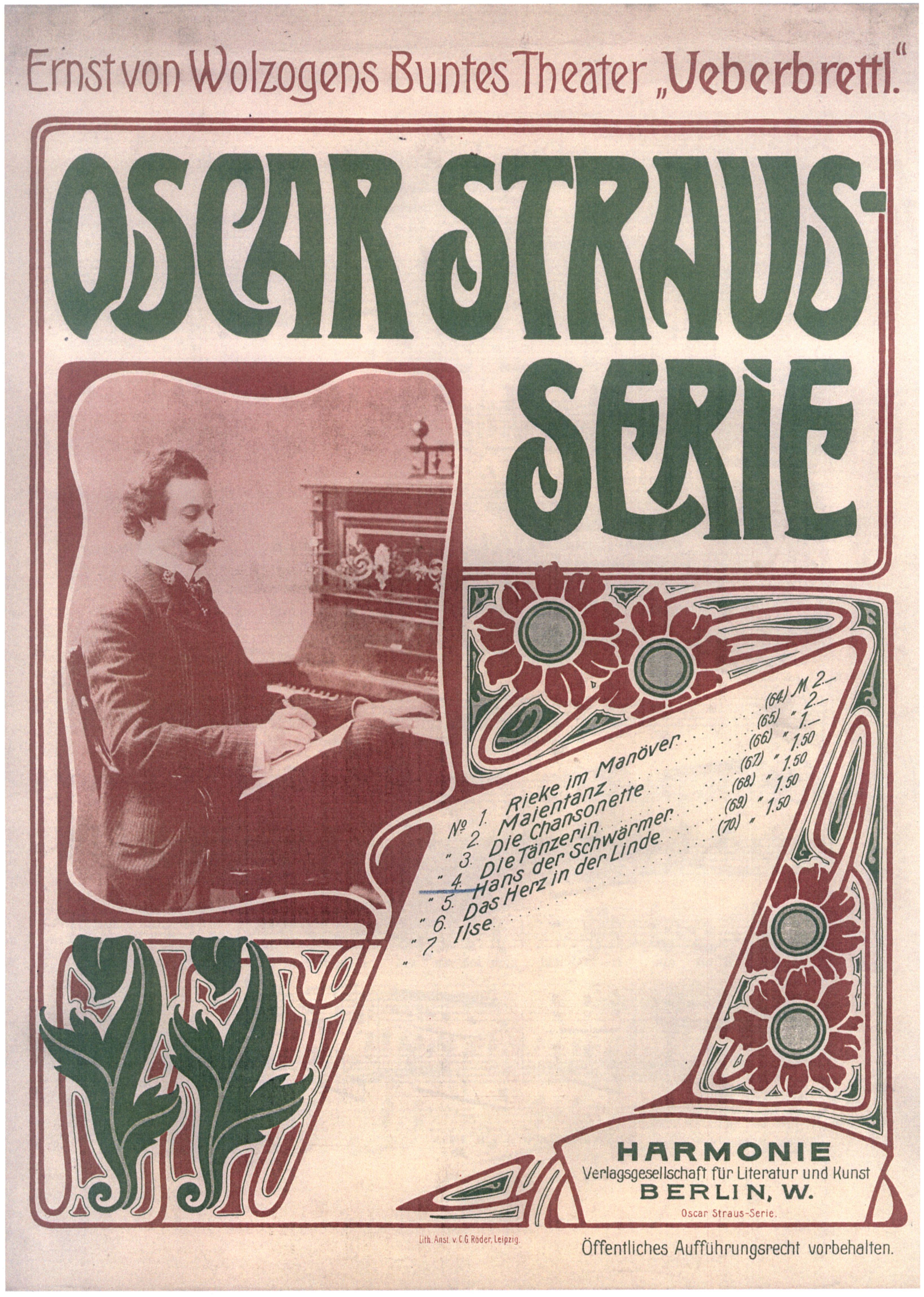
The son of a Jewish family, he studied music in Berlin under Max Bruch, and became an orchestral conductor, working at the Überbrettl cabaret. He went back to Vienna and began writing operettas, becoming a serious rival to Franz Lehár. When Lehár's popular The Merry Widow premiered in 1905, Straus was said to have remarked "Das kann ich auch!" (I can also do that!). In 1939, after the Anschluss, he fled to Paris, where he received the honour of a Chevalier of the Légion d'honneur. In 1940 he fled via Portugal to the United States, where he settled in Hollywood. After the war he returned to Europe, and settled at Bad Ischl, where he died. His grave is in the Bad Ischl Friedhof.
Straus' best-known works are Ein Walzertraum (A Waltz Dream), and The Chocolate Soldier (Der tapfere Soldat). The waltz arrangement from the former is probably his most enduring orchestral work. Among his most famous works is the theme from the 1950 film La Ronde.
Works
Operettas
- Die lustigen Nibelungen (The Merry Nibelungs) – 1904
- Zur indischen Witwe – 1905
- Hugdietrichs Brautfahrt (Hugdietrich's Honeymoon) – 1906
- Ein Walzertraum (A Waltz Dream) – 1907
- Der tapfere Soldat (The Gallant Soldier, The Chocolate Soldier) – 1908
- Didi – 1908
- Das Tal der Liebe – 1909
- Mein junger Herr (My Son John) – 1910
- Die kleine Freundin (My Little Friend) – 1911
- Der tapfere Cassian (The Brave Cassian) – 1912
- The Dancing Viennese – 1912
- Love and Laughter – 1913
- Rund um die Liebe – 1914
- Liebeszauber – 1916
- Eine Ballnacht – 1918
- Der letzte Walzer (The Last Waltz) – 1920
- Die Perlen der Cleopatra – 1923
- Die Teresina – 1925
- Die Königin – 1926
- Marietta – [1927 in French, 1928 in German]
- Eine Frau, die weiß, was sie will – 1932
- Drei Walzer (Three Waltzes) – 1935
- Die Musik kommt – 1948
- Ihr erster Walzer (revised version, Die Musik kommt) – 1950
- Bozena – 1952
Ballets
- Colombine – 1904
- Die Prinzessin von Tragant – 1912
Orchestral music
- Piano Concerto in B Minor – 1893
- Serenade for String Orchestra in G Minor, Op. 35 – 1905
Film scores
- A Lady's Morals – 1930
- Danube Love Song – 1931 (never released due to backlash against musicals)
- The Smiling Lieutenant – 1931
- The Southerner – 1932
- One Hour with You – 1932
- The Gentleman from Maxim's – 1933
- Frühlingsstimmen – 1934
- Land Without Music – 1935
- Make a Wish – 1935
- Sarajevo – 1940
- La Ronde – 1950
References
References
- [https://www.jta.org/1954/01/13/archive/oscar-straus-noted-composer-dead-fled-nazis-in-vienna-paris Oscar Straus, Noted Composer, Dead; Fled Nazis in Vienna, Paris]. ''Jewish Telegraphic Agency''. 13 January 1954
- (5 December 1940). "Portuguese Ship Brings 458 Here From War-Stricken Countries". The New York Times.
This article was imported from Wikipedia and is available under the Creative Commons Attribution-ShareAlike 4.0 License. Content has been adapted to SurfDoc format. Original contributors can be found on the article history page.
Ask Mako anything about Oscar Straus (composer) — get instant answers, deeper analysis, and related topics.
Research with MakoFree with your Surf account
Create a free account to save articles, ask Mako questions, and organize your research.
Sign up freeThis content may have been generated or modified by AI. CloudSurf Software LLC is not responsible for the accuracy, completeness, or reliability of AI-generated content. Always verify important information from primary sources.
Report