From Surf Wiki (app.surf) — the open knowledge base
Orphenadrine
Skeletal muscle relaxant
Skeletal muscle relaxant
| Field | Value | |
|---|---|---|
| verifiedrevid | 462265971 | |
| IUPAC_name | (RS)-N,N-Dimethyl-2-[(2-methylphenyl)-phenyl-methoxy]-ethanamine | |
| image | Orphenadrine.svg | |
| image_class | skin-invert-image | |
| <!--Clinical data--> | Drugs.com | |
| MedlinePlus | a682162 | |
| pregnancy_AU | B2 | |
| pregnancy_US | C | |
| legal_AU | S4 | |
| legal_CA | OTC | |
| legal_NZ | Prescription only -restricted | |
| legal_UK | POM | |
| legal_US | Rx-only | |
| routes_of_administration | Oral, intravenous, intramuscular | |
| <!--Pharmacokinetic data--> | bioavailability | 90% |
| protein_bound | 95% | |
| metabolism | Hepatic demethylation | |
| elimination_half-life | 13–20 hours | |
| excretion | Renal and biliary | |
| <!--Identifiers--> | IUPHAR_ligand | 7251 |
| CAS_number_Ref | ||
| CAS_number | 83-98-7 | |
| ATC_prefix | M03 | |
| ATC_suffix | BC01 | |
| ATC_supplemental | ||
| PubChem | 4601 | |
| DrugBank_Ref | ||
| DrugBank | DB01173 | |
| ChemSpiderID_Ref | ||
| ChemSpiderID | 4440 | |
| UNII_Ref | ||
| UNII | AL805O9OG9 | |
| KEGG_Ref | ||
| KEGG | D08305 | |
| ChEBI_Ref | ||
| ChEBI | 7789 | |
| ChEMBL_Ref | ||
| ChEMBL | 900 | |
| <!--Chemical data--> | C | 18 |
| H | 23 | |
| N | 1 | |
| O | 1 | |
| smiles | O(CCN(C)C)C(c1ccccc1)c2ccccc2C | |
| StdInChI_Ref | ||
| StdInChI | 1S/C18H23NO/c1-15-9-7-8-12-17(15)18(20-14-13-19(2)3)16-10-5-4-6-11-16/h4-12,18H,13-14H2,1-3H3 | |
| StdInChIKey_Ref | ||
| StdInChIKey | QVYRGXJJSLMXQH-UHFFFAOYSA-N |
| Drugs.com = | elimination_half-life = 13–20 hours Orphenadrine is an anticholinergic drug of the ethanolamine antihistamine class; it is closely related to diphenhydramine. It is a muscle relaxant that is used to treat muscle pain and to help with motor control in Parkinson's disease, but has largely been superseded by newer drugs. It is considered a dirty drug due to its multiple mechanisms of action in different pathways. It was discovered and developed in the 1940s.
Medical uses
Orphenadrine is a skeletal muscle relaxant. A 2004 review found fair evidence that orphenadrine is effective for acute back or neck pain, but found insufficient evidence to establish the relative efficacy of the drug in relation to other drugs in the study.
Orphenadrine and other muscle relaxants are sometimes used to treat pain arising from rheumatoid arthritis but there is no evidence they are effective for that purpose.
In 2003, a Cochrane Review of the use of anticholinergic drugs to improve motor function in Parkinson's disease found that as a class, the drugs are useful for that purpose; it identified one single-site randomised, cross-over study of orphenadrine vs placebo. Although orphenadrine and other anticholinergics have largely been superseded by other drugs; they have a use in alleviating motor function symptoms, and appear to help about 20% of people with Parkinson's.
Side effects
Orphenadrine has the side effects of the other common antihistamines in large part. Stimulation is somewhat more common than with other related antihistamines, and is especially common in the elderly. Common side effects include dry mouth, dizziness, drowsiness, constipation, urine retention, blurred vision, and headache. Its use in Parkinson's is especially limited by these factors.
Orphenadrine is contraindicated in patients with glaucoma, myasthenia gravis, sphincter relaxation disorders, digestive problems such as peptic ulcers, bowel obstruction, or with enlarged prostate, bladder disorders; that is, they should not consume this drug.
Continuous and/or cumulative use of anticholinergic medications, including first-generation antihistamines, is associated with higher risk of cognitive decline and dementia in older people.
Pharmacology
Orphenadrine is known to have these pharmacological properties:
- Nonselective mACh receptor antagonist (anticholinergic, 58% as potent as atropine) Various monographs and package inserts, nursing manuals, journal articles and so forth have proposed the theory that this anticholinergic (atropine-like) activity, NMDA antagonism and possible local anaesthetic and miscellaneous analgesic effects may be the reason for orphenadrine's efficacy against muscle and other pain. These reasons are behind the use of orphenadrine and other drugs of a number of types which are used with paracetamol, aspirin, naproxen, and similar agents with or without opioid analgesics to more effectively manage pain of various types.
- H1 receptor antagonist (antihistamine)
- NMDA receptor antagonist (Ki value of , one hundred times less potent than phencyclidine, which binds with a Ki of 59 nM)
- NDRI (norepinephrine and dopamine reuptake inhibitor)
- Nav1.7, Nav1.8, and Nav1.9 sodium channel blocker
- HERG potassium channel blocker
History
George Rieveschl was a professor of chemistry at the University of Cincinnati and led a research program working on antihistamines. In 1943, one of his students, Fred Huber, synthesized diphenhydramine. Rieveschl worked with Parke-Davis to test the compound, and the company licensed the patent from him. In 1947 Parke-Davis hired him as their Director of Research. While he was there, he led the development of orphenadrine, an analog of diphenhydramine.
Prior to the development of amantadine in the late 1960s and then other drugs, anticholinergics like orphenadrine were the mainstay of Parkinson's treatment.
Formulation
Orphenadrine has been available as a citrate salt and a hydrochloride salt; in the US as of February 2016 the citrate form was available in tablets, extended release tablets, compounding powder and by injection for acute use in a hospital setting.
Orphenadrine is often available mixed with aspirin, paracetamol/acetaminophen, ibuprofen, caffeine, and/or codeine.
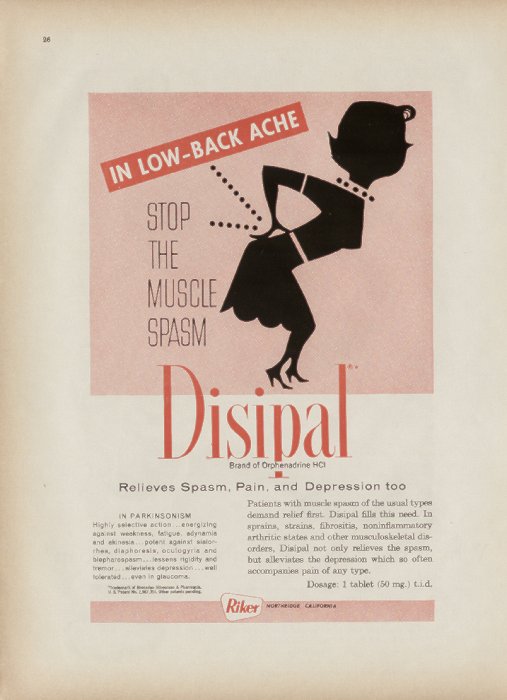
The brand names Norflex and Norgesic are formulations of the citrate salt of orphenadrine and Disipal is the hydrochloride salt.
Chemistry
Orphenadrine is a derivative of diphenhydramine with a methyl group added to one of the phenyl rings.
Stereochemistry
Orphenadrine has a chiral center and two enantiomers. When employed as a therapeutic agent, it is typically supplied as the racemate.
| Enantiomers | ||
|---|---|---|
| [[File:(R)-Orphenadrin Structural Formula V1.svg | class=skin-invert-image | 200 px]] |
| (R)-orphenadrine | ||
| CAS number: 33425-91-1 |
References
References
- (1982). "Difference between single and multiple dose pharmacokinetics of orphenadrine hydrochloride in man". European Journal of Clinical Pharmacology.
- "Orphenadrine". Drugs.com international listings.
- (1 December 2010). "Orphenadrine". Medline Plus.
- (August 2004). "Comparative efficacy and safety of skeletal muscle relaxants for spasticity and musculoskeletal conditions: a systematic review". Journal of Pain and Symptom Management.
- (January 2012). "Muscle relaxants for pain management in rheumatoid arthritis". The Cochrane Database of Systematic Reviews.
- (2003). "Anticholinergics for symptomatic management of Parkinson's disease". The Cochrane Database of Systematic Reviews.
- (October 1998). "Orphenadrine Citrate Extended release label".
- (March 2015). "Cumulative use of strong anticholinergics and incident dementia: a prospective cohort study". JAMA Internal Medicine.
- (July 2009). "Drugs with anticholinergic properties, cognitive decline, and dementia in an elderly general population: the 3-city study". Archives of Internal Medicine.
- (February 1988). "Effects of antiparkinsonian drugs on muscarinic receptor binding in rat brain, heart and lung". Pharmacology & Toxicology.
- Nurses' Drug Guide 2010 {{full. (September 2019)
- (February 1985). "Analgesic effects of antihistaminics". Life Sciences.
- (1995). "Orphenadrine is an uncompetitive N-methyl-D-aspartate (NMDA) receptor antagonist: binding and patch clamp studies". Journal of Neural Transmission. General Section.
- (1995). "Orphenadrine is an uncompetitive N-methyl-D-aspartate (NMDA) receptor antagonist: binding and patch clamp studies". Journal of Neural Transmission. General Section.
- (2002). "NMDA receptor antagonists ketamine and PCP have direct effects on the dopamine D(2) and serotonin 5-HT(2)receptors-implications for models of schizophrenia". Molecular Psychiatry.
- (March 1999). "Assessment of the adrenergic effects of orphenadrine in rat vas deferens". The Journal of Pharmacy and Pharmacology.
- (2015). "Insights into the Modulation of Dopamine Transporter Function by Amphetamine, Orphenadrine, and Cocaine Binding". Frontiers in Neurology.
- (April 2009). "Involvement of voltage-gated sodium channels blockade in the analgesic effects of orphenadrine". Pain.
- (December 2007). "Anticholinergic antiparkinson drug orphenadrine inhibits HERG channels: block attenuation by mutations of the pore residues Y652 or F656". Naunyn-Schmiedeberg's Archives of Pharmacology.
- (2005). "Drug Discovery: A History". John Wiley & Sons.
- (2012). "Marsden's Book of Movement Disorders". Oxford University Press.
- (May 2025). "FDA listing of Orphenadrine citrate registrations". United States Food and Drug Administration.
- "Disipal Brand of Orphenadrine HCl". Riker.
- (2015). "The Practice of Medicinal Chemistry". Elsevier.
- Rote Liste Service GmbH (Hrsg.). "Rote Liste 2017 Arzneimittelverzeichnis für Deutschland (einschließlich EU-Zulassungen und bestimmter Medizinprodukte)". Rote Liste Service GmbH. (2017)
This article was imported from Wikipedia and is available under the Creative Commons Attribution-ShareAlike 4.0 License. Content has been adapted to SurfDoc format. Original contributors can be found on the article history page.
Ask Mako anything about Orphenadrine — get instant answers, deeper analysis, and related topics.
Research with MakoFree with your Surf account
Create a free account to save articles, ask Mako questions, and organize your research.
Sign up freeThis content may have been generated or modified by AI. CloudSurf Software LLC is not responsible for the accuracy, completeness, or reliability of AI-generated content. Always verify important information from primary sources.
Report