From Surf Wiki (app.surf) — the open knowledge base
Organic redox reaction
Redox reaction that takes place with organic compounds
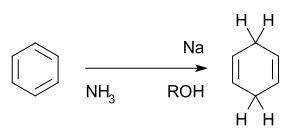
Redox reaction that takes place with organic compounds
Organic reductions or organic oxidations or organic redox reactions are redox reactions that take place with organic compounds. In organic chemistry oxidations and reductions are different from ordinary redox reactions, because many reactions carry the name but do not actually involve electron transfer. Instead the relevant criterion for organic oxidation is gain of oxygen and/or loss of hydrogen. Simple functional groups can be arranged in order of increasing oxidation state. The oxidation numbers are only an approximation:
| oxidation number | compounds |
|---|---|
| −4 | methane |
| −3 | alkanes |
| −2, −1 | alkanes, alkenes, alcohols, alkyl halides, amines |
| 0 | alkynes, geminal diols |
| +1 | aldehydes |
| +2 | chloroform, hydrogen cyanide, ketones |
| +3 | carboxylic acids, amides, nitriles (alkyl cyanides) |
| +4 | carbon dioxide, tetrachloromethane |
When methane is oxidized to carbon dioxide its oxidation number changes from −4 to +4. Classical reductions include alkene reduction to alkanes and classical oxidations include oxidation of alcohols to aldehydes. In oxidations electrons are removed and the electron density of a molecule is reduced. In reductions electron density increases when electrons are added to the molecule. This terminology is always centered on the organic compound. For example, it is usual to refer to the reduction of a ketone by lithium aluminium hydride, but not to the oxidation of lithium aluminium hydride by a ketone. Many oxidations involve removal of hydrogen atoms from the organic molecule, and reduction adds hydrogens to an organic molecule.
Many reactions classified as reductions also appear in other classes. For instance, conversion of the ketone to an alcohol by lithium aluminium hydride can be considered a reduction but the hydride is also a good nucleophile in nucleophilic substitution. Many redox reactions in organic chemistry have coupling reaction reaction mechanism involving free radical intermediates. True organic redox chemistry can be found in electrochemical organic synthesis or electrosynthesis. Examples of organic reactions that can take place in an electrochemical cell are the Kolbe electrolysis.
In disproportionation reactions the reactant is both oxidized and reduced in the same chemical reaction forming two separate compounds.
Asymmetric catalytic reductions and asymmetric catalytic oxidations are important in asymmetric synthesis.
Organic oxidations
Most oxidations are conducted with air or oxygen, especially in industry. These oxidation include routes to chemical compounds, remediation of pollutants, and combustion. Some commercially important oxidations are listed:
| product | scale (millions of tons/year in 1990's) |
|---|---|
| terephthalic acid and esters | 15 |
| cumylhydroperoxide | 6.5 |
| benzoic acid | 0.28 |
| adipic acid | 2.2 |
| propylene oxide | 4 |
| adipic acid | 2.2 |
Many reagents have been invented for organic oxidations. Organic oxidations reagents are usually classified according to the functional group attacked by the oxidant:
- Oxidation of C-H bonds: : : : : : :
- Oxidation of C-C, C=C, and bonds
- Oxidation of alcohols and various carbonyls Often the substrate to be oxidized features more than one functional group. In such cases, selective oxidations become important.
Organic reductions
In organic chemistry, reduction is equivalent to the addition of hydrogen atoms, usually in pairs. The reaction of unsaturated organic compounds with hydrogen gas is called hydrogenation. The reaction of saturated organic compounds with hydrogen gas is called hydrogenolysis. Hydrogenolyses necessarily cleaves C-X bonds (X = C, O, N, etc.). Reductions can also be effected by adding hydride and proton sources, the so-called heterolytic pathway. Such reactions are often effected using stoichiometric hydride reagents such as sodium borohydride or lithium aluminium hydride.
References
References
- March Jerry; (1985). Advanced Organic Chemistry reactions, mechanisms and structure (3rd ed.). New York: John Wiley & Sons, inc. {{ISBN. 0-471-85472-7
- ''Organic Redox Systems: Synthesis, Properties, and Applications'', Tohru Nishinaga 2016
- http://www.electrosynthesis.com [http://www.electrosynthesis.com/news/m6watts.html Link] {{webarchive. link. (2008-05-15)
- (2007). "Free Radical Functionalization of Organic Compounds Catalyzed by ''N-'' Hydroxyphthalimide". Chemical Reviews.
- {{March6th
This article was imported from Wikipedia and is available under the Creative Commons Attribution-ShareAlike 4.0 License. Content has been adapted to SurfDoc format. Original contributors can be found on the article history page.
Ask Mako anything about Organic redox reaction — get instant answers, deeper analysis, and related topics.
Research with MakoFree with your Surf account
Create a free account to save articles, ask Mako questions, and organize your research.
Sign up freeThis content may have been generated or modified by AI. CloudSurf Software LLC is not responsible for the accuracy, completeness, or reliability of AI-generated content. Always verify important information from primary sources.
Report