From Surf Wiki (app.surf) — the open knowledge base
Organ transplantation in China
none
none
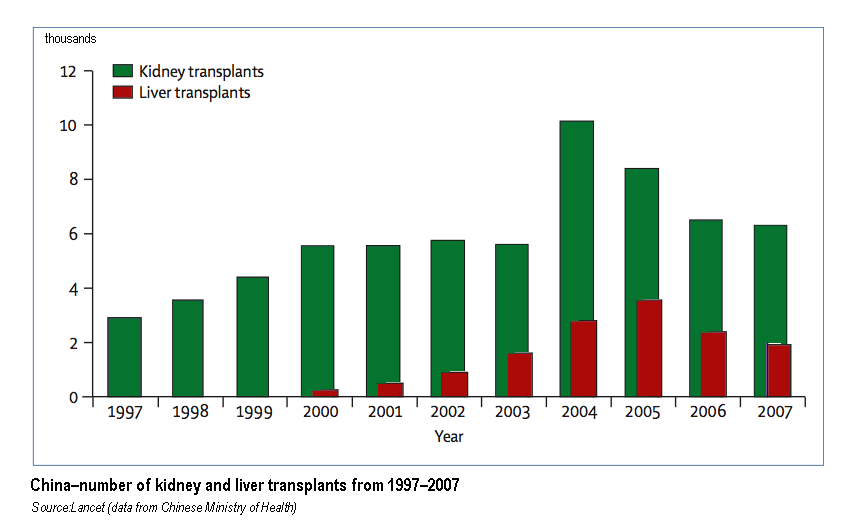
Organ transplantation in China has taken place since the 1960s, and by the early 2000s had become one of the world’s largest transplant programmes, with official figures reporting over 13,000 liver and kidney transplants in 2004. However, independent academic analyses have raised questions about the accuracy of these official figures and highlighted gaps in the transparency of China’s transplant data. Official registries are not fully accessible to outside researchers, making independent verification of transplant numbers and the sources of organs difficult.
Involuntary organ harvesting was once legal on criminals, but outlawed in 2015. Growing concerns about possible ethical abuses arising from coerced consent and corruption led medical groups and human rights organizations, by the 1990s, to condemn the practice. These concerns resurfaced in 2001, when a Chinese asylum-seeking doctor testified that he had taken part in organ extraction operations.
In 2006, allegations emerged that many Falun Gong practitioners had been killed to supply China's organ transplant industry. An initial investigation stated "the source of 41,500 transplants for the six year period 2000 to 2005 is unexplained" and concluded that "there has been and continues today to be large scale organ seizures from unwilling Falun Gong practitioners".
In December 2005, China's Deputy Health Minister acknowledged that the practice of removing organs from executed prisoners for transplants was widespread. and the Chinese Medical Association agreed that the organs of prisoners should not be used for transplantation, except for members of the immediate family of the deceased. In 2008, a liver-transplant registry system was established in Shanghai, along with a nationwide proposal to incorporate information on individual driving permits for those wishing to donate their organs.
Despite these initiatives, China Daily reported in August 2009 that approximately 65% of transplanted organs still came from death row prisoners. The condemned prisoners have been described as "not a proper source for organ transplants" by Vice-Health Minister Huang Jiefu, and in March 2010, he announced the trial of China's first organ donation program starting after death, jointly run by the Red Cross Society and the Ministry of Health, in 10 pilot regions. In 2013, Huang Jiefu altered his position on utilizing prisoners' organs, stating that death row prisoners should be allowed to donate organs and should be integrated into the new computer-based organ allocation system.
In 2014, China announced that it would stop using organs from executed prisoners for transplants starting January 1, 2015. However, critics described this as an "administrative trick," noting that prisoners including those on death row are reclassified as citizens, allowing their organs to continue being used in transplants. In 2018 and 2019, media investigations and academic analysis into these allegations increased. In August 2024, media outlets reported on the first known survivor of China’s forced organ harvesting.
Background
Globally, pioneering experimental studies in the surgical technique of human organ transplantation were made in the early 1900s by the French surgeon Alexis Carrel, and successful transplants starting spreading worldwide after the Second World War.
China itself began organ transplantation in the 1960s, which grew to an annual peak of over 13,000 transplants in 2004; and, despite some deaths from infection and hepatitis, the transplant programme has been successful in saving many lives. Organ donation, however, has met resistance, and involuntary organ donation is illegal under Chinese law, as it is against Chinese tradition and culture, which attach symbolic life affirming importance to the kidney and heart.
China is not alone in encountering donation difficulties; demand outstrips supply in most countries. The world-wide shortage has encouraged some countries—such as India—to trade in human organs. Reports of organs being removed from executed prisoners in China for sale internationally had been circulating since the mid-1980s, when a 1984 regulation made it legal to harvest organs from convicted criminals with the consent of the family or if the body goes unclaimed. Development of an immunosuppressant drug, cyclosporine A, made transplants a more viable option for patients.
Milestones
The first living related renal transplant was performed in China in 1972; The first recorded clinical liver transplant from a living donor in China took place in 1995, seven years after the world's first was performed in São Paulo, Brazil. Between January 2001 and October 2003, 45 patients received living donor liver transplantation (LDLT) at five different hospitals. In 2002, doctors at Xijing Hospital of the Fourth Military Medical University described three cases of living related liver transplantation. In 2003 a landmark brain-death case involving switched off ventilation came to the attention of the public and made a big impact on medical ethics and legislation. The first successful brain-death organ donation soon followed. From October 2003 to July 2006, 52 LDLT operations were conducted at the West China Hospital, West China Medical Center of Sichuan University. In October 2004, Peking University People's Hospital Liver Transplantation Center executed two cases of living related liver transplantation involving complex blood vessel anatomy. In 2002, the Chinese media reported surgeon Dr Zheng Wei successfully transplanted a whole ovary at the Zhejiang Medical Science University to a 34-year-old patient, Tang Fangfang, from her sister. In April 2006, the Xijing military hospital in Xian carried out a face transplant operation covering the cheek, upper lip, and nose of Li Guoxing, who was mauled by an Asiatic black bear while protecting his sheep.
The first successful penis transplant procedure was performed in September 2006, at a military hospital in Guangzhou. The patient, a 44-year-old male, had sustained the loss of most of his penis in an accident. The transplanted penis came from a brain-dead 22-year-old male. Although successful, the patient and his wife suffered psychological trauma as a result of the procedure, and had the surgery reversed fifteen days later.{{Cite journal| title = A preliminary report of penile transplantation
International concerns
Organs sourced from death row prisoners
Transplantation first began in the early 1970s China, when organs were sourced from executed prisoners. Although other sources, such as brain-dead donors, had been tried, the lack of legal framework hampered efforts. Dr Klaus Chen said in 2007 that this was still the dominant pool. Concerns that some poorer countries were answering donor shortages by selling organs to richer countries led the World Medical Association (WMA) to condemn the purchase and sale of human organs for transplantation at Brussels in 1985,
In Madrid in 1987, the World Health Organization (WHO) condemned the practice of extracting organs from executed prisoners due to the difficulty of knowing if they had given consent. which resulted in the WHO Guiding Principles on Human Organ Transplantation being endorsed in 1991. However, the wording did not allow the international community to draw up any laws preventing China from continuing to trade in human organs.
The United States Senate Committee on Foreign Relations convened a hearing in 1995 on the trade in human body parts in China; receiving evidence from various sources including statements from Amnesty International, the BBC, and Chinese government documents produced by human rights activist Harry Wu.
The WMA, the Korean Medical Association, and the Chinese Medical Association reached an agreement in 1998 that these practices were undesirable and that they would jointly investigate them with a view to stopping them; however, in 2000, the Chinese withdrew their cooperation. Amnesty International claimed to have strong evidence that the police, courts, and hospitals were complicit in the organ trade, facilitated by the use of mobile execution chambers, or "death vans". Amnesty speculated that this profitable trade might explain China's refusal to consider abolishing the death penalty, which is used on between 1,770 (official figure) and 8,000 (Amnesty estimates) prisoners annually. Corpses are typically cremated before relatives or independent witnesses can view them, fuelling suspicions about the fate of internal organs.
In June 2001, Wang Guoqi (王國齊), a Chinese doctor applying for political asylum, made contact with Harry Wu and his Laogai Research Foundation, who assisted Wang in testifying to the US Congress in writing that he had removed skin and corneas from more than 100 executed prisoners for the transplant market at the Tianjin Paramilitary Police General Brigade Hospital, and that during at least one such operation the prisoner was still breathing.
In December 2005, China's Deputy Health Minister acknowledged that the practice of removing organs from executed prisoners for transplant was widespread—as many as 95% of all organ transplants in China derived from executions, and he promised steps to prevent abuse. In 2006, the WMA demanded that China cease using prisoners as organ donors. According to Time, a transplant brokerage in Japan which organised 30–50 operations annually sourced its organs from executed prisoners in China. Edward McMillan-Scott, vice president of the European Parliament, said he believed that nearly 400 hospitals in China had been involved in the transplant organ trade, with websites advertising kidney transplants for $60,000.
On the eve of a state visit to the United States by General Secretary of the Chinese Communist Party Hu Jintao, the 800-member British Transplantation Society also criticised China's use of death-row prisoners' organs in transplants, on the grounds that as it is impossible to verify that organs are indeed from prisoners who have given consent; A BBC news report by Rupert Wingfield-Hayes in September 2006 showed negotiations with doctors in No 1 Central Hospital in Tianjin for a liver transplant.
In February 2017, CGTN quoted former vice health minister Huang Jiefu as saying "From January 1, 2015, organ donation from voluntary civilian organ donors has become the only legitimate source of organ transplantations", and Francis Delmonico interpreting this as a ban on "the use of organs from executed prisoners" in January 2015. However, after January 1, 2015, organs from prisoners, including those on death row, can still used for transplants in China with official support, according to Chinese media, doctors and researchers in China and abroad. Critics note this is possible because prisoners are reclassified as citizens.
In 2022, the International Society for Heart and Lung Transplantation (ISHLT) issued a policy statement to exclude transplant-related research involving human donors from China from its publications and scientific meetings due to the amount of evidence showing that the Chinese government stands alone in systematically supporting organ or tissue procurement from executed prisoners, a practice that the ISHLT identifies as a violation of fundamental human rights and the principle of voluntary donation.
Allegations of organ harvesting
In 2006, allegations that Falun Gong practitioners had been killed to supply China's organ transplant industry prompted an investigation by former Canadian Secretary of State David Kilgour and human rights lawyer David Matas. In July 2006, the Kilgour–Matas report questioned "the source of 41,500 transplants for the six year period 2000 to 2005" and thereby inferred that "the government of China and its agencies in numerous parts of the country, in particular hospitals but also detention centres and 'people's courts', since 1999 have put to death a large but unknown number of Falun Gong prisoners of conscience".
The authors of the Kilgour–Matas report reached their conclusion via circumstantial evidence and inference from this evidence. It included observations of the extremely short wait times for organs in China compared with other countries, indicating that organs were being procured on demand; the rise in the number of annual organ transplants in China corresponded with the onset of the persecution of Falun Gong.
In 2014, investigative journalist Ethan Gutmann published the results of his own investigation. He reported that organ harvesting from political prisoners likely began in Xinjiang province in the 1990s, and then spread nationwide. Gutmann estimates that some 64,000 Falun Gong prisoners may have been killed for their organs between 2000 and 2008.
In December 2006, after not getting assurances from the Chinese government about allegations relating to Chinese prisoners, the two major organ transplant hospitals in Queensland, Australia, stopped transplant training for Chinese surgeons and banned joint research programs into organ transplantation with China.
In July 2006 and April 2007, Chinese officials denied organ harvesting allegations, insisting that China abides by World Health Organization (WHO) principles that prohibit the sale of human organs without written consent from donors.
In May 2008 two United Nations Special Rapporteurs reiterated their previous request for the Chinese authorities to adequately respond to the allegations, and to explain the source of organs which would account for the sudden increase in organ transplants in China since 2000.
On 12 September 2012, the United States House Committee on Foreign Affairs held a hearing on the topic of organ harvesting from prisoners of conscience in China. During the hearing, Gutmann described his interviews with former Chinese prisoners, surgeons and nurses with knowledge of organ harvesting practices.
In 2012, State Organs: Transplant Abuse in China, edited by David Matas and Dr. Torsten Trey, was published with essays by Dr. Gabriel Danovitch, Professor of Medicine, Arthur Caplan, Professor of Bioethics, Dr. Jacob Lavee, cardiothoracic surgeon, Dr. Ghazali Ahmad, Professor Maria Fiatarone Singh, Dr. Torsten Trey, Gutmann and Matas.
Harry Wu, a human rights activist, has questioned the Falun Gong's claims that Falun Gong members are specifically targeted for large-scale organ harvesting.
International human rights lawyer David Matas argued Harry Wu's July 2006 article showed his views in his 21 March letter were formed before completing his investigation, so Wu's views were not based on his full investigation. Further, Harry Wu characterized the volume of organ harvesting Annie described as "technically impossible", but it is technically possible, according to medical expert.
A Chinese government panel denied the allegations in August 2016. Huang Jiefu, chairman of the National Organ Donation and Transplantation Committee, noted that there were 10,057 organ transplantation surgeries performed in China in 2015, accounting for 8.5 per cent of global total, and 8 per cent of drugs used globally, which matches China's national statistics. Michael Millis, professor of Surgery and chief of the Section of Transplantation of the University of Chicago Hospitals, corroborated that China is phasing out the organ transplantation of executed prisoners, and is moving towards a voluntary, donation-based system. José Nuñez, medical officer in charge of global organ transplantation at the WHO, noted that China is reaching global standards in organ transplantation, and believed that in a few years, China will be leading the field.
In June 2021, the Special Procedures of the United Nations Human Rights Council voiced concerns over having “received credible information that detainees from ethnic, linguistic or religious minorities may be forcibly subjected to blood tests and organ examinations such as ultrasound and x-rays, without their informed consent; while other prisoners are not required to undergo such examinations.” The press release stated that UN’s human rights experts “were extremely alarmed by reports of alleged ‘organ harvesting’ targeting minorities, including Falun Gong practitioners, Uyghurs, Tibetans, Muslims and Christians, in detention in China.”
In August 2024, The Diplomat reported its interview with Cheng Pei Ming, the first known survivor of China’s forced organ harvesting. Cheng, a Falun Gong practitioner, recounted how he was subjected to repeated blood tests and a subsequent forced surgery while imprisoned in China and later discovered during medical exams in the U.S. that segments of his liver and a portion of his lung had been surgically removed.
Ethan Gutmann, an employee of the US government think tank Victims of Communism Memorial Foundation, has said that organ harvesting from prisoners of conscience became prevalent in the northwestern province of Xinjiang during the 1990s, when members of the Uyghur ethnic group were targeted in security crackdowns and "strike hard campaigns".
By 1999, Gutmann says that organ harvesting in Xinjiang began to decline precipitously, just as overall rates of organ transplantation nationwide were rising. The same year, the Chinese government launched a nationwide suppression of the Falun Gong spiritual group. Gutmann suggests that the new Falun Gong prisoner population overtook Uyghurs as a major source of organs.
Worries about organ harvesting were renewed when China redoubled its attempts to stamp out extremism and separatism by interning a large portion of the population in the Xinjiang internment camps.
In June 2019, the China Tribunal, an investigation into forced organ transplantation in China concluded that crimes against humanity had been committed beyond reasonable doubt against China's Uyghur and Falun Gong populations, and that cutting out the hearts and other organs from living victims constitutes one of the worst mass atrocities of this century.
In 2020, Gutmann claimed that at least 25,000 people are killed in Xinjiang for their organs each year, alleging that "fast lanes" were created to streamline the process of movement of human organs in local airports and that crematoria have recently been built throughout the province.
In 2020, a Chinese woman said that Uyghurs were slaughtered on demand to provide halal organs for primarily Saudi customers. She said that in one such instance in 2006, 37 Saudi clients received organs from killed Uyghurs at the Department of Liver Transplantation of Tianjin Taida Hospital. Dr. Enver Tohti, a former oncology surgeon in Xinjiang supported allegations.
Developments since 2006
In March 2006, the Ministry of Health issued the Interim Provisions on Clinical Application and Management of Human Organ Transplantation, which stipulated that medical centres must meet new requirements for transplant services; the provinces were made responsible for plans for clinical applications. Establishments performing transplantation were thereby obliged to incorporate considerations for ethics, medical and surgical expertise, and intensive care. In April 2006, the Committee of Clinical Application of Human Organ Transplantation Technologies was created to standardise clinical practice; a national summit on clinical management took place in November 2006 which issued a declaration outlining regulatory steps. The donor had been declared brain-dead before the operation.
In May 2007, the Regulation on Human Organ Transplantation came into force, banning organ trading and the removal of a person's organs without their prior written consent, and this has been favourably received by the World Health Organization and The Transplantation Society. As a result of a systematic overhaul, the number of institutions approved for transplants has been reduced from more than 600 in 2007 to 87 as at October 2008; another 77 have received provisional approval from the Ministry of Health.
To further combat transplant tourism, the Health Ministry issued a notice in July 2007 in line with the Istanbul Declaration, giving Chinese citizens priority as organ recipients. Other safeguards implemented under the legislation include documentation of consent for organ removal from the donor, and review of all death sentences by the Supreme People's Court. Transplant professionals are not involved until death is declared. A symposium among legal and medical professionals was held in April 2008 to discuss the diagnostic criteria for brain death for donors of transplant organs.
A liver-transplant registry system was established in Shanghai, in 2008, which allows the monitoring of the after-care of liver recipients; at the same time a nationwide proposal was announced that would allow people to note on their driving licence that they wish to donate their organs.
In September 2012, the report Organ Harvesting of Religious and Political Dissidents by the Chinese Communist Party
The Hangzhou resolution was promulgated in front of the 2013 China National Transplantation Congress on 31 October 2013 and was presented on 2 November 2013. The resolution vows for the cessation of the harvesting of organs from executed prisoners. While not all transplantation facilities have adopted the resolution, a campaign to eradicate inmate organ harvesting is underway.
In June 2021, Special Rapporteurs to the United Nations Human Rights Council stated that they "were extremely alarmed by reports of alleged 'organ harvesting' targeting minorities, including Falun Gong practitioners, Uyghurs, Tibetans, Muslims and Christians, in detention in China". The Rapporteurs stated that they had "received credible information" of forced blood tests and organ examinations of "ethnic, linguistic or religious minorities" that were not forced on other prisoners. The Rapporteurs called for "China to promptly respond to the allegations of 'organ harvesting' and to allow independent monitoring by international human rights mechanisms".
Allegations of data falsification
Beginning in 2010, Chinese authorities announced that the country would transition away from the use of prisoners as an organ source, and would rely entirely on voluntary donations coordinated through a centralized registry. By 2015, officials asserted that voluntary donors were the sole source for organ transplants in China. However, critics have pointed to evidence of systematic falsification of data related to voluntary organ donations, casting doubt on reform claims.
In a paper published in the journal BMC Medical Ethics, for instance, researchers analyzed data on voluntary organ transplants from 2010 to 2018. Datasets were drawn from two national sources, several sub-national jurisdictions, and individual Chinese hospitals. The researchers found compelling evidence of "human-directed data manufacture and manipulation" in the national datasets, as well as "contradictory, implausible, or anomalous data artefacts" in the provincial datasets, which suggests that the data "may have been manipulated to enforce conformity with central quotas." Among the findings was that the purported rate of growth in voluntary donations was derived from a simple quadratic equation, with nearly perfect model parsimony. These findings appear to undermine official claims about the extent of voluntary organ donations in China. The authors of the BMC Medical Ethics article also note that China's model parsimony is one to two orders of magnitude smoother than any other nation's, even those that have experienced rapid growth in their organ transplantation sector.
Wait times
China has by far the shortest wait times for organ transplants in the world, and there is evidence that the execution of prisoners for their organs is "timed for the convenience of the waiting recipient." , organ tourists to China report receiving kidney transplants within days of arriving in China. A report produced by David Matas and David Kilgour cites the China International Transplantation Assistant Centre website as saying "it may take only one week to find out the suitable (kidney) donor, the maximum time being one month..."
By way of comparison, the median waiting time for an organ transplantation in Australia is six months to four years. In Canada, it is six years . In the UK, it is three years.
References
References
- [http://www.thelancetglobalhealthnetwork.com/wp-content/uploads/Health-System-Reform-in-China-CMT-11.pdf Government policy and organ transplantation in China] {{Webarchive. link. (17 July 2011 ''The Lancet'' Retrieved 24 September 2010)
- (2019-11-14). "Analysis of official deceased organ donation data casts doubt on the credibility of China's organ transplant reform". BMC Medical Ethics.
- Dr. Ewelina U. Ochab. "Organ Harvesting In China And The Many Questions To Be Answered". Forbes.
- "Organ harvesting in China in 2016: This is the brutal reality".
- "- ORGAN HARVESTING OF RELIGIOUS AND POLITICAL DISSIDENTS BY THE CHINESE COMMUNIST PARTY".
- (12 September 2012). "Congressional Testimony:Organ Harvesting of Religious and Political Dissidents by the Chinese Communist Party". House Committee on Foreign Affairs, Subcommittee on Oversight and Investigations.
- (2015-01-04). "器官移植停用死刑犯器官之后".
- Annika Tibell. (8 May 2007). "The Transplantation Society's Policy on Interactions With China". Doctors Against Forced Organ Harvesting.
- [https://www.nytimes.com/2001/06/29/world/doctor-says-he-took-transplant-organs-from-executed-chinese-prisoners.html "Doctor Says He Took Transplant Organs From Executed Chinese Prisoners"] {{Webarchive. link. (29 November 2017 New York Times 29 June 2001)
- link. (17 October 2015 , [[The Weekly Standard]], 24 November 2008)
- "New system to boost number of organ donors". China Daily.
- Press release, [http://www.medicalnewstoday.com/articles/84754.php "Chinese Medical Association Reaches Agreement With World Medical Association Against Transplantation Of {{sic. Pris. ioners's. link. (2 June 2009 , ''[[Medical News Today]]'', 7 October 2007. Retrieved 24 September 2010)
- "shanghai". shanghai.gov.cn.
- (26 August 2009). "China admits death row organ use". BBC News.
- (5 March 2014). "China media: Military spending". BBC.
- Tatlow, Didi Kirsten. (November 16, 2015). "China Bends Vow on Using Prisoners' Organs for Transplants".
- "BBC World Service - Discovery, China's Organ Transplants, Tourism and Transparency".
- How The West Enabled China Organ Harvesting Expansion, by Frances Martel, 22 June 2019, ''Breitbart News''
- (14 November 2019). "Analysis of official deceased organ donation data casts doubt on the credibility of China's organ transplant reform.". BMC Med Ethics.
- Cleave, Iona. (2024-08-09). "Chinese organ harvesting victim woke up chained to bed with parts of liver and lung missing". The Telegraph.
- [http://whqlibdoc.who.int/publications/1991/9241693045.pdf HUMAN ORGAN TRANSPLANTATION – A Report on Developments Under the Auspices of WHO (1987–1991)] {{Webarchive. link. (21 October 2014 , page 7, [[World Health Organization]], Geneva, 1991)
- [http://www.thelancetglobalhealthnetwork.com/wp-content/uploads/Health-System-Reform-in-China-CMT-11.pdf "Health-System-Reform-in-China"] {{Webarchive. link. (17 July 2011 ''[[The Lancet]]'', 20 October 2008. Retrieved 24 September 2010)
- (28 November 2008). "Military hospital in China conducts world-first face transplants". The Daily Telegraph.
- [https://news.bbc.co.uk/2/hi/asia-pacific/1411389.stm "China fury at organ snatching 'lies'"], BBC News, 28 June 2001. Retrieved 24 September 2010
- Treasure, Tom. (March 2007). "The Falun Gong, organ transplantation, the holocaust and ourselves". Doctors Against Forced Organ Harvesting.
- (2007). "''Autonomy and Human Rights in Health Care: An International Perspective''". Springer.
- Jane Macartney, [http://www.thetimes.co.uk/tto/news/world/asia/article2612313.ece "China to 'tidy up' trade in executed prisoners' organs"] {{Webarchive. link. (5 March 2016 , ''[[The Times]]'', 3 December 2005)
- (21 March 2006). "Japan's rich buy organs from executed Chinese prisoners". The Independent.
- the first allogeneic [[bone marrow transplantation]] was successfully executed in an acute leukaemia patient.Dr LU Daopei, [http://www.hkmj.org/article_pdfs/hkm0906sp3p9.pdf "Blood and marrow transplantation in mainland China (Supplement 3)"] {{Webarchive. link. (11 February 2014 . ''Hong Kong Medical Journal'' (3 June 2009) 15 (Suppl 3):9–12)
- Wang XH, Zhang F, Li XC, Qian JM, Kong LB, Huang J, et al. Clinical report on 12 cases of Living donor partial liver transplantation. Natl Med J Chin (Chin) 2002; 82: 435–439.
- (2006). "Early experiences on living donor liver transplantation in China: Multicenter report". Chinese Medical Journal.
- Zhonghua Klaus Chen (6 December 2007). [http://www.cityu.edu.hk/garc/ARC/ARCfile/SSS/SSS06122007.htm "Current Situation of Organ Donation and Transplantation in China"] {{Webarchive. link. (23 January 2013 of the Institute of Organ Transplantation, Tongji Hospital, Tongji Medical College and [[Huazhong University of Science and Technology]], PRC, pub: City University of Hong Kong)
- (2007). "Donor safety in adult living donor liver transplantation using the right lobe: Single center experience in China". World Journal of Gastroenterology.
- (2004). "First two cases of living related liver transplantation with complicated anatomy of blood vessels in Beijing". World Journal of Gastroenterology.
- Woodford, Peter (15 March 2007) [http://www.nationalreviewofmedicine.com/issue/2007/03_15/4_advances_medicine2_5.html "Whole ovary transplant reverses early menopause"] {{Webarchive. link. (14 July 2011 , ''National Review of Medicine'' vol 4 no. 5)
- (15 April 2006). "China's first human face transplant successful".
- Sample, Ian. (18 September 2006). "Man rejects first penis transplant". The Guardian.
- "The Bellagio Task Force Report on Transplantation, Bodily Integrity, and the International Traffic in Organs". icrc.org.
- "Human organ and tissue transplantation". WHO.
- "Draft guiding principles on human organ transplantation". World Health Organization.
- "Illegal Human Organ Trade from Executed Prisoners in China". www1.american.edu.
- (1995). "China, illegal trade in human body parts : hearing before the Committee on Foreign Relations, United States Senate, One Hundred Fourth Congress, first session, May 4, 1995". worldcat.org.
- [http://www.christusrex.org/www1/sdc/vol9e.pdf "Senate Committee Hears How Executed Prisoners’ Organs are Sold for Profit"] {{Webarchive. link. (29 April 2009 ''Laogai Report'', November 1995. The Laogai Research Foundation. Retrieved 24 September 2010)
- Hillman H. (November 2001). "Harvesting organs from recently executed prisoners". BMJ.
- Calum MacLeod, [https://www.usatoday.com/news/world/2006-06-14-death-van_x.htm China makes ultimate punishment mobile] {{Webarchive. link. (19 February 2011 , ''[[USA Today]]'', 15 May 2006. Retrieved 24 September 2010)
- Mufson, Steven. (27 June 2001). "Chinese Doctor Tells of Organ Removals After Executions". The Washington Post.
- Congressional Executive Commission on China Annual Report 2006, p. 59; note 224, p. 201
- [http://www.wma.net/en/30publications/10policies/30council/cr_5/index.html "World Medical Association Council Resolution on Organ Donation in China"] {{Webarchive. link. (4 December 2010 World Medical Association May 2006)
- Gerlin, Andrea (23 April 2006) [http://www.time.com/time/magazine/article/0,9171,1186611,00.html "China's Grim Harvest"] {{Webarchive. link. (23 August 2013 , ''Time''. Retrieved 24 September 2010)
- McMillan-Scott, Edward (13 June 2006) [http://www.yorkshirepost.co.uk/news/debate/columnists/secret-atrocities-of-chinese-regime-1-2374600 "Secret atrocities of Chinese regime"] {{Webarchive. link. (18 May 2015 Yorkshire Post)
- the WMA once again condemned the practice on similar grounds.Press release, [https://web.archive.org/web/20070427100933/http://www.wma.net/e/press/2006_4.htm "World Medical Association demands China stops using prisoners for organ transplants"], World Medical Association, 22 May 2006. Retrieved 24 September 2010
- (27 September 2006). "Organ sales 'thriving' in China". [[YouTube]].
- . (7 February 2017). ["禁止器官买卖,中国是认真的 China steps up crackdown on organ trafficking"](http://mp.weixin.qq.com/s/dk99ol0WsHPmCmdviXAReg). *CCTVNEWS*.
- (October 23, 2020). "Building a Public Health Response to Organ Transplant Abuse in China".
- "ISHLT".
- Sharif, Adnan. (December 2022). "ISHLT, transplant ethics and forced organ harvesting". The Journal of Heart and Lung Transplantation.
- [[David Kilgour]], [[David Matas]] (6 July 2006, revised 31 January 2007) [http://organharvestinvestigation.net An Independent Investigation into Allegations of Organ Harvesting of Falun Gong Practitioners in China] {{Webarchive. link. (8 December 2017 (free in 22 languages) organharvestinvestigation.net)
- [[Reuters]], AP (8 July 2006) [http://www.theage.com.au/news/world/falun-gong-organ-claim-supported/2006/07/07/1152240489760.html "Falun Gong organ claim supported"] {{Webarchive. link. (31 May 2014 , ''[[The Age]]'', (Australia). Retrieved 7 July 2006.)
- link. (17 October 2015 , Retrieved 6 July 2006.)
- link. (13 March 2007 . Retrieved 8 July 2006.)
- [http://www.washingtontimes.com/news/2010/apr/27/chinese-accused-of-vast-trade-in-organs/print/ "Chinese accused of vast trade in organs"] {{Webarchive. link. (26 December 2015 , ''[[The Washington Times]]'' 27 April 2010)
- link. (23 February 2016 , ''[[National Review]]'')
- Barbara Turnbull (21 October 2014) [https://www.thestar.com/life/2014/10/21/qa_author_and_analyst_ethan_gutmann_discusses_chinas_illegal_organ_trade.html "Q&A: Author and analyst Ethan Gutmann discusses China’s illegal organ trade"] {{Webarchive. link. (7 July 2017 , ''[[The Toronto Star]]'')
- (9 August 2014). "China's long history of harvesting organs from living political foes". [[New York Post]].
- (August 2014). "The Slaughter: Mass Killings, Organ Harvesting, and China's Secret Solution to Its Dissident Problem". Prometheus Books.
- [http://www.smh.com.au/news/National/Hospitals-ban-Chinese-surgeon-training/2006/12/05/1165080933418.html "Hospitals ban Chinese surgeon training"] {{Webarchive. link. (25 October 2016 , ''The Sydney Morning Herald'', 5 December 2006)
- Chinese Embassy in Canada (6 July 2006) [http://ca.china-embassy.org/eng/mtfw/press2/t261810.htm Response to the so called "China's organ harvesting report"] {{Webarchive. link. (15 March 2015 , ca.china-embassy.org)
- Chinese Embassy in Canada (15 April 2007) [http://ca.china-embassy.org/eng/mtfw/press2/t311443.htm Response to the so-called "Revised Report on China's Organ Harvesting"] {{Webarchive. link. (13 August 2014 , ca.china-embassy.org)
- [http://www.theinformationdaily.com/2008/05/09/united-nations-human-rights-special-rapporteurs-reiterate-findings-on-chinas-organ-harvesting-from-falun-gong-practitioners United Nations Human Rights Special Rapporteurs Reiterate Findings on China's Organ Harvesting from Falun Gong Practitioners] {{Webarchive. link. (12 May 2015 , 9 May 2008. Retrieved 24 September 2010)
- Damon Noto, M.D., Gabriel Danovitch, M.D., Charles Lee, M.D., Ethan Gutmann. [http://archives.republicans.foreignaffairs.house.gov/hearings/view/?1468 ''Organ Harvesting of Religious and Political Dissidents by the Chinese Communist Party''] {{Webarchive. link. (5 December 2014 , [[House Committee on Foreign Affairs]], 12 September 2012)
- link. (9 September 2017 , US National Library of Medicine)
- link. (9 September 2017 , US National Library of Medicine)
- link. (8 September 2017 , US National Library of Medicine)
- link. (8 September 2017 , US National Library of Medicine)
- link. (16 August 2017 , US National Library of Medicine)
- link. (8 September 2017 , US National Library of Medicine)
- [http://www.seraphimeditions.com/pdfs/Introduction-State-Organs "State Organs: Introduction"] {{Webarchive. link. (27 May 2013 seraphimeditions.com)
- Rebeca Kuropatwa (19 September 2012) [http://www.jewishtribune.ca/arts-and-culture/2012/09/19/new-matas-book-reveals-transplant-abuse "New Matas book reveals transplant abuse"] {{Webarchive. link. (2 April 2015 , ''Jewish Tribune'')
- [[Mark Colvin]] (27 November 2012) [http://www.abc.net.au/pm/content/2012/s3642188.htm "Parliament to hear evidence of transplant abuse in China"] {{Webarchive. link. (13 June 2016 , [[Australian Broadcasting Corporation]])
- David Matas, Dr. Torsten Trey (2012) [http://www.seraphimeditions.com/state-organs.html State Organs, Transplant Abuse in China] {{Webarchive. link. (24 February 2015 seraphimeditions.com p. 144)
- (8 September 2006). "Harry Wu questions Falun Gong's claims about organ transplants". AsiaNews.it.
- (9 August 2006). "Harry Wu mette in dubbio le accuse del Falun Gong sui trapianti di organi". AsiaNews.it.
- Matas/Kilgour. "Appendix 16. Sujiatun". organharvestinvestigation.net.
- Wang Shen. "Spotlight: Experts slam rumors of organ harvesting in China". New China.
- (14 June 2021). "China: UN human rights experts alarmed by 'organ harvesting' allegations".
- "First Known Survivor of China's Forced Organ Harvesting Speaks Out".
- Ethan Gutmann, [https://www.weeklystandard.com/ethan-gutmann/the-xinjiang-procedure “The Xinjiang Procedure”] {{Webarchive. link. (16 December 2018 , The Weekly Standard, 5 December 2011.)
- David Brooks, [https://www.nytimes.com/2011/12/23/opinion/brooks-the-sidney-awards-part-ii.html “The Sidney Awards Part II”] {{Webarchive. link. (25 January 2020 , New York Times, 22 December 2011.)
- "China's sick tactics used against pregnant women | Queensland Times". Queensland Times.
- "China is harvesting thousands of human organs from its Uighur Muslim minority, UN human-rights body hears". Business Insider.
- (24 September 2019). "U.N. urged to investigate organ harvesting".
- "China prison camps: Torture, brainwashing and organ harvesting".
- "China Tribunal: Final judgement detailed, the hearings records, submissions etc.".
- (3 March 2020). "Chinese doctors admitted in undercover calls that harvested organs were available, informal tribunal finds | The BMJ". BMJ.
- (3 December 2020). "China's 'XXX Files': '25 Thousand People Disappear Each Year, Their Organs Are Harvested'".
- "Committee News Release - October 21, 2020 - SDIR (43-2) - House of Commons of Canada".
- (13 November 2020). "Internment Camps in Xinjiang's Aksu Separated by Crematorium — Radio Free Asia". [[U.S. Agency for Global Media]].
- Werlemann, CJ. (24 January 2020). "China's Harvesting of Uyghur Organs Gets Darker". [[Byline Times]].
- "British government 'ignored' Chinese organ harvesting, Tribunal rules".
- "Chinese Man Gets World's Second Face Transplant". health.dailynewscentral.com.
- (5 September 2014). "人体器官移植条例". gov.cn.
- link. (17 August 2017 23 March 2012)
- link. (6 December 2014 , [[House Committee on Foreign Affairs]], 12 September 2012)
- "The Hangzhou Resolution and Report of Meeting with Minister Bin Li of the National Health and Family Planning Commission of the People's Republic of China". Declaration of Istanbul.
- (14 June 2021). "China: UN human rights experts alarmed by 'organ harvesting' allegations". United Nations.
- (15 November 2019). "ANU study says China deliberately falsifying data on organ transplants". The Canberra Times.
- (15 May 2020). "Examining China's Organ Transplantation System: The Nexus of Security, Medicine, and Predation / Part 2: Evidence for the Harvesting of Organs from Prisoners of Conscience". Jamestown Foundation, China Brief.
- Matas, David. (2011). "The Ethics of Organ Transplantation". Catholic University of America Press.
- Caplan, Arthur. (1 October 2011). "Time for a boycott of Chinese science and medicine pertaining to organ transplantation". The Lancet.
- David McNeill and Clifford Coonan. (4 April 2006). "Japanese flock to China for organ transplants". Asia Times Online.
- "Australian Organ & Tissue Donation and Transplantation Authority – Facts & Statistics". DonateLife.
- Canada. "Transplant waiting lists and dialysis costs grow as kidney supply lags behind". The Globe and Mail.
- "Archived copy".
This article was imported from Wikipedia and is available under the Creative Commons Attribution-ShareAlike 4.0 License. Content has been adapted to SurfDoc format. Original contributors can be found on the article history page.
Ask Mako anything about Organ transplantation in China — get instant answers, deeper analysis, and related topics.
Research with MakoFree with your Surf account
Create a free account to save articles, ask Mako questions, and organize your research.
Sign up freeThis content may have been generated or modified by AI. CloudSurf Software LLC is not responsible for the accuracy, completeness, or reliability of AI-generated content. Always verify important information from primary sources.
Report