From Surf Wiki (app.surf) — the open knowledge base
Oregon State Capitol
State capitol building of the U.S. state of Oregon

State capitol building of the U.S. state of Oregon
| Field | Value |
|---|---|
| name | Oregon State Capitol |
| image | Oregon_State_Capitol_1.jpg |
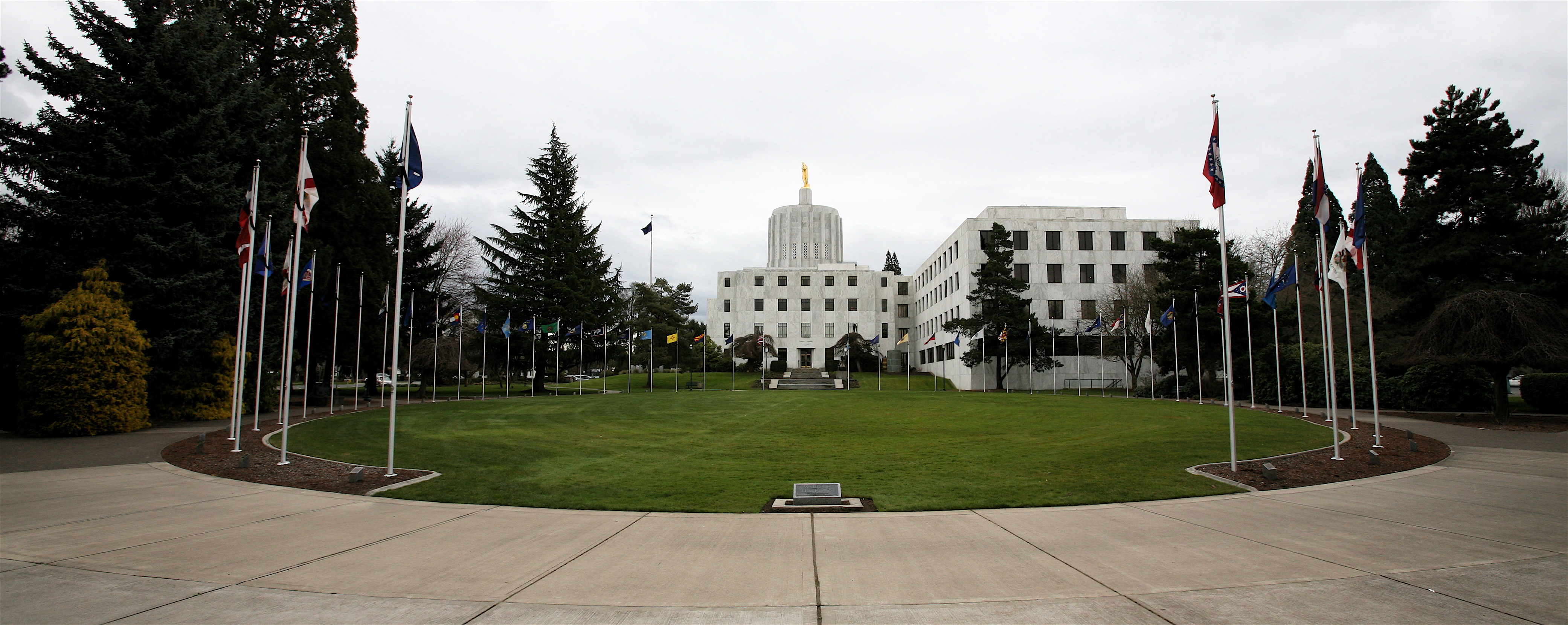
| caption | Oregon State Capitol, view from Capitol Mall |
| location | 900 Court Street NE, Salem, Oregon, U.S. |
| coordinates | |
| locmapin | USA Oregon Salem#USA Oregon |
| map_caption | Location in Salem, Oregon |
| built | |
| architect | Trowbridge & Livingston |
| architecture | Art Deco, Stripped Classicism |
| added | June 29, 1988 |
| refnum | 88001055 |
The Oregon State Capitol is the building housing the state legislature and the offices of the governor, secretary of state, and treasurer of the U.S. state of Oregon. It is located in the state capital, Salem. Constructed from 1936 to 1938 and expanded in 1977, the current building is the third to house the Oregon state government in Salem. The first two capitols in Salem were destroyed by fire, one in 1855 and the other in 1935.
New York architects Trowbridge & Livingston conceived the current structure's Art Deco stripped classical design in association with Francis Keally. Much of the interior and exterior is made of marble. The Oregon State Capitol was placed on the National Register of Historic Places on June 29, 1988.{{cite web
| author-link = National Register of Historic Places
| author2-link = State historic preservation office
| access-date = January 24, 2018
| access-date = January 24, 2018
| archive-date = June 9, 2011
| archive-url = https://web.archive.org/web/20110609105953/http://www.oregon.gov/OPRD/HCD/NATREG/docs/oregon_nr_list.pdf
| url-status = dead
The federal government's Public Works Administration partially financed construction which was completed during the Great Depression in 1938. The building was erected at a cost of $2.5 million for the central portion of the building, which includes a cupola of 166 ft. The wings, which doubled the floor space of the building to about 233750 sqft, were added later for $12.5 million. The grounds outside the capitol building contain artwork, fountains, and flora, including the state tree (Douglas fir) and state flower (Oregon grape).
History
Before the creation of the Oregon Territory in 1848, the Oregon Country provisional government, through legislation on June 27, 1844, and December 19, 1845, selected Oregon City as Oregon's first capital.{{cite book | author-link = Harvey W. Scott | author-link2 = Leslie M. Scott | author-first = John B. | author-last = Horner | author-link = John B Horner | access-date = January 25, 2018
On January 13, 1855, the Oregon Territorial Legislature passed a bill moving the seat of government from Salem to Corvallis. Governor George Law Curry and many others objected to the move, since public buildings in Salem were already under construction. Curry sent the matter to the Secretary of the Treasury in Washington, D.C., where Secretary James Guthrie declared the move invalid unless acted on by the United States Congress. Thereafter, Curry and Oregon Secretary of State Benjamin Harding moved back to Salem.
On December 3, 1855, the legislature convened in Corvallis and quickly introduced legislation to move the capital back to Salem. This bill passed on December 15, 1855. Three days later, the legislature re-convened in Salem. However, the statehouse burned down on the 29th, and the legislature re-opened debate about where to seat the capital. They decided to ask the people of the territory to vote on the question. A vote was to be held in June 1856, after which the two cities receiving the most votes would have a runoff. The initial vote set up a runoff between Eugene and Corvallis, but after some ballots were invalidated due to not being cast in accordance with the law, the two winners were Eugene and Salem. An October runoff gave Eugene the most votes, but the earlier vote-tossing led to a low turnout. With such low public participation, the election was ignored, and the capital remained in Salem.
A permanent resolution of the capital location issue came in 1864. In 1860, the legislature put the question once again to a popular vote. On a vote in 1862, no city received the 50 percent minimum required by law. In an 1864 election, Salem received 79 percent and was declared the state capital. The Oregon Constitution lists the seat of state government in Article XIV as Marion County,{{cite book | author-first = Nancy | author-last = Capace | author-link = Nancy Capace
First capitol (1855)

The land developed for the permanent capitol buildings was Salem block 84, sold to the state for this purpose by pioneer and Salem founder W. H. Willson.{{cite book | orig-year = 1956 | access-date =October 1, 2007 | archive-url=https://web.archive.org/web/20071229191946/http://www.salemhistory.net/places/state_capitol.htm | archive-date=December 29, 2007 | url-status=dead
Fire
On the evening of December 29, 1855, a fire destroyed the first capitol building and many of the territory's public records. Starting in the unfinished northeast corner of the structure, still unoccupied by the government, the fire was not discovered until around 12:30 am. Arson was suspected, but no one was arrested.{{cite news
The site of the burned-out capitol building remained a pile of stones for several years after the fire. A downtown building, Nesmith's Building (later named the Holman Building), served as a temporary capitol from 1859 until 1876. The legislature met on the second and third floors of that building, which also housed the other state offices.{{cite book
Second capitol (1876–1935)
Plans for a new building began to take shape in 1872 when the state legislature appropriated $100,000 ($ as of ) towards a new capitol building. This second capitol, built between 1873 and 1876, was a two-story structure with an additional first level that was partly underground; the total cost was $325,000 ($ as of ). The cornerstone for the building was laid on October 5, 1873, during a ceremony that included a speech by Governor Stephen F. Chadwick and the music of several bands. Construction, on the same site as the 1855 building, was partly accomplished with convict labor from the Oregon State Penitentiary. Architects Justus F. Krumbein and W.G. Gilbert designed the building.
Built of stone and five million bricks, Oregon's new capitol measured 275 by 136 feet (84 by 41 m) with a dome of 180 ft. The structure had a square rotunda on the interior that was 54 ft tall. Also inside was a Senate chamber measuring 75 by 45 feet (23 by 14 m) and a House chamber of 85 by 75 feet (26 by 23 m). On the top floor was the Oregon Supreme Court with a courtroom measuring 54 by 45 feet (16 by 14 m) and the Oregon State Law Library, 75 by 70 feet (23 by 21 m). Also on the top floor was a viewing gallery for the House. On the exterior were ornamental pilasters and two-story porticos on the east and west ends. Additionally, the building had mullion-windowed wings. At that time, the capitol faced west toward the Willamette River. The government began using the building in August 1876, before the dome was built. Originally, plans called for towers on both sides of the dome (a tower on both ends of the building with the dome in the middle), but they were left out to save money. Oregon's second capitol building stood from 1876 to 1935.
1935 Fire
On April 25, 1935, at 6:43 pm, a custodial engineer called the Salem Fire Department to report smoke. Citizens helped to remove items from the smoky building, but when firefighters arrived, they ordered everyone to leave the structure, which was soon engulfed in flame. Among the helping citizens was twelve-year-old Mark Hatfield, who later became governor of Oregon. Originating in the east wing's basement, the fire spread into documents held in storage. It was spread by an updraft to the upper stories through the hollow columns around the dome's supporting girders.
The flames could be seen as far away as Corvallis, 40 miles to the southwest. the two buildings were connected by tunnels used for electricity and heating.{{cite web
Third capitol (1938–present)
Construction
Construction of the newest building began on December 4, 1936.
Controversy occurred before construction began when Governor Martin suggested the new building be sited on a hill south of downtown (Candalaria Heights) and away from the busy center of town. Another proposal called for the purchase of the Willamette University campus and relocation of the capitol to that site. However, downtown merchants were able to keep the capitol building in downtown at the original location, though some Victorian homes were subsequently leveled to make way for the building. Another early complaint about the structure was that the cupola resembled a "paint can" rather than traditional domes on other capitols, including the earlier Oregon structures. It was even called a "squirrel cage", lacking in majesty. Additionally, the public was slow to admire the gold Oregon Pioneer atop the cupola.
The building cost $2.5 million ($ as of ), of which the federal government paid 45 percent through the Public Works Administration. Upon completion, the new capitol was 164 ft wide, 400 ft long, and 166 ft tall (50 by 122 by 51 m) and contained 131750 sqft of usable space. The rotunda's staircases and floor used Phenix Napoleon Grey Marble quarried in Phenix, Missouri, and had borders of Radio Black marble that, like the exterior stone, is from Vermont. These rooms were added in 1977 as part of a $12.5 million ($ as of ) expansion project to add new wings containing legislative offices, hearing rooms, support services, a first floor galleria, and underground parking. In 2002, the wings were remodeled at a cost of $1.3 million ($ as of ) to upgrade items such as antiquated wiring and to install new carpeting and lighting.
Maintenance, repairs and events
On March 25, 1993, the magnitude 5.6 Scotts Mills earthquake damaged the cupola, requiring closure for repairs. The rotunda area remained closed for approximately two years for these repairs. This "Spring Break Quake" shook the building enough to shift the statue on top and crack the cupola. Additionally, the quake created a three-foot (one-meter) bulge on the west end of the building. Repairs cost $4.3 million ($ as of ) and included reinforcing the structure with additional concrete and steel bars. In April 2002, the building became the first state capitol in the United States to produce solar power through the use of 60 photovoltaic panels generating 7.8 kilowatts. One-third of the power is used to light the Oregon Pioneer at night; the remaining electricity is sent into the power grid.
On December 31, 2007, the Oregon State Capitol hosted its first authorized wedding between Oregon State Representative Tobias Read and Heidi Eggert. At Read's encouragement, the Legislature created a policy authorizing up to four public events a year. On August 30, 2008, the building caught fire around 12:30 in the morning and was quickly extinguished with damage to the Governor's offices on the second floor on the south side. The governor was forced to relocate some of his offices, including some time at the Oregon State Library across the street.
During a special session in December 2020, armed protesters demonstrated at the capitol against health restrictions related to the COVID-19 pandemic in Oregon. In January 2021, a security video was released showing Representative Mike Nearman allowing protesters to enter the Capitol Building. As a result of his action, Nearman pleaded guilty to one count of official misconduct in the first degree and the Oregon House of Representatives voted 59–1 to expel him on the grounds of "disorderly behavior."
The Capitol Accessibility, Maintenance and Safety project was approved by the legislative assembly in 2016 at a cost of $59.9 million. This project was designed to address Americans with Disabilities Act deficiencies; at-risk mechanical, electrical and plumbing systems; and security and life-safety issues in the Oregon State Capitol building. A second phase of this project was approved at a cost of $70.8 million by the legislative assembly in 2020 to address seismic upgrades, historic restoration, and additional ADA accessibility issues at the building's south entrance. A final phase, approved in 2022 at a cost of $465 million, focuses on upgrades to the oldest parts of the building, including seismic upgrades, adding four hearing rooms, adding a café, lead pipe and asbestos removal, and upgrading facilities for journalists and lobbyists. The total cost of the project is nearly $600 million and includes inserting 160 base isolators in the 160-million-pound building's foundation to avoid damage during seismic activity in the Cascadia subduction zone, with the new system being rated to limit damages even while the earth moves up to 2 feet in any direction.
The project has been criticized for cost overruns and for quiet approval of $90 million of additional funding; the project's budget is now nearly double the anticipated $375 million initially estimated. The building has continued to be used for legislative purposes during construction at a cost of $20 million, although parts of the building continue to be closed off. The renovation should be complete by 2026, with the full building opening to the public by April 2025.
Exterior and interior

The Oregon State Capitol is home to both branches of the state legislature, the House and Senate, and has offices for the governor, treasurer, and the secretary of state. In its center, the floor of the prominent rotunda features an embedded Oregon State Seal sculpted in bronze by Ulric Ellerhusen. Ellerhusen also sculpted the Oregon Pioneer that rests atop the capitol dome's exterior. The dome rises 106 ft above the state seal. The interior of the dome was painted by Frank H. Schwarz and features 33 stars, symbolizing Oregon's place as the 33rd state to join the Union. Eight medallions are painted near the top of the walls of the rotunda that represent the eight objects in the state seal. An inscription on the rotunda south wall, facing the entrance from the north, reads:In the souls of its citizens will be found the likeness of the state which if they be unjust and tyrannical then will it reflect their vices, but if they be lovers of righteousness confident in their liberties so will it be clean in justice bold in freedom.Also encircling the interior of the rotunda are four murals depicting moments from Oregon history. One mural depicts Captain Robert Gray's exploration of the Columbia River in 1792, another shows the Lewis and Clark Expedition, and two others portray covered wagons from pioneer times. These four murals were painted by Schwarz and Barry Faulkner. Other murals include the Provisional Government of Oregon's salmon and wheat seal, the Oregon Territory's seal, and depictions of Oregon's industries, all located in the rotunda's wings along the grand staircase. The capitol's galleria area on the first floor includes hearing rooms, display cases, and the visitor information area.
Oregon's House chamber floor is covered with a custom carpet; the carpet's pattern incorporates a depiction of the state tree, the Douglas-fir, representative of forestry. The furniture and paneling of the chamber is made of golden oak. A large mural painted by Faulkner, depicting the 1843 Champoeg Meetings at which the provisional government was formed, is behind the desk of the Speaker of the House. The Senate chambers use black walnut for the paneling and furniture. Another custom carpet lines the floor, featuring Chinook salmon and wheat, representative of fishing and agriculture. The Senate's large mural was painted by Schwarz and depicts a street scene showing news of statehood reaching Salem. Lining the walls of both chambers are 158 names, inscribed in friezes, of prominent people in Oregon's history. On the second floor of the capitol is the Governor's suite, consisting of a ceremonial office and private offices for the state's chief executive. As in the Senate chamber, the paneling is of black walnut. The ceremonial office includes a fireplace with a painting by Faulkner. In the suite's reception area is a table made of 40 tree species.

A variety of artwork is displayed on the exterior of the building. Sculptor Leo Friedlander used Vermont marble for the large relief sculptures on both sides of the main entrance. One sculpture depicts Meriwether Lewis, William Clark, and Sacagawea, with a map of their expedition's route on the reverse (Lewis and Clark); the other (Covered Wagon) shows pioneers and a covered wagon, with a map of the Oregon Trail on the reverse. Additionally, Ellerhusen created five marble relief sculptures on the exterior, and a metal sculpture by Tom Morandi sits above the south entrance. Ellerhusen also cast six bronze sculptures arranged above the building's main entrance, three on the inside and three on the outside.
The building measures 693 by 259.5 ft (211.2 by 79.1 m). The older main portion of the building is 53.5 ft tall, while the newer wings added in 1977 are 68.7 ft tall. Inside, the building has approximately 233750 sqft of floor area and 3.2 million cubic feet (90,600 cubic meters) of volume.
In 1997, the Legislative Assembly established the non-profit Oregon State Capitol Foundation in order to "create a living history, enhance the dignity and beauty of the Capitol, and foster cultural and educational opportunities." In 2005, the foundation completed the Walk of the Flags project, a display in Willson Park on the capitol grounds of all 50 flags of the U.S. states.{{cite web |access-date = October 1, 2007 |url-status = dead |archive-url = https://web.archive.org/web/20071028070139/http://www.leg.state.or.us/capinfo/foundation/walkoftheflags_dedication.htm |archive-date = October 28, 2007
In 2007, the capitol wings closed for a restoration project to upgrade items such as furniture, plumbing, and electrical systems.{{cite web |access-date = September 19, 2007 |url-status = dead |archive-url = https://web.archive.org/web/20070820215837/http://www.leg.state.or.us/restoration/ |archive-date = August 20, 2007
Grounds
.jpg)
The capitol grounds cover three city blocks and include Willson and Capitol parks. Throughout the grounds are native trees and shrubs, including blue spruce, Oregon-grape (the state flower), giant sequoia, coast redwood, Japanese maple, dogwood species, Bradford pear, cherry tree species, English holly, rhododendron, and magnolia tree species. One Douglas-fir tree was grown using a seed that rode aboard Apollo 14 to the Moon in 1971 and was transplanted to the capitol in 1976 from Oregon State University.
East Capitol Park
On the east side of the building is Capitol Park, which includes a bronze equestrian statue by A. Phimister Proctor called The Circuit Rider, statues of Jason Lee (Jason Lee) and John McLoughlin (John McLoughlin) by Gifford Proctor, and portions of the Corinthian columns of the second capitol building.{{cite web | access-date = October 1, 2007 | access-date =October 1, 2007 |access-date = April 7, 2019}}
West Willson Park
To the west of the building is Willson Park, named for Salem founder William H. Willson and sited roughly at the center of his former landholdings.{{cite web | access-date = October 1, 2007 | access-date = October 1, 2007 | access-date = October 1, 2007 | archive-url = https://web.archive.org/web/20080513131545/http://www.oregonlink.com/then_and_now/breymanfountain.html | archive-date = May 13, 2008 | url-status = dead
Other features on the capitol grounds include Sprague Fountain and the Wall of Water. The Wall of Water is located across Court Street from the main entrance. It was added in 1990 and has 22 nozzles shooting water 12 ft into the air in a plaza that also has slabs of stone with information about Oregon's history. Added in 1985, the Capitol Beaver Family sculpture represents the state animal. Additional features of the grounds include a peace pole donated by the Society of Prayer for World Peace, a large boulder that once lay along the Oregon Trail, a planter that spells out "Oregon" using shrubs, and a rose garden maintained by the Salem Rose Society.
References
References
- Lyman, William Denison. (1909). "[[wikisource:en:The Columbia River: Its History, Its Myths, Its Scenery, Its Commerce/Part 1/Chapter 8#194". G. P. Putnam's Sons.
- Winslow, Walter O.. (1908). "[[wikisource:en:Oregon Historical Quarterly/Volume 9/Contests over the Capital of Oregon". Oregon Historical Quarterly.
- Hauck, Eldon. (1991). "American Capitols". McFarland & Co.
- (May 12, 1935). "Magazine Section". [[The Oregonian]].
- Belton, Howard. (1977). "Under Eleven Governors". [[Binford & Mort]].
- (January 15, 1893). "none". The Oregonian.
- Engeman, Richard H.. "The Public Face of Public Life".
- (April 26, 1935). "2nd Capitol Fire". [[Oregon Journal]].
- (November 17, 2017). "Floyd McMullen, the only Salem firefighter to ever die in the line of duty". Statesman Journal.
- Filips, Janet. (September 27, 1988). "A capitol idea". [[The Oregonian]].
- "Built Like a Fortress: Preserving Oregon's Historic Supreme Court Building". Oregon State Bar.
- [http://records.sos.state.or.us/ORSOSWebDrawer/Recordpdf/7255149 The Oregon State Capitol: What Could Have Been - page 23] [[Oregon State Archives]]. Retrieved on October 8, 2007.
- (September 18, 1938). "Oregon's Bronze "Pioneer" Rises to Resting Place on Capitol Top". [[Statesman Journal]].
- Oregon Legislative Information Systems. (January 23, 2002 ). "Oregon State Capitol History". Oregon Legislature.
- Graff, Randy. (February 15, 2004). "Sight lines: Losing the spirit". [[The Oregonian]].
- Wong, Peter. (December 1, 2002). "Capitol reunion spotlights rooms". [[Statesman Journal]].
- Esteve, Harry. Converging paths to leadership two adept veterans who mix personal values and political skills will direct the 2005 legislature Peter Courtney political everyman relies on dramatic, affable style. ''[[The Oregonian]]'', November 30, 2004.
- Tomlinson, Stuart. (March 20, 1994). "What have we learned?". [[The Oregonian]].
- Esteve, Harry. (April 27, 2007). "Inside the capitol: Stopping sky from falling takes money". [[The Oregonian]].
- Wong, Peter. (January 20, 2003). "Capitol to glow with solar flair". [[Statesman Journal]].
- Liao, Ruth. (January 3, 2008). "Capitol rotunda serves as wedding chapel". [[Statesman Journal]].
- (August 30, 2008). "Fire damages state Capitol". [[KATU]].
- Cole, Michelle. (November 18, 2008). "Governor's office now at State Library". The Oregonian.
- (January 7, 2021). "Kotek: GOP's Nearman let right-wing protesters into Capitol". [[KOIN]].
- Borrud, Hillary. (January 7, 2021). "Oregon Rep. Mike Nearman let right-wing protesters into the Oregon Capitol last month". [[The Oregonian]].
- Borrud, Hillary. (January 8, 2021). "Video clearly shows Rep. Mike Nearman helping right-wing demonstrators breach Oregon Capitol". [[The Oregonian]].
- Radnovich, Connor. (July 27, 2021). "Mike Nearman pleads guilty to official misconduct, receives 18 months probation". [[Salem Statesman Journal]].
- VanderHart, Dirk. (June 10, 2021). "Oregon House expels state Rep. Mike Nearman, plotter of Capitol incursion".
- "Construction at the Oregon Capitol is almost $100 million over budget. No one mentioned it to the public".
- "Capitol Accessibility, Maintenance and Safety Home Page".
- Shumway, Julia. (2024-07-25). "A look inside the Oregon Capitol under construction • Oregon Capital Chronicle".
- "Crews Face the Unexpected In Historic Upgrade of Oregon Capitol {{!}} Engineering News-Record".
- McDonald, Abbey. (2024-07-24). "Peek inside the Oregon State Capitol as crews work to finish new foundation".
- This table is inlaid with a replica of Oregon's second capitol building, the state flower ([[Oregon-Grape
- Har, Janie. (August 2, 2008). "At $34 million, is the Oregon Capitol renovation extravagant or long overdue?". The Oregonian.
- Har, Janie. (August 17, 2008). "From jailhouse to state House The high-end furniture for the Capitol's renovation is made locally --by inmates". The Oregonian.
- Wong, Peter. (December 8, 2008). "Inmate-built furniture fills Capitol wings". Statesman Journal.
- Near the west entrance of the capitol is a [[Liberty Bell (Oregon State Capitol)
- "State Capitol State Park Walking Tour". Oregon State Parks.
- "Tribal flags fly in Salem". [[The Confederated Tribes of Grand Ronde]].
This article was imported from Wikipedia and is available under the Creative Commons Attribution-ShareAlike 4.0 License. Content has been adapted to SurfDoc format. Original contributors can be found on the article history page.
Ask Mako anything about Oregon State Capitol — get instant answers, deeper analysis, and related topics.
Research with MakoFree with your Surf account
Create a free account to save articles, ask Mako questions, and organize your research.
Sign up freeThis content may have been generated or modified by AI. CloudSurf Software LLC is not responsible for the accuracy, completeness, or reliability of AI-generated content. Always verify important information from primary sources.
Report