From Surf Wiki (app.surf) — the open knowledge base
Ordsall, Greater Manchester
Suburb of the City of Salford, England
Suburb of the City of Salford, England
| Field | Value |
|---|---|
| country | England |
| coordinates | |
| official_name | Ordsall |
| population | 14,194 |
| population_ref | (2011.ward) |
| metropolitan_borough | Salford |
| metropolitan_county | Greater Manchester |
| region | North West England |
| constituency_westminster | Salford |
| post_town | SALFORD |
| postcode_district | M5 |
| postcode_area | M |
| dial_code | 0161 |
| os_grid_reference | SJ815975 |
| static_image | Ordsall Hall entire west wing 29 Jan 2009.jpg |
| static_image_width | 240px |
| static_image_caption | Ordsall Hall |
Ordsall is an inner city suburb of Salford, Greater Manchester, England. The population at the 2011 census was 14,194. It lies chiefly to the south of the A57 road, close to the River Irwell, the main boundary with the city of Manchester, Salford Quays and Manchester Ship Canal, which divides it from Stretford.
Historically part of Lancashire, Ordsall was the birthplace of the bush roller chain and is home to Ordsall Hall.
History
The name Ordsall has Old English origins, being the personal name Ord and the word halh, meaning a corner or nook, which has become the modern dialect word "haugh". This, indeed, describes the position of the manor of Ordsall, for its boundary on the south side is a large bend in the River Irwell, which became the site of the docks for the Manchester Ship Canal. Ordsall first appears in records in 1177 when Ordeshala paid two marks towards an aid, a feudal due or tax.
Antiquarian and Geologist, Samuel Hibbert-Ware gave a different etymology for the name; ord is a Saxon word for "primeval" or "very old" and hal meaning "den" - hence the name Ordeshal could mean "very old den". His reasoning for this was the location in the area of the cave known as Woden's Den.
Woden's Den
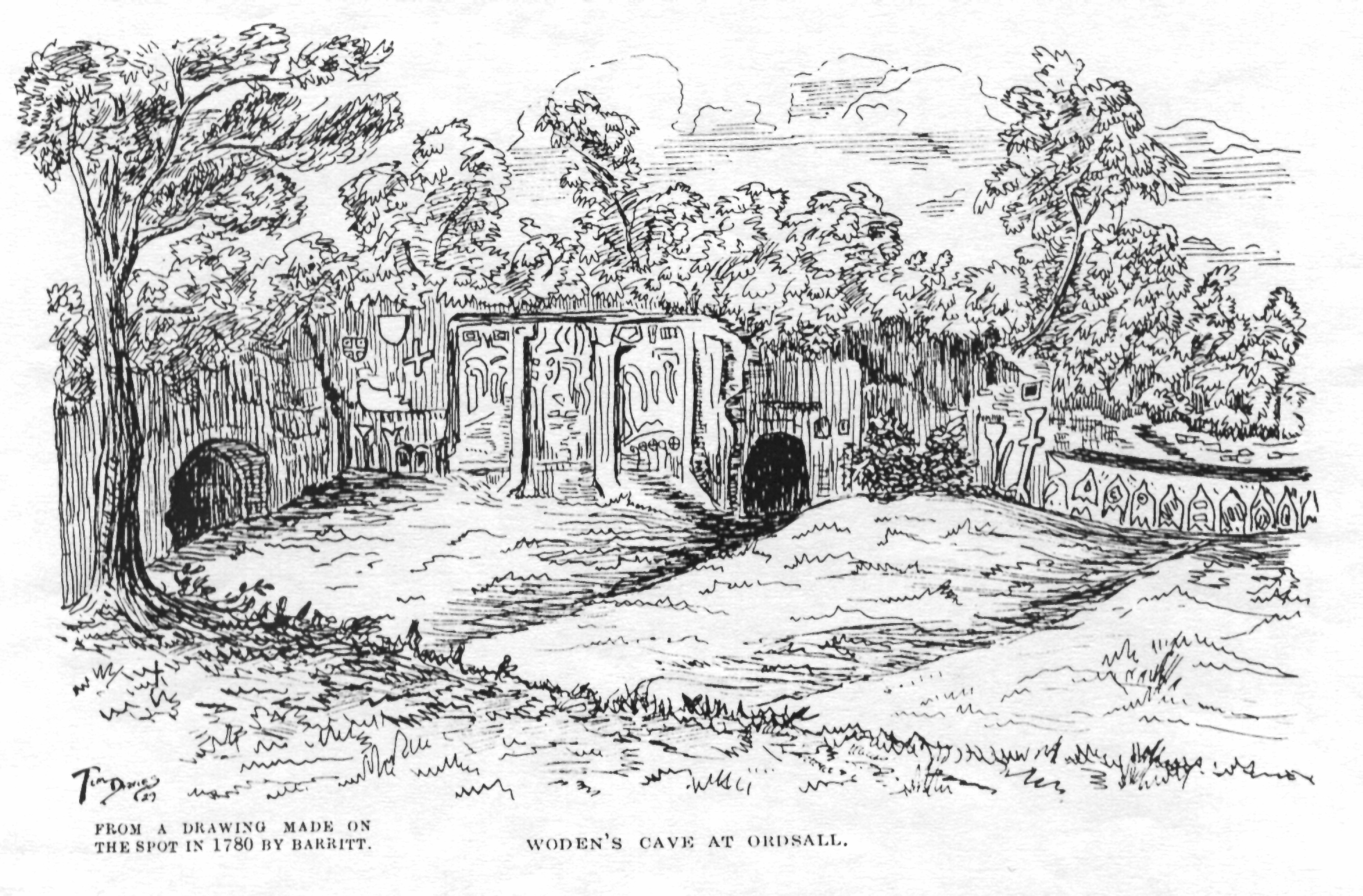
Before the River Irwell was deepened to make it navigable there was an ancient, paved ford at Ordsall known as Woden's Ford and nearby, in a lane leading to Ordsall Hall, was a cave known as Woden's Den. The cave was of great interest to 19th-century antiquarians, but their constant trespassing to view the site prompted the landowner to completely destroy it early in the century, and no trace of the feature remains. However, the cave was described and sketched by Thomas Barret in about 1780. He postulated that, as this part of the Irwell was subject to regular flooding, travellers would have made offerings to Odin, the protector of travellers, before attempting the crossing. He also said that there were strong grounds to suppose that Cluniac monks of Lenton Priory, who had a cell called "St Leonards" at nearby Kersal, converted the cave into a Christian hermitage and served as guides to the crossing at Woden's Ford and the surrounding marshes in order to supplant the earlier pagan practices.
Regeneration project
By the 1990s, Ordsall was one of the most deprived parts of Greater Manchester, with some of the highest crime rates. In April 1994, The Independent newspaper reported that the area had unemployment above 20% (around twice the national average) and that arson and car crime were a regular occurrence. In July 1992, a riot in the area saw local gangs fire gunshots at police and fire crews.
Transport
Ordsall Chord railway line became operational on 10 December 2017. This short railway line links Manchester Piccadilly and Manchester Oxford Road to Manchester Victoria, increasing capacity and reducing journey times into and through Manchester. It allows trains to run from Newcastle, Middlesbrough and Leeds direct to Manchester Airport without having to reverse at Manchester Piccadilly.
Economy
Despite its notorious past, Ordsall's location between Manchester city centre and Salford Quays has led to a regeneration boom. A study commissioned by insurers More Than, published in June 2007, revealed that Ordsall had become one of the United Kingdom's property hot spots, ranking 17th out of the 35 identified. The study rated areas by looking at homes occupied by young, affluent professionals.
Landmarks
Ordsall Hall


Ordsall Hall is a Tudor mansion that was for over 300 years the home of the Radclyffe family. In more recent times it has been a working men's club and a school for clergy, the forerunner of the Manchester Theological College, amongst other uses. Like many old buildings, Ordsall Hall is said to be haunted, in particular by "the White Lady", who it is said threw herself off the balcony overlooking the Great Hall. An episode of the TV programme Most Haunted was filmed at the hall in 2002.
Salford Lads' Club
Ordsall is home to Salford Lads Club, which is featured on the inside cover of the album The Queen Is Dead by the pop band the Smiths. The club is on the corner of St Ignatius Walk and Coronation Street.
St Clement's Church
St Clement's Church is the Anglican parish church of Ordsall. The church was opened in 1877 and is now a Grade II listed building.
St Joseph's Church
St Joseph's Roman Catholic Church was one of the few buildings to have survived the Ordsall slum clearances. The church was designed by W. Randolph and cost £5,000 to build, equivalent to £ today. It was opened on Sunday 20 April 1902. The building was severely damaged during the Manchester Blitz of Christmas 1940 and was restored over the following decades. However, it was demolished in 2021.
Education
St. Joseph's RC Primary School was rated as outstanding in its 2007 Ofsted report, and one of the 100 top performing schools in the UK. Notable developments include a new primary school for the area, Primrose Hill, as well as an inner-city academy to be affiliated with MediaCityUK at Salford Quays.
Cultural references
The now-demolished Archie Street was the inspiration for the TV soap opera Coronation Street, which began in 1960 and continues to be broadcast to the present day.
The BAFTA award-winning British comedy film East is East, released in 1999, was set in Monmouth Street, now demolished.
Notable people
- Mark Addy (1838–1890), recipient of the Albert Medal (lifesaving) and a number of other honours, was the landlord of the Old Boathouse Inn, Everard Street off Ordsall Lane until his death in 1890.
- Joe Gladwin, actor, best known for his role as Wally Batty in the BBC sitcom Last of the Summer Wine, was born and brought up in Ordsall. He attended Mount Carmel RC School.
- Alistair Cooke, journalist and presenter of Letter from America, born in Ordsall before the family moved to Blackpool, in large part due to the young Cooke's health.
- Eddie Colman, footballer with Manchester United, one of the Busby Babes who was killed in the Munich air disaster, 6 February 1958 aged 21, was born in Archie Street, Ordsall.
- Alan Clarke and Graham Nash of The Hollies pop group grew up and attended school in Ordsall.
- Nigel Pivaro, Coronation Street actor and journalist, lived for many years in the area and has written about it. Pivaro lived first in West Park Street as a young child, before its demolition in the mid sixties, and later returned to live in Nine Acre Court.
- Tim Burgess of the band The Charlatans lived in Oldfield Road in the 1990s.
- Billy Garton, Manchester United footballer, lived in Ordsall while playing for the club.
- Peter Hook of the pop group New Order has many family members from the neighbourhood and was a member of Salford Lads Club.
- Paul Massey, Organised crime figure and Salford based businessman.
Notes
References
References
- "City of Salford ward population 2011".
- Ekwall, E. (1940) ''The Concise Oxford Dictionary of English Place-names''; 2nd ed. Oxford: Clarendon Press; p. 334
- Hibbert-Ware, Samuel. (1848). "The ancient parish church of Manchester, and why it was collegiated". Thomas Agnew.
- Hibbert-Ware, Samuel. (1830). "History of the foundations in Manchester of Christ's College, Chetham's Hospital and the Free Grammar School". Thomas Agnew and Joseph Zanetti.
- Reilly, John. (1859). "The people's history of Manchester.". Simpkin (London) and Heywood (Lancashire).
- (16 April 1994). "No-Go Britain: Where, what, why".
- [https://www.bbc.com/news/uk-england-manchester-41900101 Manchester Ordsall Chord rail link completed] ''[[BBC News]]'' 9 November 2017
- (October 2010). "'YAPPY Index' Reveals Nation's Next Property Hotspots". Royal & Sun Alliance.
- "St Clement's Church Ordsall & Salford Quays".
- "GENUKI: St Clement, Ordsall, Church of England, Lancashire".
- "St Joseph's Church, St Joseph’s Drive, Ordsall - Building {{!}} Architects of Greater Manchester".
- "St Joseph's RC Primary School Ordsall". Ofsted.
- "St Joseph's RC Primary School". Ofsted.
- (9 July 2023). "Tiny houses, wonky cobbles and a bitter wind: Secrets of the 'lost Coronation Street'". Manchester Evening News.
This article was imported from Wikipedia and is available under the Creative Commons Attribution-ShareAlike 4.0 License. Content has been adapted to SurfDoc format. Original contributors can be found on the article history page.
Ask Mako anything about Ordsall, Greater Manchester — get instant answers, deeper analysis, and related topics.
Research with MakoFree with your Surf account
Create a free account to save articles, ask Mako questions, and organize your research.
Sign up freeThis content may have been generated or modified by AI. CloudSurf Software LLC is not responsible for the accuracy, completeness, or reliability of AI-generated content. Always verify important information from primary sources.
Report