From Surf Wiki (app.surf) — the open knowledge base
Order of the Golden Fleece
Catholic order of chivalry

Catholic order of chivalry
| Field | Value | |
|---|---|---|
| title | Order of the Golden Fleece | |
| image | Order_of_the_Golden_Fleece_AEA_Collections.jpg | |
| caption | Collar and badges of a knight of the Spanish order | |
| awarded_by | the King of Spain and | |
| the Head of the House of Habsburg-Lorraine | ||
| established | ||
| motto | {{Plainlist | |
| status | Extant | |
| founder | Philip III, Duke of Burgundy | |
| head_title | Grand Masters | |
| head | {{Plainlist | |
| grades | Knight | |
| higher | None | |
| lower | {{Plainlist | |
| image2 | [[File:Order of the Golden Fleece ribbon bar.svg | 96px]] |
| caption2 | Ribbon of the order |
the Head of the House of Habsburg-Lorraine
- Pretium Laborum Non Vile
- Non Aliud
- Felipe VI of Spain
- Archduke Karl of Austria
- Order of Charles III
- Order of St George
- Military Order of Maria Theresa
The Distinguished Order of the Golden Fleece (, ) is a Catholic order of chivalry founded in 1430 in Brugge by Philip the Good, Duke of Burgundy, to celebrate his marriage to Isabella of Portugal. Today, two branches of the order exist, the Spanish Fleece and the Austrian Fleece; the current grand masters are King Felipe VI of Spain and Karl von Habsburg, head of the House of Habsburg-Lorraine, respectively. The Grand Chaplain of the Austrian branch is Cardinal Christoph Schönborn, Archbishop of Vienna.
The separation of the two existing branches took place as a result of the War of the Spanish Succession of 1701–1714. The grand master of the order, Charles II of Spain (a Habsburg), had died childless in 1700, and so the right to succeed to the throne of Spain (and incidentally to become the Sovereign of the Order of the Golden Fleece) initiated a continental conflict. On one hand, Charles, brother of Holy Roman Emperor Joseph I, claimed the Spanish crown as an agnatic member of the House of Habsburg, which had inherited the Burgundian titles and had held the Spanish throne for almost two centuries. However, the late king of Spain had named Philip of Bourbon, his sister's grandchild, as his successor in his will. After the conclusion of the war in 1714, the European powers recognized Philip of Bourbon as King of Spain, but the old Burgundian Habsburg territories became the Austrian Netherlands (1714–1797), and with them went the Treasure of the Order and its archive. The two dynasties, the Bourbons of Spain and the Habsburgs of Austria, have ever since continued heading the separate orders of the Golden Fleece.
The Golden Fleece, particularly the Spanish branch, became one of the most prestigious and historic orders of chivalry in the world. |author-link1 = D'Arcy Boulton (heraldist) |orig-date = 1987 |publication-place = Woodbridge, Suffolk |access-date = 15 August 2024 De Bourgoing wrote in 1789 that "the number of knights of the Golden Fleece is very limited in Spain, and this is the order, which of all those in Europe, has best preserved its ancient splendour". Each collar is solid gold and is estimated to be worth around €50,000 as of 2018, making it the most expensive chivalrous order. Current knights of the Spanish order include Emperor Akihito of Japan, former Tsar Simeon of Bulgaria, and Princess Beatrix of the Netherlands, among 13 others. Knights of the Austrian branch include King Philippe of Belgium, his father former King Albert II, and Grand Duke Henri of Luxembourg, among 22 others.
Origin

The Order of the Golden Fleece was established on 10 January 1430, by Philip the Good, Duke of Burgundy (on the occasion of his wedding to Isabella of Portugal), in celebration of the prosperous and wealthy domains united in his person that ran from Flanders to Switzerland. The jester and dwarf Madame d'Or performed at the creation of the order of the Golden Fleece in Bruges. It is restricted to a limited number of knights, initially 24 but increased to 30 in 1433, and 50 in 1516, plus the sovereign. The order's first king of arms was Jean Le Fèvre de Saint-Remy. It received further privileges unusual to any order of knighthood: the sovereign undertook to consult the order before going to war; all disputes between the knights were to be settled by the order; at each chapter the deeds of each knight were held in review, and punishments and admonitions were dealt out to offenders, and to this the sovereign was expressly subject; the knights could claim as of right to be tried by their fellows on charges of rebellion, heresy and treason, and Charles V conferred on the order exclusive jurisdiction over all crimes committed by the knights; the arrest of the offender had to be by warrant signed by at least six knights, and during the process of charge and trial he remained not in prison but in the gentle custody of his fellow knights. was explicitly denied to heretics, and so became an exclusively Catholic honour during the Reformation. The officers of the order were the chancellor, the treasurer, the registrar, and the king of arms (herald, toison d'or).


The Duke's stated reason for founding this institution had been given in a proclamation issued following his marriage, in which he wrote that he had done so "for the reverence of God and the maintenance of our Christian Faith, and to honor and exalt the noble order of knighthood, and also ... to do honor to old knights; ... so that those who are at present still capable and strong of body and do each day the deeds pertaining to chivalry shall have cause to continue from good to better; and ... so that those knights and gentlemen who shall see worn the order ... should honor those who wear it, and be encouraged to employ themselves in noble deeds ...".
The Order of the Golden Fleece was defended from possible accusations of prideful pomp by the Burgundian court poet Michault Taillevent, who asserted that it was instituted:
Mais à la fin que soit attribuée Loenge à Dieu trestout premièrement Et aux bons gloire et haulte renommée.}}}}
Translated into English:
But for the purpose that praise shall be given To God, in the very first place, And to the good, glory and high renown.}}
The choice of the Golden Fleece of Colchis as the symbol of a Christian order caused some controversy, not so much because of its pagan context, which could be incorporated in chivalric ideals, as in the Nine Worthies, but because the feats of Jason, familiar to all, were not without causes of reproach, expressed in anti-Burgundian terms by Alain Chartier in his Ballade de Fougères referring to Jason as "Who, to carry off the fleece of Colchis, was willing to commit perjury." The bishop of Châlons, chancellor of the order, identified it instead with the fleece of Gideon that received the dew of Heaven ().
The badge of the order, in the form of a sheepskin, was suspended from a jewelled collar of firesteels in the shape of the letter B, for Burgundy, linked by flints; with the motto Pretium Laborum Non Vile ("no mean reward for labours") engraved on the front of the central link, and Philip's motto Non Aliud ("I will have no other") on the back (non-royal knights of the Golden Fleece were forbidden to belong to any other order of knighthood).
.jpg)
During this time, the Burgundian court was culturally leading in Europe and so the new order, with its festivals, ceremonies, rituals and constitution, was seen by many as a role model in the sense of a princely order based on the ideals of Christian chivalry. Aid to the Byzantine Empire or the pushing back of the Ottomans was repeatedly promoted by the Burgundian dukes in connection with their order. The Burgundian fleet actually crossed Rhodes and the Black Sea, but all of the ideas came from an extended planning phase that was not yet complete. After the death of Charles the Bold in an attempt to conquer the Duchy of Lorraine caused the extinction of the House of Burgundy in 1477, the order passed to the House of Habsburg. A few months after his marriage to the heiress Mary of Burgundy, Emperor Maximilian of Habsburg was knighted in Bruges on April 30, 1478, and then appointed sovereign (grand master) of the order. All renegade or disloyal knights of the order in the course of the subsequent War of the Burgundian Succession were expelled from the order by Maximilian. The memory of the dead was erased and their coats of arms were broken.
.jpg)
From Emperor Charles V or King Philip II of Spain, the sovereign was on the one hand the head of the Spanish line of the Habsburgs and on the other hand also king of Spain. Charles V was appointed head of the order at the age of 9 and identified himself strongly with this community throughout his life. The ideal of chivalrous and brave living was brought to him by William de Croÿ. When in 1700 Charles II of Spain died childless, both the Habsburgs from the Habsburg lands and the Bourbons, as the new kings of Spain, claimed sovereignty of the order. Both noble houses basically invoked their claims regarding the Spanish crown. The House of Habsburg's claim relied on Article 65 of the Statutes. Holy Roman Emperor Charles VI was able to claim sovereignty of the Netherlands, the Burgundian heartland, during the War of the Spanish Succession and thus he could celebrate the order's festival in Vienna in 1713. As with Maximilian I or Charles V, the order was again closely associated with the Holy Roman Empire. Regardless of this, the order was divided into two lines. The Habsburg order owns the archive and the old insignia and adheres more to the original statutes.
Spanish order
Spanish Order

With the absorption of the Burgundian lands into the Spanish Habsburg empire, the sovereignty of the order passed to the Habsburg kings of Spain, where it remained until the death of the last of the Spanish Habsburgs, Charles II, in 1700. He was succeeded as king by Philip V, a Bourbon. The dispute between Philip and the Habsburg pretender to the Spanish throne, the Archduke Charles, led to the War of the Spanish Succession, and also resulted in the division of the order into Spanish and Austrian branches. In either case the sovereign, as Duke of Burgundy, writes the letter of appointment in French.
The controversial conferral of the Fleece on Napoleon and his brother Joseph, while Spain was occupied by French troops, angered the exiled king of France, Louis XVIII, and caused him to return his collar in protest. These, and other awards by Joseph, were revoked by King Ferdinand VII on the restoration of Bourbon rule in 1813. Napoleon created by order of 15 August 1809 the Order of the Three Golden Fleeces, in view of his sovereignty over Austria, Spain and Burgundy. This was opposed by Joseph I of Spain and appointments to the new order were never made.
In 1812, the acting government of Spain conferred the Fleece upon the Duke of Wellington, an act confirmed by Ferdinand on his resumption of power, with the approval of Pope Pius VII. Wellington therefore became the first Protestant to be honoured with the Golden Fleece. It has subsequently also been conferred upon non-Christians, such as Bhumibol Adulyadej, King of Thailand.
There was another crisis in 1833 when Isabella II became Queen of Spain in defiance of Salic Law that did not allow women to become heads of state. Her right to confer the Fleece was challenged by Spanish Carlists.
Sovereignty remained with the head of the Spanish House of Bourbon during the republican (1931–1939) and Francoist (1939–1975) periods, and is held today by the present king of Spain, Felipe VI. There is confusion towards the conferral of the Fleece on Francisco Franco in 1972. The order was illegally offered by Infante Jaime to him on the occasion of his son's wedding to the dictator's granddaughter, Carmen. Franco kindly refused the order on the basis of legitimacy, stating that the Golden Fleece could only be granted by the reigning king of Spain. Moreover, the right of conferral was in any case a prerogative of Jaime's younger brother, Infante Juan, as designated heir to the throne of Spain by his father Alfonso XIII.
Knights of the order are entitled to be addressed with the style His/Her Excellency in front of their name.

Grand masters of the order
- Charles I (1516–1556)
- Philip II (1556–1598)
- Philip III (1598–1621)
- Philip IV (1621–1665)
- Charles II (1665–1700)
- Philip V (1700–1724)
- Louis I (1724–1724)
- Philip V (1724–1746)
- Ferdinand VI (1746–1759)
- Charles III (1759–1788)
- Charles IV (1788–1808)
- Ferdinand VII (1808–1833)
- Isabella II (1833–1870)
- Amadeo I (1870–1873)
- Alfonso XII (1874–1885)
- Alfonso XIII (1886–1941)
- Juan, Count of Barcelona (1941–1977)
- Juan Carlos I (1977–2014)
- Felipe VI (2014–present)

Living members
Below is a list of the living knights and dames, in chronological order and, in the first sets of brackets, the years when they were inducted into the order:
- Juan Carlos I of Spain (1941), as crown prince; king (1975–2014)
- Felipe VI of Spain (1981), as crown prince; king (2014–present)
- Carl XVI Gustaf of Sweden (1983), as king (1983–present)
- Akihito of Japan (1985), as crown prince; emperor (1989–2019)
- Beatrix of the Netherlands (1985), as queen (1980–2013)
- Margrethe II of Denmark (1985), as queen (1972–2024)
- Albert II of Belgium (1994), as king (1993–2013)
- Harald V of Norway (1995), as king (1991–present)
- Simeon Saxe-Coburg-Gotha of Bulgaria (2004), as prime minister (2001–2005); tsar (1943–1946)
- Henri of Luxembourg (2007), as grand duke (2000–2025)
- Javier Solana of Spain (2010)
- Víctor García de la Concha of Spain (2010)
- Nicolas Sarkozy of France (2011), as co-prince of Andorra (2007–2012)
- Enrique V. Iglesias of Spain and Uruguay (2014)
- Leonor of Spain (2015, presented 2018), as crown princess (2014–present)
- Sofía of Spain (2024, presented 2025), as queen mother; queen consort (1975–2014)
- Felipe González (2025), prime minister of Spain (1982–1996)
- Miguel Herrero y Rodríguez de Miñón (2025), a father of the Spanish constitution
- Miquel Roca (2025), a father of the Spanish constitution
Armorial of the Spanish Golden Fleece
| Enrique V. Iglesias |
|---|
|}
Austrian (Habsburg) order
Austrian Order
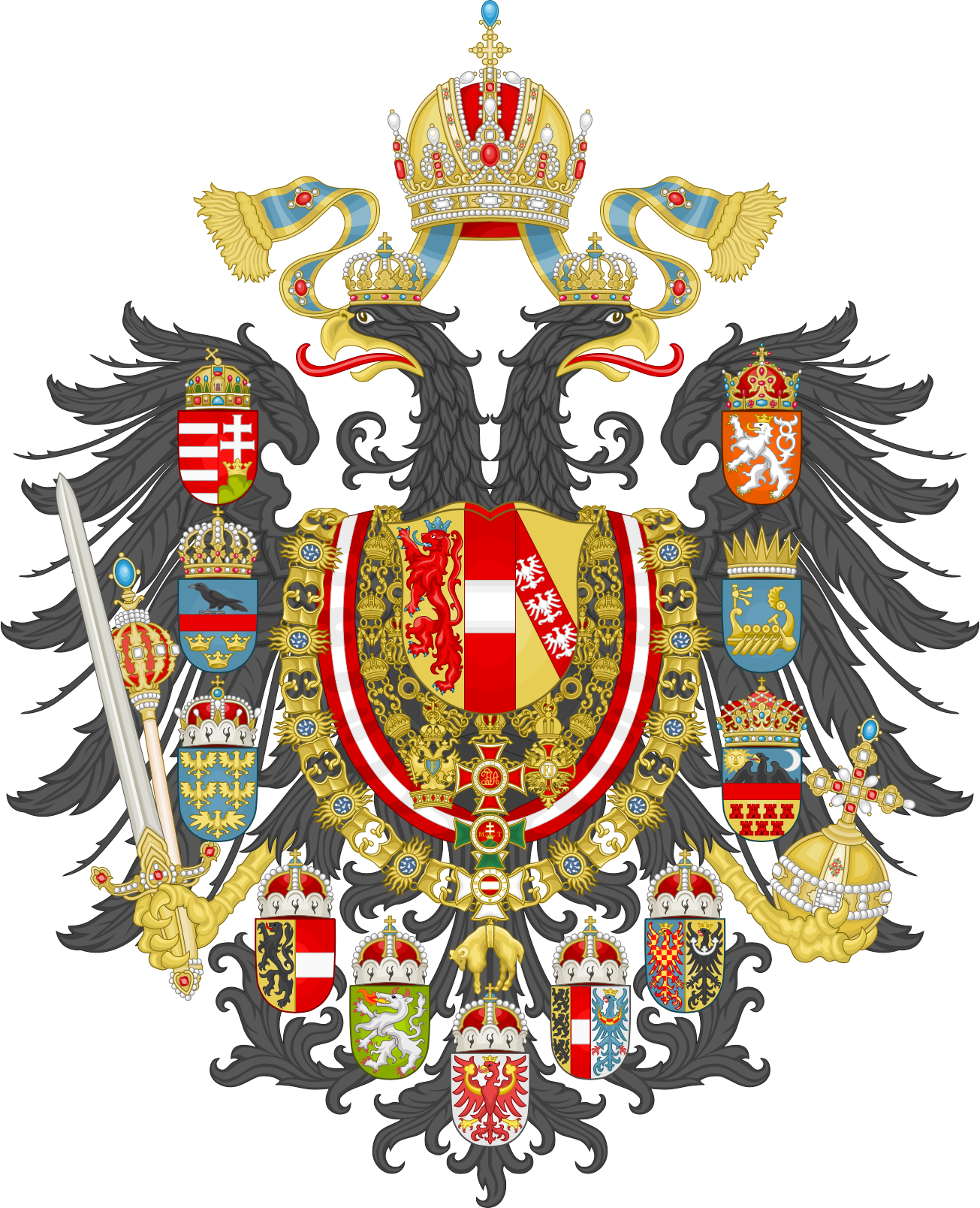


The problem of female inheritance was avoided on the accession of Maria Theresa in 1740, as sovereignty of the order passed not to herself but to her husband, Francis.
The entire treasure of the order, which also includes the "Ainkhürn sword" of the last duke of Burgundy and the centuries-old oath cross, which contains a cross splinter of the True Cross, is located in the Vienna Treasury and, like the archive and the old insignia, is the property of the Habsburg branch.
Upon the collapse of the Austrian monarchy after the First World War, King Albert I of Belgium requested that the sovereignty and treasure of the order be transferred to him as the ruler of the former Habsburg lands of Burgundy. This claim was seriously considered by the victorious Allies at Versailles but was eventually rejected due to the intervention of King Alfonso XIII of Spain, who took possession of the property of the order on behalf of the dethroned emperor, Charles I of Austria.
Nazi Germany classified the order as hostile to the state and tried to confiscate the entire treasure of the order including the archive. Hitler categorically rejected the centuries-old Habsburg principles of "live and let live" in relation to ethnic groups, peoples, minorities, religions, cultures and languages, and also wanted to seize significant works of art that are unique worldwide. Hitler intended to decide on the use of the assets after they had been confiscated. After the annexation of Austria in 1938, Max von Hohenberg, Habsburg representative in the affairs of the order, was immediately sent to a concentration camp.
After the Second World War in 1953, the Republic of Austria continued to confirm to the House of Habsburg the right to the order on its territory, in particular that the order has its own legal personality. As a result, the order itself remains the owner of the treasure and the archive. The treasure includes the oath cross from 1401/02, the golden collar of office for the herald (1517), collars of the order (approx. 1560), vestments and historical relics.
Sovereignty of the Austrian branch remains with the head of the House of Habsburg, which was handed over on 20 November 2000 by Otto von Habsburg to his elder son, Karl von Habsburg.
30 November (feast day of St. Andrew the Apostle, patron saint of Burgundy) is the day of the order, when new members are accepted into the order. The treasures are in the Vienna Treasury and in the Austrian State Archives. To date, the new knights and officers take the oath in front of the so-called "oath cross", which is kept in the treasury in Vienna. It is a simply designed golden cross set with precious stones (sapphires, rubies and pearls). In the central part of the cross there is a splinter of the Holy Cross, which makes it a relic cross.
Grand masters of the order
- Emperor Charles VI (1711–1740)
- Emperor Francis I (1740–1765)
- Emperor Joseph II (1765–1790)
- Emperor Leopold II (1790–1792)
- Emperor Francis II (1792–1835)
- Emperor Ferdinand I (1835–1848)
- Emperor Franz Joseph I (1848–1916)
- Emperor Charles I (1916–1922)
- Archduke Otto von Habsburg (1922–2011)
- Archduke Karl von Habsburg (2011–present)
Living members
Below a list of the names of the known living knights, followed in parentheses by the date, when known, of their induction into the order:
- Franz, Duke of Bavaria (1960)
- Archduke Karl of Austria (1961) – sovereign (grand master) of the order since 2000
- Archduke Andreas Salvator of Austria, Prince of Tuscany
- Archduke Carl Salvator of Austria, Prince of Tuscany
- Prince Lorenz of Belgium, Archduke of Austria-Este
- Archduke Michael of Austria
- Archduke Michael Salvator of Austria, Prince of Tuscany
- Archduke Georg of Austria
- Archduke Carl Christian of Austria
- King Albert II of Belgium
- Hans-Adam II, Prince of Liechtenstein
- Duarte Pio, Duke of Braganza
- Archduke Joseph of Austria (born 1960)
- The Prince of Löwenstein-Wertheim-Rosenberg
- Mariano Hugo, Prince of Windisch-Graetz
- Baron Johann Friedrich of Solemacher-Antweiler
- Kubrat, Prince of Panagyurishte (2002)
- Philippe of Belgium (2008)
- Michel, Prince of Ligne (2011)
- Prince Charles-Louis de Merode (2011)
- Archduke Ferdinand Zvonimir of Austria
- Alexander, Margrave of Meissen (2012)
- Zsolt Semjén (2022)
- Archduke Eduard of Austria
- Prince Ferdinand zu Schwarzenberg (2024)
Officers
- Chancellor: Count Alexander von Pachta-Reyhofen (since 2005)
- Grand chaplain: Christoph Cardinal Schönborn, Archbishop of Vienna (since 1992)
- Chaplain: (since 2007)
- Treasurer: Baron Wulf Gordian von Hauser (since 1992)
- Registrar: Count Karl-Philipp von Clam-Martinic (since 2007)
- King of Arms: Baron Georg von Frölichsthal (since 2022)
Chapters of the order
| Number | Date | City | Temple | Sovereign/Grand Master |
|---|---|---|---|---|
| I | 30 November 1431 | Lille | Saint-Pierre's Collegiate Church | Philip III of Burgundy |
| II | 30 November 1432 | Bruges | St. Donatian's Cathedral | Philip III of Burgundy |
| III | 30 November 1433 | Dijon | Sainte-Chapelle | Philip III of Burgundy |
| IV | 30 November 1435 | Brussels | Cathedral of St. Michael and St. Gudula | Philip III of Burgundy |
| V | 30 November 1436 | Lille | Saint-Pierre's Collegiate Church | Philip III of Burgundy |
| VI | 30 November 1440 | Saint-Omer | Abbey of Saint Bertin | Philip III of Burgundy |
| VII | 30 November 1445 | Ghent | Saint Bavo Cathedral | Philip III of Burgundy |
| VIII | 2 May 1451 | Mons | Sainte-Waudru's Collegiate Church | Philip III of Burgundy |
| IX | 2 May 1456 | The Hague | Grote or Sint-Jacobskerk | Philip III of Burgundy |
| X | 2 May 1461 | Saint-Omer | Abbey of Saint Bertin | Philip III of Burgundy |
| XI | 2 May 1468 | Bruges | Church of Our Lady | Charles I of Burgundy |
| XII | 2 May 1473 | Valenciennes | St. Paul 's Church | Charles I of Burgundy |
| XIII | 30 April 1478 | Bruges | St. Salvator's Cathedral | Maximilian of Austria (regent of the order) |
| XIV | 6 May 1481 | 's-Hertogenbosch | St. John's Cathedral | Maximilian of Austria |
| XV | 24 May 1491 | Mechelen | St. Rumbold's Cathedral | Philip I of Castile |
| XVI | 17 January 1501 | Brussels | Chapel of the Carmelite Convent | Philip I of Castile |
| XVII | 17 December 1505 | Middelburg | Philip I of Castile | |
| XVIII | October 1516 | Brussels | Cathedral of St. Michael and St. Gudula | Charles I of Spain (Charles V, Holy Roman Emperor) |
| XIX | 5–8 March 1519 | Barcelona | Cathedral of the Holy Cross and St. Eulalia | Charles I of Spain |
| XX | 3 December 1531 | Tournai | Cathedral of Our Lady | Charles I of Spain |
| XXI | 2 January 1546 | Utrecht | St. Martin's Cathedral | Charles I of Spain |
| XXII | 26 January 1555 | Antwerp | Cathedral of Our Lady | Philip II of Spain |
| XXIII | 29 July 1559 | Ghent | Saint Bavo Cathedral | Philip II of Spain |
Source: Livre du toison d'or, online, fols. 4r-66r
Insignia
File:Collar of the Order of the Golden Fleece.svg|Collar (Spanish and Austrian branches)
| Spanish branch | Austrian branch | ||||
|---|---|---|---|---|---|
| [[File:Sovereign's Neck Insignia of the Spanish Order of the Fleece.svg | 155px | center]] | [[File:Insignia of Knights and Dames of the Spanish Order of the Fleece.svg | 145px | center]] |
| Sovereign's neck insignia | Neck and lapel insignia |
Privileges
Knights of the order enjoy a variety of privileges. Some privileges are shared, while others differ due to split of the order in 1700 and they henceforth developed their own characteristics. The Spanish order has developed into a state order of merit, while the Austrian order has remained a Catholic order of knighthood with a strong bond of brotherhood.
Heraldry
Jean-Baptiste Christyn (1630–1690) records and codifies the heraldic privilege of golden helmets during his time as Chancellor of Brabant (1687–1690). He was considered a leading authority on heraldic law in the Habsburg Netherlands by contemporaries, and discusses it in his work Jurisprudentia heroica (part 2, page 19). The privilege of the golden helmets was based on the practices observed at the chapters of the order.
|File:PMa 001054 B Gent StB.jpg|Escutcheon of Philip III, Philip The Good |File:Claude de Vergy 1495-~1560-Toison d'Or.png|Escutcheon of Claude de Vergy (1495–1560?) |File:Gent, Sint-Baafskathedraal blazoen Fernandez Alvarez de Toledo B STB 433 194.jpg|Escutcheon of Fernando Álvarez de Toledo, 3rd Duke of Alba |Gent, Sint-Baafskathedraal blazoen Duc de Medina de Ryo Seco B STB 433 219.jpg | Duke of Medina de Rioseco
Form of address
The bond of knights within the brotherhood was enforced with the privilege to address each other in writing and when greeting one and another in person with "Mon Cousin."
Holy Mass and altar
Pope Pius X reestablished in 1913 the privilege that Knights of the Austrian Order of the Golden Fleece have the right to deem a location as worthy for holding a Holy Mass. The celebration of a Holy Mass on non-sacred ground, e.g. at home, is usually only possible with the permission of the local bishop. Knights may do so without asking for permission.
A derivative privilege from the above mentioned right is the possibility to possess and use a personal, portable altar. This enables a knight to raise an altar wherever he deems it suitable in order to hold a Holy Mass. This privilege stems from the medieval and annulled right to hold the Holy Mass at the sick-bed of a knight.
References
Literature
- Weltliche und Geistliche Schatzkammer. Bildführer. Kunsthistorischen Museum, Vienna. 1987.
- Fillitz, Hermann. Die Schatzkammer in Wien: Symbole abendländischen Kaisertums. Vienna, 1986.
- Fillitz, Hermann. Der Schatz des Ordens vom Goldenen Vlies. Vienna, 1988.
- Boulton, D'Arcy Jonathan Dacre, 1987. The Knights of The Crown: The Monarchical Orders of Knighthood in Later Medieval Europe, 1325–1520, Woodbridge, Suffolk (Boydell Press), (revised edition 2000)
References
- Vellus aureum Burgundo-Austriacum sive Augusti et ordinis torquatorum aurei velleris equitum ... relatio historiaca. Ed.I., Antonius Kaschutnig, Paulus-Antonius Gundl
- {{cite EB1911. Cecil. Weatherly
- D'Arcy Jonathan Dacre Boulton (2000) [February 1987]. The knights of the crown: the monarchical orders of knighthood in later medieval Europe. Woodbridge, Suffolk: Boydell Press, Palgrave Macmillan. {{ISBN. 0-312-45842-8.
- Méndez, Daniel. (18 February 2012). "Toisón de oro: el collar de los poderosos".
- [https://books.google.com/books?id=Rt4LAAAAYAAJ&q=ancient+splendour&pg=PR3 Jean-François de Bourgoing, ''Travels in Spain: Containing a New, Accurate, and Comprehensive View of the Present State of that Country'', G.G.J. and J. Robinson (London, 1789), p. 110]
- (30 January 2018). "Bandera, María: ¿Qué es el Toisón de Oro y quiénes lo han merecido?".
- Gibbons, Rachel. (2013). "Exploring history 1400–1900: An anthology of primary sources". Manchester University Press.
- (1844). "The Anglo American".
- (8 September 1953). "Origins of the Golden Fleece". Antiquesatoz.com.
- Buchon, Jean Alexandre. (1838). "Choix de chroniques et mémoires sur l'histoire de France: avec notices". Auguste Desrez.
- The order, conceived in an ecclesiastical spirit in which [[Mass (liturgy). mass]] and [[obsequies]] were prominent and the knights were seated in choirstalls like [[Canon (priest). canon]]s,[[Johan Huizinga]], ''[[The Autumn of the Middle Ages. The Waning of the Middle Ages]]'' (1919) 1924:75.
- Doulton, op. cit., pp. 360–361
- [[Johan Huizinga]], ''[[The Autumn of the Middle Ages. The Waning of the Middle Ages]]'' (1924 [1919]), p. 75).
- "''qui pour emportrer la toison De Colcos se veult parjurer.''"
- Huizinga 1924:77.
- (22 February 1994). "Search object details". British Museum.
- [https://www.academia.edu/33308633/_Joan_de_Borgonya_pintor_del_XIXo_cap%C3%ADtulo_de_la_orden_del_Toisón_de_Oro_Actas_congreso_Carlos_V_Barcelona_2000_Madrid_2001_v._III_p._121-180.pdf Ernest Berenguer Cebriá, ''De la Unión de Coronas al Imperio de Carlos V'', Sociedad Estatal para la Conmemoración de los Centenarios de Felipe II y Carlos V, Universitat de Barcelona, Congreso Internacional (Madrid, 2001), p. 128]
- Hermann Kamp „Burgund – Geschichte und Kultur“ (2011), p. 82.
- Johannes Fried „Das Mittelalter. Geschichte und Kultur.“ (2011), pp. 460, 512.
- Johannes Fried „Das Mittelalter. Geschichte und Kultur“ (The middle age. History and culture. – German), 2011, p. 524.
- Manfred Hollegger "Maximilian I." (2005), p. 59.
- "Wapenrol van de ridders van het Gulden Vlies (fragment)".
- Luise Schorn-Schütte "Karl V." (2006), p. 12.
- Vgl. Leopold Auer „Der Übergang des Ordens an die österreichischen Habsburger“ in „Das Haus Habsburg und der Orden vom Goldenen Vlies“ (2007), S. 53ff.
- Manfred Leithe-Jasper, Rudolf Distelberger „Kunsthistorisches Museum Wien: die Schatzkammer“ (1998–1), p. 60.
- "Rey y Cabieses, Amadeo-Martín – La descendencia de José Bonaparte, rey de España y de las Indias, slide 22".
- [https://books.google.com/books?id=mgDWLYcTYIAC&dq=order+of+the+golden+fleece+franco&pg=PA582 Stanley G. Payne, ''The Franco Regime, 1936–1975'', The University of Wisconsin Press (London, 1987), p. 582]
- [https://books.google.com/books?id=1hK_DAAAQBAJ&dq=order+of+the+golden+fleece+franco&pg=PA56 Charles Powell, ''Juan Carlos of Spain: Self-Made Monarch'', St Antony's College, Oxford, Palgrave Macmillan (London, 1996), p. 56]
- [https://www.nytimes.com/1972/03/09/archives/wedding-of-francos-granddaughter-attended-by-2000.html Richard Eder, "Wedding of Franco's Granddaughter Attended by 2.000" in ''The New York Times'', March 9, 1972]
- Satow, Ernest Mason; [https://archive.org/details/guidetodiplomati00satouoft ''A Guide to Diplomatic Practice''], p. 249.
- ''[http://boe.es/boe/dias/1983/04/20/pdfs/A10953-10953.pdf Boletín Oficial del Estado]'' {{in lang. es, 20 April 1983 (accessed on 23 October 2016)
- ''[http://boe.es/boe/dias/1985/02/28/pdfs/A05055-05055.pdf Boletín Oficial del Estado]'' {{in lang. es, 28 February 1985 (accessed on 23 October 2016)
- ''[http://boe.es/boe/dias/1985/10/08/pdfs/A31635-31635.pdf Boletín Oficial del Estado]'' {{in lang. es, 8 October 1985 (accessed on 23 October 2016)
- ''[http://boe.es/boe/dias/1985/10/24/pdfs/A33619-33619.pdf Boletín Oficial del Estado]'' {{in lang. es, 24 October 1985 (accessed on 23 October 2016)
- ''[http://boe.es/boe/dias/1994/09/17/pdfs/A28673-28673.pdf Boletín Oficial del Estado]'' {{in lang. es, 17 September 1994 (accessed on 23 October 2016)
- ''[http://boe.es/boe/dias/1995/04/25/pdfs/A12158-12158.pdf Boletín Oficial del Estado]'' {{in lang. es, 25 April 1995 (accessed on 23 October 2016)
- ''[http://boe.es/boe/dias/2004/10/02/pdfs/A33224-33224.pdf Boletín Oficial del Estado]'' {{in lang. es, 2 October 2004 (accessed on 23 October 2016)
- ''[http://www.boe.es/boe/dias/2007/04/14/pdfs/A16516-16516.pdf Boletín Oficial del Estado]'' {{in lang. es, 14 April 2007 (accessed on 9 June 2007)
- ''[http://www.boe.es/boe/dias/2010/01/23/pdfs/BOE-A-2010-1055.pdf Boletín Oficial del Estado]'' {{in lang. es, 23 January 2010 (accessed on 23 January 2010)
- ''[http://www.boe.es/boe/dias/2010/01/23/pdfs/BOE-A-2010-1056.pdf Boletín Oficial del Estado]'' {{in lang. es, 23 January 2010 (accessed on 23 January 2010)
- ''[http://boe.es/boe/dias/2011/11/26/pdfs/BOE-A-2011-18623.pdf Boletín Oficial del Estado]'' {{in lang. es, 26 noviembre 2011 (accessed on 23 October 2016)
- (25 November 2011). "iafrica.com | news | world news | Sarkozy to get Golden Fleece". News.iafrica.com.
- ''[http://www.boe.es/boe/dias/2014/03/29/pdfs/BOE-A-2014-3401.pdf Boletín Oficial del Estado]'' {{in lang. es, 29 March 2014 (accessed on 30 March 2014)
- ''[https://www.boe.es/boe/dias/2015/10/31/pdfs/BOE-A-2015-11718.pdf Boletín Oficial del Estado]'' {{in lang. es, 31 October 2010 (accessed on 31 October 2015)
- ''[https://www.euroweeklynews.com/2018/01/30/king-of-spain-celebrates-birthday-by-knighting-daughter/ Euro Weekly News]'', 30 January 2018 (accessed 19 March 2020)
- RTVE.es. (10 January 2025). "Felipe VI concede a la reina Sofía el Toisón de Oro por su entrega y dedicación a España".
- Santesteban, Nuria. (21 October 2025). "El rey concede el Toisón de Oro a Felipe González, Miquel Roca y Miguel Herrero de Miñón – EFE".
- Manfred Leithe-Jasper, Rudolf Distelberger „Kunsthistorisches Museum Wien: die Schatzkammer“ (German), 1998 – 1.
- Birgit Schwarz „Hitlers Sonderauftrag Ostmark: Kunstraub und Museumspolitik im Nationalsozialismus“ (2018), p 129.
- Theodor Brückler „Kunstraub, Kunstbergung und Restitution in Österreich 1938 bis heute.“ (1999), p 61.
- Timothy Snyder "The Red Prince: The Secret Lives of a Habsburg Archduke" (2008); James Longo "Hitler and the Habsburgs: The Fuhrer's Vendetta Against the Austrian Royals" (2018); Bob Carruthers "Hitler's Violent Youth: How Trench Warfare and Street Fighting Moulded Hitler" (2015).
- Les manuscrits du C.E.D.R.E. – Dictionnaire Historique et Généalogique, vol. II. L’Empire d'Autriche. Cercle d'Études des Dynasties Royales Européennes (president, Jean-Fred Tourtchine), Paris- 1991, pp. 190–195.
- Peter Diem „Die Symbole Österreichs (German – The symbols of Austria)“ (1995), p 214.
- [https://www.kaiserliche-schatzkammer.at/fr/besuchen/sammlungen/weltliche-schatzkammer/ausgesuchte-meisterwerke/ Imperial Treasury Vienna]
- "Schatz des Ordens vom Goldenen Vlies".
- [https://www.wienerzeitung.at/startseite/archiv/108061_Verteidiger-des-Glaubens-und-der-Kirche.html Symposium on the history of the Order of the Golden Fleece (German), Wiener Zeitung, 7 December 2006.]
- "Chevaliers de la Toison d'Or, Toison Autrichienne".
- ''Genealogisches Handbuch des Adels'', Fürstliche Häuser XVIII (Limburg an der Lahn: C.A. Starke, 2007), 4.
- ''Genealogisches Handbuch des Adels'', Fürstliche Häuser XIV (Limburg an der Lahn: C.A. Starke, 1991), 111.
- ''Genealogisches Handbuch des Adels'', Fürstliche Häuser XIV (Limburg an der Lahn: C.A. Starke, 1991), 113.
- ''Genealogisches Handbuch des Adels'', Fürstliche Häuser XIV (Limburg an der Lahn: C.A. Starke, 1991), 95.
- ''Genealogisches Handbuch des Adels'', Fürstliche Häuser XIV (Limburg an der Lahn: C.A. Starke, 1991), 119.
- ''Genealogisches Handbuch des Adels'', Fürstliche Häuser XIV (Limburg an der Lahn: C.A. Starke, 1991), 112.
- ''Genealogisches Handbuch des Adels'', Fürstliche Häuser XIV (Limburg an der Lahn: C.A. Starke, 1991), 94.
- ''Genealogisches Handbuch des Adels'', Fürstliche Häuser XVIII (Limburg an der Lahn: C.A. Starke, 2007), 50.
- ''Genealogisches Handbuch des Adels'', Fürstliche Häuser XIV (Limburg an der Lahn: C.A. Starke, 1991), 122.
- ''Genealogisches Handbuch des Adels'', Fürstliche Häuser XIX (Limburg an der Lahn: C.A. Starke, 2011), 271.
- ''Genealogisches Handbuch des Adels'', Fürstliche Häuser XIX (Limburg an der Lahn: C.A. Starke, 2011), 436.
- ""The Habsburg Most Illustrious Order of the Golden Fleece: Its Potential Relevance on Modern Culture in the European Union"".
- (April 2020)
- [http://www.markgraf-von-meissen.de/en/markgraf_alexander.htm Prince Alexander of Saxony Duke of Saxony]
- "Semjén Zsolt".
- "Eduard Habsburg on X: 'Thanks for getting me across the threshold of 💐80.000 followers💐! Thanks for enduring my oddball mix of 🇭🇺 Hungary and history (&Habsburgs), 🇻🇦 Vatican diplomacy and movies, family and novels. And the odd anime. It's a joy to interact with you all, you give me hope daily! / X".
- "IDNES.cz – s námi víte víc".
This article was imported from Wikipedia and is available under the Creative Commons Attribution-ShareAlike 4.0 License. Content has been adapted to SurfDoc format. Original contributors can be found on the article history page.
Ask Mako anything about Order of the Golden Fleece — get instant answers, deeper analysis, and related topics.
Research with MakoFree with your Surf account
Create a free account to save articles, ask Mako questions, and organize your research.
Sign up freeThis content may have been generated or modified by AI. CloudSurf Software LLC is not responsible for the accuracy, completeness, or reliability of AI-generated content. Always verify important information from primary sources.
Report