From Surf Wiki (app.surf) — the open knowledge base
Order of Merit of the Federal Republic of Germany
Federal decoration of Germany

Federal decoration of Germany
| Field | Value |
|---|---|
| name | Order of Merit of the |
| Federal Republic of Germany | |
| image | German order merit with special_sash.jpg |
| image_size | 250px |
| caption | Special Class of the Grand Cross |
| (reserved for heads of state) | |
| presenter | the President of Germany |
| country | Federal Republic of Germany |
| type | Order of merit with one special and eight regular classes |
| eligibility | Civilian and military personnel |
| established | |
| total_awarded | 262,532 (as of December 31, 2022) |
| website | |
| caption2 | Ribbon bars of the Order of Merit |
Federal Republic of Germany (reserved for heads of state) | post-nominals =
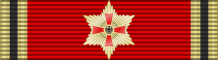

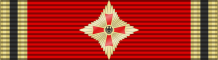


The Order of Merit of the Federal Republic of Germany (, or Bundesverdienstorden, BVO) is the highest federal decoration of the Federal Republic of Germany. It may be awarded for any field of endeavor. It was created by the first President of the Federal Republic of Germany, Theodor Heuss, on 7 September 1951. Colloquially, the decorations of the different classes of the Order are also known as the Federal Cross of Merit (Bundesverdienstkreuz).
It has been awarded to more than 262,000 individuals in total, both Germans and foreigners. Since the 1990s, the number of annual awards has declined from more than 4,000, first to around 2,500, then from 2015 to under 1,500, with a low of 918 awards in 2022. Since 2013, women have made up a steady 30–35% of recipients.
Most of the German federal states (Länder) have each their own order of merit as well, with the exception of the Free and Hanseatic Cities of Bremen and Hamburg, which reject any orders (by tradition their citizens, particularly former or present senators, will refuse any decoration in the form of an order, the most famous example being former Chancellor Helmut Schmidt).
History
The order was established on 7 September 1951 by the decree of Federal President Theodor Heuss. Signed by Heuss, German Chancellor Konrad Adenauer, and Minister of the Interior Robert Lehr, the decree states:
Desiring to visibly express recognition and gratitude to deserving men and women of the German people and of foreign countries, on the second anniversary of the Federal Republic of Germany, I establish the Order of Merit of the Federal Republic of Germany. It is awarded for achievements that served the rebuilding of the country in the fields of political, socio-economic, and intellectual activity, and is intended to be an award for all those whose work contributes to the peaceful rise of the Federal Republic of Germany.
In 2022 Federal President Frank-Walter Steinmeier introduced a gender quota which demands a minimum of 40% of nominees to the order to be women.
Classes
The Order comprises four groups with eight regular classes and one special (medal) class (hereafter enumerated in English):
- Grand Cross ()
- Grand Cross special class of the Order of Merit (Sonderstufe des Großkreuzes, Special Class of Grand Cross), official insignia of the President of Germany, reserved for heads of state and their spouses
- Grand Cross 1st class of the Order of Merit in exceptional finish (Großkreuz in besonderer Ausführung, Grand Cross 1st class in exceptional finish), reserved for former Federal Chancellors of Germany
- Grand Cross 1st class of the Order of Merit (Großkreuz, Grand Cross 1st class)
- Great Cross of Merit (Großes Verdienstkreuz)
- Grand Cross of the Order of Merit (Großes Verdienstkreuz mit Stern und Schulterband, Great Cross of Merit with Star and Sash)
- Knight Commander's Cross of the Order of Merit (Großes Verdienstkreuz mit Stern, Great Cross of Merit with Star)
- Commander's Cross of the Order of Merit (Großes Verdienstkreuz, Great Cross of Merit)
- Cross of Merit (Verdienstkreuz)
- Officer's Cross of the Order of Merit (Verdienstkreuz 1. Klasse, Cross of Merit 1st Class)
- Cross of the Order of Merit (Verdienstkreuz am Bande, Cross of Merit)
- Medal of Merit (Verdienstmedaille)
- Medal of the Order of Merit (Verdienstmedaille, Medal of Merit)
The President of the Federal Republic holds the Grand Cross special class ex officio. It is awarded to him in a ceremony by the President of the Bundestag, attended by the Chancellor of Germany, the President of the Bundesrat, and the Supreme Court President. Other than the German president, only a foreign head of state and their spouse can be awarded with this highest class. There is also the provision of awarding the Grand Cross 1st class in exceptional finish (Großkreuz in besonderer Ausführung), in which the central medallion with the black eagle is surrounded by a stylized laurel wreath in relief. This Grand Cross 1st class in exceptional finish has been awarded only to three persons, the former German chancellors Konrad Adenauer, Helmut Kohl and Angela Merkel.
Insignia

Except for the lowest class, the medal, the badge is the same for all classes, but with slightly different versions for men and women (slightly smaller badge and ribbon for women):
The badge for the Member and Officer classes however are only enamelled on one side, and flat on the reverse. The badge of the Order is made up of a golden four-armed cross enamelled in red, with a central gold disc bearing a black enamelled German federal eagle (Bundesadler).
The star is a golden star with straight rays, its size and points vary according to class, with the badge superimposed upon it. An interesting fact about the stars, of which no less than four grades use one, is that they all have the same basic shape as various other breast stars from German history.
- 8-pointed golden Star: Grand Cross special class - the same shape as the Prussian Order of the Black Eagle
- 6-pointed golden Star: Grand Cross 1st class (and special issue design if golden oak crown between the cross branches around the medallion) - the same shape as the Third Reich Order of the German Eagle
- 4-pointed golden Star: Grand Cross (Grand Cross of Merit with Star and Sash) - the same shape as the Third Reich Social Welfare Decoration
- silver Square-upon-point: Knight Commander (Grand Officer) - the same shape as the Grand Cross of the Pour le Mérite
The reasoning behind this is not clear. It is not known if this is deliberate or coincidence, as the tools used to make the stars were in short supply after the war, and using stamping dies that were readily available and could be reused or acquired from other manufacturers would have been a good way of cutting costs and simplifying production in a Germany only just starting to experience the Wirtschaftswunder. It is of course possible that this could have been deliberate, and a way to celebrate German history in the design of the new honour for the Federal Republic. This is unlikely however as two stars represent decorations awarded during the Third Reich, and the other two are of Prussian origin. Prussia itself had only been recently abolished and the legacy of so called "Prussian militarism" was not something openly celebrated in the new Federal Republic of Germany.
The riband of the Order is made up of the colours of the German flag. The pattern is a large central band of red, edged on both sides in a smaller band of gold-black-gold.
Gallery
File:German order merit with special sash.jpg| File:German Order of Merit Grand Cross First Class.jpg| File:Bundesverdienstkreuz mit Schulterband.jpg| File:Bundesverdienstkreuz Stern.jpg| File:Saksan liittotasavallan ansioristikunnan suurristin rintataähti.png| File:Gr Verdienstkreuz BVK.jpg| File:Order of Merit of the Federal Republic of Germany.jpg| File:OĞUZ MADALYA 003.jpg| File:Bundesarchiv Bild 199-1992-089-29, Britische Königin Elisabeth II. in Brühl.jpg| File:Bundesadler on the inner lid of the German Order of Merit.png|The gold foil German Bundesadler found on the inner lid of the Order File:Bundesverdienstkreuz Grand Cross with Star and Sash.png|Grand Cross with Star and Sash File:Bundesverdienstkreuz Grand Cross badge.png|Grand Cross with badge File:Bundesverdienstkreuz Grand Cross with Star and Sash in case.png|Grand Cross with Star and Sash in case File:Bundesverdienstkreuz Grand Cross with Star and Sash set.png|Grand Cross with Star and Sash set File:Bundesverdienstkreuz Grand Cross Star.png|Grand Cross Star File:Bundesverdienstkreuz Commander Class.png|Commander's Cross set File:Bundesverdienstkreuz Commander.png|Commander's Class in case File:Commander Class set of the German Bundesverdienstkreuz.png|Commander's Class
Recipients
Main article: List of recipients of the Order of Merit of the Federal Republic of Germany
References
References
- "The Order of Merit of the Federal Republic of Germany".
- (1992). "The Oxford dictionary of abbreviations". Oxford University Press.
- "The Order of Merit of the Federal Republic of Germany".
- "The Order of Merit of the Federal Republic of Germany".
- [http://www.bundespraesident.de/EN/Role-and-Functions/HonoursAndDecorations/TheOrderOfMerit/theorderofmerit-node.html The Order of Merit of the Federal Republic of Germany], English; [http://www.bundespraesident.de/DE/Amt-und-Aufgaben/Orden-und-Ehrungen/Verdienstorden/Statistik/statistik-der-ordensverleihungen-node.html German, statistics], both Website of the President, and accessed 29 March 2014.
- (6 September 2001). "Bundesverdienstkreuz: Das Kreuz mit dem Dank". [[Der Tagesspiegel]].
- Wördehoff, Bernhard. (26 May 1989). "Ehre in Serie". [[Die Zeit]].
- "Ordensstufen des Verdienstordens der Bundesrepublik Deutschland". [[Foreign Office (Germany).
- (26 October 1998). "Bundesverdienstkreuz mit Lorbeerkranz für Kohl". Rhein-Zeitung.
- "Rede: Ordensverleihung an Kanzlerin a.D. Angela Merkel".
- (28 March 2023). "Altkanzlerin Merkel erhält höchstmöglichen Verdienstorden".
- "Kapitel 1.2".
- Hieronymussen, P. O., ''Orders and Decorations of Europe in Color'' (London: [[Macmillan Publishers]], 1967).
This article was imported from Wikipedia and is available under the Creative Commons Attribution-ShareAlike 4.0 License. Content has been adapted to SurfDoc format. Original contributors can be found on the article history page.
Ask Mako anything about Order of Merit of the Federal Republic of Germany — get instant answers, deeper analysis, and related topics.
Research with MakoFree with your Surf account
Create a free account to save articles, ask Mako questions, and organize your research.
Sign up freeThis content may have been generated or modified by AI. CloudSurf Software LLC is not responsible for the accuracy, completeness, or reliability of AI-generated content. Always verify important information from primary sources.
Report