From Surf Wiki (app.surf) — the open knowledge base
Orchomenus (Boeotia)
| Field | Value |
|---|---|
| name | Orchomenos |
| name_local | Ορχομενός |
| type | municipality |
| image_map | 2011 Dimos Orchomenou.png |
| periph | Central Greece |
| periphunit | Boeotia |
| pop_municipality | 9381 |
| area_municipality | 415.9 |
| pop_municunit | 7105 |
| area_municunit | 230.098 |
| pop_community | 4285 |
| area_community | 43.431 |
| population_as_of | 2021 |
| coordinates | |
| image_skyline | The derelict state of the tower on the top of the Acropolis of Orchomenus on September 30, 2020.jpg |
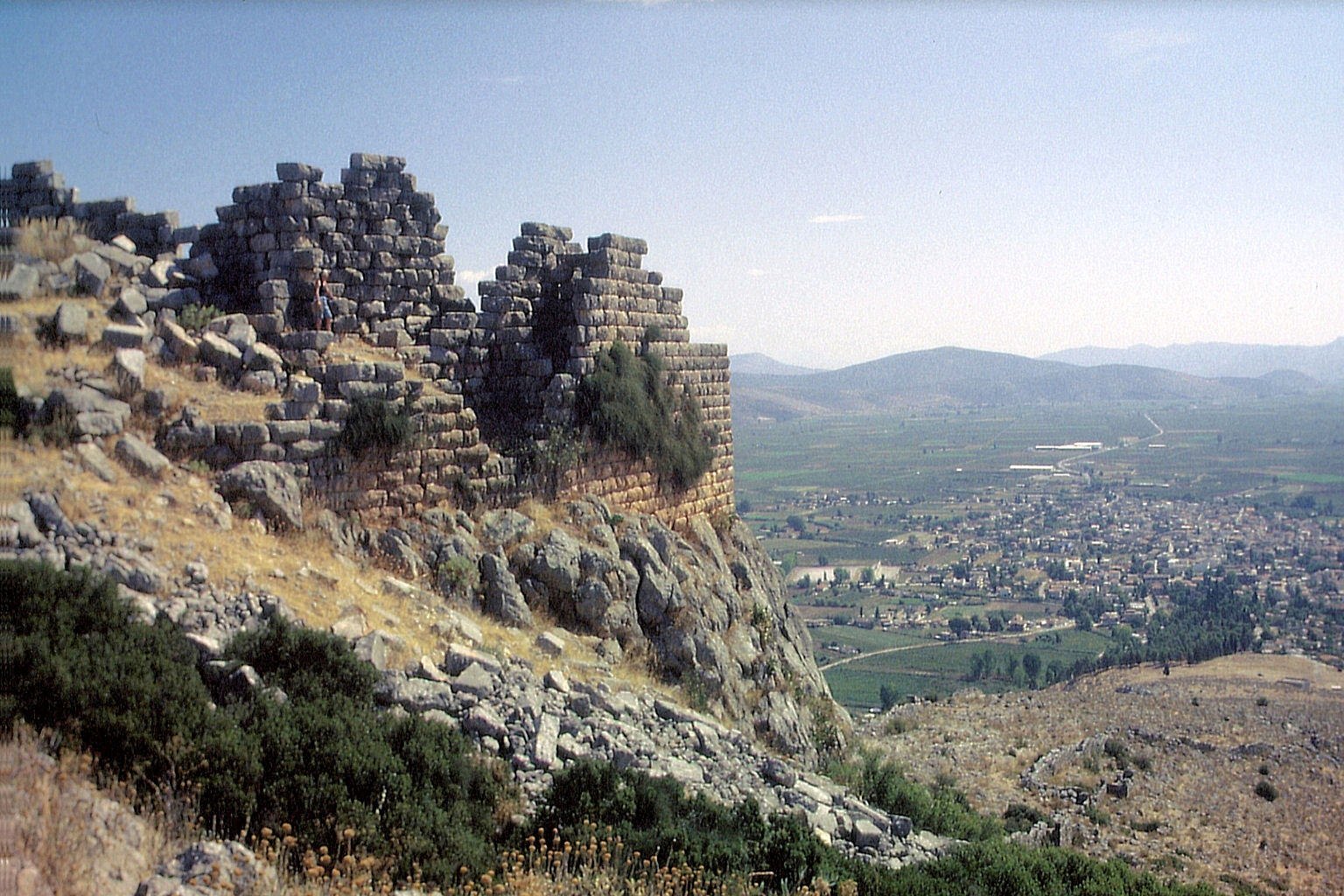
| caption_skyline | The Acropolis of Orchomenus |
Orchomenus (; , Orchomenos) is a town and a municipality in Boeotia, Greece. It is best known today for its rich archaeological site, that was inhabited from the Neolithic through the Hellenistic periods and is the setting for many early Greek myths. It is often referred to as "Minyan Orchomenus", to distinguish it from a later city of the same name in Arcadia.
Ancient history
According to the founding myth of Orchomenos, its royal dynasty was established by the Minyans, who had followed their eponymous leader Minyas from coastal Thessaly to settle the site.
In the Bronze Age, during the fourteenth and thirteenth centuries BC, Orchomenos became a rich and important centre of civilisation in Mycenaean Greece and a rival to Thebes. The palace with its frescoed walls and the great beehive tomb show the power of Orchomenos in Mycenaean Greece. A massive hydraulic undertaking drained the marshes of Lake Kopaïs, making it a rich agricultural area. Orchomenos is mentioned among the Achaean cities sending ships to engage in the Trojan War in Homer's "Catalogue of Ships" in the Iliad: together with Aspledon, they contributed thirty ships and their complement of men. The wealth brought in via the agricultural land under its control probably explains its Homeric epithet "rich in gold" (πολύχρυσος).
Many histories of Mycenaean Greece contend that Orchomenos was, like Pylos, one of the cities destroyed during the turbulent period referred to as the Bronze Age Collapse. Ancient Greek legends attribute the destruction to a war with the neighboring power of Thebes. However, Jesse Millek recently challenged this assumption, claiming it is based on misreading archeological evidence that the site was simply abandoned during the same time period. Bryan Feuer commented that archeological information on Mycenaean Orchomenos is fragmentary in part because much of its remains "have been destroyed by erosion or subsequent rebuilding".
Orchomenos seems to have been one of the city-states that joined the Calaurian maritime League in the seventh century BC. Although their rivals Thebes confirmed their supremacy by the end of the century reflected by inscriptions, Orchomenos joined the Theban-led Boeotian League in c. 600 BC.
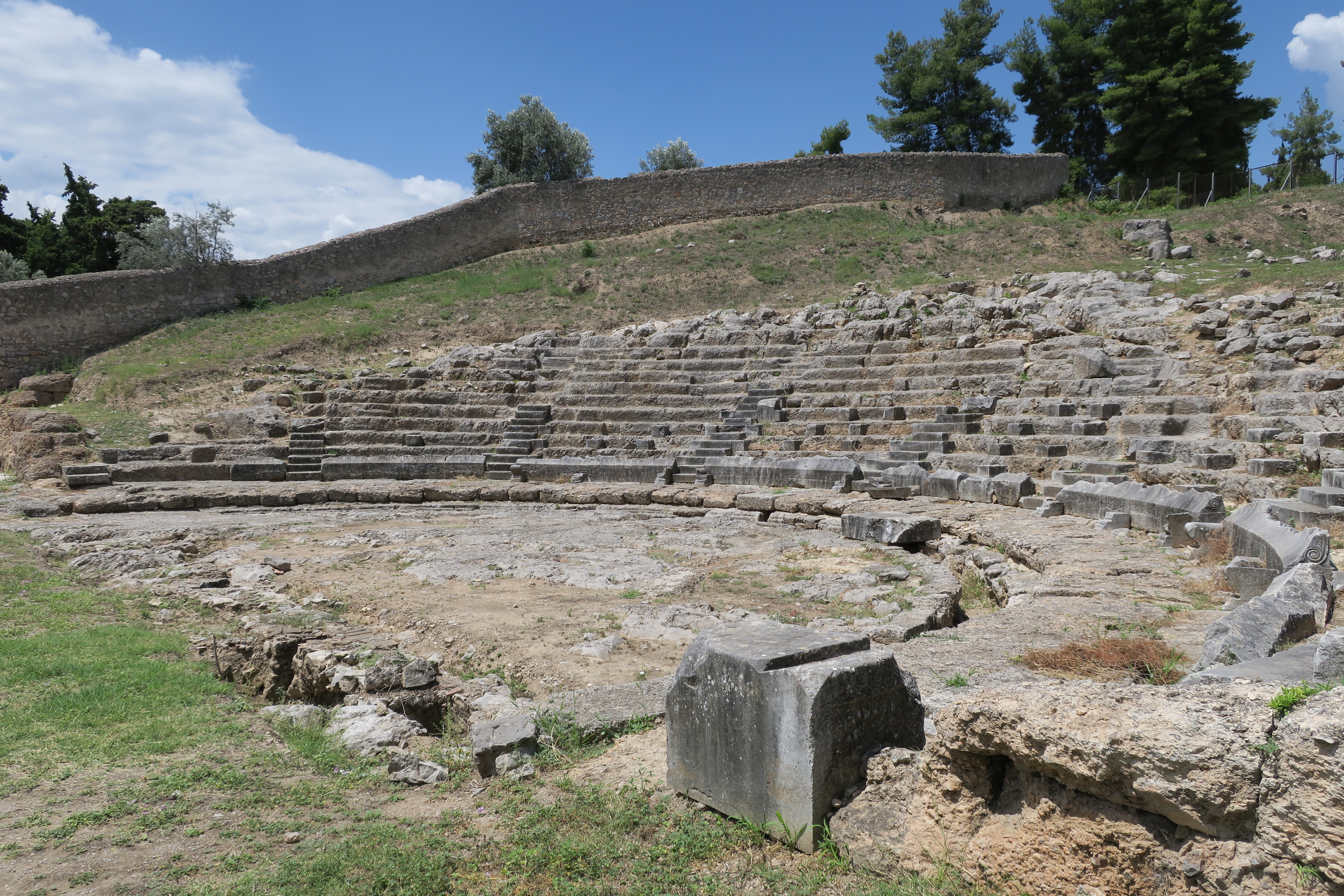
Classical Orchomenos was known for its sanctuary of the Charites or Graces, the oldest in the city (the 9th century Byzantine monastery church of Panagia Skripou probably occupies the same spot). Here the Charites had their earliest veneration, in legend instituted by Eteocles; musical and poetical agonistic games, the Charitesia, were held in their honour, in the theatre that was discovered in 1972. The Agrionia, a festival of the god Dionysus, involved the ritual pursuit of women by a man representing Dionysus. Orchomenos struck its coinage from the mid-sixth century.
In 480–479 BC, the Orchomenians joined their neighbouring rivals the Thebans to turn back the invading forces of Xerxes in the Greco-Persian Wars. In mid-century, Orchomenos sheltered the oligarchic exiles who freed Boeotia from Athenian control. In the fourth century the traditional rivalry with Thebes made Orchomenos an ally of Agesilaus II and Sparta against Thebes, in 395 and again in 394 BC. The Theban revenge after their defeat of Sparta in the Battle of Leuctra (371 BC) was delayed by the tolerant policies of Epaminondas: the Boeotian League sacked Orchomenos in 364 BC. Although the Phocians rebuilt the city in 355 BC, the Thebans destroyed it again in 349.
The broad plain between Orchomenos and the acropolis of Chaeronea witnessed two battles of major importance in Classical antiquity. In 338 BC, after a whirlwind march south into central Greece, Philip II of Macedon defeated Thebes and Athens on the plain of Chaironeia during the first Battle of Chaeronea, establishing Macedonian supremacy over the city-states, and demonstrated the prowess of Philip's young son Alexander the Great. During Alexander's campaign against Thebes in 335 BC, Orchomenos took the side of the Macedonians. In recompense, Philip and Alexander rebuilt Orchomenos, when the theatre and the fortification walls, visible today, were constructed.
The second Battle of Chaeronea occurred when Roman Republican forces under the later Dictator Sulla defeated those of King Mithridates VI of Pontus near Chaeronea, in 86 BC during the First Mithridatic War. This Second Battle of Chaeronea was followed by the Battle of Orchomenus, when Archelaus' forces were completely destroyed.
Orchomenos remained a small town until Late Roman times when the theatre was still in use, and continued afterwards.
Archaeology
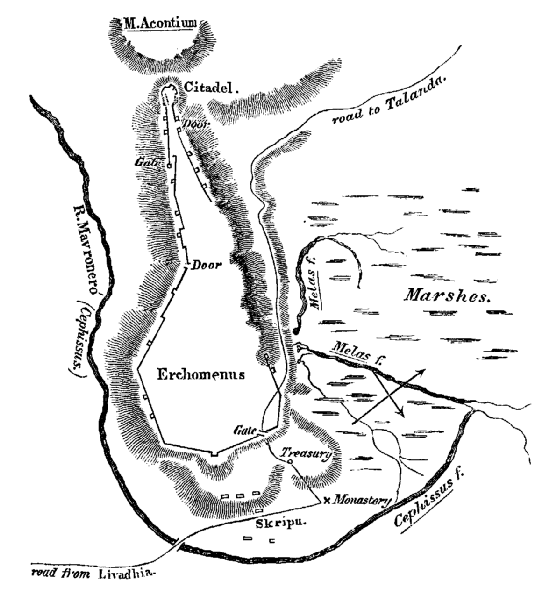

Round houses (two to six metres in diameter) from the Early Bronze Age (2800–1900 BC) were discovered.
Most excavations have focused on the early and Mycenean areas of the lower town, while the later Hellenistic city on the acropolis remains largely unexplored.
In 1880–86, Heinrich Schliemann's excavations revealed the tholos tomb he called the "Tomb of Minyas", a Mycenaean monument that equaled the "Tomb of Atreus" at Mycenae itself. In 1893, André de Ridder excavated the temple of Asklepios and some burials in the Roman necropolis. In 1903–05, a Bavarian archaeological mission under Heinrich Bulle and Adolf Furtwängler conducted successful excavations at the site. Research continued in 1970–73 by the Archaeological Service under Theodore Spyropoulos, uncovering the Mycenaean palace, a prehistoric cemetery, the theatre and other structures.
The Tomb of Minyas is one of the greatest burial monuments of the Mycenaean period. The tomb was probably built for the members of the royal family of Orchomenos in 1250 BC and was plundered in antiquity. The monument was visible for many centuries after its original use and even became a place of worship in the Hellenistic period. It was probably a famous landmark until at least the second century AD, when Pausanias visited Orchomenos and described the tholos in detail. It had a dromos thirty metres long. Its entrance was built of dark grey Levadeia marble and had a wooden door. The lintel, still in place today, is six metres long and weighs several tons. The entrance and the chamber were decorated with bronze rosettes as shown by the attachment holes on the walls and the ceiling of the side chamber is decorated with spirals and floral motifs in relief. In the centre of the Tholos, a rectangular burial monument dates to the Ηellenistic period (323–30 BC). It was partially restored by the architect-archaeologist A. Orlandos. In 1994, the Hellenic Ministry of Culture undertook restoration work consisting mainly of drainage and strengthening of the walls of the side chamber.
The Mycenaean palace to the east of the Tholos tomb and lying partially underneath the church is only partially excavated and consists of three wings, some of which were decorated with frescoes. The palace was destroyed c. 1200 BC.
The fortification walls of Orchomenos were built in the 2nd half of the 4th century BC under the Macedonians and crown the east end of mount Akontion.
The theatre was built around the end of the 4th century BC. The cavea, with seats for the spectators, the orchestra and part of the scena are all preserved. It was in use until late Roman times (4th century AD).
Later history

Opposite the ancient theatre is the 9th-century Byzantine church of the Dormition of the Virgin Mary (Panagia) of Skripou. Well-preserved inscriptions date the church securely to 873/4, naming its sponsor as the Protospatharios Leon, who served as a senior official of the emperor Basil I during the period of his joint reign with his sons Constantine and Leo.
The modern municipality of Orchomenos was formed in the local government reform of 2011 by the merger of the following two former municipalities, which became municipal units, each subdivided into local communities:
- Akraifnia (Akraifnio, Kastro, Kokkino)
- Orchomenos (Agios Dimitrios, Agios Spyridonas, Dionysos, Karya, Loutsio, Orchomenos, Pavlos, Pyrgos)
The municipality has an area of 415.914 km2, the municipal unit Orchomenos 230.098 km2, the community Orchomenos 43.431 km2. The seat of the municipality is in the town Orchomenos.
Notes
References
References
- Encyclopedia of Ancient Greece By Nigel Wilson {{ISBN. 9781136788000
- (1884). "Troja: Results of the Latest Researches on the Site of Homer's Troy". John Murray.
- (1992). "The Twilight of the Early Helladics: A Study of the Disturbances in East-Central and Southern Greece Toward the End of the Early Bronze Age". Åström Editions.
- (8 February 2019). "Technology in Crisis: Technological Changes in Ceramic Production During Periods of Trouble". Presses universitaires de Louvain.
- (25 May 2021). "Societies in Transition in Early Greece: An Archaeological History". University of California Press.
- [[Michael Wood (historian). (1998). "In Search of the Trojan War". University of California Press.
- (15 February 2023). "Destruction and Its Impact on Ancient Societies at the End of the Bronze Age". Lockwood Press.
- (16 March 2004). "Mycenaean Civilization: An Annotated Bibliography through 2002, rev. ed.". McFarland & Company.
- (April 1966). "The Calaurian Amphictiony". American Journal of Archaeology.
- (2013). "Encyclopedia of Ancient Greece". Taylor and Francis.
- [[Pausanias (geographer). Pausanias]] 5.172–80
- [[J. G. Frazer]]'s note on Pausanias, 1898.
- (1981). "Cults of Boiotia: 1. Acheloos to Hera". Bulletin Supplement (University of London, Institute of Classical Studies).
- Schachter 1981
- (1984). "The Charitesia at Boiotian Orchomenos". The American Journal of Philology.
- (1980). "The Theban hegemony, 371-362 BC". Harvard University Press.
- Travels In Northern Greece, William Martin Leake (1777–1860)
- (1931). "Orchomenos II: Die neolithische Keramik". Verlag der Bayerischen Akademie der Wissenschaften.
- (1983). "Le Néolithique et le Bronze Ancien Égéens". Diffusion de Boccard.
- (1981). "Mycenaean Greece". Noyes Press.
- (2009). "The Emergence and Development of a Round Building Tradition in the Aegean and Crete". Mediterranean Archaeology and Archaeometry.
- (1881). "Bericht über meine Ausgrabungen im böotischen Orchomenos". F. A. Brockhaus.
- (1895). "Fouilles d'orchomène". Bulletin de correspondance hellénique.
- (1907). "Orchomenos I: Die älteren Ansiedlungsschichten". Verlag der Bayerischen Akademie der Wissenschaften.
- (1974). "Το ανάκτορον του Μινύου εις βοιωτικόν Ορχομενόν". Athens Annals of Archaeology.
- "Popular Archeology - Rediscovering a Giant".
- "Ministry of Culture and Sports | Tholos tomb of Minyas".
- Description of Greece (9, 38, 2–3)
- Maria Soteriou, Ὁ ναός τῆς Σκριποῦς Βοιωτίας", ''Ἀρχαιολογική Ἐφημερίς'' 1931, pp. 119–157.
- ''Corpus Inscriptionum Graecarum'' [https://books.google.com/books?id=oPNfAAAAcAAJ&pg=PA316 8685]; Oscar Prieto-Domínguez, [https://grbs.library.duke.edu/article/view/14231/3855 "On the Founder of the Skripou Church,"] ''Greek, Roman and Byzantine Studies'' 53 (2013), pp. 166–191.
- "ΦΕΚ B 1292/2010, Kallikratis reform municipalities". [[Government Gazette (Greece).
- "Population & housing census 2001 (incl. area and average elevation)". National Statistical Service of Greece.
This article was imported from Wikipedia and is available under the Creative Commons Attribution-ShareAlike 4.0 License. Content has been adapted to SurfDoc format. Original contributors can be found on the article history page.
Ask Mako anything about Orchomenus (Boeotia) — get instant answers, deeper analysis, and related topics.
Research with MakoFree with your Surf account
Create a free account to save articles, ask Mako questions, and organize your research.
Sign up freeThis content may have been generated or modified by AI. CloudSurf Software LLC is not responsible for the accuracy, completeness, or reliability of AI-generated content. Always verify important information from primary sources.
Report