From Surf Wiki (app.surf) — the open knowledge base
Orchidoideae
Subfamily of orchids
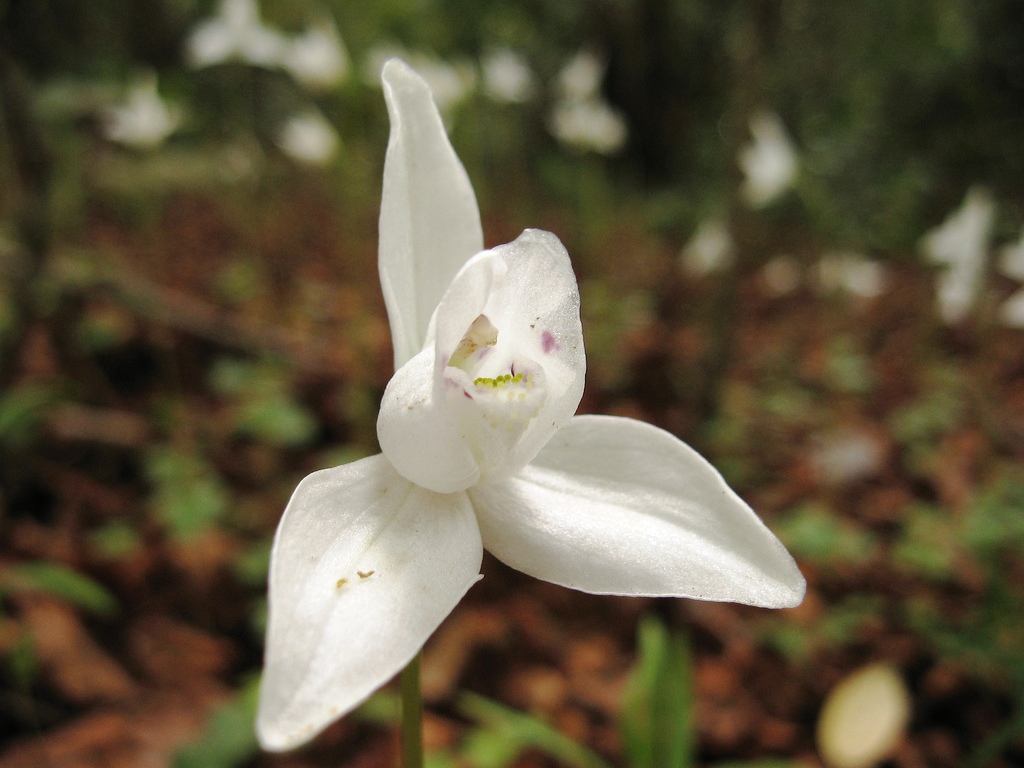
Subfamily of orchids
The Orchidoideae, or the orchidoid orchids, are a subfamily of the orchid family (Orchidaceae) that contains around 3630 species. Species typically have a single (monandrous), fertile anther which is erect and basitonic.
Description
The subfamily Orchidoideae and the previously recognized subfamily Spiranthoideae are considered the closest allies in the natural group of the monandrous orchids because of several generally shared characters:
- a shared terrestrial habit
- sectile (capable of being severed) or granular pollinia
- erect anthers.
Taxonomy
Phylogeny of the Orchidoideae is volatile and still subject to change. Historically, the Orchidoideae have been partitioned into up to 6 tribes, including Orchideae, Diseae, Cranichideae, Chloraeeae, Diurideae, and Codonorchideae. However, the most recent molecular phylogenetics analysis led by Chase et al. in 2015 and subsequently by Chen et al. in 2017 indicates that the Orchidoideae should be split into 4 tribes: the Orchideae, Cranichideae, Diurideae, and Codonorchideae.
[[Codonorchis|Codonorchideae]]
This monophyletic tribe consists of only one genus, Codonorchis, found in South America.
[[Cranichideae]]
This cosmopolitan tribe comprises 8 currently accepted subtribes. Molecular evidence suggests that the former Chloraeeae are sister to the rest of the Cranichideae. As such, the Chloraeeae are now considered a subtribe of the Cranichideae. Moreover, based on morphological and genetic evidence, the genus Discyphus was elevated out of the Spiranthinae to form its own monophyletic subtribe, the Discyphinae.
- Subtribe Chloraeinae
- Subtribe Cranichidinae
- Subtribe Galeottiellinae
- Subtribe Goodyerinae
- Subtribe Manniellinae
- Subtribe Pterostylidinae
- Subtribe Discyphinae
- Subtribe Spiranthinae --
.JPG)
[[Orchideae]]
Once divided into the Orchidinae and Habenariinae (a nonsystematic paraphyletic splitting), the Orchideae now comprise 6 subtribes. Along with previous molecular studies, Chase et al's 2015 analysis confirmed that Diseae was a polyphyletic grouping. Consequently, the former subtribes of Diseae have been redistributed within the Orchideae (for instance, Satyrium is now classified in the Orchidinae). In his 2015 study Chase recommended further study of historically problematic genera in the former Diseae such as Huttonaea and Pachites. Further molecular analysis by Chen et al. in 2017 led to the following reorganization:
- Subtribe Coryciinae
- Subtribe Orchidinae
- Subtribe Huttonaeinae
- Subtribe Pachitinae
- Subtribe Brownleeinae --

[[Diurideae]]
The Diurideae, a predominantly Australasian tribe, retain their previous subtribal organization and comprise 9 taxa:
.jpg)
- Acianthinae (monophyletic)
- Caladeniinae (polyphyletic)
- Cryptostylidinae (monophyletic)
- Diuridinae (monophyletic)
- Drakaeinae (monophyletic)
- Megastylidinae (monophyletic)
- Prasophyllinae (monophyletic)
- Rhizanthellinae (monophyletic)
- Thelymitrinae (monophyletic)
References
- Pridgeon, A.M., P.J. Cribb, M.W. Chase and F.N. Rasmussen [eds.]. 2003. Genera Orchidacearum vol. 3: Orchidoideae part 2, Vanilloideae. Oxford University Press, Oxford, U.K.
- Salazar, G.A., M.W. Chase, M.A. Soto Arenas and M. Ingrouille. 2003. Phylogenetics of Cranichideae with emphasis on Spiranthinae (Orchidaceae, Orchidoideae): evidence from plastid and nuclear DNA sequences. American Journal of Botany 90: 777-795.
- Salazar, G.A., L.I. Cabrera, S. Madriñán and M.W. Chase. 2009. Phylogenetic relationships of Cranichidinae and Prescottiinae (Orchidaceae, Cranichideae) inferred from plastid and nuclear DNA sequences. Annals of Botany 104: 403-416. https://web.archive.org/web/20090818212341/http://aob.oxfordjournals.org/cgi/reprint/mcn257?ijkey=hw5Onay5piJrT2y&keytype=ref
References
- (1 March 2018). "Types of Orchids: A Visual Compendium".
- (2015). "An updated classification of Orchidaceae". Botanical Journal of the Linnean Society.
- (2017-11-28). "New subtribe Pachitinae (Orchideae) of Orchidaceae: Evidence from morphological and molecular analyses". Phytotaxa.
- (May 2003). "Molecular phylogenetics and evolution of Orchidinae and selected Habenariinae (Orchidaceae)". Botanical Journal of the Linnean Society.
- (2017). "Phylogenetics of subtribe Orchidinae s.l. (Orchidaceae; Orchidoideae) based on seven markers (plastid matK, psaB, rbcL, trnL-F, trnH-psba, and nuclear nrITS, Xdh): implications for generic delimitation". BMC Plant Biology.
This article was imported from Wikipedia and is available under the Creative Commons Attribution-ShareAlike 4.0 License. Content has been adapted to SurfDoc format. Original contributors can be found on the article history page.
Ask Mako anything about Orchidoideae — get instant answers, deeper analysis, and related topics.
Research with MakoFree with your Surf account
Create a free account to save articles, ask Mako questions, and organize your research.
Sign up freeThis content may have been generated or modified by AI. CloudSurf Software LLC is not responsible for the accuracy, completeness, or reliability of AI-generated content. Always verify important information from primary sources.
Report